
Ergonomically Women Friendly Weeder: A Review
Weeding operation mainly done by woman. Millions of farm women engaged in these activities are without any mechanical advantageous tools. They experience drudgery; output is low, more time at task, physical strain and suffers from occupational problems. To enhance participation in mechanization especially women workers, ergonomic design considerations have to be incorporated in tools and equipment. As we know that anthropometry of women is different from that of men so, there is a need to modify the existing tools and to make them women friendly. If the tool geometry is evaluated based on the bio-mechanical analysis of women worker, the fatigue caused could be reduced and tool efficiency can be improved. This paper aims to present a review of different women friendly weeder developed by researchers. Anthropometric data and strength data is very important in design of wedeer for women.
Introduction
Weeds are one of the major biological constraints that limit crop productivity. A weed can be thought of as any plant growing in the wrong place at the wrong time and doing more harm than good [1]. Bhan, et al. [2] estimated that weeds in India reduce crop yields by 31.5% (22.7% in winter and 36.5% in summer and kharif seasons). Weeding is an important but equally labour intensive agricultural unit operation. Kharif crops are most affected due to weeds. Weeding accounts for about 25 % of the total labour requirement (900–1200 man-hours/hectare) during a cultivation season [3].
In India about 4.2 billion rupees are spent every year for controlling weeds in the production of major crops. At least 40 million tons of major food grains are lost every year due to weeds alone [4]. Weeding activity is a strenuous one and the odd posture adopted by women while weeding may result in increased heart rate and leads to fatigue. Women generally adopt squatting and bending posture while doing these activities and maintain it for long hours, which cause muscular-skeletal problems [5]. It was estimated that the average time spent by women on the farm activities varied from 30 to 240 min day-1 depending on the farming operation being performed. The maximum average time spent by women in weeding was 252 min day-1 and it was performed for 15 days in a season [6].
Weeding operation is carried out with indigenous hand tools like ‘Khurapi’ and spade. Recently many improved hand tools have been introduced for weeding. Straight blade hoes and triangular blade hoes made by black smiths and village artisans are traditionally used. Use of rotary tools e.g. discs and rotating rods is limited. These tools vary in design from place to place. But there is extent of discomfort and injuries caused by these tools as they are designed for male worker. The high demand work, awkward work posture and design deficiencies of the hand tools result in cumulative muscular-skeletal strain and injuries in farm activities. Postural discomfort plays an important role in increasing the productivity and efficiency of agriculture workers. The performance of the weeders as well as operator vastly depends on the design of the weeders. A weeder if designed without taking into account the human capabilities will fail to deliver the desired results and will ultimately be rejected. The drudgery of women’s worker in agriculture affects even their education, food security, health and productivity. Introduction to new technologies in agricultural operation and adoption by farm women leading to mechanization will reduce the drudgery and improve the efficiency.
But it is reported that many agricultural weeding tools are designed for male workers with the assumption that they can also be used by women though ergonomic characteristics of women are different than men workers. The size, design and dimensions of these tools and implements have a great bearing on operational difficulties because of mismatch of physical capabilities of workers [7]. Therefore many researcher design and developed a various type of hand tool according to women’s capabilities. A brief review of differentdeveloped weeder has been incorporated into this paper.
Women Friendly Weeder
Gite and Yadav [8] conducted experiment on optimum handle height for a pushpull type manually operated dry land weeder and used 15-point scale for determining rating of perceived exertion. They found rating of perceived exertion (RPE) values of 16.4, 11.5, 12.1 and
18.3 for four handle heights, i.e. 0.6, 0.7, 0.8 and 0.9 of shoulder height (SH), respectively.
Yadav and Pund [9] developed and ergonomic evaluated of manual weeder could work up to 30 mm depth with field capacity of 0.048 ha/h and higher weeding efficiency was obtained up to 92.50%. The average travelling speed was found to be 20 m/min. The average draft required for weeding was 39.15 kg. The power requirement for the weeder was estimated to be 0.17 hp. The developed weeder shown in Figure 1.
![Figure 1: Manually weeder [9].](/fulltextimages/3044/fig_1.jpeg)
Yadav, et al. [10] studied the performance of the operator in different field operation can be assist on the basis physiological responses. They took four male and four female workers in their study. The physiological cost of male and female subjects on the basis of OCR was 15.87, 15.87, 16.08 and 15.87 kJ min-1 and 8.14, 8.35, 8.35 and 8.35 kJ min-1 for subjects 1, 2, 3 and 4 respectively. Similarly physiological cost for female worker during weeding operations by manual weeder was 13.57, 14.41, 14.20 and 14.41 kJ min-1 for subject 1, 2, 3 and 4 respectively.
Jaya [11] selected wheel hoe for modification according to ergonomic consideration. Modification in wheel hoe was done by reducing cutting blades and handle width. The study was conducted by using two different size of cutting blade which was geometrically 5% and 10% lesser than the existing size of cutting blade of wheel hoe. In addition, three different handle widths of 40cm, 44cm and 48 cm were also studied. The ergonomic evaluation of modified wheel hoe was done with six different combination blade reduction and handle width i.e. 5%-40cm, 10%-40cm, 5%- 44cm, 10%-44cm, 5%- 48cm and 10%-48cm. It was observed that heart rate of operator during the operation of modified wheel hoe reduced by 11 beats per minutes as compared to the existing wheel hoe. Correspondingly oxygen consumptions also reduce. There was shift in the category of work load from “heavy” to “moderate”. It was observed that the heart rate, oxygen consumption and energy expenditure was least for the workers operating the wheel hoe having cutting blade with 10% reduction and handles width of 44cm.
Suchitra [12] developed women friendly cono weeder as per the feedback received from women workers with ergonomic consideration. The mean value of working heart rate of all the selected subjects for cono weeder was 117.96 beats/min and mean value of corresponding oxygen consumption were 0.58 l/min. The average value of energy expenditure of all selected subjects for cono weeder was 10.04 kJ/min. The mean value of force required for pushing and pulling the cono weeder was 4.52 kg and 4.40 kg, respectively. The actual field capacity for cono weeder was found to be 0.0094 ha/h. The field efficiency for cono weeder was found to be 56.98%. The weeding efficiency of cono weeder was found to be 74.01%. The cost of cono weeder (DBSKKV) was Rs. 1150. The operating cost of cono weeder was Rs. 24.11.
Amrita [3] developed a push type weeder for women which seen in Figure 2. The effects of blades and operators on the speed, effective field capacity, draft, power required, field efficiency, performance index and weeding efficiency of the developed weeder was found significantly higher i.e. 0.95 km/h, 67x10-3 ha/h, 11.03kg, 31x10-3hp, 94.14%, 189.03 and 91.89% respectively for blade having 150˚ approach angle and performed by the healthiest operator having BMI (24.35kg/m2). Taking into consideration the ergonomic aspects of the operation, it can be concluded that the percentage increase in case of the heart rate, body temperature and the oxygen consumption rate were found within the limit. Further on the basis of subjective evaluation the operation was graded as easier. Economic point of view, it was found that the hourly cost of operation was Rs. 38.53/h and cost of weeding was Rs. 875.45/ha. Thus, it can be recommended that developed push type manual dual wheel weeder can be successfully used for weeding by female operator with blade having 150˚ approach angle.
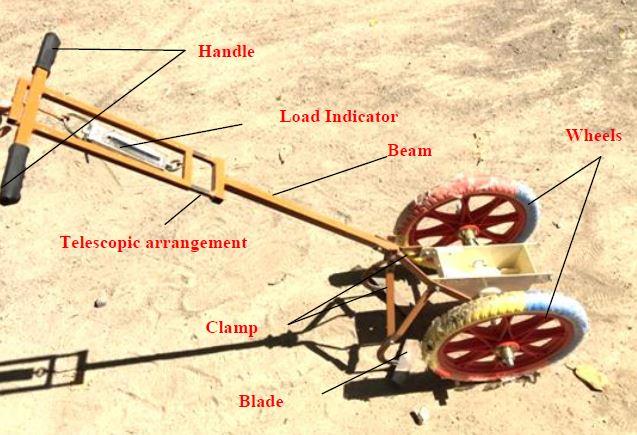
Summary and Conclusion
To increase the productivity per unit area of small land holdings and considering the economic condition of Indian farmers, it is quite necessary to have suitable agricultural implements which women friendly. Weeding is an important agricultural unit operation. Delay and negligence in weeding operation affect the crop yield up to 30 to 60 per cent. Diameter of ground wheel of weeder consider around 400. The weeding blades were made from steel flat to impart enough strength to sustain the prevailing forces acting on it. V-shape support made of mild steel was directly welded to the handle to join the ground wheel with the main frame. The arrangement is also required to adjust the height and angle of the handle as per the need and posture of the operator. The developed weeder by different researcher could work up to 30 mm depth with field capacity of around 0.05 ha/hr and higher weeding efficiency was obtained up to 92.5%. According to review, the peak heart rate of the subjects was found to range from 142 to 150 beats per min. In case of heavy work and dense grass infested field, the rest pause of 14 min was required by the subjects to come to the normal heart rate.
References
-
Parish S (1990) A Review of Non-Chemical Weed Control Techniques. Biological Agriculture and Horticulture 7: 117-137.
-
Bhan VM, Sushil kumar, Raghuwanshi MS (1999) Weed Management in India. Indian Journal of Plant Protection 17: 71-202.
-
Nag PK, Datt P (1979) Effectiveness of Some Simple Agricultural Weeders with Reference to Physiological Responses. Journal of Human Ecology 8: 13-21.
-
Singh G, Sahay KM (2001) Research Development and Technology Dissemination. A Silver Jubilee Publication, CIAE Bhopal.
-
Sharma V (1999) Ergonomic assessment of weeding activity with conventional and modified tool. M.Sc. Thesis (Unpublished). Maharana Pratap University of Agriculture & Technology, Udaipur.
-
Singh S, Mathur P, Rathore M (2007) Weeders for Drudgery Reduction of Women Farm Workers in India. Journal of Agricultural Engineering 44(3): 33- 38.
-
Yadav R, Jakasania RG, Vadher AL (2018) Segmental Proportions Based on Anthropometry of Female Agricultural Workers, India. Ergonomics International Journal 2(7): 1-9.
-
Gite LP, Yadav BG (1990) Optimum handle height for a push-pull type manually operated dryland weeder. Ergonomics 33(12): 1487-1494.
-
Yadav R, Pund S (2007) Development and Ergonomic Evaluation of Manual Weeder. Agricultural Engineering International: the CIGR E-journal.
-
Yadav R, Pund S, Gite LP (2010) Ergonomic evaluation of male and female operators during weeding operation. Agricultural Mechanization in Asia, Africa and Latin America 41(2): 26-29.
-
Jaya S (2016) Ergonomic Design Modification in Intercultural Hand Tools to Make Female Worker Friendly. MTech Thesis (Unpublished), Indian Agricultural Research Institute, New delhi.
-
Suchitra C (2016) Development of Women Friendly Cono Weeder for Paddy. MTech Thesis (Unpublished). DBSKKV, Dapoli.
-
Amrita T (2017) Development and Performance Evaluation of Push Type Weeder for Women. M.Tech. Thesis (Unpublished). Junagadh Agricultural University, Junagadh.
- The Expanding Landscape of Road Rage: A Systematic Review of Conflicts Involving Drivers, Pedestrians, and Micromobility
- Validating Cognitive Models of Royal Navy Performance on Control Systems
- Comparing Standard and State-of-the-art Firefighter Coats on Postural Balance and Gait in a Live Burn Environment
- Investigating the Integration of Telemedicine into Clinicians Workflow: A Review of Methods
- Risk Assessment of Ergonomic Factors in a Textile Firm by RULA, REBA and Fine Kinney Methods
- Impact of Self-Esteem Training on Individuals with Disabilities Aged 17-30