
Prevalance of Work Related Musculoskeletal Disorder among the Car Mechanics of Indo-Pak Boarder City of Punjab
Working conditions and the nature of profession tend to have a major effect on the health of the worker. Occupational health and safety systems are still in developing stage in India. The quantity of work-related problems in India is greater. The study is aimed to appraise the work-related musculoskeletal disorders (WMSD) among car-repair mechanics of an Indo-Pak border area (Gurdaspur) of Punjab, India. This cross-sectional study included 125 car mechanics, conveniently selected from different authorized and unauthorized workshops. A comprehensive questioner was designed and used to seek information on WMSD. The rapid entire body assessment (REBA) technique was used to assess the risk level of musculoskeletal symptoms. The results showed that about 58 %of workers are having the musculoskeletal disorder at least one region of the body. The most reported MSD complaints are; lower back pain (52%), neck stiffness and shoulder pain (49%). The socio-demographic and physical risk factor are significantly associated (at ‘P’
Introduction
According to the international labor organization (ILO) report, the death rate of the workers in the world is much higher per year. It is about 6300 per day and annually it is 2.3 million death of workers related to occupational safety and health [1]. The report shows that the reporting system about the occupational safety and health in many Prevalance of Work Related Musculoskeletal Disorder among the Car Mechanics of Indo-Pak Boarder City of Punjab countries are not true. According to the Indian reporting system about the occupational safety and health is 222 per year while the Czech Republic reports 231] but the total workers in Czech Republic is 1% of the India. The ILO give some true numbers of the fatal accident or occupational health diseases in India are 40000 [2], which is a very large number. A foreign study also describes that 87.4%workers in Malaysia, 77% in Bangladesh and 96% Ergonomics Int J
mechanics in Norway are suffering from musculoskeletal disorder problem in one or more region of the body [3, 4, 5]. In a study rates of MSDs prevalence were reported in welders at shoulders (32%), back (81.3%) [6]. The poor health and safety conditions are still a challenge for all the working sites in India. Musculoskeletal disorders (MSDs) is one of the main sources of work-related injuries and disability in the developed and industrial developing nations. At this time, MSDs is one of the big issues experienced by ergonomists in different working environments around the globe. The financial loss because of such issue influences, not just the individual but also to the association and the general public. An automobile car care centre is the place where cars (diesel or patrol) are repaired by auto mechanics and technicians. Automobile car care centres are also known as garage, automobile workshops, automobile service centre etc. The workers of the car care centres usually involve in heavy manual material handling job. They face many physical problems like injuries, low back pain, neck stiffness, shoulder pain, arm pain, legs pain, knee pain, elbow pain etc. The car mechanics usually works in standing, sitting, and lying position for a long time in the awkward posture of the body. When they work under car bonnet their trunk gets a twist as well as flex. They use some heavy tools on repetitive basis in daily routne. Normally when they change the oil of the car then they work underlying the cars or standing under the car. When they work under car normally their face remains upward side and their neck remains bent/extended. This is the main reason for neck stiffness and shoulder pain. The main motive of study was to identify the prevalence of musculoskeletal symptoms and their association with physical risk factor among the car mechanics.
Methodology
The study included different automobile car care centres of boarder area city (Gurdaspur) of Punjab (India).It was in the month of Nov 2016 to June 2017.There are many small and large car workshops in the city and around. The main function of these workshops is repairing, servicing and maintenance of the cars in this area. The study included both authorized and unauthorized car care centres. The work functions in both the authorized and unauthorized car care centers are same but the working conditions and set up are different. Car mechanics in both workshops perform different types of work; maintenance of the car engine, changing the engine oil, changing/rotation of the tyres, wheel balancing and allignment, repairing electrical and mechanical Singh LP and Singh G. Prevalance of Work Related Musculoskeletal Disorder among the Car Mechanics of Indo-Pak Boarder City of Punjab. Ergonomics Int J 2018, 2(6): 000187.
system. They also repair car damage body, cleaning, washing, and painting. The hydraulic lift was very rare in the unauthorized car care centre so they use a hydraulic jack to lift the cars on the other hand, authorized car care center uses hydraulic or mechanical lifts.
With a prior permission from workshop owner to conduct the study was obtained from the owners of the care centers. A sample of 125 workers was considered from different workshops. Out of these, seventy-five workers from authorized and fifty were from unauthorized workshops. A crossectional survey method was used for the data collection. The population in the study was workers of the different car care centers whose involved in repairing cars. The minimum age of the workers was 18 years. A comprehensive questionnaire was designed to collect socio demographic data and corporal risk factors.
The REBA tool was used to identify the physical risk level of developing musculoskeletal symptoms among car care worker [7]. It gives a result on musculoskeletal risk action level with a quick and easy observation. It is a postural analysis tool for whole static and dynamic activities. After the video recording of the car care mechanics, photo graphs were cropped to analyse the trunk, neck, leg, arm, knee, elbow and wrist movement or position during working in their actual work setting. REBA gave the clear result about the corporal risk level of the workers.
Data input and analysis were performed by the statistical package for social science version 20(IBMSPSS 20 version) to increase the trustworthiness of the analysis and lessen the influence of the missing value [7]. The process of data analysis followed the studies focus and objective. The chi-square test was performed at p<0.05 to describe the relationship between the prevalence of musculoskeletal symptoms and socio demographic and corporal risk factor [8].
Results
The study was conducted on 125 workers of different car care centers of Gurdaspur city. Out of the participants, 75(60%) were working in authorized car care centers and 50(40%) were working in unauthorized car care centers. Among the workers, 70(56%) were 18-27 year old and 55(44%) were age >27 years, 58(46%) were married and 67(54%) were single. The education level of 8(6%) workers was primary and 117(94%) were secondary and Copyright© Singh LP and Singh G.
above secondary level (12th, ITI, diploma, graduation). The Body mass index showed that 19(15%) were underweight, 87 (70%) were normal, 19(15%) were overweight. The total working experience was divided into three categories. Out of 125 workers, 51(41%) had 1- 4 year work experience, 31(25%) had 5-10 year and 43(34%) had more than 10 years’ work experience.
According to the knowledge, 92 (74%) were skilled and 33(26%) were semiskilled workers.
Table 1 Illustrates that socio-demographic characteristics have a great significant association with the Musculoskeletal disorder.
| Variables | Opts | MSD | Chi test | P value | Result | ||||||||||
|---|---|---|---|---|---|---|---|---|---|---|---|---|---|---|---|
| Age ( in year) | 18- 27(n=70) | 31(44%) | 13.045 | 0 | Significant | ||||||||||
| >27 (n=55) | 42(76%) | ||||||||||||||
| Marital status | Single(n=67) | 27(40%) | 19.475 | 0 | Significant | ||||||||||
| Married(n=58) | 46(79%) | ||||||||||||||
| Working hr/day | 8 hr(n=23) | 8(35%) | 6.471 | 0.011 | Significant | ||||||||||
| >8hr(n=102) | 65(64%) | ||||||||||||||
| Job title | Skilled(n=92) | 60(65%) | 6.667 | 0.01 | Significant | ||||||||||
| Semiskilled(n=33) | 13(39%) | ||||||||||||||
| Education | Primary(n=8) | 7(87%) | |||||||||||||
| Secondary & Above secondary (n=117) | 66(56%) | 2.979 | 0.138 | Not significant | |||||||||||
| BMI | Underweight(n=19) | 10(53%) | |||||||||||||
| Normal (n=87) | 50(57%) | 1.076 | 0.584 | Not significant | |||||||||||
| Overweight(n=19) | 13(68%) | ||||||||||||||
| Work experience | 1-4 (n=51) | 18(35%) |
Table 1: Association of MSD at least one region of body with socio-demographic characteristics.
| Variables | Opts | MSD | Chi test | P value | Result | ||||||||||
|---|---|---|---|---|---|---|---|---|---|---|---|---|---|---|---|
| Awkward posture | Yes (n=112) | 71(63%) | 11.05 | 0.001 | Significant | ||||||||||
| No (n=13) | 2(15%) | ||||||||||||||
| Repetive movement | Yes (n=102) | 64(63%) | 4.308 | 0.038 | Significant | ||||||||||
| No (n=23) | 9(39%) | ||||||||||||||
| Force exertion | Yes (n=88) | 55(62%) | 2.057 | 0.151 | Not Significant | ||||||||||
| No (n=37) | 18(49%) | ||||||||||||||
| Load lifting | Yes (n=98) | 63(64%) | 6.469 | 0.01 | Significant | ||||||||||
| No (n=27) | 10(37%) |
Table 2: Association of MSDs at least one region of body with work-related risk factor.
These results also indicate that awkward posture (p- 0.001), Load lifting (p-0.01), repetitive work (p-0.03), has Singh LP and Singh G. Prevalance of Work Related Musculoskeletal Disorder among the Car Mechanics of Indo-Pak Boarder City of Punjab. Ergonomics Int J 2018, 2(6): 000187.
significant association with musculoskeletal symptoms except force exertion (p-0.151).
Copyright© Singh LP and Singh G.
According to the REBA score Table 3, it was clear that 67workers were working with high physical risk, 37 workers were working at medium risk and 21 workers were working at high risk due to work environment and posture of the body. There was significant association between MSDs and REBA score (p-0.009). The REBA shows that workers suffering from MSDs, 31.5% workers were at medium, 60.3% were at high and 8.2% were at very high risk level. It was clearly from the REBA table that maximum problem among the car mechanics was only because of the wrong body posture at the time of the work.
| Respondent % | |||||||||||||||
|---|---|---|---|---|---|---|---|---|---|---|---|---|---|---|---|
| Reba Score | Chi Value | P Value | Result | ||||||||||||
| Yes | No | ||||||||||||||
| 1(negligible) | - | - | 9.365 | 0.009 | Significant | ||||||||||
| 2-3 (low) | - | - | |||||||||||||
| 4-7(medium) | 23(31.5%) | 14 (26.9%) | |||||||||||||
| 8-10(high) | 44(60.3%) | 23 (44.2%) | |||||||||||||
| >11(very high) | 6(8.2%) | 15 (28.8%) |
Table 3: Influence of authorized and unauthorized service centers.
- The proportion of workers with various REBA scores is given in Table 3; there is significant association of high
- REBA score with MSD reporting.
- Similarly, Table 4 shows the influence of authorized and unauthorized car care centers on occurrence of musculoskeletal disorders and injuries problems. It is
- Neck stiffness
- Variable
- Overall MSDs
- LBP
- &shoulder pain
- Authorized workshops
- (n=75)
- 34(45%)
- 15 (20%)
- 14(19%)
- 13(17%)
- 9(12%)
- 23(31%)
- Unauthorized workshops
- (n=50)
- 39(78%)
- 23(46%)
- 22(44%)
- 12(24%)
- 11(22%)
- 29(58%)
- Total
- 73(58%)
- 38(30%)
- 36 (29%)
- 25(20%)
- 20(16%)
- 52(42%)
- Chi test
- 13.177
- 9.585
- 9.389
- 0.833
- 2.232
- 9.226
- P-value
- 0
- 0.002
- 0.002
- 0.361
- 0.135
- 0.002
- Results
- Significant significant significant
- Not Significant Not significant
- Significant
Table 4: Influence of authorized and unauthorized service centers.
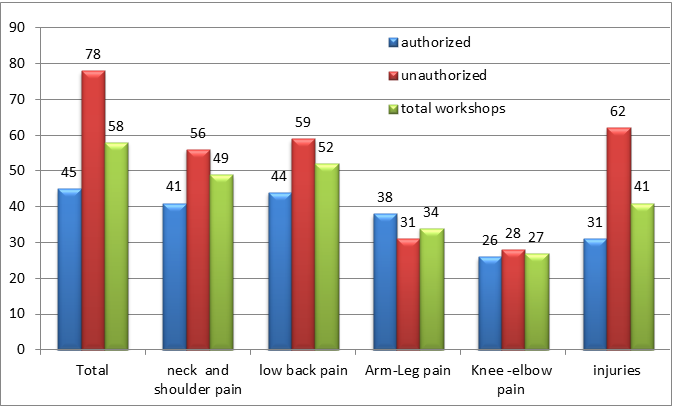
Qualitative data of the study reveal that overall 58% of workers are suffering from MSD. Out of this 52 %workers reported low back pain, 49 % neck stiffness and shoulder pain, 27 % knee-elbow pain and 34% was arm-leg pain problem. It is evident from Fig.1 that workers of unauthorized workshops witness higher level of MSD such as; low back pain and neck stiffness and shoulder pain, however there is marginal difference in arm-leg pain and knee-elbow pain among authorized and unauthorized workshops. At the same time there is significantly higher level of minor injuries at unauthorized car workshops as compared to the authorized centers.
Singh LP and Singh G. Prevalance of Work Related Musculoskeletal Disorder among the Car Mechanics of Indo-Pak Boarder City of Punjab. Ergonomics Int J 2018, 2(6): 000187.
Copyright© Singh LP and Singh G.
The present study highlights that most of the mechanics are working under risk because they usually works in standing posture with twisted and flexed trunk and neck under the bonnet. According to the REBA analysis, the trunk of the mechanics frequently remains twisted at an angle 600 for 4-5 hours of their total working time and their neck also remains bent at more than 200 with the trunk. This posture produces constant pressure on spinal and neck muscles which produce pain and increase the chances of injuries [9]. Therefore, the main reason for low back pain is the wrong body posture of workers at the time of work. Moreover, they lift load with wrong body posture and constant standing which further increases the chances of low back pain, shoulder pain, neck stiffness, arm pain, leg pain, and knee pain elbow pain. After the low back pain second most prevalent body part was neck stiffness and shoulder pain [3, 10, 11, 12]. In the study it was also found that, the workers in unauthorized workshops do not using protective equipment while working and proper tools that could be major reason of injuries at the workstation.
Conclusion
It is seen that lack of awareness and guidance of the tasks undertaken is the main reason for existing health problems. All the workers should be educated on ergonomics, working body posture, working hour breaks in between work, use of proper tools and equipments and good technique in the work. Proper ergonomics are necessary to minimise the complaints of low back pain among the mechanics. The proper tools and equipments for special purpose like, to lift the heavy objects in the Singh LP and Singh G. Prevalance of Work Related Musculoskeletal Disorder among the Car Mechanics of Indo-Pak Boarder City of Punjab. Ergonomics Int J 2018, 2(6): 000187.
workshops, pneumatic gun to open the nut bolt shoud be provided at the unauthorized workshops, the workers are usually deprived of such tools. Moreover unavailability of hydraulics lifts and proper tool at the unauthorized car care centres further enhances the occurance of MSD, because mecahics use traditional openers to remove the tyre or open the heavy nut, thus they exerts too much force. The maximum number of injuries happened at unauthorized workshops due to non-use of protective equipments at workstation. So it should be necessary that all the workers use protective as well as appropriate tools/equipments at the work place. In nutshell, car care workers are deprived of ergonomics awareness and appropriate interventions are required to be implemented. The occurrences of injuries among the mechanics are due to falls from ladders, stairs, raised platforms etc. and falls into dug (inspection pits) fall on the wet /slippery or oily floors of garage [13, 14]..
Future Scope
The present study the questionnaire based survey restricted to one of the Indo-Pak boarder, which is also a backward area. The study can further be expanded to another parts of the country. For validation it can be taken up at the international level also.
References
-
ILO (2005) Global workplace deaths vastly under- reported, says ILO. International Labour Organisation. Copyright© Singh LP and Singh G.
-
Safety and health at work. Internatonal Labour Organisation.
-
Rahman AA, Yazdani A, Shahar HK, Adon MY (2014) Association between Awkward Posture and Musculoskeletal Symptom among Automobile Assembly Line Workers in Malaysia. Malaysian J Med Heal Sci 10(1): 23-28.
-
Akter S, Rahman MM, Mandal S, Nahar N (2016) Musculoskeletal symptoms and physical risk factors among automobile mechanics in Dhaka, Bangladesh. South East Asia J Public Heal 6(1): 8-13.
-
Dodge Y (2008) Chi-square test of independence. Concise Encycl Stat pp: 79-82.
-
Mallikraj S, Kumar ST, Ganguly AK (2011) Ergonomic intervention on musculoskeletal problems among welders. Int J of Adv Eng Tec 2(3): 33-35.
-
Middlesworth M (2015) A Step-by-Step Guide Rapid Entire Body Assessment (REBA). Ergon Plus.
-
Nur NM, Dawal SZ, Dahari M (2014) The Prevalence of Work Related Musculoskeletal Disorders Among Workers Performing Industrial Repetitive Tasks in the Automotive Manufacturing Companies. Int Conf Ind Eng Oper Manag Bali Indones pp: 1-8. Singh LP and Singh G. Prevalance of Work Related Musculoskeletal Disorder among the Car Mechanics of Indo-Pak Boarder City of Punjab. Ergonomics Int J 2018, 2(6): 000187.
-
Monney I, Asare BD, Mensah IO, Kuffour R (2014) Occupational health and safety practices among vehicle repair artisans in an urban area in Ghana. J Environ Occup Sci 3(3): 147-153.
-
Torp S, Riise T, Moen BE (1996) Work-related musculoskeletal symptoms among car mechanics: a descriptive study. Occup Med (Lond) 46(6): 407-413.
-
Rahman MAA, Aziz FA, Yusuff RM (2009) Investigation of ergonomic risk factors in a car tyre service centre. Natl Symp Adv Ergon Saf 1(2): 137- 141.
-
Choudhary M, Rahman L, Uddin SM, Karim MA, Ahmed M (2015) Evaluation of Work Postures - The Associated Risk Analysis and the Impact on Labor Productivity. ARPN J of Eng and applied sci 10(6): 2542-2550.
-
ILO/CIS, (1999) International Hazard Datasheets on Occupation, what is a Hazard Datasheet on Occupation ? What is dangerous about this job ? Hazards related to these job Preventive measures.
-
Resource B, ‘Introduction to Ergonomics’. Copyright© Singh LP and Singh G.
- The Expanding Landscape of Road Rage: A Systematic Review of Conflicts Involving Drivers, Pedestrians, and Micromobility
- Validating Cognitive Models of Royal Navy Performance on Control Systems
- Comparing Standard and State-of-the-art Firefighter Coats on Postural Balance and Gait in a Live Burn Environment
- Investigating the Integration of Telemedicine into Clinicians Workflow: A Review of Methods
- Risk Assessment of Ergonomic Factors in a Textile Firm by RULA, REBA and Fine Kinney Methods
- Impact of Self-Esteem Training on Individuals with Disabilities Aged 17-30