
Mismatch between Actual and Perceived Sense of Slip Detrimentally Influences Postural Stability in Older workers
Age-associated impairment of proprioception and decreased sensitivity to underfoot pressure, may have serious problems for the elderly for their ability to “correctly” judge or perceive the degree of slipperiness, while walking on an inclined slippery surface, such as a ramp. The present study focuses on investigating the role of age-associated influences on workers’ ability to perceive surface slipperiness and its impact on postural balance and slip and fall events while negotiating a ramp. The study was carried out on 32 younger and 33 older workers. All workers’ postural balance and slip/fall events were objectively quantitated with a human motion analysis system and subjectively measured with the perceived sense of slip/fall (PSOF) tool respectively, while they walked up and down a ramp (on a level surface or 0, or at 10, 15, and 20 degrees) on 2 surface coefficient of frictions (dry: 0.76-1.06; moderately slippery: 0.19-0.21). While slip rating scores for the dry surface were comparable between the groups, the older workers significantly (p=0.046) underestimated the slippery surface. The deviation of the subjective surface slipperiness rating from the mean (DSSSR) for each surface was calculated. As expected, the older workers’ objective measure of postural balance was poorer than the younger group when they negotiated the slippery ramp surface. Repeated measure logistic regression analysis showed that the younger group was more likely to slip but much less likely to fall as DSSSR increased. Therefore, a mismatch between perception of slippery surface risk and the actual risk may jeopardize workers’ ability to safely negotiate a slippery ramp surface and thereby make them more susceptible to slip-related fall-injuries.Age-associated impairment of proprioception and decreased sensitivity to underfoot pressure, may have serious problems for the elderly for their ability to “correctly” judge or perceive the degree of slipperiness, while walking on an inclined slippery surface, such as a ramp. The present study focuses on investigating the role of age-associated influences on workers’ ability to perceive surface slipperiness and its impact on postural balance and slip and fall events while negotiating a ramp. The study was carried out on 32 younger and 33 older workers. All workers’ postural balance and slip/fall events were objectively quantitated with a human motion analysis system and subjectively measured with the perceived sense of slip/fall (PSOF) tool respectively, while they walked up and down a ramp (on a level surface or 0, or at 10, 15, and 20 degrees) on 2 surface coefficient of frictions (dry: 0.76-1.06; moderately slippery: 0.19-0.21). While slip rating scores for the dry surface were comparable between the groups, the older workers significantly (p=0.046) underestimated the slippery surface. The deviation of the subjective surface slipperiness rating from the mean (DSSSR) for each surface was calculated. As expected, the older workers’ objective measure of postural balance was poorer than the younger group when they negotiated the slippery ramp surface. Repeated measure logistic regression analysis showed that the younger group was more likely to slip but much less likely to fall as DSSSR increased. Therefore, a mismatch between perception of slippery surface risk and the actual risk may jeopardize workers’ ability to safely negotiate a slippery ramp surface and thereby make them more susceptible to slip-related fall-injuries.
Introduction
In many countries, including in the United States, the workforce is aging [1]. This is partially due to the aging of the US population as well as continued workforce participation. The share of workers over ages 60 and over has doubled since 2000 and is expected to continue to rise, based on population estimates. It is important to study older workers’ health and safety, and specifically postural control in older workers.
It has been shown that with aging controlling mechanisms of postural stability can be altered with relatively minor physiological changes, including temporary failure of binocular vision or sudden changes in the floor surface [2]. Previous investigators have implied that the central nervous system’s (CNS) ability to control postural muscle tone and balance deteriorates with age [3, 4]. Furthermore, the age- induced modification in the afferent-efferent pathways (visual, vestibular and proprioception) of the neuromuscular system causes increases in postural stability [5, 6]. Studies have shown that postural stability undergoes maturation from birth to about 10 years of age, when it becomes adult- like, and then remains stable until about 25 to 30 years of age [3, 4, 7, 8, 9, 10]. After around 30 years of age, balance begins to deteriorate gradually until 70 years; after that, the rate of deterioration significantly increases [11, 12, 13, 14, 15].
These age-related increases in postural stability imply poorer postural balance. Maximum muscle strength is achieved between 20 and 30 years and, thereafter, a progressive age-related decline in the strength of most muscles begin [16, 17, 18, 19]. Similarly, maximum oxygen uptake, after reaching a peak level at 25 years, begins a significant decline with age [20]. There are also significant age-related decrements in neuromuscular performance affecting balance [3, 4, 7]. In humans aged 60 years and older, the detrimental effects on physical strength are associated with muscle wasting, decrease in number of available motor units, and decrease in nerve conduction velocity [21]. Since the age-associated decrease in leg and trunk muscles are much greater than those observed in the arm muscles [19, 22] and the leg/trunk muscles are also critical for postural stability, walking and navigating different inclines and surfaces may be impacted. In this study, dynamic postural balance during task performance while walking up and down the ramp will be quantified.
Joint mobility decreases in healthy people between the ages of 20 and 60 years [23, 24]. Morgan [23] showed that the incidence of arthritis increases significantly beyond age 45 years, which may contribute to decreased joint mobility. Anderson [25] reported decreased lumbar spine mobility with increasing age. Reduced elasticity may also contribute to impairment in joint mobility. In older workers with reduced joint mobility, the occurrence of shoulder muscle fatigue, when performing jobs with elevated arms, has been a significant concern. Reduced joint mobility and tissue elasticity may compromise older workers’ performance of tasks which require them to bend and reach. Furthermore, decreased joint mobility will have detrimental impacts in compromised situations such as when a worker is experiencing a slip. For example, studies by Perkins [26] and our group have shown that sliding of feet during a slip more than 3 cm may cause irrecoverable postural instability (resulting in a fall) in subjects with joint mobility impairment. Additionally, in older workers with limited joint mobility, a slip associated foot slide may cause undue sprain/strain on the joint ligaments/muscles, thereby causing postural instability. In this study, kinematic measures provide information on sliding distance and the associated impact on workers’ postural instability and potential for loss of balance during task performance. Previous studies have shown that sensory-motor activities are detrimentally affected in people older than 55 years [23]. The reaction time in older subjects (66 years and older) is about 30% slower than that of younger workers (18 to 30 yrs. of age) [27]. From the same study, movement of the older group was about 76% slower than those in the younger age group [27]. Adelsberg et al. [28] examined the relationship between age associated delayed reaction time and coordination time as a possible contributing factor to lower extremity fracture in subjects aged 6 to 85 years of age. Their data suggest that subjects with longer reaction times have higher risk of fracture, particularly those subjects aged 55 years and older. Both reaction time and coordination time increased after 45 years of age. Since the sensory-motor pathways are required for postural balance control, an age associated decline in performance likely has a detrimental impact on older workers’ ability to maintain safe upright balance during task performance. The degree of detrimental impact on postural balance may be even more severe when older workers are required to perform tasks under suboptimal conditions, such as in a poorly lit environment and/or with a slippery standing/walking surface. Visual acuity decreases from the mid 20’s to the 50’s. After that, the rate of decrement in visual acuity is rapid [29, 30]. Visual acuity problems are exacerbated in a poorly lit environment [31, 32]. In comparison to workers < 40 years old, the illumination requirement increases by 50% for workers in the age range of 40-55 years and by 100% for workers over 55 years [33]. Depth perception also declines after age 45 years [30]. As visual input is critical for balance, an older worker’s ability to perform tasks while maintaining a safe upright balance in a poorly lit environment may be seriously jeopardized. Also, declines in depth perception may affect an older workers’ ability to maintain safe upright balance while walking on a ramp. No such data exists for older workers. This study will be the first to report data that tests this hypothesis.
With aging, the vestibular system has been shown to undergo several changes. Rosenhall and Rubin [34] have shown that subjects over 40 years age have an age- associated progressive reduction in the number of sensory cells and nerve fibers in the peripheral vestibular system. This reduction is significant in individuals older than 70 years old. Age associate decrements in both vestibulo- ocular reflexes and vestibulospinal reflex has been reported in the literature. Fregly [35] and Fregly, et al. [36] reported significant deterioration in these functions, especially beyond the age of 40 years.
The normal aging process has been shown to be associated with declines in proprioceptive function, which is a critical afferent needed for postural balance maintenance [14, 37]. Previous researchers [38] found marked deterioration in elderly (>60 years old) subjects’ ability to correctly judge and/or reproduce a passive knee position. In addition, pressure sensation felt under the feet (during standing/walking) is also impaired by the normal aging process, which in turn, has detrimental impacts on these elderly workers’ ability to correctly judge the direction of motion of the body during task performance. Center of gravity (CG) based data provides a biomechanically sound assessment of body movement in space. This assessment is based on the concept that the entire body weight is concentrated at one point and the subject has no conscious “feeling” about the motion of the CG with respect to his/ her base of support. On the other hand, center of pressure (CP) is a point under the feet of the subjects through which the resultant force passes during task performance. As the task dynamics change, the magnitude of the resultant force and its point of application underneath the feet also change. This movement of CP is actually “felt” by the subject as a concentrated pressure point under the sole of his/her feet, which may cue the subject about the direction of his body motion, thereby allowing the subject to maintain safe upright balance by contracting the appropriate postural muscle groups. CP based data (not CG based) is a better predictor of slip potential during task performance. Therefore, an older worker, with age associated impairment of proprioception and decreased sensitivity to underfoot pressure, will have serious problems maintain safe upright balance, particularly while carrying out tasks while standing or walking on a slippery surface.
In an older worker, normal age-associated declines in functional abilities may cause most of the fall/slip risk factors to place undue demand on their neuromuscular system during task performance. The normal aging process has been shown to be associated with declines in proprioceptive function, which is a critical afferent needed for postural balance maintenance [14, 38, 39]. In addition, pressure sensation felt under the feet (during standing/ walking) is also impaired by the normal aging process, which in turn, detrimentally impacts these older workers’ ability to correctly judge the degree of slipperiness of the walking surface. A previous study [40] has shown that in the presence of poorer judgment of surface slipperiness the higher centres elicit an inadequate motor control strategy for maintenance of upright postural balance even during semi-dynamic tasks performed in a standing position on a slippery surface. Therefore, a mismatch between actual risk and the perceived risk of surface slipperiness may jeopardize workers’ safety and cause a greater number of severe acute and traumatic injuries particularly when negotiating a ramp.
Methods
The present study focused on investigating the role of age-associated influences on workers’ ability to perceive surface slipperiness and its impact on postural balance maintenance and probability of slips/falls during negotiating slippery ramps of various inclinations and with various shoe and lighting conditions. The study was carried out on 32 younger [mean age (SD): 49.5(2.59) yrs.] and 33 older workers [mean age (SD): 69.5 (3.12) yrs.]. All subjects were screened for the following exclusion criteria: daily requirements of prescription medication which may act upon the central nervous system, significant history of dizziness and/or tremors, alcoholism, vestibular, neurological, or cardiopulmonary disorders, diabetic symptoms and acute or chronic low-back or knee pain. All subjects were required to sign and complete a University of Cincinnati Institutional Review Board (IRB) approved consent form prior to completing testing. Subjects then completed a questionnaire that included hours slept, PSOF, hours worked, regular exercise, and amount of alcohol consumed. Upon completion of the questionnaire, the subject was dressed in a laboratory- supplied shirt, shorts, socks, and shoes, and donned a safety harness. Each subject first provided subjective slipperiness ratings of a dry and a slippery surface of known dynamic coefficient of friction (DCOF).
Subjects performed the study protocol of negotiating a ramp (up and down) with the following factors completely randomized: 1) varying angles (0, 10, 15 and 20 degrees); 2) two surface conditions (Dry: DCOF 0.76 – 1.06; Slippery: DCOF 0.19-0.21); 3) two foot wear conditions [41] (Hard: 71 Shore A; Soft: 53 Shore A); and 4) two lighting conditions [42] (Good: 49.9 fc; Poor: 1.5 fc).
The subjective dependent measures were the Perception of Slipperiness Rating and the Rating of Perceived Sense
of Slip/Fall (PSOF). Additionally, a research staff member observed and recorded whether or not the subject slipped and/or fell. A slip was defined as a visual sign of lateral movement of the foot on the force platform surface.
The Perception of Slipperiness Rating of the dry and slippery surfaces were assessed with our previously validated technique [40]. This rating allowed the subject to evaluate the degree of slipperiness of various shoe/surface interfaces before each trial. The subject stood with his or her dominant foot on the force plate with the other foot on the floor surface next to the force plate such that they were standing with their body weight on both feet. The force plate had an aluminum plate attached on top that was either dry or with a slippery contaminant on it. The subject was instructed to move their dominant foot on the plate for a total of 15 seconds. The subject then stepped off the plate onto the floor surface and rated the slipperiness on a scale of 0, meaning “very slippery”, to 10, meaning “not slippery at all or dry”. The PSOF scale included four questions regarding the subject’s experience of postural instability while performing the task of walking on the ramps [40, 43, 44]. The subject provided the PSOF after each trial. Each question was scored between 0 to 2 by increments of 0.5. Zero meant that he/she perceived “no postural instability”. The summation of the scores from the four questions defined the overall PSOF score. A maximum score of 8 meant that they perceived the “greatest instability”. This summed score was used in the statistical analyses.
The objective dependent measures were collected from the ramp fitted with a multi-axis force platform system. The objective measures included: the coefficient of friction (COF), medio-lateral (M-L) and anterior-posterior (A-P) excursion of center of pressure parameters, and ground reaction forces. These measurements were obtained as per the instructions given our previous publications [45, 46, 47].
Data Analysis
The deviation of the subjective surface slipperiness rating (DSSR) from the mean of objective measure of COF for each surface and ramp direction was calculated. Repeated measure logistic regression was used to relate the probability of slips and falls to all test conditions of the experiment. To determine the statistical models, covariates were tested by Mixed Model Analysis of Covariance. Statistically significant covariates that were included for the probability of slip were hours of sleeping and PSOF, and for probability of fall were hours slept, hours worked, regular exercise, amount of alcohol consumed, and PSOF. Both models included age, the DSSSR and the interaction of age with DSSSR.
Results and Discussion
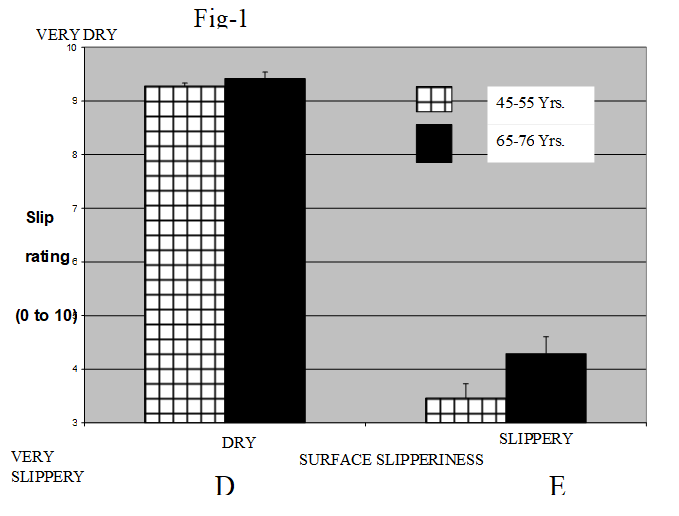
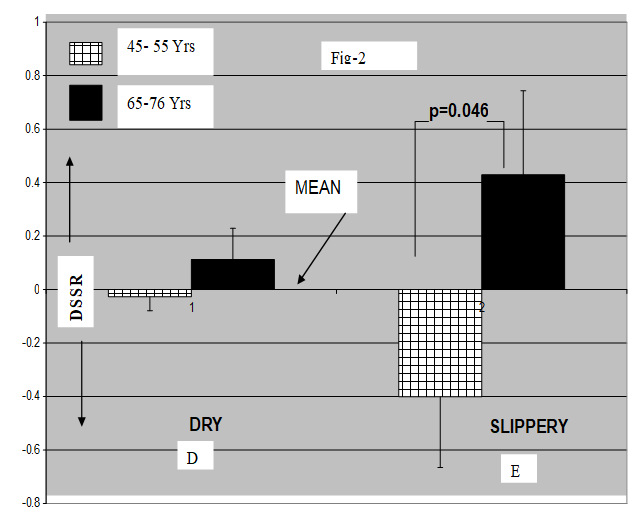
There was a monotonic increase in the % of slip occurrence as subjects walked on level floor - 0° (14.5% slips) to ramps of 10° (31% slips) to 15° (37% slips) to 20° (50.2 % slips). Both the younger and the older workers rated the dry surface with comparable slip rating sores (not statistically significant). This implies that both groups were equally capable of correctly estimating the slipperiness of the dry surface, D (Figure 1). However, in comparison to the younger group the older workers significantly (p=0.046) underestimated the slipperiness of the slippery surface E (i.e. the DSSSR was more positive in the older group than in the younger group (Figure 2).
Since the older workers underestimated the slipperiness of the slippery surface, it is theorized [44, 48] that their motor control system will be less prepared (than the younger group) to negotiate a dynamic task on a slippery ramp [49]. Because of this underestimation of slipperiness of the surface, their ability to perceive the risk of postural balance and slip/fall while walking on the ramp will be poorer, as is supported by lower PSOF scores observed in the older workers than in the younger group (Figure 3). Since older workers had a lower perception of postural balance and slip/fall while walking on the ramp, they would, therefore, not deploy an appropriate muscle control strategy needed to reduce postural sway during ramp negotiation. This was supported by findings of higher M-L and AP sway responses observed in the older group compared to the younger workers especially for the slippery surface. Similar findings were reported in another study [49] where older workers showed a plateau effect, whereby, despite a rapid decrease in the slipperiness; their perception of the slipperiness does not decrease accordingly. On the other hand, younger workers’ perception of slipperiness decreased along with the decrease in actual COF. This suggests that with increasing age, workers may not be able to adequately assess the risk of loss of balance and falling when working on a slippery surface.
Ramp angle, surface and age were significantly associated with PSOF response (p<0.0001). Older workers perceived less of a threat particularly for slippery surface on a greater inclination ramp. The 200 inclination was perceived to be 2500% more hazardous while wearing soft-soled shoes and 73% more hazardous while wearing hard-soled shoes, as compared to a flat surface. Also, on average, soft-soled shoes were associated with 65.4% greater hazard than hard-soled shoes (p<0.0001). This finding is consistent with the fact that 48% of the slips occurred with soft shoes, compared to only 5.9% with hard sole shoes during gait tests.
Repeated measure logistic regression was used to relate the probability of slips and falls to all test conditions of the experiment using the statistically significant covariates. The younger group was more likely to slip (OR=1.27, p<0.05) but much less likely to fall (OR=0.16, p<0.003) as DSSSR increased. These results indicate that misjudging a surface to be less slippery may have dangerous consequences for older workers, as they are more likely to fall than are younger individuals who underestimate the slipperiness of a surface.
![Figure 3: Workers’ perception of slipperiness as a function of age. With increasing age, workers are not be able to assess the risk of loss of balance and falling when working on a slippery surface [49].](/fulltextimages/12272/fig_3.png)
Conclusion
This study sought to determine if various risk factors for fall. As expected, as the ramp angle increased from 0° to 20°, slip occurrence increased. Workplaces should follow walking and working surface standards and provide appropriate handrails. In addition, work practices and safety topics should enforce the use of handrails. While only two types of footwear were tested in these lab conditions, the difference detected indicated that a harder soled shoe performed better on increased inclinations and slippery conditions. By using the actual coefficients of friction measured during the tasks performed and rated by the participants, we were able to provide a unique insight to determine if a mismatch is correlated with a slip or fall event. Comparing the results between the older and younger participants, we found that misjudging the surface slipperiness may be riskier for older participants. The younger participants who perceived the surface slipperiness wrong were more likely to slip but less likely to fall as opposed to the older workers. Additionally, the findings that the older participants underestimated the slipperiness of surfaces supports the use of engineering and administrative controls for all workers. These findings highlight the importance of addressing the slip/fall hazards in workplace and public situations that may involve ramps and slippery surfaces, and not relying on the worker to be able to appropriately negotiate the hazards. In addition, further work on appropriate footwear and flooring conditions can provide solutions for such hazards.
Acknowledgement
This work is dedicated to the memory of Dr. Paul Succop.
Funding
This research was partially supported by NIOSH grants (R01-OH02794-02 and R01-OH03079-02).
References
-
(2022) Understanding the Aging Workforce: Defining a Research Agenda. In: Fiske ST et al. The National Academies Press, Washington DC, USA.
-
Weir N (1977) Investigation and management of vertigo in the elderly. Nursing Mirror 145(18): 16-20.
-
Sheldon JH (1963) Effect of age on control of sway. Gerontologica Clinica 5(3): 129-138.
-
Sheldon JH (1960) On the natural history of falls in old age. British Medical Journal 2(5214): 1685-1690.
-
Sidebotham P (1988) Balance through the ages of man. Journal of Laryngology and Otology 102(3): 203-208.
-
Hasselkus BR (1974) Aging and the human nervous system. American Journal of Occupational Therapy 28(1): 16-21.
-
Shumway-Cook A, Woollacott MH (1985) The growth of stability: Postural control from a developmental perspective. Journal of Motor Behavior 17: 131-147.
-
Odenrick P, Sandstedt P (1984) Development of postural sway in the normal child. Human Neurobiology 3(4): 241-244.
-
Bhattacharya A, Shuklo R, Dietrich KN, Bornschein RL, Berger O (1995) Effects of early lead-exposure on children’s postural postural balance. Developmental Medicine and Child Neurology 37(10): 861-878.
-
Bhattacharya A, Shukla R, Dietrich KN, Bornschein RL (2006) Effect of early lead exposure on the maturation of children’s postural balance: a longitudinal study. Neurotoxicol Teratol 28(3): 376-385.
-
Overstall PW, Exton-Smith AN, Imms FJ, Johnson AL (1977) Falls in the elderly related to postural imbalance. British Medical Journal 1(6056): 261-264.
-
Fernie GR, Gryfe CI, Holliday PJ, Llewellyn A (1982) The relationship of postural sway in standing to the incidence of falls in geriatric subjects. Age and Ageing 11(1): 11-16.
-
Masdeu JC, Wolfson L, Lantos G, Tobin JN, Grober E, et al. (1989) Brain white-matter changes in the elderly prone to falling. Archives of Neurology 46(12): 1292-1296.
-
Stelmach GE, Phillips JEA, Fabio RP, Teasdale M (1989) Age functional postural reflexes, and voluntary sway. Journal of Gerontology: Biological Sciences 44(4): B100-B106.
-
Kodithuwakku Arachchige SNK, Chander H, Turner AJ, Knight C (2021) Impact of Prolonged Exposure to a Slippery Surface on Postural Stability. Int J Environ Res Public Health 18(5): 2214.
-
McArdle W, Katch FI, Katch VL (1981) Exercise physiology: energy, nutrition and human performance. Lea and Febiger Publishers, Philadelphia, USA, pp: 508.
-
Garg A, Funke S, Janisch D (1988) One-handed dynamic pulling strength with special application to lawn mowers. Ergonomics 31(8): 1139-1153.
-
Viitasalo JT, Era P, Leskinen AL, Heikinnen E (1985) Muscular strength profiles and anthropometry in random samples of men aged 31-35, 51-55 and 71-75 years. Ergonomics 28(11): 1563-1574.
-
Asmussen E, Heeboll-Nielson K (1962) Isometric muscle strength in relation to age in men and women. Ergonomics 5(1): 167-169.
-
Astrand I (1988) Physical demands in worklife. Scandinavian Journal of Work Environment and Health 14(1): 10-13.
-
Campbell MJ, McComas AJ, Petito F (1973) Physiological changes in ageing muscles. Journal of Neurology, Neurosurgery and Psychiatry 36(2): 174-182.
-
Astrand PO, Rodahl K (2002) Textbook of work physiology. McGraw-Hill Publishers, New York, USA.
-
Garg A (1991) Ergonomics and the older worker- an overview. Experimental Aging Research 17(3): 143-155.
-
Morgan CT, Cook JS, Chapanis, A, Lund MW (1963) Human engineering guide to equipment design. McGraw Hill, New York, USA.
-
Andersson GB (1981) Epidemiologic aspects on low- back pain in industry. Spine 6(1): 53-60.
-
Perkins PJ, Wilson MP (1983) Slip resistance testing of shoes - new developments. Ergonomics 26(1): 73-82.
-
Tolin P, Simon JR (1968) Effect of task complexity and stimulus duration on perceptual-motor performance of two disparate age groups. Ergonomics 11(3): 283-290.
-
Adelsberg S, Pitman M, Alexander H (1989) Lower extremity fractures: relationship to reaction time and coordination time. Archives of Physical Medicine and Rehabilitation 70(10): 737-739.
-
Bailey RW (1982) Human performance engineering: A guide for systems engineers. Prentice-Hall, Englewood Cliffs, USA, pp: 656.
-
Welford AT (1985) Changes of performance with age: An overview. Aging and Human Performance. Wiley, New York, pp: 159-188.
-
Fozard JL (1981) Person-environment relationships in adulthood: implications for human factors engineering. Human Factors 23(1): 7-27.
-
Evans DW, Ginsburg AP (1985) Contrast sensitivity predicts age-related differences in highway-sign discriminability. Human Factors 27(6): 637-642.
-
(1980) Selection of Illuminance Values for Interior Lighting Design (RQQ Report No. 6): Prepared by the Committee on Recommendations for Quality and Quantity of Illumination of the IES (RQQ). Journal of Illuminating Engineering Society 9(3): 188-190.
-
Rosenhall U, Rubin W (1975) Degenerative changes in the human vestibular sensory epithelia. Acta Otolaryngologica 79(1-2): 67-80.
-
Fregly AR, Graybiel A (1970) Labyrinthine defects as shown by ataxia and caloric tests. Acta Otolaryngologica 69(1-6): 216-222.
-
Graybiel A, Fregly AR (1966) A new quantitative ataxia test battery. Acta Otolaryngologica 61(1-6): 292-312.
-
Manchester DL, Woollacott M, Zederbauer-Hylton N, Marin O (1989) Visual, Vestibular and Somatosensory Contributions To Balance Control In The Older Adult. Journal of Gerontology 44(4): M118-M127.
-
Skinner HB, RL Barrack, Cook SD (1984) Age-related decline in proprioception. Clinical Orthopedics and Related Research 184: 1q208-211.
-
Stelmach GE, Zelaznik HN, Lowe D (1990) The influence of aging and attentional demands on recovery from postural instability. Aging clinical and experimental research 2(2): 155-161.
-
Chiou SY, Bhattacharya A, Succop PA (2000) Evaluation of workers’ perceived sense of slip and effect of prior knowledge of slipperiness during task performance on slippery surfaces. American Industrial Hygiene Association Journal 61(4): 492-500.
-
Iglesias M, Vallejo R, Pena D (2012) Impact of Soft and Hard Insole Density on Postural Stability in Older Adults. Geriatric Nursing 33(4): 264-271.
-
Dev MK, Wood JM, Black AA (2021) The effect of low light levels on postural stability in older adults with age- related macular degeneration. Ophthalmic Physiological Optics 41(4): 853-863.
-
Chiou SY, Battacharya A, Chwan-Fu L, Paul S (1998) Effect of environmental and task risk factors on workers’ percieved sense of postural sway and instability. Occupational Ergonomics 1(2): 81-93.
-
Chiou SY (1996) Assessment of postural instability during semi-dynamic task performance on slippery surface. ProQuest Dissertations Publishing, Cincinnati, OH, USA.
-
Bhattacharya A (2004) Effect of task, environmental and personal factors on workers’ postural balance.
-
Bhattacharya A, Succop PA, Lu M-L, Kin CL (2006) Workers’ postural balance response on dry surface can predict their balance performance on slippery surface. American Industrial Hygiene Conference and Exposition May, Chicago, USA.
-
Chiou SY, Bhattacharya A, Fu LC, Succop PA (2003) Effects of environmental and job-task factors on workers’ gait characteristics on slippery surfaces. Occupational Ergonomics 3(4): 209-223.
-
Chiou SY, Bhattacharya A, Succop PA (1996) Effect of workers’ shoe wear on objective and subjective assessment of slipperiness. American Industrial Hygiene Association Journal 57(9): 825-831.
-
Dunning K, Mani A, Bhattacharya A (2016) Improving Balance Control: Current State and Practices. In: Hongwei Hsio (Ed.), Fall Prevention and Protection Principles, Guidelines, and Practices. 1st (Edn.), CRC Press, Boca Raton, USA, pp: 223-239.
- The Expanding Landscape of Road Rage: A Systematic Review of Conflicts Involving Drivers, Pedestrians, and Micromobility
- Validating Cognitive Models of Royal Navy Performance on Control Systems
- Comparing Standard and State-of-the-art Firefighter Coats on Postural Balance and Gait in a Live Burn Environment
- Investigating the Integration of Telemedicine into Clinicians Workflow: A Review of Methods
- Risk Assessment of Ergonomic Factors in a Textile Firm by RULA, REBA and Fine Kinney Methods
- Impact of Self-Esteem Training on Individuals with Disabilities Aged 17-30