
Beyond Luminescence: How Science and Technology are being Revolutionized by Quantum Dot
A brief review of quantum dots (QDs), a new class of nanomaterials with profound implications for cutting edge technological developments and research, is provided in this work. The notion of quantum dots is presented, explaining their special characteristics and operation, which originate from several quantum events in these remarkable spherical crystals. Because of their exceptional optical and electrical characteristics, QDs have great promise for a variety of uses. This paper also showcases some of the most widely used QD-based applications in biology and electronics, highlighting their adaptability and potential influence in several domains.
Introduction
Quantum dots (QDs) have emerged as a revolutionary technology in the realm of consumer electronics, particularly in the display industry. The 2023 Nobel Prize was conferred upon three scientists, Moungi G. Bawendi, Louis E. Brus, and Alexei I. Ekimov, for their pivotal contributions to “the discovery and synthesis of quantum dots” [1]. Awarded for their ground breaking work leading to the creation of particles whose properties are governed by quantum phenomena due to their exceptionally small size. Known as QDs, these particles have since become integral to the field of nanotechnology, holding immense significance in various applications. Their remarkable ability to enhance picture quality has garnered significant attention, positioning them as a pivotal player in display technology. QDs are minuscule semiconductor particles, typically measuring between 2 and 10 nanometers (nm) in diameter. Their diminutive size imparts them with distinctive optical and electrical properties, making them highly desirable for various applications [2]. Notably, the size and morphology of quantum dots can be precisely manipulated during fabrication, facilitating scalability and versatility in display applications. QDs exhibit two primary mechanisms for color production. Firstly, through photoluminescence (PL), wherein the injection of light photons of specific wavelengths activates the quantum dots, resulting in the emission of light at a precise and narrow spectrum. Secondly, electroluminescence (EL) occurs when electric energy, in the form of electrons, stimulates the quantum dots, generating distinctly colored light [3]. This process involves the formation of “holes” from the electrodes, which interact with the quantum dots to emit light (Figure 1).
![Figure 1: The depiction showcases quantum dots of varying sizes and configurations, emphasizing the correlation between quantum dot size and the resultant change in the material’s color [4].](/fulltextimages/12477/fig_1.png)
Principle of Functioning of QDs
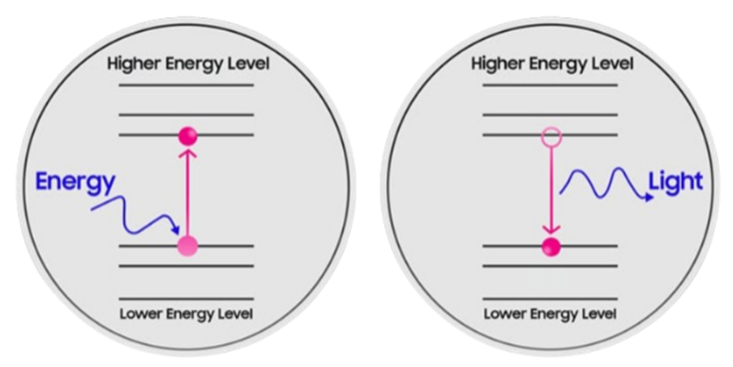
Understanding the fundamental physics governing QDs is crucial to understanding how they work. This investigation clarifies how quantum dots emit light and explains why the wavelength—which is important in identifying particular colors—depends on the size of the dots. An essential step is photoluminescence, which happens when electrons in QDs are excited. These electrons go up to higher energy bands in response to light. Photons then revert to lower energies during relaxation, which causes recombination and re- radiation within energy bands (Figure 2) [5].
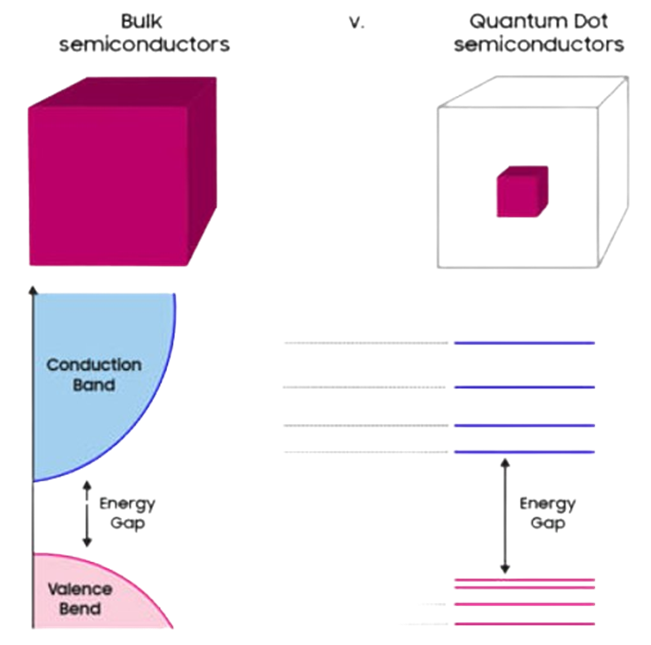
The band gap, a space between the valence and conduction bands that lacks energy levels, is what scientists believe to be responsible for the wavelength of the light that is released. The particular hue that quantum dots emit is defined by this determinant factor. The confinement effect and the quantization of electronic states are two nanoscale processes that give QDs their unique properties. These bright particles’ distinct electronic states are the cause of these phenomena [4].
Quantum Confinement Phenomenon
Electrons are described by wave-functions and energy levels inside conduction sub bands due to quantum confinement phenomena. When a crystal’s size is far smaller than its wavelength, visible quantum confinement effects result [6]. In these cases, material parameters, especially the Bohr radius, determine the degree of electron confinement and the size of the resultant hole. Excitations are thus limited to three spatial dimensions, and quantum dot attributes show size-dependence. The release of confinement energy is a basic characteristic of quantum dots that clarifies the relationship between the size of a QD and its emission frequency (Figure 3).
Quantized Electronic States in Quantum Dots
The quantum confinement effect creates a significant band gap between discrete energy levels, in contrast to bulk semiconductors with continuous energy bands. Because of their quantized band gap, quantum dots may emit light at a very specific wavelength that can be precisely controlled by changing their size, which essentially modifies their energy levels [7]. One of the main benefits of using quantum dots in a variety of applications, including quantum computing, biomedical imaging, and display technologies, is their ability to precisely adjust the wavelength at which they emit light. Researchers and engineers can customize the optical characteristics of quantum dot-based systems to satisfy specific needs by varying the size of the quantum dots.
Furthermore, an extensive color gamut may be produced in vivid, extremely efficient displays thanks to the flexibility to adjust the wavelength that is emitted. Additionally, quantum dots in biomedical imaging have outstanding photostability and brightness, allowing for comprehensive biological structure identification with low photobleaching (Figure 4).
The capacity to precisely manipulate the energy levels of quantum dots is essential for processing and encoding quantum information in the field of quantum computing. All things considered, the discrete character of electronic states in quantum dots opens up a wide range of opportunities for improving science and technology.
Application of Quantum Dots
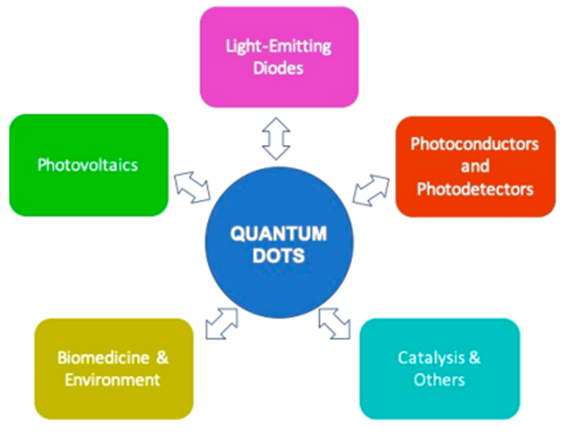
Over the years, research on semiconductor reduced dimensionality has evolved, giving rise to quantum dots (QDs), also known as “artificial atoms”. These nanocrystals, with diameters in the nanometer range, display quantum size effects in their optical and electronic properties, notably achieving tunable and efficient photoluminescence (PL), characterized by narrow emission and high photochemical stability. Today, core-shell structures are commonly realized across various QD materials systems. Consequently, QDs have found widespread use in numerous devices and applications, including QD-based displays integrated into our daily lives. Despite their integration into mature technologies, the synthesis, characterization, and applications of QDs remain a highly active area of research. While initial studies primarily focused on group IV and III-V compounds, advancements in synthesis techniques have broadened the range of elemental compositions utilized. Currently, QDs are based on various compounds, including II-VI, I-III-VI, transition- metal dichalcogenides, perovskites, and carbon, among others [8, 9]. Their applications predominantly leverage their exceptional optical properties, encompassing areas such as light emission, conversion, and detection, as depicted in Figure 5.
![Figure 5: Quantum Dots-based Applications [9].](/fulltextimages/12477/fig_5.png)
Quantum Dots (QDs) in Light-Emitting Diodes (LEDs) and Display Technologies
Early light emitting diode (LED) technology integrated epitaxial quantum dots (QDs) within multilayer heterostructures grown on semiconductor substrates, notably InAs/GaAs QDs, though challenges include interface control due to In desorption. Enhancing photoluminescence (PL) intensity, vertically coupled QD bilayers capped by self- assembled InxGa1–xAs layers have been developed, while chemically etched semiconductor nanomembranes and scanning tunneling spectroscopy address post-processing analysis issues [10]. In LED and display applications, colloidal InP QDs exhibit tunable, bright, and narrow PL, with added ZnSe/ZnS multishells improving performance. Silicene- based QDs confined in few-layer siloxene nanosheets show potential as blue-light-emitting diode emitters. CsPb(Br/I)3 and CsPbI3 QDs demonstrate enhanced properties suitable for LEDs emitting at 670 nm, and CsPbBr3 QDs enable dual- wavelength green-light-emitting diodes when decorating ZnO nanorods on GaN films. Graphene oxide QDs/GaN composites enhance GaN PL spectra [11]. In phosphors and white-light-emitting diodes, CsPbBr3 QDs are utilized, while hexagonal boron nitride sheets enhance thermal stability of CdSe/CdS QD-based devices. Ultrastable QD- based phosphors, LED encapsulated with a CdSe/CdS/ZnS QD–SiO2/Al2O3 monolith phosphor, and a bovine serum albumin/QD complex nanocomposite provide white light. Moreover, Zn3N2-based colloidal QDs present an alternative for QD LED displays. Thin-film-type LEDs utilize CsPbX3 QDs fabricated via a solid-state ligand-exchange method, while CuInS2/ZnS QDs with stable ligands are suggested for efficient film-type display devices [12].
Quantum Dots in Photovoltaic
Nanomaterials have long been integrated into photovoltaic devices to enhance energy conversion efficiency. Recent advancements in this realm include strategies involving CdS QDs, as well as CdSe and CdSe/CdS core-shell QDs[13]. Additionally, novel methods have been developed for capping PbS QDs with atomic ligands and improving passivation of CdSe/CdS/ZnS core-shell-shell QDs thin films. Ligand and solvent engineering techniques have been applied to PbS QD films, with studies also exploring their interaction with ZnO films. Achieving homogeneous dispersion of core- shell CdS/ZnS QDs in copolymers has been accomplished through supercritical carbon dioxide synthesis. Theoretical studies utilizing DFT calculations have contributed to the design of CdSe QD-based materials for energy conversion applications [14].
Photoconductors and Photodetectors
Photon detection devices like light-dependent resistors (photoconductors) and photodiodes utilize materials tailored to specific spectral ranges. Quantum dots (QDs) enhance performance in these devices [15]. PbS QD photodetectors show improved responsivity with a two-step ligand-exchange method. PbS QD films, synthesized rapidly via microwave-polyol, enable high- performance photoconductors. Ag2Se QDs yield high- responsivity mid-wavelength infrared (IR) photoconductive photodetectors. PbS QD-based broadband photoconductors and photodetector arrays are fabricated using printing techniques. WS2 QD–graphene nanocomposites enable ultra-violet (UV) photodetectors. CsPbBr3 colloidal QDs paired with few-layer MoS2 achieve balanced photodetection in phototransistors [16].
Biomedical And Environmental Applications
Quantum dots (QDs) are versatile for bioimaging, diagnostics, and biosensing due to their high luminescence, narrow emission, and biocompatibility. Fibrous phosphorus QDs are used for adenocarcinoma bioimaging, while CuInS2/ ZnS QDs serve as cell imaging markers. MoS2 QDs are proposed for cell imaging and biosensing [9]. Zinc chalcogenide QD complexes are effective in bioimaging and biosensing. Ultrabright graphene QDs and N–S-doped graphene QDs are applied in cell imaging and pollutant sensing. Luminescent porous Si with Si QDs analyzes toxic metal ions in water samples [17]. WS2 QDs sense Fe3+ ions, while MoSe2 QDs act as chemosensors and Fe3O4 QDs sense peroxides. CdTe QDs and SiO2 polydopamine nanoparticles are used in clinical diagnostics. CuInS2 QDs function as thermometers, while CdSe and ZnSe QDs disrupt membranes [18].
Catalysis and other applications
Semiconductor photocatalysis technology harnesses light to drive chemical reactions, and QDs have emerged as promising catalysts to enhance existing processes or develop new routes. Carbon QD-modified graphitic carbon nitride exhibits prolonged photocatalytic H2 evolution without activity decay over six months. Light-driven H2 generation is achieved using carbon QD-sensitized TiO2/Pt nanocomposites [19]. N-doped graphene QDs synthesized via liquid-laser ablation demonstrate high catalytic selectivity for the O2 reduction reaction and the conversion of 4-nitrophenol to 4-aminophenol under near-IR light [20]. CdS QD-decorated catalysts enable the photocatalytic synthesis of imines. Additionally, strong synergy between Deoxyribonucleic acid (DNA) cages and CdSe/CdZnS/ZnS core-shell-shell and CdSe/ZnS core-shell QDs enhances enzyme activity [21].
Finally, according to recent developments, QDs are even employed in ultrafast lasers because of their wide optical gain bandwidth. QDs (QDs) are used in this kind of laser as the active medium. Their ultrafast temporal response, which allows them to produce incredibly brief light pulses of the order of picoseconds or femtoseconds, is what distinguishes them. UQDL synthesis is a difficult process that calls for sophisticated methods including molecular beam epitaxy, vapor-phase growth, and colloidal synthesis [22, 23]. The primary benefit of mode-locked QDLs is their capacity to produce ultrafast pulses of light, thereby rendering them valuable in a variety of fields like communications, sensing, and spectroscopy. However, a lot of problems in their development still need to be worked out beforehand QDs become commonly used in commercial applications. The synthesis of consistent, superior QDs with consistent optical properties is a major problem. QDs can react with one another and create unwanted byproducts when the conditions for synthesis are not right, including high pressure and temperature.
Conclusion
In summary, QDs are an innovative technology with a wide range of uses in environmental science, healthcare, catalysis, and converting energy, among other domains. They are useful instruments for bioimaging, biosensing, and diagnosis because of their special qualities, which include strong luminescence, narrow emission, and biocompatibility. In addition, QDs have demonstrated incredible promise in photocatalysis, improving on currently available catalytic pathways and opening up new avenues for process development. QDs are paving the way for significant advances in science and technology by pushing the boundaries of innovation in a variety of applications, including pollution sensing, hydrogen generation, and enzyme activity augmentation. We may expect more discoveries and uses as this field of study develops, which will surely influence the direction of QD-based technologies and how they affect society in future generations.
References
-
Bawendi MG, Brus LE, Yekimov A (2023) The Nobel Prize in Chemistry 2023.
-
Ameta SC (2023) Introduction. In: Ameta R, et al. (Eds.), Quantum Dots. Elsevier, Netherland, pp: 1-13.
-
Lin S, Tan G, Yu J, Chen E, Weng Y, et al. (2019) Multi- primary-color quantum-dot down-converting films for display applications. Opt Express 27 (20): 28480-28493.
-
(2024) Understanding Quantum Dots. Samsung Display.
-
Singh S, Paswan SK, Kumar P, Singh RK, Kumar L (2023) Nanomaterials based sensors for detecting key pathogens in food and water: developments from recent decades. In: Singh P, et al. (Eds.), Environmental Applications of Microbial Nanotechnology. Elsevier, Netherlands, pp: 65-80.
-
Neikov OD, Yefimov NA, Naboychenko S (2019) Handbook of Non-Ferrous Metal Powders. (2nd Edn.), Elsevier, Netherlands, pp: 271-311.
-
Tarucha S, Honda T, Austing DG, Tokura Y, Muraki K, et al. (1998) Electronic states in quantum dot atoms and molecules. Phys E Low-Dimens Syst Nanostructures 3(1): 112-120.
-
He X (2024) Quantum Dots Unleashed: An Ever-Evolving Application Landscape. IDTechEx.
-
Cotta MA (2020) Quantum Dots and Their Applications: What Lies Ahead? ACS Appl. Nano Mater 3(6): 4920- 4924.
-
Tongbram B, Sengupta S, Chakrabarti S (2018) Impact of an InxGa1–xAs Capping Layer in Impeding Indium Desorption from Vertically Coupled InAs/GaAs Quantum Dot Interfaces. ACS Appl Nano Mater 1(8): 4317-4331.
-
Jang E, Kim Y, Won YH, Jang H, Choi SM (2020) Environmentally Friendly InP-Based Quantum Dots for Efficient Wide Color Gamut Displays. ACS Energy Lett 5(4): 1316-1327.
-
Zhong H, Bai Z, Zou B (2012) Tuning the Luminescence Properties of Colloidal I–III–VI Semiconductor Nanocrystals for Optoelectronics and Biotechnology Applications. J Phys Chem Lett 3(21): 3167-3175.
-
Chen G, Seo J, Yang C, Prasad PN (2013) Nanochemistry and nanomaterials for photovoltaics. Chem Soc Rev 42(21): 8304-8338.
-
Sykora M, Petruska MAJ, Alstrum-Acevedo J, Bezel I, Meyer TJ, et al. Photoinduced Charge Transfer between CdSe Nanocrystal Quantum Dots and Ru−Polypyridine Complexes. J Am Chem Soc 128 (31): 9984-9985.
-
Konstantatos G, Sargent EH (2010) Nanostructured materials for photon detection. Nat Nanotechnol 5(6): 391-400.
-
Zheng W, Xiong X, Lin R, Zhang Z, Xu C, et al. (2018) Balanced Photodetection in One-Step Liquid-Phase- Synthesized CsPbBr3 Micro-/Nanoflake Single Crystals. ACS Appl Mater Interfaces 10(2): 1865-1870.
-
Li L, Yan X (2010) Colloidal Graphene Quantum Dots. J Phys Chem Lett 1(17): 2572-2576.
-
Mubeen M, Khalid MA, Gul T, Mukhtar M, Ul-Hamidb A, et al. (2022) Cu-Enhanced Efficient Förster Resonance Energy Transfer in PBSA Sunscreen-Associated Ternary CuxCd1–xS Quantum Dots. ACS Omega 7(39): 35014- 35022.
-
Li H, Shi W, Huang W, Yao E-P, Han J, et al. (2017) Carbon Quantum Dots/TiOx Electron Transport Layer Boosts Efficiency of Planar Heterojunction Perovskite Solar Cells to 19%. Nano Lett 17(4): 2328-2335.
-
Claussen JC, Malanoski A, Breger JC, Oh E, Walper SA, et al. (2015) Probing the Enzymatic Activity of Alkaline Phosphatase within Quantum Dot Bioconjugates. J Phys Chem C 119(4): 208-2221.
-
Durmusoglu E, Turker Y, Acar H (2019) Luminescent PbS and PbS/CdS Quantum Dots with Hybrid Coatings as Nanotags for Authentication of Petroleum Products. ACS Appl Nano Mater 2(12): 7737-7746.
-
Yadav A, Chichkov NB, Avrutin EA, Gorodetsky A, Rafailov EU (2023) Edge emitting mode-locked quantum dot lasers. Prog in Quantum Electrons 87: 100451
-
Ustinov V, Zhukov AE, Egorov AY, Maleev NA (2003) Quantum Dot Lasers. Oxford University Press, US, pp: 304.
- The Expanding Landscape of Road Rage: A Systematic Review of Conflicts Involving Drivers, Pedestrians, and Micromobility
- Validating Cognitive Models of Royal Navy Performance on Control Systems
- Comparing Standard and State-of-the-art Firefighter Coats on Postural Balance and Gait in a Live Burn Environment
- Investigating the Integration of Telemedicine into Clinicians Workflow: A Review of Methods
- Risk Assessment of Ergonomic Factors in a Textile Firm by RULA, REBA and Fine Kinney Methods
- Impact of Self-Esteem Training on Individuals with Disabilities Aged 17-30