
Evaluation of the Quality of the Vermicompost from the Exhausted Substrate of Pleurotus spp. through the Analysis of the Nematological Population and of the Arthropodofauna
In the last decades the cultivation of mushrooms of the genus Pleurotus has spread more and more, raising the problem of the disposal of crops waste material. An economically and ecologically advantageous possibility could be that of transforming this material into organic vermicompost to be used in agriculture. In the present work the exhausted residue (Spent Mushroom Substrate = SMS) of a cultivation of Pleurotus eryngii, P. ostreatus, P. cornucopiae and P. nebrodensis was transformed into vermicompost. To evaluate the quality of the vermicompost obtained, the nematological community and the artropodofauna were analyzed both of the exhausted material and of the final vermicompost with methods and indices typical of the evaluation of the soil quality, as the principles on which these methodologies are based make them usable for measuring the quality of any type of substrate. The results obtained in these studies showed in the vermicompost the presence of a reacher nematological population and of an arthropodofauna greatly adapted to soil life, what indicates that the vermicompost obtained from the exhausted substrate of Pleurotus spp. has characteristics suitable for soil enrichment and can therefore be used as soil fertilizer in agriculture.
Introduction
The mushrooming activity in Italy represents an ever expanding agricultural sector. Of the approximately 62,000 tons of cultivated mushrooms produced annually, 8% are mushrooms of the genus Pleurotus (from Italian association of mushroom growers). The growth substrate of the Pleurotus mushrooms is made of shredded wheat straw, enriched with substances with high nitrogen content (alfalfa, pollen, etc.). This material is heat treated in tunnels or autoclaves, bagged in plastic bags and inoculated with mycelium grown in laboratory. At the end of the production cycle the exhausted substrate (Spent Mushroom Substrate = SMS) must be eliminated from the production premises and properly disposed of. This has always been one of the critical aspects of mushroom cultivation, resulting in high costs for the companies operating in the mushroom sector. The possibility of re- using this exhausted substrate in productive activities has long been the object of sector studies. Several solutions have been proposed at this purpose: as building material [1], as biomass for the production of energy [2], as soil improver by composting or vermicomposting [3]. The re- use of the SMS would lead to an increase in the environmental sustainability of the mushrooming activity and to a further possibility of economic development for the companies operating in the sector.
Organic soil improvers play an increasingly important role in current agriculture. Their properties are now well known (enrichment of carbon, enrichment of microbial flora, increase in water retention capacity, improvement of soil structure, slow release of nutrients, etc.) [4, 5, 6].
The vermicompost represents the result of the mesoterm decomposition operated by the earthworm. Its own characteristics make it a useful product not only for soil fertilization but also for the defense against pests, especially phytoparasitic nematodes [7, 8]. The soil microbial content increases in presence of this type of soil improver [9], giving a phyto-stimulant action. In addition, a species of entomopathogenic nematode [10] was isolated in the vermicompost showing that this substrate is also suitable for the survival of species that can be used for biological control.
Steel, et al. (2010, 2013) [11, 12] have demonstrated that nematodes are able to survive in compost as soon as the temperature of the composting process drop and that the nematological communities vary according to the phases of the process and can therefore be used to evaluate the maturity of the compost. They also showed how the presence of insects is of great importance in the succession of the nematological community. The high temperatures that develop in a composting process, however, create problems for the survival of insects. The process of vermicomposing, otherwise, being a mesoterm process should allow the survival of both nematodes and insects.
In this work the exhausted residue of a cultivation of Pleurotus eryngii, P. ostreatus, P. cornucopiae and P. nebrodensis was transformed into vermicompost. To assess the quality of the final vermicompost compared to that of the SMS, their nematofauna and arthropodofauna were studied. The composition of the nematological community was analyzed by means of the Maturity Index (MI) [13] which is based on the r-k strategies of nematode families , the analysis of the trophic groups [14, 15] and the analysis of the functional groups [16]. The composition of the arthropodofauna was evaluated using the soil biological quality index QBS-ar [17, 18]. QBS-ar is based on a qualitative survey carried out on arthropods belonging to the edaphic mesofauna present in a soil sample. The sampled animals are grouped with respect to their biological forms that are the set of convergent morphological characters which they commonly possess and which make them more suitable to the soil life, and therefore more susceptible to disturbance. Each biological form is assigned an index EMI (Ecomorphological Index) ranging from 1 to 20 which characterizes the different biological forms and the adaptation degree of the animal to the soil life.
Materials and methods
Vermicomposting Process
This operation required 120 days at the end of which the vermicompost was made. To realize the experimental litter, an excavation of 200x100 cm in size and 20 cm deep was carried out; it was covered with a plastic film above which the exhausted substrate (Figure 1) of the following types was placed: - No. 2 blocks of P. ostreatus, HS 35 strain, produced by Az.
Agri. Mola Mendola Villalba CL - No. 2 blocks of P. cornucopiae, Produced by Az. Agri.
Mola Mendola Villalba CL - No. 2 blocks of P. eringi strain D +, produced by Az. Agri.
De Biasi Castellaneta TA - No. 2 blocks of P. nebrodensis, produced by Az. Agri. De Biasi Castellaneta TA
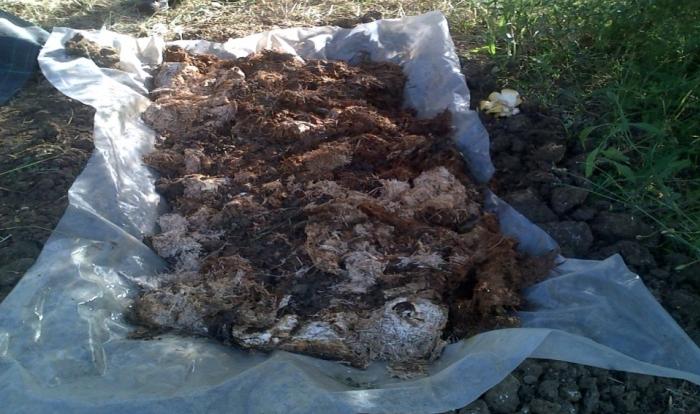
Finally, an inoculum of 4 kg of mature vermicompost litter from an active farm was added, containing specimens of Californian red earthworms (Lombricus rubellus), all covered with a non-woven fabric mulch.
The substrate bedding thus created was kept constantly humid and mixed regularly every 30 days for the entire duration of the experiment.
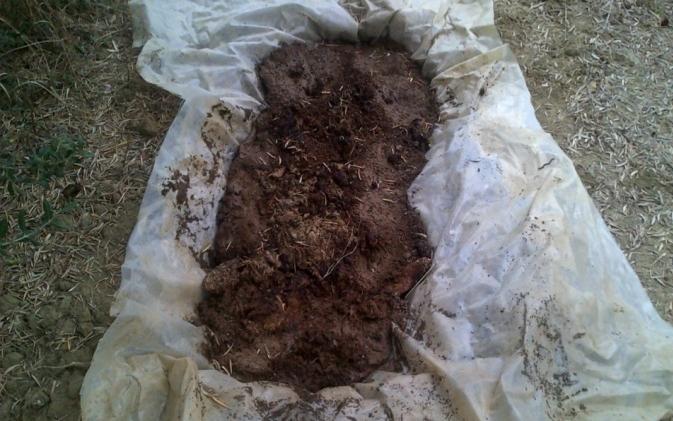
At the end of the aforementioned period (Figure 2) the mixture was sieved, with a 1 cm mesh screen, separating the litter residues and the earthworms from the vermicompost (Figure 3).
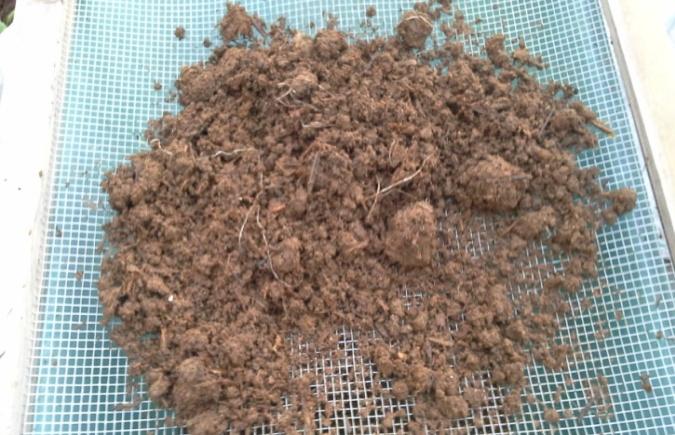
The vermicompost obtained was stored in micro- perforated plastic bags protected from direct light.
Study of Nematode Fauna
Samples of both substrates were obtained by means of a prismatic-rectangular soil corer measuring cm 5x5x25 till reaching a volume of 625 cc. The nematodes were extracted using the Baermann funnel method for wildlife and the animals were collected with a needle, fixed with 4% formalin and transferred into glycerine according to the De Grisse method (1969) [19]. All the nematodes sampled were mounted in slides and observed with an optical microscope. Each specimen was identified at the genus level, and the results obtained were used to study the community composition.
Study of Arthropod Fauna
Samples of both substrates were obtained by means of a soil corer measuring cm 10x10x10 till reaching a volume of 1000 cc.
The samples were placed in a Berlese funnel for a period of 10 days for the extraction of the arthropods.
At the end of this period, the arthropods extracted were observed under the stereo microscope, identified and divided into the various groups to which the value of EMI was attributed and the QBS-ar was calculated.
Results
The analysis of the nematode fauna (Table 1) indicates a greater biodiversity at genus level in the vermicompost compared to the SMS, although in both cases the composition is almost entirely constituted by bacterial- feeding cp-1 nematodes, r strategists and typical colonizers. Such composition is typical of highly enriched soils (EI = 100 for SMS and 99.85 for vermicompost) but with a poor structure. A beginning of colonization by fungal-feeding nematodes in the vermicompost determines a Basal index (BI) of 1.15 against a BI = 0 of the SMS. The maturity index (MI), which is 1 in the SMS, scarcely tends to rise (1.01) in the vermicompost due to the slight increase in the cp2 groups (Tables 2 and 3).
| Rhabditis | Fictor | Ditylenchus | Cuticularia | Filenchus | Butlerius | Seinura | Diploscapter | |
|---|---|---|---|---|---|---|---|---|
| SMS | 309 | 2 | 1 | |||||
| Vermicompost | 124 | 342 | 6 | 20 | 3 | 9 |
Table 1: Nematode specimens per genus present in the two substrates.
SMS cp-1 cp-2 Ba 99,68
Pl 0,32
Ba = bacterial-feeding; Pl = plant-feeding Table 2: Functional diagram with combinations of nematode feeding groups and life-history characteristics of SMS (Bongers and Bongers, 1998) [16]. Groups are calculated in %.
Vermicompost cp-1 cp-2
Ba 98,21
Pl 1,19
Fu 0,59
Ba = bacterial-feeding; Pl = plant-feeding; Fu = fungal- feeding Table 3: Functional diagram with combinations of nematode feeding groups and life-history characteristics of vermicompost (Bongers and Bongers, 1998) [16]. Groups are expressed in %.
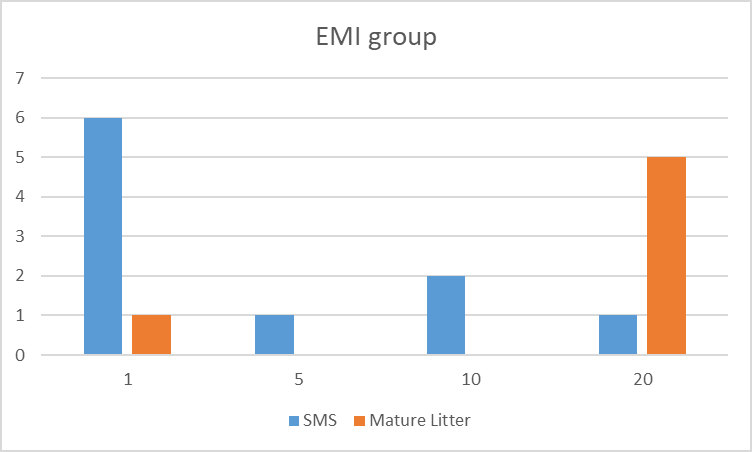
The study of the arthropod fauna and the relative application of the QBS-ar index in the SMS and in the vermicompost (Tables 4 and 5, Figure 4) showed in the two artificial microenvironments a significant variation in the fauna composition and in the soil quality index. The QBS-ar increases from 41 up to 101, a value found in many natural soils. In the SMS there is prevalence of flying insects and of their larvae (Diptera, Coleoptera, Tysanoptera, Hemiptera, Hymenoptera). The groups present in this sample showed little adaptation and poor links with the hypogeal life, and therefore they are not useful to improve soil formation and fertility.
In the vermicompost sample, instead, forms highly adapted to the edaphic environment largely prevail. All groups present, with the exception of adult Diptera, were assigned an EMI value of 20. Among them there are typically predatory groups of animals (Chilopoda and Pseudoscorpiones) with a high value of adaptation to the soil life. The faunal differences of the two samples show the process of transformation of the SMS into vermicompost with a colonization of the substrate by groups strongly adapted to the edaphic environment and the differences in value of QBS-ar clearly highlight a maturation of the substratum.
| Taxa | EMI | ||||
|---|---|---|---|---|---|
| Formycidae | 5 | ||||
| Diptera | 1 | ||||
| Diptera larvae | 10 | ||||
| Coleoptera | 1 | ||||
| Coleoptera larvae | 10 | ||||
| Tysanoptera | 1 | ||||
| Hymenoptera | 1 | ||||
| Acarina | 20 | ||||
| Collembola | 1 | ||||
| Hemyptera | 1 | ||||
| QBS-ar | 41 |
Table 2: Taxa present in mature vermicompost, their EMI and QBS-ar of the sample.
| Taxa | EMI | ||||
|---|---|---|---|---|---|
| Diptera | 1 | ||||
| Coleoptera | 20 | ||||
| Acarina | 20 | ||||
| Collembola | 20 | ||||
| Chilopoda | 20 | ||||
| Pseudoscorpiones | 20 | ||||
| QBS-ar | 101 |
Table 3: Taxa present in mature vermicompost, their EMI and QBS-ar of the sample.
Conclusions
The results of the two ecological analyses based on the faunistic composition of the two substrates agree in demonstrating the neat improvement of the quality of the vermicompost obtained from the treatment of exhausted substratum of fungal cultivations of the genus Pleurotus in respect to that of the original SMS. The fauna population of the mature compost shows that it has all the characteristics, both biological and structural, such as to make it a good agricultural fertilizer, already containing the biodiversity necessary for the formation of fertile soil. What is more, this fact can be turned into an economically advantageous investment, since a material that requires costs to be disposed of can otherwise be transformed into a source of income rather easily. The use of indices such as QBS-ar, which has been used so far to evaluate soil quality, and the study of the nematological community, even though less clearly of the former analysis, have shown to be suitable also for the evaluation of substrates different from soil, having given consistent answers in the present study.
References
-
Mayoral E (2010) Growing architecture through mycelium ad agricultural waste. Columbia University. Int constructed Environmenta 1(4): 87-137.
-
Bisaria R, Vasudevan P, Bisaria VS (1990) Utilization of spent agro-residues from mushroom cultivation of biogas production. Applied Microbiol Biotechnol 33(5): 607-610.
-
Ahlawat OP, Sagar MP (2007) Management of spent mushroom substrate. _InTechnical Bulletin._ National Research Centre for Mushroom, Indian Council of Agricultural Research Conference, Chambaghat, Solan.
-
Akhtar M, Malik A (2000) Roles of organic soil amendments and soil organisms in the biological control of plant-parasitic nematodes: a review. Bioresource Technology 74(1): 35-47.
-
Hu C, Qi Y (2010) Effect of compost and chemical fertilizer on soil nematode community in a Chinese maize field. European J Soil Biol 46(3-4): 230-236.
-
Nair A, Ngouajio M (2012) Soil microbial biomass, functional microbial diversity, and nematode community structure as affected by cover crops and compost in an organic vegetable production system. Appl soil ecology 58: 45-55.
-
D’Addabbo TD (1995) The nematicidal effect of organic amendments: a review of the literature 1982- 1994. Nematologia Mediterranea 23(2): 299-305.
-
Arancon NQ, Galvis P, Edwards C, Yardim E (2003) The trophic diversity of nematode communities in soils treated with vermicompost: The 7th international symposium on earthworm ecology. Cardiff Wales 2002. Pedobiologia 47(5-6): 736-740.
-
Uz I, Tavali IE (2014) Short-term effect of Vermicompost application on biological properties of an alkaline Soil with high lime content from Mediterranean region of Turkey. _Scientific World_ _Journal_, Hindawi Publishing Corporation.
-
Weimin YE, Torres-Barragan A, Cardoza YJ (2010) _Oscheius carolinensis_ n. sp. (Nematoda: Rhabditidae), a potential entomopathogenic nematode from vermicompost. Nematology 12(1): 121-135.
-
Steel H, de la Peña E, Fonderie P, Willekens K, Borgonie G, et al. (2010) Nematode succession during composting and the potential of the nematode community as an indicator of compost maturity. Pedobiologia 53(3): 181-190.
-
Steel H, Verdoodt F, Čerevková A, Couvreur M, Fonderie P, et al. (2013) Survival and colonization of nematodes in a composting process. Invertebrate Biol 132(2): 108-119.
-
Bongers T (1990) The maturity index: An ecological measure of environmental disturbance based on nematode species composition. Oecologia 83(1): 14- 19.
-
Yeates GW, Bongers TD, De Goede RGM, Freckman DW, Georgieva SS (1993) Feeding habits in soil nematode families and genera-an outline for soil ecologists_._ J Nematology 25(3): 315-331.
-
Ferris H (2010) Form and function: metabolic footprints of nematodes in the soil food web. European J Soil Biolo 46(2): 97-104.
-
Bongers T, Bongers M (1998) Functional diversity of nematodes. Applied Soil Ecology 10(3): 239-251.
-
Parisi V (2001) La qualità biologica del suolo. Un metodo basato sui microartropodi. Acta naturalie de “L’ateneo parmense”. Art 37: 105- 114.
-
Parisi V, Menta C, Gardi C, Jacomini C, Mozzanica E (2005) Microarthropod communities as a tool to assess soil quality and biodiversity: a new approach in Italy. Agri Eco Environ 105(1-2): 323-333.
-
De Grisse AT (1969) Redescription ou modifications de quelques techniques utilisées dans l’étude des nematodes phytoparasitaires. Mededelingen Rijksfakulteit Landbouwwetenschappen_,_ Gent 34: 315-369.
- Lessons to Learn: Trees are More than the Lungs of the World
- Community Forestry Enterprises as a Model for Sustainable Forest Development: The Case Of The "Baja Tarahumara" in Chihuahua, Mexico
- Ecological and Socio-Economic Impacts of Chromolaena odorata and Mesosphaerum suaveolens, Two Invasive Alien Species in Central and Southern Benin, West Africa
- Epigenetic Sustainability: Modeling the Human Factor as a Natural Resource through Science 4.0 and the NR3C1 Biological Pilot
- Growth-at-Risk: A Framework for Assessing Economic Vulnerability
- The Rural Territory as a Socioecological System for the Management of Public Policy for Sustainable Rural Development