
Habitat Preferences and Conservation Status of Himalayan Musk Deer (Moschus Chrysogaster) in Langtang National Park, Nepal
Himalayan Musk Deer (Moschus chrysogaster) is one of the endangered mammals that distributes to the Himalayan region. Our study was carried out in the Langtang National Park (LNP) to explore the distribution and conservation status of Himalayan Musk Deer. In order to explore these aspects of the biology of the species, a total number of 18 horizontal strip transects were laid in the field, each block having six transects within three blocks (A, B and C) across an altitudinal gradient between 3500 and 4000 m. Direct and indirect observations were carried out within the transects and a questionnaire survey was conducted to find the conservation attitude of the local people. The salient drive count method was carried out to observe the species in the field and linear regression models were applied to estimate the population status of the study area. Similarly, one way ANOVA, linear model and Principle Component Analysis were performed to analyze the data. We estimated the population density of Himalayan Musk Deer was 4.33/Km2. The distribution of the species was found in an altitudinal range of 3600-4000m asl. They mostly used altitudes between 3700-3800m asl (IV=0.7), and avoided altitudes below 3600m asl (IV= -0.2). Musk Deer select the different habitats for bedding sites and relic sites. They selected the steep slope (450) with high canopy cover (50%) for bedding sites and moderate canopy cover (30%), herb cover (30%) and gentle slope (380) for relic sites. In LNP, poaching was the major threat followed by feral dog, habitat destruction and unmanaged grazing. Further study should be conducted in LNP to explore the distribution pattern, habitat suitability, survival threats as well as genetic study is necessary for species confirmation.
Tilak Thapamagar1,2, Kiran Thapa Magar1, Mitra pandey3, Shivish
Bhandari2 and Daya Ram Bhusal1*
Nepal, Tel: +977 9845144911; Email: drbhusal@cdztu.edu.np Keywords: Altitudinal Gradient; Habitat; Conservation; Threats
Introduction
Himalayan Musk Deer is one of the solitary and crepuscular mammals [1, 2] that inhabit to higher altitude ranging in between 2500m and 4500m [1, 2]. The Himalayan musk deer is distributed across the Himalayas from Nuristan in Afghanistan in the west to Nepal, Sikkim and extreme north-west Myanmar in the east [2, 3] and northwards into extreme southwestern China [3, 4]. They mostly prefer to oak forest, rhododendron forest, blue pine forest, juniper forest and grassland habitat and distribution in Nepal Himalaya is widely [2, 5].
The population trend of Musk Deer is in decreasing due to anthropogenic pressure and poaching. The high dependency of local people on natural forest also leads to decline the species [6]. Additionally, the species is highly hunted for its musk pod which has high value and used in perfume industries, as well as in traditional Chinese Medicine [5, 7, 8]. Musk remains one of the most expensive natural products, much more valuable even than gold [2, 9]. In Asia, traders are the major providers and also the main consumers of musk products, primarily for medicinal purposes that pushed this deer to the verge of extinction [10]. Very few efforts have been made to control poaching and other anthropogenic pressure of Musk deer in Nepal. Considering threats to Musk deer, our study is aimed at investigating how musk deer survive in Langtang National Park and which factors affect their site selection within their distribution range.
Materials and Methods
Study site
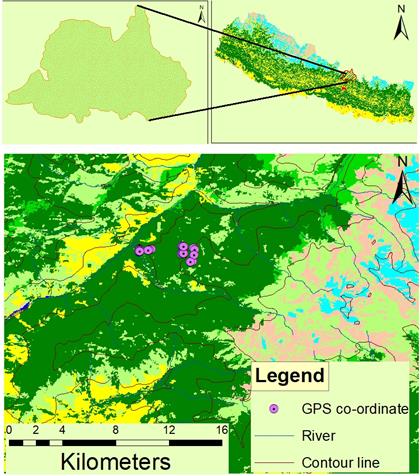
The Langtang National Park (280 12'59N, 85030'22"E) covers 1,710 Km2 which encompasses Rasuwa, Nuwakot and Sindhupalchok districts [10, 11, 12]. It is one of the prime habitats for Himalayan Musk Deer (Figure 1).
Data Collection and Analysis
The study area was divided into three blocks (A, B and C). Each block contained six horizontal strip transects on the basis of altitudinal gradients 3500 m to 4000 m. A total of 18 strip transects were laid in the field to collect the information on Musk deer presence in that areas. Each transect was 100m apart, 1.5 km long and 20m wide (10m in each side) [13].
Direct species observation was carried out by salient drive count method for population status. The indirect species observation was also carried out in the study site based on pellet identification. The pellet frequency, pellet type, GPS coordinates, altitude, canopy cover (%), shrub cover (%), herb cover (%), slope, and vegetation type were noted in the data sheet. The pellet in the transect line was categorized into random, relic, and bedding site [11]. The regression model was developed to estimate the population of Himalayan Musk Deer from the number of fresh pellet group found and the number of species counted in salient drive count method [14]. Published guidelines [13, 15] were used to explore the Pellet density of Himalayan Musk Deer. The random sampling was used to determine the altitudinal habitat relation. The altitudinal habitat preference was determined by Ivlev's electivity index (IV). The values range from -1 to +1, where negative values indicate habitat avoidance, positive values indicate a preference and 0 indicate random use [13, 15].
Results
The estimated population density of Himalayan Musk Deer in LNP was 4.33/Km2. The range of pellet group density was estimated from 1.05 to 1.16. The pellet type distribution was analyzed by one away ANOVA across altitude, canopy cover, herb cover, shrub cover, and slope resulting in the significant differences across them. The distribution of pellet type was moderately significant different across altitude indicating the higher presence of the relic site in the high elevation, F= 5.167, d.f. 2, P= 0.011). The distribution of pellet type was also highly significantly different across the canopy cover indicating the higher presence of the bedding site in higher canopy cover (50%), F= 8.734, d.f. 2, P<0.05.
Additionally, pellet type was highly significantly different across the herb cover showing the higher presence of random pellet type in higher herb cover, F= 13.57, d.f. 2, P<0.05; shrub cover resulting the higher presence of random pellet type in higher shrub cover F= 21.9, d.f. = 2, P<0.05 and across slope resulting in the slope angle ≥450, F= 9.29, d.f. 2, P < 0.05.
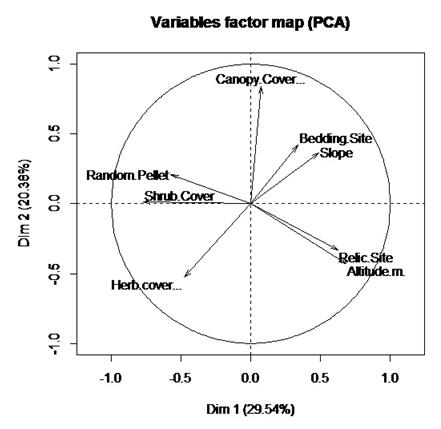
The distribution of pellet type and related factors were analyzed with a Principle Component Analysis (PCA). This indicates bedding site, slope and canopy cover were inter- related and relic sites were highly related with altitude but there is no any relation with herb cover. They were analyzed in 6-dimensions scales, and major dominant dimensions 1 and 2 accounted for 29.54% and 20.38% of the variance (Figure 2).
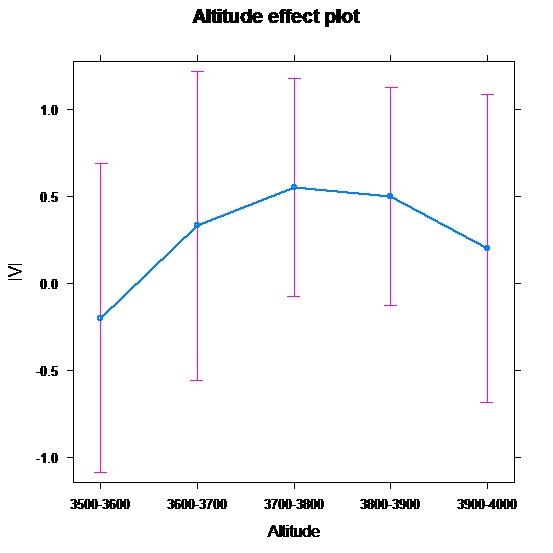
The Himalayan Musk Deer highly preferred the altitudinal range of 3700 to 3800 m (Ivlev's Electivity Index =0.7) and avoided the area below 3600 m (Ivlev's Electivity Index = -0.2). Additionally, habitat used by Himalayan Musk Deer was significantly different across the altitude resulting in the preferred altitude between 3700 to 3900m asl, and avoid the 3500 to 3600m asl (Figure 3).
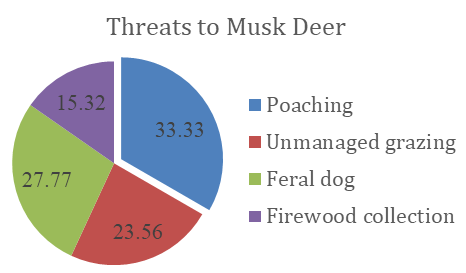
The vegetation preference by Himalayan Musk Deer was significantly different across vegetation type resulting the higher frequency in the forest (F= 19.53, d.f. 2, P= 0.004). In respect to conservation threats, the poaching (33.33%), was one of the major threats to the species followed by feral dogs (28.12%), unmanaged grazing 23.95%), and firewood collections (14.58%).
Identified Major Threats
Musk Deer were threatened in the study site by poaching, feral dog, unmanaged grazing and firewood collection. The poaching (33.33) was the major threats to the species followed by feral dog, unmanaged grazing and firewood collections (Figure 4).
Discussion
This study depicted important factors that affecting Musk deer were habitat destruction, illegal hunting, firewood collection, open livestock grazing, and attack from a feral dog. Our study indicates the distribution of Himalayan Musk Deer has been influenced by altitude. Himalayan Musk Deer prefer the higher and avoid the lower altitude (below 3600m) within the study area. The result behind this was due to the human disturbance, livestock grazing, and habitat destruction in the lower elevation [10, 13].
Sharma, et al. (2008) [14] reported the extremely high population density from Langtang National Park (26.5- 29.3 individual/Km2) and Kanchanjanga Conservation Area (18.2 individual/Km2). However, Aryal (2005) [15] reported the 4.5 to 3.5 individual/Km2 from Manang district and Chalise (2006) [16] found lower population density (1.79-1.59 individual/Km2) in Api Nampa Conservation Area in decreasing trend which is similar to my findings. In contrast, Qamar & Minhas (2008) [17] stated Himalayan Musk Deer population trend was increasing in Machiara National Park.
The present study revealed that habitat utilization by Himalayan Musk Deer was significantly different across the studied parameters (slope, canopy cover, herb cover, and shrub cover). Himalayan Musk Deer selected the gentle to steep slope for bedding and relic sites. In this way, they avoid any threats of livestock and human disturbance. It is thus very likely that Himalayan Musk Deer do not have any preference for slopes, but this would depend on resource availability, topography, anthropogenic pressure, livestock disturbance etc. This study also revealed that canopy cover, herb cover and shrub cover were significant factors for Himalayan Musk Deer habitat selection.
The specific structure of their feet helps them to climb in such rough terrain [2, 18]. This result was supported by Aryal, et al. (2005) [19] found 450 slopes in Sagarmatha National Park, Joshi (2011) [20] found 410-600 in Mustang district, Karki (2008) [10] and Panday (2011) [11] obtained a similar result where Himalayan Musk Deer adapted to live on the steep slope. However, Subedi, et al. (2012) [13] stated that Himalayan Musk Deer mostly preferred gentle slope of 210-300 in Manaslu Conservation Area.
Himalayan Musk Deer select for high canopy cover for bedding site. This result was also supported by Aryal
(2005), Aryal, et al. (2010), Subedi, et al. (2012), and Khadka & James (2016) [21]. The relic sites were found in low shrub cover and herb cover. However, the random pellet was distributed with high shrub and herb cover in Langtang National Park.
This study showed that Himalayan Musk Deer mostly used forest habitat for bedding site within the study area. This was probably due to the low disturbance of livestock, human encroachment and hiding from predators, as well as other species. The grassland and shrubland having heavy amounts of livestock grazing and human encroachment force Himalayan Musk Deer to confine to forested habitats [10, 21, 22].
This study also revealed that Himalayan Musk Deer use the grassland and shrubland for foraging food during twilight. The random pellets were distributed to the grassland and shrubland which showed that Himalayan Musk Deer also used these habitats. Pandey (2006) [11] found random pellets in the grassland and human walking trails, whereas open places and meadows of valleys were used as bedding sites. The findings of the present study are similar with Karki (2008) [10] at Dhorpatan Hunting Reserve, Aryal (2008) [23] at Mustang District of Humde and Pisang site, where Himalayan Musk Deer preferred forest habitats followed by shrublands and grasslands. Human wildlife conflict due to the different socioeconomic causes area the major threats of Musk Deer conservation in the study area. This result is similar to the findings of Green (1986) [2], Yang, et al. (2002) [24], Zhou, et al. (2004) [22], Khan, et al. (2006) [8]. Sathyakumar and Prasad (1993) [25] agreed on livestock grazing and associated impact as the major problem for Himalayan Musk Deer, which is similar to our findings. Grazing of livestock, highly dependency of natural forest cause-effect to wildlife, and raise human-wildlife conflicts [26, 27]. Singh, et al. (2018) [28] also explored that that Himalayan Musk Deer has facing threats in Nepal Himalaya. This is in contrast to our study that deforestation (firewood collection), unmanaged grazing and feral dogs were becoming the key threats to the Himalayan Musk Deer in Langtang National Park. These threats should be minimized for the long-term conservation of Himalayan Musk Deer.
Conclusion
This study revealed the poaching is the major threats for Himalayan Musk Deer in study area. Increased poaching of Himalayan Musk Deer is related to socioeconomic causes such as lack of knowledge about the ecological value on species as well as poverty, and unemployment of the locals. Habitat degradation due to overgrazing that creating more human wildlife conflict in the area. Similarly, feral dogs are the key threats to the Himalayan Musk Deer in Langtang National Park. The habitat utilization by Himalayan Musk Deer showed significant different across the studied parameters (slope, canopy cover, herb cover, and shrub cover). Therefore, our overall result shows the sustainable mitigation for livelihood of local people is urgent. Similarly, robust habitat suitability modelling is further needed to formulate the sustainable habitat management of this charismatic mammal in Langtang National Park, Nepal.
Acknowledgement
We are thankful to Tribhuvan University, Central Department of Zoology and Himalayan Biodiversity Network-Nepal for logistic support. Our thanks go to WWF Nepal for the field support grant to the first author. We would like to thank local people of LNP who helped during the field works.
References
-
Kattle B (1992) Ecology of Himalayan Himalayan Musk Deer in Sagermatha National Park, Nepal. Ph.D. thesis, Colorado State University, Fort Collins, Colorado, USA.
-
Green MJB (1986) The distribution, status and conservation of the Himalayan Himalayan Musk Deer (Moschus chrysogaster). Biol Conser 35(4): 347-375.
-
Corbet GB, Hill JE (1992) The mammals of the Indomalayan region: a systematic review. Oxford: Oxford University Press.
-
Qureshi BD, Anwar M, Hussain I, Beg MA (2013) Habitat Utilization Of Himalayan Himalayan Musk Deer (Moschus chrysogaster) In The Himalayan Musk Deer National Park Guraiz, Azad Jammu And Kashmir, Pakistan. J Ani Plant Sci 23(5): 1366-1369.
-
Kattel B, Alldredge AW (1991) Capturing and handling of the Himalayan Himalayan Musk Deer. Wildlife Society Bulletin 19(4): 397-399.
-
Syed Z, Ilyas O (2016) Habitat preference and feeding ecology of alpine Himalayan Musk Deer (Moschus chrysogaster) in Kedarnath Wildlife Sanctuary, Uttarakhand, India. Ani Product Sci 56(6): 978-987.
-
Zhixiao L, Helin S (2002) Effect of habitat fragmentation and isolation on the population of alpine Himalayan Musk Deer. Russ J Ecol 33(2): 121- 124.
-
Khan AA, Qureshi BUD, Awan MS (2006) Impact of musk trade on the decline in Himalayan Himalayan Musk DeerMoschus chrysogasterpopulation in Neelum valley. Pak Current Sci 91(5): 696-699.
-
Shrestha TK (1997) Mammals of Nepal: With reference to those of India, Bangladesh, Bhutan and Pakistan, Tribhuvan University, Kathmandu, Nepal.
-
Karki MB (2008) Distribution and Population Status of Himalayan Himalayan Musk Deer (Moschus chrysogaster, Hodgson 1839) in Dhorpatan Hunting Reserve, Nepal. M.Sc. Thesis. Central Department of Zoology, Tribhuwan University, Kirtipur, Kathmandu, Nepal.
-
Pandey M (2006) Status, Habitat Utilization, Threats and Conservation of Himalayan Musk Deer (Moschus Chrysogaster Hodgson, 1839) in Langtang National Park, Nepal. M.Sc. Thesis. Central Department of Zoology, Tribhuwan University, Kirtipur, Kathmandu, Nepal.
-
Khatiwada JR (2004) The status of Snow Leopard (UnciaUnciaSchreber 1778) and its conflict perception in Langtang NationalPark. M.Sc. Dissertation. Tribhuvan Unviersity, Kathmandu.
-
Subedi A, Aryal A, Koirala RK, Timilsina YP, Meng X, et al. (2012) Habitat ecology of Himalayan Himalayan Musk Deer (Moschus chrysogaster) in Manaslu Conservation Area, Nepal. Int J Zool Res 8(2): 81-89.
-
Sharma BK, Wagle BH, Karki K, Regmi NP, Kadariya R, et al. (2008) Distribution, Population Status and Conservation of the Himalayan Himalayan Musk Deer (Moschus chrysogaster) in Kanchanjunga Conservation Area and Langtang National Park and Buffer Zone in the Sacred Himalayan Landscape. A report submitted to World Wildlife Fund – Nepal Program, Nepal.
-
Aryal A (2005) Status and distribution of Himalayan Himalayan Musk Deer‘Moschus chrysogaster’ in Annapurna Conservation Area of Manang district, Nepal. A report submitted to International Trust for Nature Conservation (ITNC) UK.
-
Chalise MK (2006) Current Status of Himalayan Musk Deer in Api Nampa Conservation Area. Darchula (A study in the Ghusa and Khabndeswori VDCs of ANCA), Ministry of Forest and Soil Conservation, Department of National Parks and Wildlife Conservation, Api Nampa Conservation Area, Darchula.
-
Qamar QZ, Anwar M, Minhas RA (2008) Distribution and Population Status of Himalayan Himalayan Musk Deer (Moschus chrysogaster) in the Machiara National Park, AJ&K. Pak J Zool 40(3): 159-163.
-
Green MJB (1987) Scent-marking in the Himalayan Himalayan Musk Deer (Moschus chrysogaster). J Zool 1(4): 721-737.
-
Aryal A, David R, Subedi S, Kattel B (2010) Spatial habitat overlap and habitat preference of Himalayan Himalayan Musk Deer (Moschus chrysogaster) in Sagarmatha (Mt. Everest) National Park, Nepal. Current Res J Biol Sci 2(3): 217-225.
-
Joshi P (2011) Himalayan Musk Deer in Mustang, Nepal: A study on species confirmation and potential distribution. M.Sc. Thesis. Central Department of Botany, Tribhuvan University, Kathmandu, Nepal.
-
Khadka KK, James DA (2016) Habitat selection by endangered Himalayan Himalayan Musk Deer (Moschus chrysogaster) and impacts of livestock grazing in Nepal Himalaya: Implications for conservation. J Nat Conserv 31: 38-42.
-
Zhou Y, Meng X, Feng J, Yang Q, Feng Z, et al. (2004) Review of the distribution, status and conservation of Himalayan Musk Deer in China. Folia Zoologica-praha 53(2): 129-140.
-
Aryal A (2007) Conservation of Himalayan Musk Deer‘Moschus chrysogaster’ in Annapurna Conservation area of Mustang district of Nepal. Himalayan Himalayan Musk Deer Conservation Project and the Biodiversity Research and Training Forum (BRTF), Pokhara, Nepal.
-
Yang Q, Feng Z (1998) Status and conservation of Himalayan Musk Deer at the southeast of Qinghai- Xizang (Tibet) Plateau (in Chinese). Resources and Conservation of Vertebrate. Sichuan Sciences and Technology Publishing House, Chengdu, China.
-
Sathyakumar S, Prasad SN, Walker S (1993) Status of captive Himalayan Forest Himalayan Musk DeerMoschus c. chrysogaster in India. Int Zool Yearbook 32(1): 32-38.
-
Bhandari S, Chalise MK, Pokhreal CP (2017) Food habits of the tiger (Panthera tigris tigris) in Chitwan National Park, Nepal. Europ J Eco 3(1): 80-84.
-
Ilyas O (2015) Status, habitat use and conservation of Alpine Himalayan Musk Deer (Moschus chrysogaster) in Uttarakhand Himalayas, India. J Appl Anim Res 43(1): 83-91.
-
Singh PS, Shrestha BB, Thapa A, Saud P, Jiang Z (2018) Selection of latrine sites by Himalayan musk deer (Moschus chrysogaster) in Neshyang Valley, Annapurna Conservation Area, Nepal. J Appl Anim Res 46(1): 920-926.
- Lessons to Learn: Trees are More than the Lungs of the World
- Community Forestry Enterprises as a Model for Sustainable Forest Development: The Case Of The "Baja Tarahumara" in Chihuahua, Mexico
- Ecological and Socio-Economic Impacts of Chromolaena odorata and Mesosphaerum suaveolens, Two Invasive Alien Species in Central and Southern Benin, West Africa
- Epigenetic Sustainability: Modeling the Human Factor as a Natural Resource through Science 4.0 and the NR3C1 Biological Pilot
- Growth-at-Risk: A Framework for Assessing Economic Vulnerability
- The Rural Territory as a Socioecological System for the Management of Public Policy for Sustainable Rural Development