
Germination Investigations of Monodora myristica (Gaertn.) Dunal Progenies in Ekiti State
Monodora myristica is an important indigenous tree species with seeds that do not readily germinate. This study therefore examined seed germination of Monodora myristica progenies in Ekiti State at the nursery and laboratory. Matured pods of M. myristica were obtained from Otun-Ekiti (7.9903oN and longitude 5.1249oE), Ayegbaju-Ekiti (latitude 7.7930oN and longitude 5.2920oE) and Ise-Ekiti (7.4563oN and longitude 5.4332oE). Seeds were extracted from the pods after they were allowed to ferment for about a week. Weight of 30 seeds in three replicates was determined from each location. One hundred and twenty seeds from each location were sown in germination trays filled with topsoil in four replicates at the nursery. Seeds were subjected to germination in the laboratory using four treatments thus: control (T1), hot water (T2), water at room temperature (T3) and scarification (T4) under both light and dark conditions. Data were subjected to Analysis of Variance (ANOVA) which revealed significant difference (p≤0.05) for mean seed weight among the locations and pretreatments. Duncan’s Multiple Range Test was used to separate the means that were significantly different. Mean seed weight differed among locations with Otun-Ekiti having highest value of 44.06g followed by Ise-Ekiti (36.98g) and Ayegbaju-Ekiti with a value of 31.12g. Nursery experiment produced highest mean germination of 91.7% from Ayegbaju, followed by 90% from Otun while Ise had least value of 80.8%. From laboratory experiment, Ise seeds under light condition started germinating at 17 DAS, 10 DAS and 9 DAS under T1, T3 and T4 respectively whereas seeds under T2 did not germinate till end of experiment. Cumulative germination of 53.3%, 40% and 80% were obtained from T1, T3 and T4 respectively. Seeds subjected to different pretreatments but placed under dark condition did not germinate at all. Appreciable germination percentage can be obtained in M. myristica seeds sown soon after extraction with or without pretreatment although soaking in hot water should be totally avoided.
Introduction
Different parts of tropical forest tree species have been put to other uses apart from wood use some of which can be broadly grouped under food, cosmetics, medicine and spice. Spices and condiments are defined as vegetable products or mixtures, free from extraneous matter, used for flavouring, seasoning or imparting aroma in foods [1]. Spices have been used from ancient times to provide a unique taste and aroma for food and at times to serve medicinal purpose. Different parts of wood and non-wood forest species ranging from seeds, leaves, bark to roots have been used as spice. Some of these species include Parkia biglobosa, Piper guineense and Monodora myristica. Monodora myristica is an indigenous tree species that belongs to the family Annonaceae and its seeds are an aromatic spice. M. myristica is said to be indigenous to tropical West Africa but can also be found in some parts of East Africa while it is also exotic to Jamaica, other parts of the Caribbean and elsewhere [2]. M. myristica is commonly known as Calabash nutmeg or African nutmeg. Also, it is called Ariwo or Ario by the Yorubas, Gujiya dan miya by the Hausas and Ehuru by the Ibos of Nigeria [2]. The fruit is a berry of 20cm diameter and it is smooth, green, spherical and becomes woody. It is attached to a long stalk which is up to 60cm long. Inside the fruit, the numerous oblongoid, pale brown, 1.5cm long seeds are surrounded by a whitish fragrant pulp. M. myristica seed seems to be the most popular of its plant parts due to its use as a spice. However, as important as this species is, its natural population is depleting very fast in the wild as a result of overexploitation, deforestation and forest degradation consequent upon many underlying causes many of which are no more obscure. Excessive pressure on tropical forests by people and their animals has posed a very serious challenge to natural regeneration of many tropical tree species because the mother trees that should serve as seed trees are being removed for one reason or the other [3]. Moreover [4] reported that though Monodora myristica is one of the valued forest tree species, it is facing the threat of extinction caused by large scale exploitation and destruction of the natural forests.
There appeared to be some information regarding the silvical requirements of tropical tree species, many of these are inconsistent and results vary from location to location. Although some authors [5, 6, 7] earlier evaluated the germination of M. myristica, further work is still needed [7]. Worked on nursery techniques and germination patterns of M. myristica in Southeastern Nigeria with the seeds of M. myristica sown in moistened sawdust. Likewise, [6] sowed pretreated seeds of M. myristica in two different media being topsoil and river sand. They used pretreatments which were mechanical scarification and soaking in water at room temperature for 24 hours. This study therefore investigated germination of M. myristica seeds both at the nursery and in the laboratory. Also, evaluation of whether M. myristica is photoblastic was monitored which none of the earlier studies reported. Although authors have used different germination media in the nursery, this study adopted the use of topsoil because the result would be able to predict the likely success of the natural regeneration of this important species in the wild. The other media such as sawdust and river sand may not be readily available under the mother tree of this important species.
Materials and Methods
Experimental Site and Description of Fruit Collection Locations
The laboratory and field experiments were carried out at the Laboratory and the Nursery of the Department of Forest Resources and Wildlife Management, Ekiti State University, Ado-Ekiti (EKSU). EKSU is located on latitude 7.6167oN and longitude 5.2167oE in the elevation of 250m above sea level. The temperature varies from 17.78oC to 32.22oC and is rarely below 14.44oC or above 35oC.
Matured fruits of M. myristica were collected from Ayegbaju-Ekiti, Ise-Ekiti and Otun-Ekiti. Ayegbaju-Ekiti is located on latitude 7.7930oN and longitude 5.2920oE while Ise-Ekiti is located on latitude 7.4563oN and longitude 5.4332oE. Also, Otun-Ekiti is located on latitude 7.9903oN and longitude 5.1249oE; it has an area of 199km2.
Methods
Fruit Collection and Seed Extraction
Matured fruits of M. myristica obtained from the three sources aforementioned were allowed to ferment for about one week before seeds were extracted from them. The colour of the fruits was green at collection (Plate 1) but later turned brownish-black after allowing them to ferment for about one week. The seeds were rinsed with water to remove the pulp on them and air-dried (Plate 2). The weight of thirty seeds was determined from each location in three replicates.
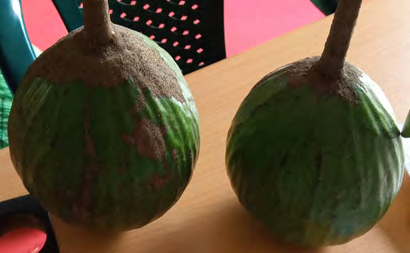
Plate 1: Matured pods of M. myristica.
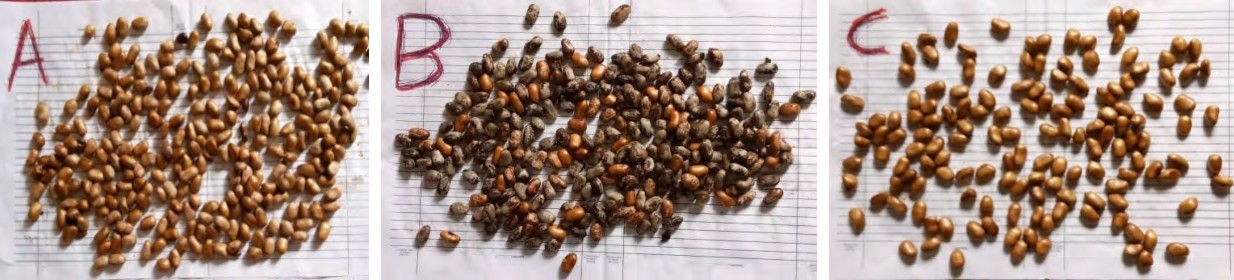
a: Ise-Ekiti seeds b: Ayegbaju-Ekiti seeds c: Otun-Ekiti seeds Plate 2: Rinsed and air-dried seeds of M. myristica.
Germination of M. myristica Seeds in the Nursery
One hundred and twenty seeds from each location were sown in germination trays filled with topsoil in four replicates without any form of pretreatment. The germination trays were watered to field capacity daily in the morning. Watering was not done on the day it rained. Germination was observed daily.
Germination of M. myristica Seeds in the Laboratory
Germination experiment on M. myristica was set up in the laboratory in order to monitor sprouting of its seeds within a short period. Seeds from two locations were used for this experiment because sufficient seeds could not be obtained from the third location.
Seeds from each location were subjected to four pretreatments which are control represented as T1, hot water as T2, water at room temperature depicted by T3 and scarification by T4. Seeds were raised under both light and dark conditions. There were three replicates under each treatment. Seeds under control were not subjected to any form of pretreatment. Hot water treatment was achieved by bringing water to boil and seeds were steeped in the hot water while the hot water was allowed to cool with the seeds overnight. Seeds subjected to water at room temperature were steeped in water for twelve hours. Scarification of the seeds was done by rubbing the hilum of the seed on sandpaper. As much as possible, same pressure was applied on the seeds as they were being rubbed on the sandpaper.
Seeds under each treatment were then placed in petri dish previously laid with filter paper, moistened with water and then covered with the petri dish lid. These were then laid on laboratory desk without any form of covering to depict light condition. The same procedures were repeated for dark condition but covered with brown paper to improvise dark condition. Cumulative germination count was done daily till no further germination was observed for seven consecutive
days. Germination was taken to have occurred when the radicle becomes visible on the seed.
Results and Discussion
Results
Characteristics of M. myristica Seeds obtained from the Locations: The number of seeds in each fruit of M. myristica varied among the three locations. Fruits obtained from Ise- Ekiti had the highest mean number of 306 seeds followed by those from Ayegbaju-Ekiti with a mean number of 293 while the pod obtained from Otun-Ekiti produced the least number of 145 seeds. Also, the number of seeds obtained from each fruit was not dependent on fruit size. Likewise, it was observed that the colour of the seeds from the three locations differed. It ranged from golden-brown to dark brown with Ise-Ekiti and Otun-Ekiti having the former colour while Ayegbaju-Ekiti had the latter colour (Plate 2).
Seed Weight of Monodora myristica Seeds from the Locations: Analysis of Variance (ANOVA) result for mean seed weight revealed significant difference (p≤0.05) among the locations. Moreover, when Duncan’s Multiple Range Test (DMRT) was used to separate the values of the mean seed weight, it revealed that mean seed weights from the three locations were significantly different from one another (Table 1). Likewise, when the values were considered, it was observed that seeds from Otun-Ekiti had the highest mean value of 44.06g followed by Ise-Ekiti with a mean value of 36.98g, while Ayegbaju-Ekiti produced the least mean value of 31.12g (Table 1).
| Location | Mean Seed Weight (g) |
| Otun | 44.06^{a}$ |
| Ise | 36.98^{b}$ |
| Ayegbaju | 31.12^{c}$ |
Table 1: Difference in Mean Seed Weight of _Monodora_ _myristica_ Across Locations.
Germination of Monodora myristica Seeds in the Nursery: The mean germination percentages from the three locations are shown in Figure 1. The highest mean germination of 91.7% was obtained from Ayegbaju closely followed by the seeds obtained from Otun with the mean germination of 90%, while the least was from the seeds obtained from Ise with a mean germination of 80.8%.
Germination rate could not be monitored for M. myristica seeds raised in the nursery because no seedling emerged on the surface of the seed tray till the experiment was terminated. The experiment was terminated at 42 DAS. While the experiment was on, it was observed that the seed trays could not be readily lifted from the ground and then it was discovered that the radicles from the seeds had protruded from the base of the seed trays making contact with the soil of the nursery floor on which the trays were placed (Plate 3). The seed trays were then well watered to loosen the soil and the sprouted seeds were carefully removed from the soil without damaging the roots as much as possible and this made it possible to count the seeds that had sprouted.
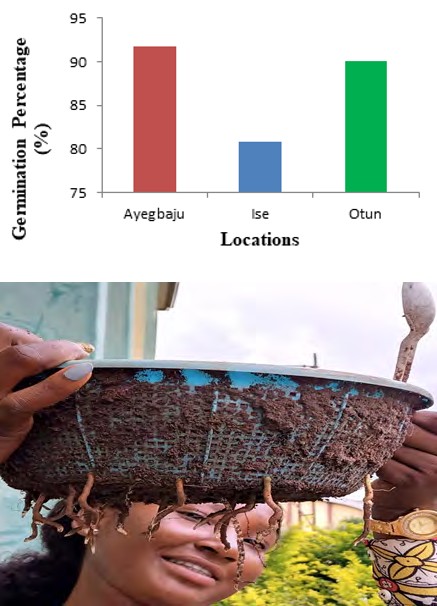
Plate 3: Protruded Radicles from the Base of the Seed Tray.
Germination of M. myristica Seeds in the Laboratory Germination of M. myristica Seeds Obtained from Ise- Ekiti under Light Condition: Germination of 53.3% was observed at 17 DAS for Ise under T1 whereas no other seed germinated after. Seeds subjected to T2 did not germinate at all thereby producing germination of 0%. Also, germination began at 10 DAS for T3 and was completed at 17 DAS with cumulative germination of 40%. Similarly for T4, germination began at 8 DAS and ended at 20 DAS giving cumulative germination of 80% (Table 2).
Analysis of Variance (ANOVA) Results for Germination Rate of M. myristica Seeds under Different Pretreatments: ANOVA results for germination rate of M. myristica seeds revealed significant differences (p≤0.05) among the different pretreatments across the assessment period. However, when Duncan’s Multiple Range Test (DMRT) was used to separate the mean germination rate values of the different pretreatments, it was observed that at 9 DAS, T1 and T2 were not significantly different from each other, but different from both T3 and T4 while T3 and T4 were also significantly different from each other (Table 3). Likewise, at 11 DAS, 13
DAS and 15 DAS, T1 and T2 were not significantly different from each other but different from both T3 and T4 while the latter two were also significantly different from each other. Furthermore, at 17 DAS and 19 DAS, T2, T3 and T4 were significantly different from one another but T1 and T3 were not significantly different from each other while T1 and T4 were not also significantly different from each other. Moreover, at 21 DAS and 23 DAS, T1 and T3 were not significantly different from each other but differed from T2 and T4 while T2 was also different from T4 (Table 3).
| Pretreatments | Germination percentage (%) | Start of germination (DAS) | End of germination (DAS) |
|---|---|---|---|
| T1 | 53.3 | 17 | 17 |
| T2 | 0 | - | - |
| T3 | 40 | 10 | 17 |
| T4 | 80 | 9 | 20 |
Table 2: Mean Germination Percentage of M. myristica Seeds from Ise-Ekiti Subjected to Different Pretreatments under Light Condit
Where DAS = Days after Sowing Table 2: Mean Germination Percentage of M. myristica Seeds from Ise-Ekiti Subjected to Different Pretreatments under Light Condition.
| DAS | T1 | T2 | T3 | T4 |
|---|---|---|---|---|
| 9 | 0.00c | 0.00c | 35.01a | 26.56b |
| 11 | 0.00c | 0.00c | 35.01b | 55.37a |
| 13 | 0.00c | 0.00c | 35.01b | 59.22a |
| 15 | 0.00c | 0.00c | 35.01b | 59.22a |
| 17 | 46.92ab | 0.00c | 38.85b | 59.22a |
| 19 | 46.92ab | 0.00c | 38.85b | 59.22a |
| 21 | 46.92b | 0.00c | 38.85b | 63.44a |
Table 3: Cumulative Germination Rate of M. myristica Under Different Pretreatments.
Note: Means with the same letter across rows are not significantly different from each other Table 3: Cumulative Germination Rate of M. myristica Under Different Pretreatments.
Germination of M. myristica Seeds Obtained from Ayegbaju-Ekiti under Light Condition: Germination of 20% was observed to have begun at 10 DAS for T1 and ended on the same day with cumulative germination of 20%. Seeds subjected to T2 did not germinate at all producing germination of 0%. Also, T3 produced 20% germination at 6 DAS and no other germination was observed till the end of the experiment. Similarly for T4, germination began at 9 DAS and ended at 14 DAS giving cumulative germination of 60% (Table 4).
Data obtained could not be subjected to ANOVA because the values were the same for the replicates used for this experiment under the various pretreatments.
Germination of M. myristica Seeds Obtained from Ise- Ekiti and Ayegbaju-Ekiti under Dark Condition: Seeds subjected to different pretreatments but placed under dark condition did not germinate till the end of the experiment in both Ise and Ayegbaju progenies. In other words, germination of 0% was obtained across the various pretreatments for the two locations.
| Locations | Germination percentage (%) | Start of Germination (DAS) | End of Germination DAS |
|---|---|---|---|
| T1 | 20 | 10 | 10 |
| T2 | 0 | - | - |
| T3 | 20 | 6 | 6 |
| T4 | 60 | 9 | 14 |
Table 4: Mean Germination Percentage of M. myristica Seeds from Ayegbaju-Ekiti Subjected to Different Pretreatments under Light C
Where DAS = Days after Sowing Table 4: Mean Germination Percentage of M. myristica Seeds from Ayegbaju-Ekiti Subjected to Different Pretreatments under Light Condition.
Discussion
Germination of M. myristica Seeds in the Nursery and Laboratory
Seed size is an important parameter which influences the germination, growth and biomass of nursery seedlings and that trend leads to the future crop [8, 9]. Generally, bigger seeds germinate quicker and would take lesser duration when compared to smaller ones [10, 11]. Seed size usually reflects the comparative nutrient pool and energy of a seed which affects its future growth and development [12]. Realized that seed germination index, cotyledon number and length, and seedling diameter were significantly and positively correlated with seed weight in Pinus yunnanensis. The effect of seed size on germination and seedling growth of tropical tree species could be relative, whereas it could favour some, it might make no difference in others [13]. Although, it has been opined that bigger seed size with more food reserve has positive influence on seed germination as aforementioned, this study did not buttress this finding because seeds with higher weight which implied bigger size as found in Otun- Ekiti did not produce the highest germination percentage in the seeds of M. myristica in the nursery. Also, it could not be ascertained whether it influenced germination rate since that could not be monitored in the nursery because of the peculiarity with which M. myristica seeds germinated in this experiment. However, seed size seemed to influence germination percentage of M. myristica seeds in the laboratory with Ise seeds with higher seed weight than Ayegbaju seeds producing the higher germination percentage in all the treatments. Nevertheless, higher seed weight did not produce any positive effect on germination rate across the various pretreatments in the laboratory.
Furthermore, the fact that no seedling emerged on the soil surface of the seed trays could be attributed to the topsoil used for this experiment. Earlier studies by Peter-Onoh, et al. [7] and Kolapo [6] used different sowing media which were sawdust; and topsoil and river sand respectively.
Germination of Monodora myristica Seeds Subjected to Different Pretreatments in the Laboratory
Different pretreatments have been used to enhance germination of tropical tree seeds particularly orthodox seeds that usually have dormancy problems however Aduradola [14] reported that seed treatment can also enhance germination of recalcitrant seeds [4]. Earlier reported that the seeds of M. myristica are recalcitrant. Scarification produced the highest germination percentage in seeds of M. myristica in this study which is in line with the findings of Amonum [15] where scarification using sand paper gave the best germination percentage in Parkia biglobosa seeds [16]. Also reported that seeds of Parkia that were mechanically scarified germinated best. Likewise, Missanjo [17] reported that scarification using secateurs on seeds of Acacia polycantha performed best in terms of germination percentage [18]. Also reported seed cutting otherwise called nicking as the most effective method to increase seed germination of Garcinia kola. Therefore, scarification has the potential of yielding very high germination percentage in many tropical seeds irrespective of the way it is applied. This might be so because it enables faster imbibitions of both air and water in such seeds especially seeds with hard seed coat. Furthermore, germination rate was favoured by scarification because germination began earlier in seeds subjected to scarification than in other pretreatments. This is in agreement with the findings of Pierre [19] that scarification increased the germination rates of Terminalia ivorensis, Vitellaria paradoxa and Myrica faya. However, it was discovered in this study that hot water pretreatment did not favour germination of M. myristica seeds because seeds subjected to this pretreatment did not germinate at all. This result is similar to the findings of Olayode [20] where seeds of Blighia sapida soaked in hot water did not germinate. Similarly, Wakawa [21] discovered that Tetrapleura tetraptera seeds that were pretreated with hot water failed to germinate. This might be as a result of the fact that the embryo has been injured by hot water.
The fact that M. myristica seeds gave very high germination percentage in the nursery without any form of pretreatment could be attributed to the fact that the seeds were sown fresh. None of the seeds exceeded a week before being sown after extraction. This agrees with the report of Ariyanninuola [22] who reported very high germination percentage in fresh seeds of Irvingia gabonensis. Likewise, it is in line with the discovery of Olayode [23] that fresh seeds of Dacryodes edulis sown gave very high germination percentage. Also, it is in agreement with the result of Olayode [20] who found that high germination percentage of Blighia sapida seeds can be achieved when the seeds are sown fresh. It seems that many tropical seeds would produce appreciable germination percentage without any form of pretreatment if the seeds are sown soon after collection.
Germination of M. myristica Seeds under Dark Condition
Tropical tree species differ in their light requirements for germination to occur. While some would readily germinate under direct light, some would require heavy shading to depict dark condition before germination can occur. However, dark condition did not favour germination of M. myristica seeds in this study. The report Onyekwelu JC [24] of on Irvingia gabonensis seeds was that the highest germination percentage was under 100% light intensity which is similar to that obtained in this study for M. myristica. Nevertheless, the result on M. myristica seeds in this study contradicts the findings of Olayode [25] where some degree of shading favoured both germination percentage and rate in seeds of Terminalia superba. Similarly, Olayode [26] reported that low light condition produced the highest germination percentage in Parkia biglobosa seeds.
Conclusion
Seed size did not significantly influence germination percentage in seeds of M. myristica in this study across the progenies. Scarification gave the best germination in M. myristica seeds in terms of both percentage and rate. Whereas soaking in water at room temperature and control produced germination of M. myristica seeds, steeping such seeds in hot water should be avoided altogether. Likewise, M. myristica seeds does not require any form of shading for germination to occur. Very high germination percentage can be achieved if M. myristica seeds are sown fresh.
References
-
United Nations Industrial Development Organization (UNIDO) and Food and Agriculture Organizztion of the United Nations (FAO) (2006) Herbs, Spices and Essential Oils: Post-harvest Operations in Developing Countries.
-
Kew Science (2020) Plants of the World Online.
-
Longman KA (1998) Tropical Trees: Propagation and Planting Manuals. Commonwealth Science Council.
-
Ngwuta AA, Peter-Onoh CA, Agu CM, Nwokeji EM, Chigbundu NI, et al. (2016) Monodora myristica Seedlings damage by Zonocerous variegatus in Southeastern Nigeria. Nigeria J Agric Food Environ 12(2): 125-127.
-
Peter-Onoh CA, Obiefuna JC, Ngwuta AA, Onoh PA, Ibeawuchi II, et al. (2014) Efficacy of Five Different Growth Media on Seedling Emergence and Juvenile Phenology of Monodora myristica (African nutmeg, Ehuru) in the Nursery. IOSR J Agric Vet Sci 7(5): 60-63.
-
Kolapo SR, Kolapo MA, Jimoh SO (2017) Effects of Sowing and Pre-sowing Treatments on Germination of Monodora myristica (Gaertn.) Dunal African J Agric Tech Environ 6(2): 20-29.
-
Peter-Onoh CA, Chigbundu IN, Nwagbaraocha N, Eke EA, Anah CO, et al. (2017) Evaluation of Pre-sowing Treatments for Two Fruit Tree Crops (Afzelia africana Sm. Ex Pers. and Monodora myristica (Gaertn.) Dunal) in the Rain Forest Agro-Ecology of South-East Nigeria. FUOYE J Agric & Human Ecol 1(1): 27-33.
-
Bargali SS, Singh SP, Pandya KS (2004) Effects of Acacia nilotica on Gram Crop in a Traditional Agroforestry System of Chhatisgarh Plains. Int J Ecol Environ Sci 30: 363-368.
-
Bargali SS, Bargali K, Singh L, Ghosh L, Lakhera ML (2009) Acacia nilotica based Traditional Agroforestry System: Effect on Paddy Crop and Management. Curr Sci 96(4): 581-587.
-
Manonmani V, Vanangamudi K, Ral RSV (1996) Effect of Seed Size on Seed Germination and Vigour in Pongamia pinnata. J Tropical Forest Sci 9(1): 1-5.
-
Negi AK, Todaria NP (1997) Effect of Seed size and Weight on Germination Pattern and Seedling Development of Some Multipurpose Tree Species of Garhwal Himalaya. Indian Forester 123(1): 32-36.
-
Cai N, Xu Y, Chen S, He B, Li G, et al. (2016) Variation in Seed and Seedling Traits and their Relations to Geo- climatic Factors among Populations in Yunnan Pine (Pinus yunnanensis). J For Res 27: 1009-1017.
-
Burslem DFRP, Miller J (2001) Seed Size, Germination and Seedling Relative Growth Rates in Three Tropical Tree Species. J Tropical For Sci 13(1): 148-161.
-
Aduradola AM, Adeola BF, Adedire MO (2005) Enhancing Germination in Seeds of African Star Apple, Chrysophyllum albidum (G. Don). J Food Agric Environ 3(2): 292-294.
-
Amonum JI, Nyam RT, Gbande S (2016) Effects of Pretreatments on Seed Germination of Parkia biglobosa (Benth). J Research in Forestry Wildlife Environ 8(4): 81-85.
-
Oyebamiji NA, Abdulrahman HD, Ogor AA (2019) Improvement of Parkia Seedling Growth Using Various Seed Dormancy Breaking Technologies in Different Soil Media. World News of Nat Sci 22: 139-150.
-
Missanjo E, Chioza A, Kulapani C (2014) Effects of Different Pretreatments to the Seed on Seedling Emergence and Growth of Acacia polyacantha. Int J Forestry Research.
-
Anegbeh PO, Iruka C, Nkirika C, (2006) Enhancing Germination of Bitter Cola (Garcina kola Heckel): Prospects for Agroforestry Farmers in the Niger Delta. Scientia Africana: 5(1).
-
Pierre MM, Bahiru D, Bernard AN, Eric S (1999) The Effect of Various Seed Pretreatments to Improve Germination in Eight Indigenous Tree Species in the Forests of Cameroon. Annals of Forest Science 56(8): 679-684.
-
Olayode OO, Osuji TN (2016) Seedling Emergence of Blighia sapida (K.D. Konig) Seeds Subjected to Different Lengths of Storage and Pretreatments. J Agric Ecol Res Int 6(1): 1-9.
-
Wakawa LD, Akinyele AO (2016) Effects of Pretreatment on the Germination Response of Old Seed of Tetrapleura tetraptera (Schum. and Thonn.) Taub. J For Sci Env 1(2): 81-86.
-
Ariyanninuola TS (2019) Lengths of Storage and Pretreatments on Germination and Early Growth of Irvingia gabonensis (Aubry-Lecomte Ex O’Rorke) Baill. An unpublished B. Forestry and Wildlife Mgt Project, Ekiti State University, Ado-Ekiti, Ekiti State, Nigeria, pp:
-
Olayode OO, Kolawole FS (2013) Seed Viability of Dacryodes edulis (G. Don) H.J. Lam subjected to Different Lengths of Storage. J Agric & Sustainable Res 13(2): 17- 21.
-
Onyekwelu JC, Stimm B, Mosandl RM, Olusola JA (2012) Effects of Light Intensities on Seed Germination and Early Growth of Chrysophyllum albidum and Irvingia gabonensis Seedlings. Nigerian J Forestry 42(2): 58-67.
-
Olayode OO (2016) Seedling Emergence and Growth of Terminalia superba Eng. El. Diels under Different Light Conditions. J Researches in Agricultural Sciences 4(1&2): 1-6.
-
Olayode OO, Olatunji AO (2014) Seedling Emergence and Growth of African Locust Bean (Parkia biglobosa R. Br. Ex (G. Don)) under Different Light Conditions. J Tropical Forest Resources 30: 102-112.
- Lessons to Learn: Trees are More than the Lungs of the World
- Community Forestry Enterprises as a Model for Sustainable Forest Development: The Case Of The "Baja Tarahumara" in Chihuahua, Mexico
- Ecological and Socio-Economic Impacts of Chromolaena odorata and Mesosphaerum suaveolens, Two Invasive Alien Species in Central and Southern Benin, West Africa
- Epigenetic Sustainability: Modeling the Human Factor as a Natural Resource through Science 4.0 and the NR3C1 Biological Pilot
- Growth-at-Risk: A Framework for Assessing Economic Vulnerability
- The Rural Territory as a Socioecological System for the Management of Public Policy for Sustainable Rural Development