
Pathways to Low Carbon Development in Nigeria - A Policy Approach
Low carbon development initiative is a strategy to combat climate change and develop green economy. It is presently a popular trend amongst countries of the world. Nigeria is a major oil producing country whose economy depends largely on oil exploration but whose energy sector remains poorly managed. The main objective of this study is to review policies and strategies for promoting low carbon development and describe efforts to exploit the energy sector of the nation for effective low carbon development. Despite existing national initiatives and the efforts of the Government and other stakeholders to achieve economic development while reducing CO2 emission from the energy sector over the years, current approach has not been efficient. Considering best practices, the paper suggests specific strategies as key steps to the establishment of low carbon development in Nigeria. It also proposes the participation of higher educational institutions and the establishment of regional institutional framework as pathways to promote low carbon initiatives and a way forward to encourage green economy towards sustainable development in Nigeria. The paper will serve as a policy approach for achieving low carbon development among Nigerian cities.
Introduction
Benefits of low carbon development to economic growth and development are enormous. Growth and development is supported by energy use for movement, manufacturing and running of domestic equipment. It is necessary to establish low carbon development in Nigeria to promote environmentally friendly activities that will contribute to socio-economic development in a manner beneficial to the environment [1, 2].
Cities are engine of growth and oil remains the cheapest and most adequate source of power to drive current scale of development as well as power the factories and manufacture of products that support the teaming human population. For thriving economy, the energy use scenario must continue to grow often inducing carbon dioxide (CO2) emissions through the combustion of fossil fuel based energy. Therefore economic growth results in continued build-up of CO2 emissions which is a major driving force for global warming attributed to climate change and threatening natural environment [3].
Nigerian Government aims to become a high income nation that is inclusive and sustainable by the year 2020. Sustaining such a pace of growth will entail rapid expansion of activity in key carbon-emitting sectors of the economy [4]. Therefore, if the economy must continue to grow under the business as usual (BAU) scenario, it is important to adopt climate resilient growth strategies and encourage communities that are liveable through the formulation of low carbon policies [5], as an approach to reduce emissions of greenhouse gases (GHGs) at National, Regional and Local government levels. Low Carbon Development initiative as a major solution to economic growth without increasing CO2 emission requires alternative source of energy such as the wind, solar, hydro among others. Technology and adaptation offer the most successful response to the challenges of modernization and human advancement [6]. Charting the pathway for low carbon development policies in Nigeria may promote adaptation of low carbon technology, promoting renewable energy use and designing mitigation policies to tackle effects of climate change and achieve sustainable human development.
Concerns over issues of climate change, global warming and the management of the environment require a movement towards green development through green growth, green economy and green environment [7, 8, 9, 10, 11]. Low carbon development represents steady movement into the clean energy future. Investing in low carbon technologies will ameliorate the growing unemployment among the youths through job creation. While the approach of nurturing green economy through increased investments in environmental assets, green technology and production at national, state and regional levels would serve as a model for the overall development. Unless a unique stance that permits growth with minimal carbon emission is taken, growing human activities would increase CO2 emission and restrict the move towards the global trend of low carbon economy. Hence, for future generations to inherit an environment that is safe for human habitation, conducive to growth and prosperity, informed and coordinated actions to ensure green development through green growth and green economy is desirable.
Low carbon development requires political will and appropriate policies as a key step essential to drive change. There is also the need to change the mind-set of the individual consumers and the ability to recognize and appreciate the link between consumption pattern and environmental impact as well as innovative strategies of CO2 emission reduction. However, significant scale of financial requirement is expected for the pursuit of Low carbon development strategy and the transition to urban low- carbon transportation pattern, characterized by low-energy consumption, high-energy efficiency, low pollution and low emission providing steady movement for development of economy and transportation to reduce tendencies associated with global warming and climate change [12]. However, ensuring green development through green growth and green economy, calls for informed and coordinated actions.
The purpose of the study is to discuss the prospects of developing low carbon society as a way forward to combating climate change. It reviews policies and strategies for promoting low carbon development and the challenges of implementing low carbon development initiatives in Nigeria. The paper also suggested strategies as key steps to chart a pathway for the establishment and development of low carbon initiatives and low carbon growth in the country. Finally, the paper will serve as spring board for discussions on how best to promote low carbon development initiatives and achieve emission reduction in Nigeria.
Significance of Energy Efficiency to Low Carbon Development
Energy is very critical to fuel economic growth for nations [13, 14]. The kind of technology that fuels the growth of most cities today is principally fossil fuel based energy for transport and electricity, whose combustion result in the emission carbon dioxide (CO2 ) - a major driving force for global warming. The use of fossil fuels by emerging economies continues to grow rapidly as economies expand. Stimulating thriving economic growth and socio-economic benefits may result in increasing energy demand and rising greenhouse gas emission. Although, a large amount of natural and associated gas is produced in Nigeria every year, generally, little of this gas is used to generate power for domestic and industrial use.
Nigeria is blessed with abundant sources of energy, including oil and gas, hydro, biomass and solar energy (Table 1), which if properly harnessed could drastically reduce threats posed to ecosystem and communities. About 60 – 70 per cent of Nigerians live without access to electricity or modern cooking fuels, Emodi and Ebele [15] and more Nigerians are moving from electricity, gas and kerosene to traditional use of fire wood. Also, poor access to electric power, underutilization of available capacity and widespread corrupt practices in the power sector led companies to resort to the use of diesel generators to provide their own electricity, thereby crippling the country’s industrial landscape [15, 16].
There is a need for diverse electricity generation mix because some of the most cost- effective renewable technologies, such as wind, are intermittent and cannot produce electricity on demand. Production may continue to need fossil fuels as part of a diverse energy mix because electricity generation cannot rely on renewable energy alone. Increasing concentration of emission producing activities in the cities is responsible for greenhouse gases, consequently, switching to zero–carbon emissions through energy efficiency within an ever increasing urbanization become paramount.
| Resource | Potential | Comments |
|---|---|---|
| Large Hydropower | 11,250 MW | 1900MW exploited |
| Small Hydropower | 3,500 MW | 64.2 MW exploited |
| Solar | 4.0kWh/m2/day 6.5 kWh/m2/ day | Significant Potential for solar infrastructure, both for on-grid and on-grid use |
| Wind | Average of 2-4m/s @10m hub height | Moderate wing potentials in the country |
| Biomass | Municipal Waste | 18.5 million tonnes produced in 2005 and now estimated at 0.5kg/capita/day |
| Fuel Wood | 43.4 million tonnes/yr of fuel wood consumption | |
| Agricultural residues | 91.4 million tones/yr produced | |
| Energy crops | 28.2 million hectares of arable land, 8.5% cultivated. |
Table 1: Renewable Energy Potentials in Nigeria. Source: ECN [17], Energy implication of Vision 20:2020 and Beyond, Report No.ECN
Table 1: Renewable Energy Potentials in Nigeria. Source: ECN [17], Energy implication of Vision 20:2020 and Beyond, Report No.ECN/EPA/2014/01 The energy system faces new challenges and threatens major consequences worldwide. Energy efficiency is vital to a modern economy and a major index for low carbon development needed to sustain and expand economic processes like agriculture, electricity, production, industries, services and transport [14]. Although, several factors contribute to global warming, lifestyles, through transportation, domestic energy uses, and consumption, are very prominent [18]. Given that cities contribute about 70 percent of energy-related carbon emissions, as energy consumption continues, the threat to global warming also increases [3], hence, addressing cities’ emissions reduction becomes a crucial element of low carbon development.
Efficient energy use is central to low carbon development as a necessary prerequisite for economic growth and sustainable development. The general option to low carbon lifestyle requires technological and socio-psychological changes, enforcement of sustainable development policies, and deployment of low carbon technologies that show how these can benefit people socially, environmentally and economically. This means encouraging greenness through new growth, new market and new consumer culture, renewable energy use as well as promoting green economy through innovative strategies in a manner that facilitates the setting and realization of emission reduction targets is desirable.
Climate change is largely caused by burning fossil fuels, this is more so in Nigeria where majority use fire wood for cooking [19]. Planning the reduction of carbon emission from energy use becomes imperative, hence the need for energy management through development strategies for low carbon emission so as to achieve a climate smart world. Developing the low carbon culture in Nigeria must create opportunities and shift the mindset of the people away from unsustainable practices towards sustainable energy use and green Technology. It is also important to measure what matters and monitor progress for effective management of low carbon development [20], because measurement and monitoring progress of agreed energy system variables is considered important to carbon emission reduction [21].
Although there is no single best approach to achieving emission free environment, it is desirable to examine the energy consumption pattern in order to identify the sources of fossil fuels combustion and develop strategies that result in greater cuts in CO2 emission. It is also vital that technologies necessary to mitigate emissions from burning fossil fuels are developed and deployed as rapidly as possible.
The implementation of low carbon policies may bring about energy sustainability and changes to the industrial structure and energy mix Zheng [2] which impact on different sectors and employment structures. There exist broad gains in welfare provided through significant non-energy benefits for economies and societies [22], therefore low carbon development becomes very significant for Nigeria. Consequently, planning efficient use of energy in a manner that limits carbon emission, adopting lifestyles that respect and work within nature’s limits will assist to realize low carbon development [23]. Also central to implementation of low carbon development initiatives, are issues of low carbon innovations and emission reduction [1].
Finally, by providing actions and pathways directed towards voluntary reduction of greenhouse gases GHG, low carbon development concept would chart a path for alternative infrastructure and spatial planning, while the promotion of the initiatives would offer enormous benefits to economic growth and development through environmentally sustainable, reliable and competitive energy markets that will support economic growth in the economic development corridors of the nation.
Existing Policies and Programmes for Low- Carbon Development
In view of the commitment of the Federal government of Nigeria to United Nations Framework Convention on Climate Change (UNFCCC) and Kyoto Protocol, a number of policy documents established institutions in various states to promote sustainable utilization of available energy resources in line with low carbon development. For example, the National Electric Power Policy of 2001 extended power to all the local government areas. Also in recognition of the need to diversify the nation’s electricity supply, government through the formulation of Rural Electrification Policy established Rural Electrification Boards to extend power to all the nation’s 774 local government areas. The expansion of renewable energy supply and the need to use natural gas for power generation as well as proposed joint electricity and natural gas capacity expansion Eleri [19] were among government’s effort for Low-Carbon Development in Nigeria.
Implementation of policies on energy sustainability may bring about changes to the industrial structure and energy mix as well as impact on different sectors and employment structures of a nation [2]. Based on recommendations of the National Electric Power Policy, the Electric Power Sector Reform Act of 2005 was formulated, emphasizing the role of renewable electricity in the overall energy mix especially for expanding access to rural and remote areas. However, the Agency was scrapped in 2009 having achieved very little.
Furthermore, the establishment of Rural Electrification Agency (REA) set up the Nigeria Electricity Regulatory Commission (NERC), while the National Energy Policy was developed by Energy Commission of Nigeria (ECN) in 2003. NEP provided for optimum utilization of the nation’s conventional and renewable energy resources, however, no agency of government has taken active steps to implement the policy since it was launched. Other policies directed towards the promotion of low carbon development in Nigeria include the National Oil and Gas Policy, produced by the Bureau for Public Enterprises in 2004. The policy provides for establishment of a National Gas Grid and promoted the use of gas for industrial processes and power generation; and also made provision for fiscal incentives as well as investments in the use of non-fossil based energy sources such as solar, hydro and biomass, among others. Although the policy provided for requisite research and development, the extent to which the document informed the actions of subsequent governments is not certain.
Notwithstanding, the Energy Commission with the support of UNDP developed the Renewable Energy Master Plan (REMP) in 2005 as a road map to address the key development challenges experienced in exploitation of renewable energy in Nigeria. Unfortunately, the Renewable Energy Master Plan was never endorsed by the Federal Executive Council or passed into law by the National Assembly, nor formed the basis for government actions.
In addition, Federal Government in 2007 enacted the National Biofuels Policy that seeks to establish a thriving bio-fuel industry and improve the quality of automotive fossil-based fuels in Nigeria. It is sad to note that no tangible results have been yielded by this policy despite significant investments and funding of the pilot projects [19]. Similarly, the Petroleum Industry Bill (PIB) which seeks to protect health, as well as enforce safety and environmental quality management systems in oil and gas explorations in order to ensure compliance with international standards, was presented to the National Assembly in 2012. But the stand-off between the government and labour unions over deregulation of fuel pricing affected the bill.
Although the Federal Government developed a number of policy documents and strategies aimed at growing Nigeria’s energy sector along a low carbon pathway, in line with the country’s blueprint for economic growth, and consistent with low carbon development, there is no clear-cut national policy or strategies for low carbon energy development in Nigeria yet [16]. It is evident that government policies directed towards low carbon development were for most times affected by political instability, lack of continuity in administration and poor implementation. In view of this, there is need for a more robust approach of policy formulation and implementation of low carbon development policies and programmes.
Prospects for Development of Low Carbon in Nigerians Cities
Nigeria is currently experiencing an array of social, economic and political problems which affect human activities from many dimensions. Despite being the largest exporter of crude oil in Africa, the nation is experiencing continuous growth in poverty due to unstable economy, weak government institutions and corruption, poor infrastructure and inadequate levels of investment in human capital. About 70% of the population of Nigeria lives in poverty, while 60% have no access to electricity and 72 % depend on firewood for cooking [19].
Energy and power occupy important position in the sustenance of economic activities [13]. More energy is needed to meet rising demand, due to population outburst, inevitable industrialization, more agricultural production and improved living standards. There are many challenges due to economic, social, technical and political barriers. Overcoming these challenges through low carbon development will make a meaningful impact on the energy mix of the nation. Renewable or low carbon energy development techniques may be the best alternative to improve the electric power sector in Nigeria.
Energy production and consumption, economic development and environmental pollution are all directly related. As a result of predominant fossil fuel energy use, continuous emission of greenhouse gases (GHGs) and warming of the global environment due to human activities has been on the increase. The impact on human and natural system presents imminent risks and damages in the future unless the warming is reduced. Therefore, the need to limit the increasing global warming and prevent dangerous climatic change is critical [24]. Many nations are charting the path to low carbon development as the appropriate solution to combat the imminent damages of future warming and the impact on human and natural system [7, 25, 26, 27, 28].
United Kingdom for instance, is on a path to a 60% reduction in its carbon dioxide emissions by 2050. The new energy policy to address the threat of climate change and update the energy infrastructure ‘Our energy future’ decisively shift UK towards ‘becoming a low carbon economy where higher resource productivity with less pollution is expected to contribute to higher living standards and a better quality of life [29]. Similarly, Malaysia launched the Green Technology Policy in July 2009, to achieve the objective of reducing total carbon emissions by 15% and reducing total emissions per GDP by 40% by 2020 compared to 2005 levels [30, 11, 8]. At the United Nations summit on climate change in September 2009, China indicated the intention to move towards an environmentally friendly and low carbon economy. Today, China is among the leading countries promoting low carbon development that has achieved some milestones in working toward emissions reduction target, by promoting energy efficiency and sharply reducing carbon emissions as well as encouraging Green growth and Green economy [2, 27].
Nigeria is a signatory to the United Nations Framework Convention on Climate Change (UNFCCC) and the Kyoto Protocol [19]. The government aims to become a high income nation that is inclusive and sustainable by 2020 and has made international commitments to promote low-carbon development. Therefore, the country can borrow a leaf from the best practices worldwide to promote and implement low carbon development strategies.
The increasing concentration of emission producing activities in the cities is responsible for greenhouse gases, this is more so in Nigeria with many scores of cities. Hence, reducing the growth of greenhouse gases and at the same time achieve economic growth is difficult, unless the technology that make the outflow of greenhouse gases greater than the inflow is developed. Several steps can be introduced to reduce greenhouse gas emissions; a major approach may be introduction of policies to substitute fossil fuel with alternative renewable fuel sources. Policy makers can change human behavior and improve technology related to climate change [3]. Government should use low carbon initiatives reinforced by sensible policies and awareness creation as an opportunity to move toward a more sustainable city. Furthermore, Cities are among the largest contributors of carbon emission and play important role in the development of low carbon economy [20]. It is desirable therefore, to change human behavior through improved environmentally friendly technology focused on direct CO2 emission reduction.
Economic development efforts in many nations are being pursued while enhancing ecological sustainability. In view of the procedures governing sustainability, cities and institutions of higher learning become the main focus to chart the path to low carbon development. The question is ‘what natural resource management and environmental quality improvement policies would catalyze low carbon development in Nigeria. The development and utilization of clean energy is dependent on having in place the technological know-how, right policies, financing and infrastructure to ensure access to the abundant energy source with low or zero fuel and maintenance cost [31].
The capacity of the local government authorities to address climate change is a potential for Low Carbon Development in Nigeria. For instance, the 774 local government areas in Nigeria have similar low carbon challenges. Local goals can be achieved alongside an enabling state and national policy framework via local-state-federal partnerships to ensure energy efficiency and renewable energy throughout the country.
Despite the enormous potentials of renewable energy sources in Nigeria, the development of low carbon initiatives are highly dependent on some key factors such as right economy, available technology, political conditions and weather conditions [31]. However, the right economic policies and attractive lending rates in Nigeria can attract interested investors’ confidence to invest in the economy.
Low carbon initiatives offer opportunity toward a more sustainable society (Worldbank 2010), Nigerian governments should put in place national policies to encourage private sector investment in green urban infrastructure at all levels, increase funding for low-carbon initiatives, encourage varied transportation options and remove barriers to implement regulations for clean energy technology.
Challenges of Low Carbon Development in Nigeria
Nigeria has a large share of Africa’s abundant energy and mineral resources, yet it is among African countries without access to modern energy services despite potentials to transform Africa, and also make a substantial contribution to the world’s energy transitions [32]. The supply of energy for development has been on the increase in Nigeria. Total primary energy supply rose from about 65, 000 Ktoe in 1990 to about 145,000 Ktoe in 2017 (Figure 1). However, majority of the supply comes from the Primary and secondary oil source, with increase in Natural gas in recent times, while hydro power source remain static since 1990 to date.
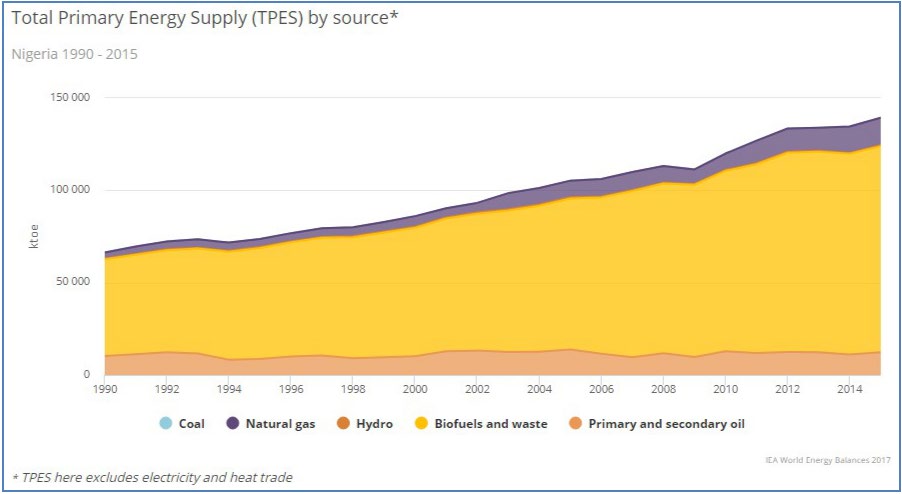
Most critical economic, social, and environmental issues impacting the future development of Nigeria as a result of climate change have an energy underpinning [16]. The challenges of enormous development are complicated by the reality of climate change. The ambition of Nigerian government is to promote economic growth and reduce carbon intensity; naturally, stopping emission would mean stopping growth which is undesirable. Under current economic pattern, oil remains the cheapest and most adequate source of power to drive development, thus economic growth will continue to induce build-up of carbon emission [3]. The challenge is how to ensure economic growth and development while reducing emissions of greenhouse gases by making better use of gas resources, expanding power generation and broadening access to electricity while reducing the carbon footprint of the sectors. Hence, the need for alternative energy source in Nigeria becomes a priority issue to meet the energy requirements [31]. This can be achieved through mitigation and adaptation strategies to reduce carbon intensity. However, the challenges of implementing low carbon development initiatives in Nigeria are numerous. Policy implementation, financing and investment, as well as ineffective institutional framework constitute serious obstacles which may hinder low carbon development initiatives in the country.
Nigeria exhibits gross inadequacy of infrastructural facilities; the patterns of settlements are dispersed and accessibility to efficient energy security is also poor. Also, knowledge of low carbon technologies is inadequate and the capacity to manufacture it is absent as the country relies solely on importation of low carbon technologies. Similarly, a shift to public transport so as to achieve large scale reduction in the country’s emissions presents a significant obstacle due to high cost of major infrastructural improvements, constituting a major challenge to low carbon development and the country in general. Furthermore, about 72% of the population rely on biomass fuel energy source [19], which is hazardous to health and the environment Aside of contributing to the build-up of emission of harmful gases, the flared gas could meet the nation’s energy needs.
The establishment of low carbon initiatives can reverse this phenomenal waste of resources from gas flaring as an opportunity to improve health and save the environment. Similarly, accompany economic growth with strategy to reduce carbon footprint in key carbon -emitting sectors like agriculture and land use, oil and gas, power, and transport sectors may be a welcome approach. Therefore, it is necessary to develop an ambitious strategy and ensure that Nigeria effectively and equitably contribute to the global objective of low-carbon development and reduce GHG emissions.
Cutting carbon emissions and promoting sustainable consumption and production is a key to combating climate change. For instance, making better use of gas resources, expanding power generation and broadening access to electricity can be achieved through mitigation and adaptation strategies to reduce carbon intensity. Also, Nigeria can borrow a leaf from best practices worldwide, by establishing Rapid Bus Transit to assist residents’ access cheap, quick and efficient public transport and reduce emission from transport sector that constitutes significantly to total emission.
However, establishment of efficient frame work and effective implementation strategies through required incentives to attract investments into the economic sector, promote efficiency measures, and encourage sustainable practices, as well as ensure the feasibility of renewable energy technologies and demonstrate responsible use of energy resources would render the challenges surmountable. Never the less, foreign partners and companies may be encouraged to establish green-based industries to create jobs, stimulate essential green economies, create acceptable co-benefits for low carbon options in terms of cost, time, accessibility, flexibility, comfort and safety in the energy and transport sectors of the nation.
Finally, participation of other stakeholders from private and public sectors should be ensured to complement government effort, while the challenges are turned into opportunities for job and wealth creation, sustainable growth and development. The Way Forward for Low Carbon Development Clean energy technology is the way forward for Low Carbon and future global development. Negotiating sustainable practices and outcomes for low Carbon societies in Nigeria would require change in attitude and other mitigation strategies as preliminary approach to solving the energy problem through technological based solution. It is necessary to develop ambitious low-carbon development strategies to ensure that Nigeria effectively and equitably contributes to the global objective to reduce GHG emissions.
Achieving sustainability is a process involving setting of goals to determine the extent of what aspects required to be sustained, taking inventories and setting targets and finally planning the program of implementation of the actions necessary to achieve the targets and then repeating the process all over [33, 34]. Therefore, policy approach for pathways to low carbon development in Nigeria will entail adopting an intellectually defendable target for meeting the transition to low carbon development and developing the approaches and time scale specifically designed to reach the target.
It is desirable to produce the blueprint to serve as roadmap for low carbon development in all the sectors of the economy and provide an integrated approach across sectors as well as a clear-cut set of quantifiable measures that will seek to deliver a cleaner, more efficient, low carbon future in Nigeria. Focus should be on direct CO2 emission reduction from the transport and electricity sectors of the economy by anglicising emission using an interface that can easily be understood by administrators for policy formulation and implementation purposes.
The goals of low carbon development require the establishment of institutional framework entrusted with the responsibility of pursuing green growth for sustainability and resilience. For greater success, low carbon development in Nigeria should encourage prominent actors at national, state and local levels to buy into the low carbon initiative through establishment of Low Carbon Regional Development Authorities (LCRDA) as economic development corridors to ease implementation of programs and actions of low carbon initiatives and serve as major agency for setting targets for low carbon footprint.
The LCRDAs will create awareness for low carbon development, organize workshops and conferences and publications and assist the municipal authorities on the preparation of local plans and implementation of low carbon projects and programs. Furthermore, collaboration with local and international research bodies is necessary to produce substantive research findings that can be translated into development policies and programs. This may assist to develop realistic policy initiatives and cost effective solutions involving diverse stakeholders through focus group discussion with the local non- governmental organization (NGOs) and business community.
Green Development strategies must be accepted as the engine of growth, where Green practices provide employment and wealth and guide the people to avoid unsustainable practices. The LCRDA should continuously implement and monitor progress of the programs and GHG emissions through continuous data collection and inventory of development, energy consumption and CO2 emission, based on the PDCA (Plan-Do-Check –Act) cycle. There is also the need to effect changes in business as usual (BAU) approach. therefore, adopting ‘science to action’ (S2A) approach will enable researchers from universities and collaborators to work closely with policy makers to come up with objective decisions using quantitative modelling system to produce the baseline study to understand the “Business as usual” (BAU) and counter measure scenarios that will assist to make better decisions and policy options.
Other policies and programs may involve a mix of low -carbon power generation by utilizing renewable energy sources to replace the fossil-fuel based energy use in transport and electricity. High energy-intensive transport sector contributes more CO2 emission and have higher global warming potentials (GWP), therefore, identifying the extent of emission and encouraging investments in energy efficient transport through renewable energy sources, or integrated smarter and cleaner services that link all journeys to all parts of the city would be beneficial and yield sustainable mobility as well as improve performance in the transport sector [6].
Unstable government and security challenges deprive any nation good investment opportunities. Nigeria is rated as one of the most unsafe Nations of Africa in view of the threats of different armed groups in some parts of the country [31]. Opinions of this nature pose a great challenge to the economic and infrastructural development, however, vigorously pursuing low carbon development programmes in Nigeria may kick-start new domestic industries and be a means of local job creation for the youth as well as support growing international market for green technologies.
Key Steps to Establish Low Carbon Development in Nigeria
The strategies for the way forward are presented as key steps or building blocks and links of related processes for establishment of LCD initiatives in Nigeria (Figure 2).
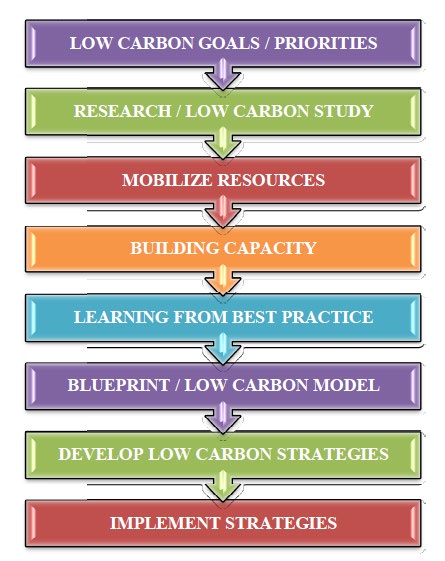
The key steps are represented by elements in the columns reflecting the flow of policies, decisions and procedures as important steps of actions of how and when specific actions would fit into national process and institutional arrangements for low carbon initiatives. The blocks or steps constitute common information platforms needed to establish procedures and structures to collect information, direct measurements of the GHG reductions, assess and report the estimated impacts of policies on emissions reductions.
Low Carbon Goals / Priorities
The Goals and Objectives stage where national low carbon mitigation goals and priorities areas are defined and verified to determine scope and targets Research / Low Carbon Study Research and Data collection stage to support low carbon study and identify organizations and individuals to champion the cause of low carbon development and engage stakeholders early in the planning process.
Mobilize Resources
Analysis and synthesis of the research will guide the mobilization of financial human and material resources to select the teams and machinery for planning and design, from broad based local experts through consultation Building Capacity The stage responsible for building crucial technical and strategic capacity necessary for effective policy formulation and implementation through the engagement of local, national and international experts. Furthermore, for an effective technological transfer, exchange programs with more advanced countries should be organized to avoid inadequate staff training and man power development.
Learning from Best Practice
This stage considers global best practices and recognizes four key steps to conduct a low carbon development study namely; learning by doing, maximize collaboration, communicate across sectors and boundaries and invest in capacity building.
Blueprint / Low Carbon Model
This is the planning and programming stage. Models for low carbon growth are designed and developed based on the best practices by establishing a baseline, identifying and quantifying low carbon options, assessing the costs and build low carbon emissions scenarios.
Develop Low Carbon Strategies
This stage identifies greenhouse gas mitigation options and develops strategies for effectuation of the plans based on the design and model. Priorities are drawn from the modelling data and cost-benefit and sensitivity analyses.
Implement Strategies
This is the implementation stage for actualizing the low carbon goal as designed. However the biggest challenges of implementation are establishing cohesive policies across sectors, financing the upfront costs and creating partnerships for implementation.
Finally, some actions may be amenable while others are complex; nevertheless, it is important to develop efficient monitoring, reporting and verification method to measure progress according to actions. Adopting the “GRAPE model” of planning [34], i.e. Goal, Research Analysis, Planning and Effectuation will provide effective monitoring and efficient implementation support for the policies through continuous decision making process [35].
Conclusion
Nigerian government and other stakeholders have been contributing to the development of low carbon initiatives in the country, however, progress is thwarted by weak policies, vested interests and poor financing, hence, efforts have not been so articulated and well-coordinated towards achieving tangible results. Consequently, infrastructural development is grossly inadequate partly due to political instability, lack of continuity in administration and inefficient implementation of existing policies.
Creating inclusiveness and pursue durable infrastructure programs considering the values, norms and culture of citizens in the design of plans to improve society and environment should be the focus. The general option to low carbon lifestyle requires technological and socio-psychological changes, enforcement of sustainable development policies, and deployment of low carbon technologies that show how these can benefit people socially, environmentally and economically.
Negotiating more sustainable practices and outcomes will require commitment from the government to promote initiatives and measures that encourage energy efficiency, alternative fuels as well as advanced and cleaner technologies among others. Nigerian government will need to establish Regional Development Authority for the preparation of low carbon blue print and demonstrating the willingness to reduce carbon emission while encouraging green growth and green economy in the region.
Willingness to intensify efforts towards carbon reduction programs will achieve sustainability in the societies; therefore, it is important to put in place measures capable of facilitating changes, and ensuring effective implementation of sustainability policies to create a more sustainable city. Furthermore, construction of urban low- carbon transportation through improvement of urban transportation structure to reduce and control of carbon emission of urban transportation is an approach of great significance towards low carbonization and sustainable development.
Recommendations
In addition to the key steps, the recommendations listed below would also assist to chat the way forward low carbon development in Nigeria and encourage a change in the mind- set of citizens. Other recommendations are: 1) Creating opportunities for a shift in the mindset of people and towards sustainable practices through enlightenment programs and creation of awareness and other government propagated initiatives, sustainable energy use and green technology with commitment from government to promote initiatives and measures that encourage energy efficiency, alternative fuels and cleaner technologies. 2) Citizens must adopt and practice low carbon lifestyle through mitigation and adaptation strategies. 3) Establishment of regional development institution and framework responsible for the promotion of low carbon initiatives in the society. 4) Formulation of policies at regional and local levels and preparation of blueprints for low carbon society should emphasis on co-benefits to be realized from the implementation of low carbon development projects in terms of better quality of life, better equity and economic growth. 5) Effective management requires measuring what matters, the authorities should implement and monitor progress of GHG emissions reduction programs through continuous data collection and emission inventory in a manner easier to understand by all stakeholders and facilitate policy formulation. 6) Identifying the extent of emission and encouraging investments in energy efficient transport system to improve performance in the transport sector. 7) Effective management of cities’ carbon emission from the sources of energy use, and mobilization of stakeholders through strengthened partnerships, and provision of additional financing to support low-carbon power generation in the electricity sector. 8) Strengthening institutional framework for measuring and monitoring emission reduction initiatives and ensuring that all large private and public enterprises report on their environmental, social impacts and contribution to wellbeing, and rewarding compliance and progress.
9) Monitoring of CO2 should be a continuous process, and the Emission results should serve as baseline for setting reduction targets, while significant findings should be turned into actions. 10) Encourage policy decisions to promote sustainability within the university campus and achieve emission reduction with little change in lifestyle through political ability to persuade people to accept change. 11) It is also important to adopt socio-economic approach, whereby youths involvement in Green Job Creation and Innovation is encouraged while establishing development of green economy in every sector. 12) Low carbon development should be neatly fitted into municipal planning through construction of urban low- carbon transportation system to produce a clean energy future that is ecologically sound and economically feasible. 13) There is also a need for diverse electricity generation mix through the most cost- effective renewable technologies 14) Strategies for low carbon development should focus on initiatives to change the mind-set of the people, promote a green culture and minimize carbon emission in all sectors to create a sustainable environment.
References
-
Urban F, Nordensvard J (2013) Low-Carbon Development key issues in environmental sustainability. Routledge taylor & Francis Group London and New York.
-
Zheng Y, Wagner JE, Zhou L, Yali W (2010) Low Carbon Development and Green Jobs in China. Institute for Urban and Environmental Studies, Chinese Academy of Social Sciences (CASS). ILO office for China and Mongolia April 2010.
-
The World Bank (2010) Cities and climate change: An Urgent Agenda. Urban Development Series Knowledge Papers. The International Bank for Reconstruction and Development/The World Bank,1818 H Street NW. Washington DC 20433.
-
Cervigni R, Dvorak I, Rogers JA (2013) Assessing Low- Carbon Development in Nigeria: An Analysis of Four Sectors.
-
OECD, IEA (2010) Low Emission Development Strategies. OECD Publishing.
-
Varadkar L (2003) Minister for Transport, Tourism and Sport (Ireland). CLIMATE CHANGE MITIGATION Preparation of Low-Carbon Roadmap for Transport, Issues Paper for Consultation.
-
Ho CS, Matsuoka Y (2013) The Low Carbon Society Blueprint for Iskandar-Malaysia 2025 – Summary for Policymakers. UTM-Low Carbon Asia Research Center.
-
Ho CS, Chau LW, Teh BT, Matsuoka Y, Gomi K, et al. (2015) Low Carbon Society Action Plan for Johor Bahru 2025: Vibrant World Class Cosmopolis of the South. Johor Bahru: UTM-Low Carbon Asia Research Centre.
-
UNDESA (2012) A guidebook to the Green Economy, Division for Sustainable Development, UNDESA August 2012.
-
UNEP (2011) United Nations Environment Programme, Towards a Green Economy: Pathways to Sustainable Development and Poverty Eradication
-
Santiago J (2010) Promoting the green economy Environmental Development in Malaysia.
-
Cheng DX, Wan LJ, Chen J, Yan DW, Wu XL (2014) Summary of Urban Low-carbon Transportation. WIT Transactions on the Built Environment, Issue Number: 157. Wessex Institute of Technology. WIT Press, Ashurst Lodge, Ashurst, Southampton SO40 7AA United
-
Jebaraj S, Iniyan S (2006) A review of energy models. Renewable and Sustainable Energy Reviews 10(4): 281- 311.
-
Bloomfield, Yadoo (2013) Low carbon energy and energy access in developing countries in Low Carbon Development: key issues (ed.) Frauke Urban & Johan Nordensverd. Routledge Taylor & Francis Group London & New York.
-
Emodi NV, Ebele NE (2016) Policies Enhancing Renewable Energy Development and Implications for Nigeria. Sustainable Energy 4(1): 7-16.
-
Eleri EO, Ugwu O, Onuvae P (2011) Low carbon Africa: Nigeria. POVERTY. International Center for energy, environment & Development.
-
ECN (2014) Energy Implications of Vision 20: 2020 and Beyond, Report No. ECN/EPA/2014/01.
-
Caves J, Leano M, Lee J, Tupper A (2007) Leaving Tracks: Measuring the Carbon Footprint of Rice University Students: Carbon Footprint Group, Spring.
-
Eleri EO, Onuvae, P, Ugwu O (2013) Low-carbon energy development in Nigeria: Challenges and opportunities. (International Centre for Energy, Environment and Development) The SUNGAS project. International Institute for Environment and Development (IIED), 80– 86 Gray’s Inn Road, London WC1X 12. 8NH, UK.
-
Su M, Li R, Lu W, Chen C, Chen B, et al. (2013) Evaluation of a Low- Carbon City: Method and Application. Entropy 15: 1171-1185.
-
Abdul-Azeez IA (2016) Measuring and Monitoring Carbon Emission to Promote Low-Carbon Development in Johor Bahru, MIT-UTM, Malaysia Sustainable Cities Program, Working Paper Series, Massachusetts Institute of Technology 2016.
-
IEA Energy Issues 2013
-
Abdul -Azeez IA, Ho CS (2015) Realizing Low Carbon Emission in the University Campus towards Energy Sustainability. Open Journal of Energy Efficiency 4(2): 15-27.
-
Hare WL (2009) State of The World into a Warming World, The World watch Institute 2009.
-
Bowen A, Fankhauser S (2011) Low-Carbon Development for the Least Developed Countries. World Economics 12(1).
-
Johnson TM (2010) Low-Carbon Development for Mexico. THE WORLD BANK Washington D.C. 1818 H Street NW Washington DC 20433.
-
Sheng P, Ding L (2015) Low-carbon development and carbon reduction in China.
-
Raffaello C (2013) Low-Carbon Development, Opportunities for Nigeria THE WORLD BANK Washington D.C. 1818 H Street NW Washington DC 20433.
-
Blair T (2003) ENERGY WHITE PAPER our future- creating a low carbon economy.
-
Eleventh Malaysia Plan 2016-2020 (2015) ANCHORING GROWTH ON PEOPLE Economic Planning Unit, Prime Minister’s Department, Block B5 & B6,Federal Government Administrative Centre, 62502 Putrajaya. MALAYSIA. Printed by Percetakan Nasional Malaysia Berhad, Kuala Lumpur, 2015. www.printnasional.com. my
-
Chilakpu KO (2015) Renewable Energy Sources. Its Benefits, Potentials and Challenges in Nigeria. Journal of Energy Technologies and Policy 5(9): 21-24.
-
IEA (2019) Africa Energy Outlook 2019. World Energy Outlook Special Report. Executive summary, Regional and country energy profiles pp: 240.
-
Graedel TE (2002) Quantitative Sustainability in a College or University Setting. International Journal of Sustainability in Higher Education 3: 346-358.
-
Abdul-Azeez IA (2012) The Development and Application of Malaysian University Carbon Emission Tool (MUCET) towards Creating Sustainable Campus. Ph.D. Thesis, UTM, Johor, Malaysia.
-
Morita T, Robinson J, Adegbulugbe A, Alcamo J (2001) Greenhouse gas emission mitigation scenarios and implications. Climate change 2001: mitigation: Contribution of Working Group III to the Third Assessment Report of the Intergovernmental Panel on Climate Change. Cambridge university press.
- Lessons to Learn: Trees are More than the Lungs of the World
- Community Forestry Enterprises as a Model for Sustainable Forest Development: The Case Of The "Baja Tarahumara" in Chihuahua, Mexico
- Ecological and Socio-Economic Impacts of Chromolaena odorata and Mesosphaerum suaveolens, Two Invasive Alien Species in Central and Southern Benin, West Africa
- Epigenetic Sustainability: Modeling the Human Factor as a Natural Resource through Science 4.0 and the NR3C1 Biological Pilot
- Growth-at-Risk: A Framework for Assessing Economic Vulnerability
- The Rural Territory as a Socioecological System for the Management of Public Policy for Sustainable Rural Development