
The Results of Observation of Precipitated Water on Suffa Plateau in the Period 2015-2020
The results of measurements of the amount of precipitated water at the Radio Astronomy Observatory RT-70 on the Suffa Plateau (Uzbekistan, λ=65°26, φ=39°37, h=2500 m) are presented. Observations were carried out automatically every 11 minutes during the year, starting from January 2015. Seasonal variations of the amount of precipitated water in the atmosphere are considered, and statistical diagrams are constructed. The main result of the work is the statistical data characterizing the astroclimate, which make it possible to predict the possibility of radio astronomical observations in the transparency windows of the wavelength range.
Introduction
It is known that the most promising area of the spectrum of electromagnetic oscillations is the millimeter wavelength range in solving problems of astrophysics, as well as applied problems of national economic importance, such as ground- space communications, remote sensing of the Earth, the creation of a global navigation system, and many others [1]. The advantage of this range in radio astronomy is weak scattering and absorption in space plasma, a rich spectrum of rotational-vibrational lines of most interstellar atoms and molecules, and the ability to realize the highest angular resolution [2]. Realization of the advantage of mm range has become possible in the last decade due to the development of high-tech developments in the element base of microwave devices, as well as the creation of adaptive large-aperture radio telescopes and the possibility of combining them into a system of ground-based and ground-space interferometers with ultra-long bases [3].
However, the instability of many parameters of the Earth’s atmosphere, due to both global circulation and mixing of atmospheric layers, and local turbulence caused by the inhomogeneity of the earth’s surface (orographic factor), and their influence on the passage of electromagnetic waves in the microwave range, exclude the possibility of building a universal radio model of the atmosphere. The need for constant monitoring of the state of the atmosphere, in addition to using the observed parameters to solve fundamental problems of atmospheric physics, and dictated by economic feasibility, from the point of view of more efficient use of large (expensive) radio telescopes in the implementation of research programs [4].
Therefore, at present, at all major radio observatories of the world (in the places where radio telescopes are installed), systematic studies of atmospheric parameters are being carried out using modern measuring systems in order to accumulate statistical material for predicting the conditions for the passage of microwave radiation from space objects [5, 6, 7, 8, 9].
In this paper, we present the results of monitoring of precipitated water in the atmosphere, carried out on the Suffa plateau in the period from January 2015 to November 2020 using the MIAP-2 measuring complex.
Measuring Equipment
The measuring complex consists of two independent channels for recording atmospheric absorption in the so- called transparency windows of the Earth’s atmosphere - 84-99 GHz (λav = 3 mm) and 132-148 GHz (λav = 2 mm), located in a common housing with an amplitude-to-digital converter (ADC ), a device for scanning zenith angles from 0° (zenith) to 90° (horizon), horn antennas brought out. All radiometer equipment is installed on a single platform, with a hermetic, rigid stainless steel casing that provides reliable protection against adverse weather conditions and has a radio transparent fluoroplastic window. The beam width of the horn antennas of the radiometer at half power level in both ranges is 2.5°. The structure and principle of operation of the MIAP-2 complex are described in detail in Nosov VI, Yu NA [10, 11]. The functional diagram of the receiver block of the MIAP-2 is shown in Figure 1.
The measurement of the total vertical absorption of radio waves at the specified frequencies is carried out by the method of vertical sections based on the measurement of the own thermal radiation of the atmosphere at various angles above the horizon (60.5°, 76.3°, 81.4°, 84.2°, 88.6° ). The last corner is as close to the horizon as possible. The method is implemented by comparing the increments of the brightness temperatures of two sections of the atmosphere at different zenith angles with the temperature of the reference region. This region is usually used as atmospheric radiation in the direction of the horizon, assuming that the brightness temperature of the atmosphere in the direction of the antenna is close to the thermodynamic temperature of the surface air layer, and itself the atmosphere is isothermal in horizontal coordinates.
Atmospheric absorption calculated value at the zenith, expressed in Napiers (1 Nep = 8.686 dB) i.e. the so-called optical thickness of the atmosphere is displayed on the graph. The registration cycle lasts about a minute. The possibility of continuous monitoring of radio transparency is provided.
As noted above, atmospheric parameters measurements on the Suffa Plateau are carried out from January 2015 to November 2020. During this period, we have received more than 250,000 values of atmospheric parameters. The results of monitoring atmospheric parameters are presented in ACTA IMEKO.
Amount of Precipitated Water
The main problem of these ranges for the purposes of radio astronomy and telecommunications is the significant absorption of radiation by atmospheric gases and, first of all, by water vapor [13]. It is subject to significant seasonal and daily variations, significantly depends on the climate of the area and altitude above sea level.
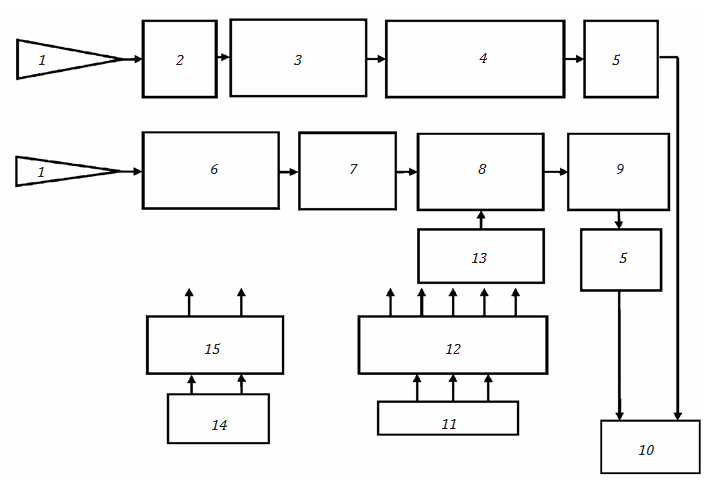
Figure 1: Functional diagram of the MIAP-2 radiometer: 1 - horn antennas, 2 - high-frequency filter (75 GHz), 3 - modulator-calibrator on a diode with a Schottky barrier (84÷99 GHz), 4 - valve, amplifier, detector (84÷ 99 GHz), 5 - DC amplifier, low-pass filter, 6 - Schottky barrier diode modulator-calibrator (132÷148 GHz), 7, 10 - WFI-170 valve, 8 - mixer (132÷148 GHz), 9 - constant frequency amplifier, analog-to-digital converter (USB-4716), 11 - power supply, 12 - power control unit, 13 - local oscillator (140 GHz), 14 - digital-to-analog converter (USB-4716), 15 - drivers modulators.
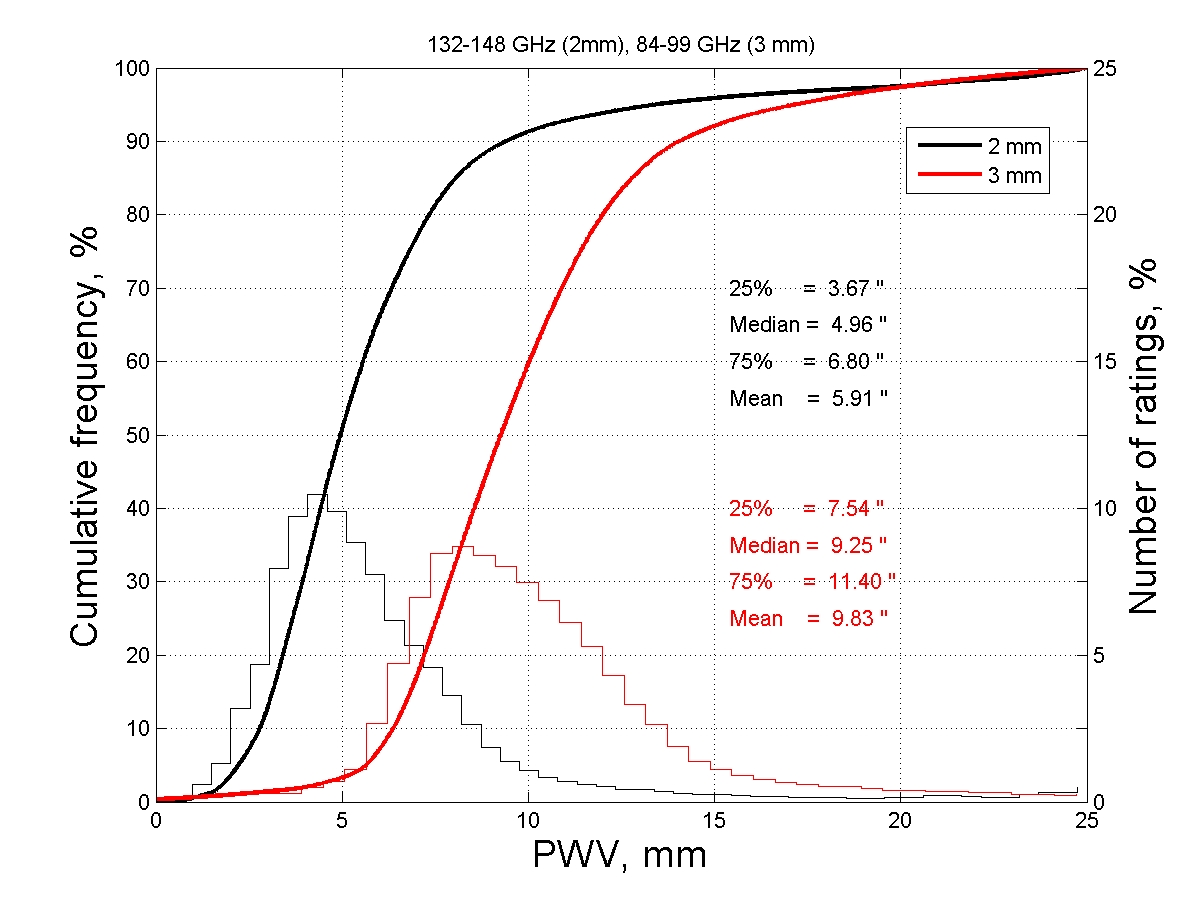
Observations in two windows of atmospheric absorption make it possible to calculate the amount of precipitated water vapor (PWV) according to the method presented in Liebe HJ [14], using the methods for calculating the specific absorption coefficients for a given radiometer given in Ulich BL [15].
The results of PWV calculations are found separately for each channel, but in clear time they coincide up to the measurement error. The result is the arithmetic mean between the values for the two channels, at each point in time.
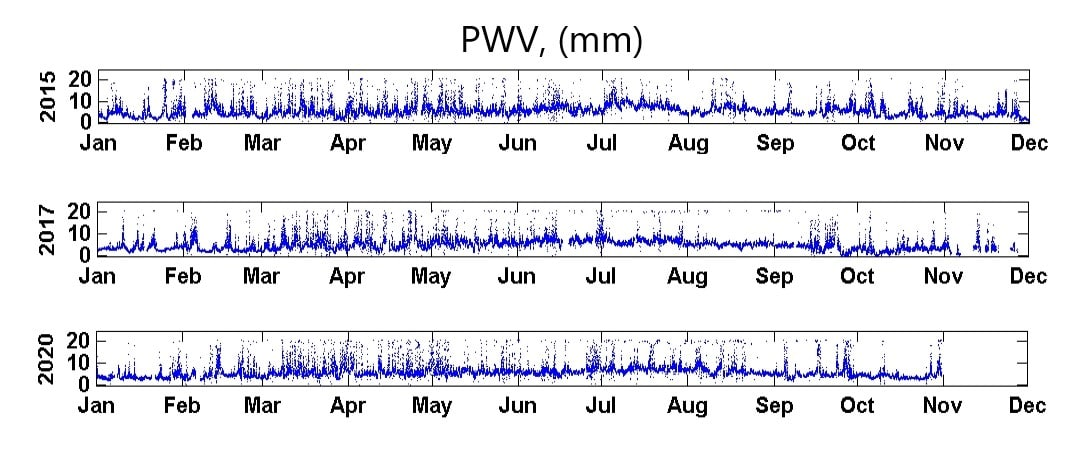
As an example, Figure 2 shows the time series of the amount of deposited water received on the Suffa plateau for 2015, 2017 and 2020. As can be seen from the figure, the average value of the amount of precipitated water remains stable.
| PWV, mm3 mm | PWV, mm2 mm | |
|---|---|---|
| January | 8,81 | 4,84 |
| February | 10,44 | 5,05 |
| March | 11,42 | 5,89 |
| April | 12,22 | 6,22 |
| May | 12,82 | 7,21 |
| June | 13,26 | 7,27 |
| July | 13,38 | 7,40 |
| August | 13,25 | 7,28 |
| September | 12,57 | 7,09 |
| October | 12,05 | 6,62 |
| November | 11,11 | 5,56 |
| December | 9,25 | 4,69 |
| Mean | 11,30 | 5,91 |
Table 1: The average monthly values of deposited water in the above period.
For a visual representation of the statistics of atmospheric absorption and its trend of change, the seasons were chosen according to the principle of weather conditions: November, December, January and February belong to the winter season; the transitional season includes March, April, September and October, the summer season - May, June, July and August. In the winter season, the average value of precipitated water for the 2 mm range is 5.04 mm, and for the 3 mm range it is 9.90 mm. In the transition season, the amount of precipitated water for the 2 mm range is 7.71 mm, and for the 3 mm range it is 13.17 mm. In the summer season - 7.29 mm for the 2 mm range, and for the 3 mm range - 13.17.
It is known, that clouds do not affect the operation of a radio telescope except for the extreme centimeter and millimeter ranges. Since in this work we are talking about measurements in the millimeter range, we analyzed the data of radio measurements obtained on absolutely clear and cloudy days.
In winter, on clear days, the value of the precipitated water is always lower by 30% than on cloudy days in the 3 mm range, and in the 2 mm range - 35%.
The amount of precipitated water during the transition period on cloudy days is 60% higher than on clear days for the 2 mm range, and for the 3 mm range - 57%.
In summer, on cloudy days, the value of deposited water is always higher by 31% than on clear days in the 2 mm range, and 46% in the 3 mm range.
The diurnal variations of the precipitated water in the summer period are more significant than in winter. On some nights in December and January, the amount of precipitated water drops to a minimum of about 2 mm, in summer it rises to 15 mm.
Conclusion
Based on the studies carried out, it can be concluded that over a six-year period of time the atmospheric parameters on the Suffa plateau remain fairly stable. The values of precipitated water presented here correspond to the values of the entire thickness of the atmosphere at the zenith. It can be reduced to parameters at any angle as well as extrapolated to any height, taking into account the standard model of the atmosphere.
References
-
Yu PK, Titov SV (1989) Radio engineering and electronics 33: 13-20.
-
Yu NA, Bubnov GN, Bolshakov OS, Vdovin VF (2014) Uzbek Journal of Physics pp: 421.
-
Danilevsky DB, Zheleznyakova AI, Raupov DA (2016) Uzbek Journal of Physics 18: 206-213.
-
Bubnov GM, Artemenko YN, Vdovin VF, Danilevsky DB, Zinchenko II, et al. (2016) Universities of Radiophysics 8-9(59): 852-861.
-
Radford SJE in Observing Dark Energy. ASP Conf Ser 339: 177.
-
Radford SJE (2002) ALMA Site and Configurations. National Radio Science Meeting pp: 364.
-
Calisse PG, Ashley MCB, Burton MG (2004) In Third International Workshop on Astrophysics at Dome C. PASA 21(3): 256-263.
-
Calisse PG, Ashley MCB, Burton MG (2003) in Astronomy in Antarctica. Highlights of Astronomy pp: 33.
-
Peterson JB, Radford SJE, Ade PAR, Chamberlin RA, O Kelly MJ, et al. (2003) Stability of the Submillimeter Brightness of the Atmosphere Above Mauna Kea, Chajnantor and the South Pole. PASP 115(805): 383-388.
-
Nosov VI, Bolshakov OS, Bubnov GM (2016) Devices and Experimental Technique 3: 49.
-
Yu NA, Bubnov GM, Bolshakov OS (2014) Uzbek Journal of Physics 16(6): 421-423.
-
Raupov D, Ilyasov S, Shanin G (2023) ACTO IMEKO (in press).
-
Zuev VE, Makushkin YS, Ponomarev YN (1987) Modern Problems of Atmospheric Optics. Atmospheric Spectroscopy Leningrad.
-
Liebe HJ, Rosenkranz PW, Hufford GA (1992) J Quant Spectrosc Radiat Transfer 48(5/6): 629.
-
Ulich BL (1980) Improved correction for millimeter- wavelength atmospheric attenuation Astroph. Lett 21: 21.
- Lessons to Learn: Trees are More than the Lungs of the World
- Community Forestry Enterprises as a Model for Sustainable Forest Development: The Case Of The "Baja Tarahumara" in Chihuahua, Mexico
- Ecological and Socio-Economic Impacts of Chromolaena odorata and Mesosphaerum suaveolens, Two Invasive Alien Species in Central and Southern Benin, West Africa
- Epigenetic Sustainability: Modeling the Human Factor as a Natural Resource through Science 4.0 and the NR3C1 Biological Pilot
- Growth-at-Risk: A Framework for Assessing Economic Vulnerability
- The Rural Territory as a Socioecological System for the Management of Public Policy for Sustainable Rural Development