
Hydrographical Studies in the Nearshore Seawater of the Red Sea Coast of Al-Hodeida City, Yemen
Hydrographic studies of nearshore seawater are important because they are sensitive to both natural and human influences. The hydrographic study is very important for nearshore waters because it is very sensitive to natural and human influences. In this research, an attempt was made to study the hydrographic properties of the nearshore water of the Red Sea coast of Hodeida city, Yemen. During the period from December 2021 to June 2022, to represent the two seasons of winter and summer. The water temperatures ranged from 30 to 34.5°C, salinity fluctuated from 39.3 to 42.4 psu, pH varied from 7.9 to 8.2 and dissolved oxygen ranged from 4.88 to 8.54 mg/l. The higher values of temperature and salinity were recorded during summer. In contrast, an increase in pH and dissolved oxygen were observed during winter. The present study confirmed that salinity has a negative correlation with pH and dissolved oxygen although it was not significant and also it showed significant positive correlation between pH and dissolved oxygen (0.828). Hydrographic parameters showed different patterns of spatial and temporal distributions. These current baseline data are useful for further environmental monitoring, assessment and management along Yemeni coastal beaches.
Introduction
Coastal ecosystems are some of the most productive and dynamic ecosystems on Earth [1]. The increasing population, urbanization, and rapid development activities have led to a significant deterioration in water quality. Increasing human activities in and around the coastal area lead to harming the quality of water, changing the physical and biochemical properties of the water, and ultimately affecting the organisms that reside in the coastal area [2]. Assessing coastal water quality is an important part of maintaining the health and environment of our coasts now and in the future. Environmental conditions such as topography, water movement, salinity, oxygen, temperature, and nutrients that characterize a given water body also determine the composition of its organisms [3]. Thus the nature and distribution of plants and animals in an aquatic system is mainly controlled by fluctuations in the hydrographic parameters of the water body [4]. Coastal hydrography is very complex due to the dynamic nature of the coastal ecosystem as the coastal zone provides an important buffer zone and filtering system for the ecosystem. In general, the coastal environment is a complex system and is mainly affected by various physical, geochemical, and biological processes [5]. The open ocean is more stable compared to nearshore waters as it interacts with land and creates differences in hydrographic characteristics [6].
Changes in hydrographic characteristics such as temperature, salinity, dissolved oxygen, and pH affect nutrients and thus the activities and growth of organisms in the ecosystem [7]. Hence, the hydrological study of coastal waters is very necessary as it gives the necessary information about the quality of the water and its ability to support marine species to live in, and shows how activities on land affect the quality of coastal waters. Therefore, the results of these investigations are a continuation of the evaluation at these sites and can be considered a reference for comparison for further evaluations and future studies.
Materials and Methods
Study area
The area under investigation is lying from the south eastern part of the Red Sea in the coast of Yemen, Hodeida City. It extends from Hodeida power plant which is located at latitude 15° 00’ 20” N and longitude 42° 56’ 02” E to Fishing port in the south at 14° 46’ 54” N latitude and 42° 56’ 50” E longitude. The distinctive areas are namely Al Hodeida port, Hodeida power plant, Fishing port and The Corniche of Al- Hodeida (Figure 1 & Table 1). The sampling stations were located by Global Positioning System (GPS).
| Station No. | Description | Location of Station | |
|---|---|---|---|
| Latitudes (North) | Longitudes (East) | ||
| St-1 | Al Hodeida port | 14° 49’ 58” | 42° 56’ 02” |
| St-2 | Hodeida power plant | 15° 00’ 20” | 42° 55’ 15” |
| St-3 | Fishing port | 14° 46’ 54” | 42° 56’ 50” |
| St-4 | The Corniche of Al-Hodeida | 14° 46’ 49” | 42° 56’ 33” |
Table 1: Geographical locations of the sampling stations.
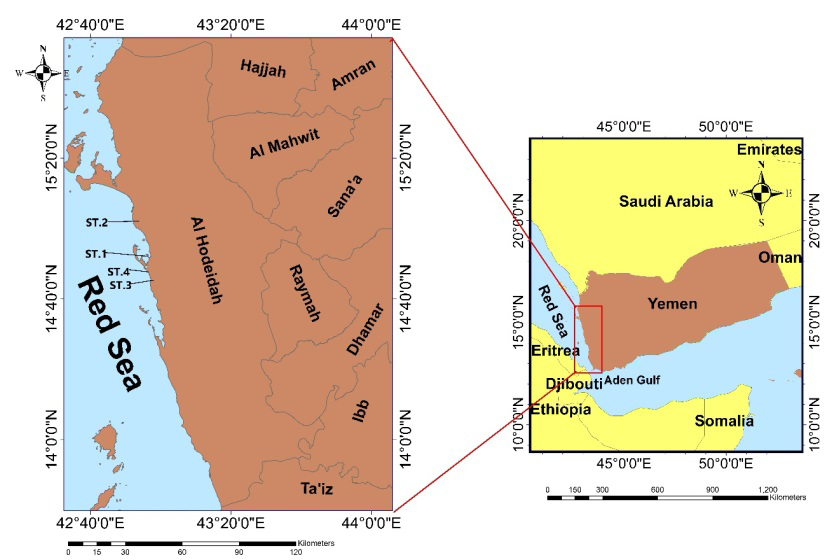
Surface seawater sample collection
The surface seawater samples were collected at the nearshore seawater of the Red Sea coast of Hodeida city, Yemen. During the period from December 2021 to June 2022, to represent the two seasons of winter and summer, to assess the hydrographical properties. The surface seawater temperature was measured directly at the sampling site using a mercury thermometer calibrated to 0.1°C. The thermometer was immersed in seawater about 5 - 10 cm below the seawater surface and allowed to stabilize for about 3 - 5 minutes. The average values for seawater temperatures were recorded in degrees centigrade (°C). The salinity of seawater was measured immediately at the sampling site using a handheld refractometer/salinometer (Atago, Japan), which is a unit based on the properties of seawater conductivity. It has scale in the range 0 - 100 psu and accuracy ±1.0, the average values have been expressed in psu.
The average value of pH in surface seawater were estimated by using a pocket pH-meter (Ezodo model 5O11A), with range 0.00 - 14.00 pH unit and Accuracy ±0.02 pH unit. The electrodes were immersed in seawater about 5cm below the seawater surface, stir gently, allowed to stabilize for about five minutes and pH value was read. The electrodes used for measuring pH are calibrated using a two- or three- point calibration with standard buffer solutions of pH values of 4, 7 and 9. Dissolved oxygen in the seawater samples were collected by glass bottles of 125 ml capacity and fixed on the field using Winkler’s reagents. All the analyses were based on standard methods as appropriate to each seawater quality parameter, as prescribed in the APHA [8].
Statistical Analysis
Hydrographical data were examined using Microsoft Excel. Analysis of correlation was carried out to indicate significant differences between various hydrographical parameters: water temperature, pH, salinity, dissolved oxygen.
Results
Hydrographical parameters in surface sea water
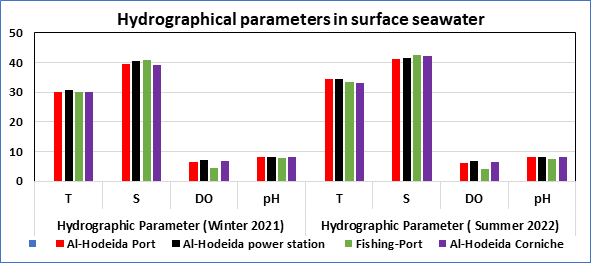
The hydrographical characteristics of surface seawater were meticulously examined during both the winter and summer seasons across four designated locales along the coastal expanse of Al-Hodeida city on the western periphery of Yemen. These locations spanned from the Fishing Port situated at 14° 46’ 54” N latitude and 42° 56’ 50” E longitude to the Hodeida Power Plant positioned at latitude 15° 00’ 20” N and longitude 42° 56’ 02” E, encompassing the Strait. The subsequent section presents the findings concerning the hydrographical parameters delineated in the course of this investigation (Table 2 & Figure 2).
| Location | Hydrographic Parameter (Winter 2021) | Hydrographic Parameter (Summer 2022) | ||||||
|---|---|---|---|---|---|---|---|---|
| T | S | DO | pH | T | S | DO | pH | |
| °C | PSU | mg/l | °C | PSU | mg/l | |||
| Fishing-Port | 30.2 | 40.8 | 4.3 | 7.90 | 33.5 | 42.4 | 4.4 | 7.6 |
| Al-Hodeida Corniche | 30.2 | 39.3 | 6.7 | 8.00 | 33.1 | 42.2 | 6.3 | 8.1 |
| Al-Hodeida Port | 30.1 | 39.4 | 6.3 | 8.04 | 34.5 | 41.3 | 6.1 | 8.1 |
| Al-Hodeida Power Station | 30.6 | 40.6 | 7.0 | 8.03 | 34.4 | 41.6 | 6.9 | 8.2 |
| Average | 30.2 | 40.2 | 6.8 | 7.99 | 33.8 | 41.8 | 5.8 | 8,0 |
| Maximum | 30.6 | 40.8 | 7.1 | 8.04 | 34.5 | 42.4 | 6.9 | 8.2 |
| Minimum | 30.0 | 39.3 | 4.3 | 7.9 | 33.1 | 41.3 | 4.0 | 7.6 |
Table 2: Seasonal average of temperature, salinity, pH and dissolved oxygen in surface seawater of the study areas.
Discussion
Surface seawater temperature (°c)
It is known that the temperature of sea water has a clear effect on the organisms that live in the area near the shore, directly through its effect on physiological behavior and indirectly through the change in the hydrographic parameters of the sea water, as the temperature affects the biochemical processes of the water such as dissolution. Sedimentation, adsorption and desorption, oxidation- reduction and biotic community physiology in nearshore biota habitats [9]. Therefore, water temperature becomes one of the most important factors in environmental studies. Water temperature during the sampling of different seasons was found to vary from 30°C in December at Al-Hodeida Corniche to 34.5°C in June at Al-Hodeida Port. These observations unveil an augmenting average surface water temperature the summer, culminating in its zenith at Al- Hodeida Port, and a subsequent decrement during the winter months, reaching its nadir at Al-Hodeida Corniche. Comparatively, the recorded surface water temperatures during this study align harmoniously with those observed in analogous tropical waters and conform to acceptable ranges conducive to aquatic life within tropical ecosystems. The rise in surface seawater temperatures during the month of June may be due to intensification of solar radiation, atmospheric warmth, and humidity. In contrast, lower surface water temperatures in December can be attributed to lower solar radiation, lower atmospheric warmth and humidity, as well as active winds and waves, and the inflow of cool Gulf of Aden waters into the Red Sea [2, 10].
Salinity
Salinity is considered one of the most important dynamic indicators of the natural exchange system. Salinity is considered one of the most important factors that widely affect the diversity, abundance and distribution of living organisms in the environment of river mouths and valleys near the coast. Salinity levels in coastal waters vary due to inputs from rivers, wadis, tidal and ocean currents, water and sewage flows, and variable rates of evaporation and freshwater runoff with rainfall [11]. Surface water salinity values in this study ranged from 39.3 practical salinity units (psu) at the Hodeidah Corniche in December to 42.4 practical salinity units (psu) at the fishing port in June. It is clear that the survey depicts an overall dominance of high salinity values throughout the study area throughout the year. Peak salinity was clearly recorded in the fishing port, likely affected by the discharge of seawater waste. It is worth noting that the salinity level is higher during the summer months compared to the winter months, which is consistent with higher temperatures. The temporal and spatial variation in salinity echoes the warm subtropical conditions prevailing in the southern Red Sea. These variations have their origins in a combination of oceanographic conditions, which include shallow sea water, semi-isolated beaches, intense evaporation, little freshwater influx, constrained circulation, and the time of sampling [10, 12].
Hydrogen ion concentration (pH)
The effect of pH on the chemical and biological properties of liquids makes its determination very important. It is one of the most important parameter in water chemistry. The pH concentration gets changed with time due to the changes in temperature, salinity and biological activity [13]. The pH values across the study area, varied from 7.6 in June at Fishing Port to 8.2 in June at Al-Hodeida Power Plant. Evidently, substantial deviations in pH values emerged at Fishing Port, attributed to the decomposition of organic matter via aerobic and anaerobic bacterial activity, thereby escalating the release of CO2 into the seawater column. This phenomenon chiefly emanates from anthropogenic activities, runoff from proximal land, and sewage discharge at the specific site. Conversely, marginally elevated pH levels in June may be attributed to photosynthetic activity during that season, facilitating CO2 uptake from sea seawater and consequently engendering an elevation in pH levels. This relationship was substantiated by a positive correlation between seawater pH and dissolved oxygen, underscoring their utility as dependable indicators of production levels. The increased atmospheric levels of CO2 due to anthropogenic factors such as the combustion of fossil fuels—including coal, oil, and natural gas—prompt an augmented uptake of carbon dioxide by the ocean, instigating a decline in seawater pH and giving rise to a suite of chemical perturbations collectively recognized as ocean acidification [2]. Although the long-term ramifications of ocean acidification remain enigmatic, its anticipated impact on diverse ecosystems and their attendant services to society are irrefutable. The pH value of seawater stands influenced by carbon dioxide concentration, dissolved oxygen levels, salinity, seawater temperature, sewage discharge, land runoff, organic matter decomposition, photosynthetic activities, and the temporal facet of sampling [2, 10].
Dissolved oxygen (DO)
Dissolved oxygen pH has a wide influence on the biochemical properties of water. It is one of the most important parameters in water chemistry. The pH concentration changes due to changes in temperature, salinity, dissolved oxygen, and biological activities. pH values in the study area ranged from 7.6 mg/l in June at the fishing port to 8.2 mg/l in June at the Hodeidah Power Station. It is clear that deviations in pH values appeared in the fishing port, attributed to the decomposition of organic matter by aerobic and anaerobic bacterial activity, which led to an escalation of carbon dioxide release into the seawater column. This phenomenon mainly stems from human activities, runoff from nearby lands, and sewage discharge at a specific site. Conversely, the marginally higher pH levels in June may be attributed to photosynthetic activity during that season, which facilitates the uptake of carbon dioxide from seawater and thus leads to higher pH levels. This relationship has been demonstrated by a positive relationship between seawater pH and dissolved oxygen, confirming their usefulness as reliable indicators of production levels. Increased levels of carbon dioxide in the atmosphere due to human factors such as the combustion of fossil fuels – including coal, oil and natural gas – increase the uptake of carbon dioxide by the ocean, lowering the pH of seawater and creating a pool of carbon dioxide. of chemical disturbances collectively recognized as ocean acidification [2]. Although the long-term consequences of ocean acidification remain ambiguous, its expected impact on diverse ecosystems and associated services to society is irrefutable. The pH value of seawater is affected by carbon dioxide concentration, dissolved oxygen levels, salinity, seawater temperature, sewage discharge, land runoff, organic matter decomposition, photosynthetic activities, and the temporal direction of sampling [1, 10].
Correlation analysis of environmental parameters
Al-Hagibi [2] reported a positive correlation between surface water temperature and salinity. This study also confirmed a positive correlation between these two parameters (0.852). High temperature and salinity cause the oxygen to be relatively low [10]. The present observation also confirmed that salinity has a negative correlation with pH and dissolved oxygen although it was not significant. Al-Hagib [2] found a positive correlation between pH and dissolved oxygen; this study also showed positive correlation between these two parameters (0.828). These correlations of environmental parameters of the study area have been illustrated in Table 3.
| Variable | Temperature | Salinity | pH | Dissolved oxygen (DO) |
|---|---|---|---|---|
| Temperature | 1 | |||
| Salinity | *0.852 | 1 | ||
| pH | -0.118 | -0.283 | 1 | |
| Dissolved oxygen (DO) | -0.049 | -0.388 | *0.828 | 1 |
Table 3: Correlation coefficient between various environmental parameters.
Correlation is significant at (< 0.05 and < 0.001). Table 3: Correlation coefficient between various environmental parameters.
Conclusions and Recommendations
Hydrographic parameters in seawater near the Red Sea coast of Hodeidah city, Yemen; It showed clear seasonal and spatial patterns. The knowledge of hydrographic characteristics provides us with information about the productivity, quality and health of the coastal ecosystem. The study revealed that all the selected stations are in good health, with the water quality reflecting its natural condition. Hydrographic parameters showed different patterns of spatial and temporal distributions. The highest values of temperature and salinity were recorded during the summer. In contrast, a significant increase in pH and dissolved oxygen values was observed during the winter. The present study confirmed that salinity has a negative relationship with pH and dissolved oxygen, although it is not significant. It also showed a significant positive relationship between pH and dissolved oxygen. This study provides a good overview of the prevailing state of surface sea water and gives essential information for monitoring, managing and evaluating the coastal waters of Hodeidah city. The difference between these areas is mainly due to local hydrographic conditions, for example semi-enclosed beaches: intense evaporation, sewage discharge, land runoff, organic matter decomposition, and photosynthetic activities prevailing in the sites. It is recommended to implement an ongoing program to assess, manage and protect Yemeni coastal areas. As well as activating the early warning systems program in these areas.
Acknowledgements
The authors wish to express their sincere gratitude and appreciation to Department of Environmental Science, Faculty of Petroleum and Natural Resources for providing necessary facilities.
References
-
Al-Hagibi HA, Hisham MN, Al-Selwi MK, Al-Shwafi AN (2018) Assessment of Heavy Metals Concentration in Mangroves Leaves of the Red Sea Coast of Yemen. J Ecol & Nat Resour 2(1): 120.
-
Al-Hagibi HA (20170 Study of Some Heavy Metals Concentrations in Mangroves Environment – Red Sea Coast of Yemen. Unpublished M.Sc. Thesis, Fac Sci, Sana’a Univ, Yemen, pp: 161.
-
Shruthi PA, Lakshmipathi MT (2022) Diatom diversity in relation to physico-chemical parameters of coastal waters of Mangalore and Padubidri, Southwest coast of India. International J Ecol & Environ Sci 4(4): 28-37.
-
Sagar MW, Pramod TH, Debashish MB K (2020) Application of Remote sensing and GIS techniques to study sediment movement along Harwada Beach, Uttar Kannada, West coast of India. J Coastal Research 36(6): 1121-1129.
-
Poonam B, Rahul K (2012) Status of seawater quality at few industrially important coasts of Gujarat (India) off Arabian Sea. Indian J Geo-Marine Sci 41(1): 90-97.
-
Sridhar R, Thangaradjou T, Kannan L (2008) Comparative investigation on physic-chemical properties of the coral reef and seagrass ecosystems of the Palk Bay. Indian J Mar Sci 37(2): 207-213.
-
Asha P, Diwakar S (2007) Hydrobiology of the inshore waters off Tuticorin in the Gulf. J Mar Biol Ass India 49: 7-11.
-
APHA (2017) Standard methods for examination of water and wastewater. 23rd Edition, American Public Health Association, Washington, D.C. (USA); pp: 1200.
-
Abowei J (2010) Salinity, dissolved oxygen, pH and surface water temperature con-ditions in Nkoro River, Niger Delta, Nigeria. Adv J Food Sci Technol 2(1): 36-40.
-
Al-Hagibi HA, Hisham MN, Al-Selwi MK, Al-Shwafi AN (2014) Hydrographical Studies on Mangroves Ecosystem of The Red Sea Coast of Yemen from Al-Salif to Bab-el- Mndab Strat. University of Aden Journal of Natural and Applied 18(2): 381-391.
-
Jha DK, Devi MP, Vidyalakshmi R, Brindha B, Vinithkumar NV, et al. (2015) Water quality assessment using water quality index and geographical information system methods in the coastal waters of Andaman Sea, India. Mar Pollut Bull 100(1): 555-561.
-
Suski C, Killen S, Keiffer J, Tufts B (2006) The influence of environmental temperature and oxygen concentration on the recovery of largemouth bass from exercise. Implications for live-release angling tournaments. J Fish Biol 68: 120-136.
-
Elahi NAQ, Bat L, Yousuf F (2015) Physicochemical parameters and seasonal variation of coastal water from Balochistan coast, Pakistan. J Coast Life Med 3(3): 199- 203.
- Lessons to Learn: Trees are More than the Lungs of the World
- Community Forestry Enterprises as a Model for Sustainable Forest Development: The Case Of The "Baja Tarahumara" in Chihuahua, Mexico
- Ecological and Socio-Economic Impacts of Chromolaena odorata and Mesosphaerum suaveolens, Two Invasive Alien Species in Central and Southern Benin, West Africa
- Epigenetic Sustainability: Modeling the Human Factor as a Natural Resource through Science 4.0 and the NR3C1 Biological Pilot
- Growth-at-Risk: A Framework for Assessing Economic Vulnerability
- The Rural Territory as a Socioecological System for the Management of Public Policy for Sustainable Rural Development