
Use of Humour in Learning Anatomy in a Better Way in Lecture Theatre or Dissection Hall - A Questionnaire Based Study
Background: First year medical students normally experience a variety of emotional reactions and mixed feelings, when they encounter human cadavers for the first time. With changing curriculum, peer pressure, stressful work conditions, etc. it becomes tough or even difficult to relax our mind. Humour has been shown to boost motivation, improve problem-solving skills, and foster creativity and critical thinking. It also promotes a happy learning atmosphere and reduces examination anxiety. The purpose of this study was to assess opinions of medical students about using humour while learning Anatomy in acquiring excellence in clinical skills and knowledge. Material & Methods: 258 medical students participated in the study and responded to the paper-based questionnaire. The student questionnaire comprised of sixteen questions related to attitudes towards the use of humour in the subject of anatomy in lecture and dissection hall. The responses were collected and the data was then compiled and analysed. Results: 83.72% to 93.79% of students believed in the usefulness of humour in anatomy theory lectures in terms of increasing interest in learning Anatomy, making them less anxious in recalling the muscle attachment, concentrate better on the topic. All the students were of opinion that the use of humor created a comfortable classroom atmosphere that makes the learning experience more positive and helpful in improving rapport between student and teacher. A very low evaluation was observed that use of humour during teaching distracts attention of the students and wastage of time. Inappropriate humour related to sarcasm, mockery received 226(87.59%) evaluation. Students 203(78.68%) also emphasized the use of dark humour to cope with morbidity and stress during dissection. Ad-libbed humour was considered to be the most effective form of humour. Most students emphasized that humour worked best in a small amount i.e. 2-3 times of humorous remarks. Conclusion: Keeping in mind the effectiveness of the system of anatomy instruction it seems logical that the subject should be learned with humor. The present study confirms that most medical students support the use of humour in teaching anatomy topics.
Introduction
Tolsgaard MG, Ku C, Woods NN, et al. Quality of randomised controlled trials in medical education reported between 2012 and 2013: a systematic review protocol. BMJ Open 2014; 4: e0051To develop fundamental clinical skills are the aim of a medical student and the clinical skills are built upon anatomical knowledge. First year medical students normally experience a variety of emotional reactions and mixed feelings, when they encounter human cadavers for the first time [1]. Being a medical student is incredible but in the long run, it gets exhausting, boring and even stressful. With changing curriculum, peer pressure, stressful work conditions, etc. it becomes tough or even difficult to relax our mind. The main reason for sitting in the dullness in medical school is our lost humour. The concept of humour has been defined by a number of researchers [2]. Leung (2004) defines humour as ‘the ability to understand, enjoy, and express what is amusing’ or anything that the teacher or the students find funny or amusing’ is defined as humour [3]. Humour, according to Faulkner (2011) is “any physical action or spoken phrase that leads the students to react by laughing, giggling, smiling, or other means [4]. It is also stated that in a supportive classroom environment, it has been observed that the students may be more motivated to study and participate [5].
Numerous studies have looked at how humor might aid students in lowering anxiety, encouraging creativity, boosting motivation, and assimilating knowledge more rapidly while learning anatomy subject. Humor and test results of students were found to be positively correlated [6, 7]. There is a funny part in our body itself-The Funny Bone. But it turns out that the funny bone is not actually a bone, it is the ulnar nerve and we experience the funny feeling after a hit on the elbow and it is simply the nerve innervating in response to the hit. Research done by William Fry, professor emeritus at Stanford University School of Medicine, has found that kindergarteners laugh 300 times a day, whereas adults laugh just 17 times [8]. Interesting research by Petersen, Seligman, and Park showed that recovery from a psychological disorder or serious illness was associated with an increase in elevated levels of humor. Humor not only changes the mood, but also allows viewing adversity on a lighter side, and sustaining a positive mood. What clinicians and therapists know is that humor is an essential coping tool for surviving tough times. Shared laughter gives the strength in adversity and can help us feel a bit more in control when the future looks uncertain. Laughter makes us stronger. Recent studies have found that a good laugh can boost our dopamine levels and even shore up our immune systems [9]. While some types of offensive humour that is violent or prejudiced may be hurtful or demeaning to the students [10, 11, 12, 13]. The purpose of this study was to assess opinions of medical students about using humour while learning Anatomy in acquiring excellence in clinical skills and knowledge.
Material & Methods
258 medical students participated in the study and responded to the paper-based questionnaire. The purpose of the study was explained to each student and quantitative data were generated. A wide variety of literature related to the use of humour in medical education was reviewed and questionnaire for medical students was established. In line with principles of Liu YP, et al. [14] the questionnaire consisted of a matrix of 16 statements that covered a range of student’s perception in the form of paper based questionnaire responses towards in the subject of anatomy in lecture and dissection hall. Each item in the questionnaire was critically evaluated. Recommendations from the students and teachers were used to develop the final questionnaires. Participant responses were summarized and shown in (Tables 1 & 2) (Figures 1 & 2). Student’s name was not recorded to keep anonymity. For each question in our study, the student had to choose one of the three possible responses:‘ Yes’, ‘No’, and ‘Undecided’ (Table 1) except the sixteenth question. The sixteenth question comprised of student’s responses on number of times of humour is appropriate in one hour lecture in the subject of anatomy (2024). It consists of A, B, C options to choose the response as per their perspective (Table 2). For all the questions in our study, there was no option for the students to suggest other responses. The members in the groups were requested to tick only those statements with which they were in full agreement. Writing survey questions are listed below in the order in which they were presented to the students (Table 1 & Table 2) (Graph 1 & Graph 2). The responses were collected and the data was then compiled and analysed [14]. Student’s responses on number of times of humour and type of humour is appropriate in one hour lecture in the subject of anatomy is depicted in Graph 1 and Graph 2 in the present study (2024).
Results
A total of 258 students participated in the study. Out of 258 students, 237 (91.86%) were of opinion that humour increases their interest in learning Anatomy. The majority of students agreed that humour could be used to make them feel less anxious in recalling the muscle attachments on bones 224 (86.82%); helps them to focus and concentrate better on the topic in the classroom 216 (83.72%); 242 (93.79%) students were of view that using humour helps to recall the topic taught in the class at the time of revision. All the students (100% students) were of the opinion that humour creates a relaxed, more comfortable and conducive learning environment that helps to improve the ability of the student to learn anatomy in the classroom and makes the learning experience more positive and enjoyable and also very helpful in improving rapport between student and teacher. A very low evaluation was observed on the views on use of humour during classroom teaching distracts attention of the students 12 (4.65%) and seems to be a wastage of time during teaching 14(5.42%).
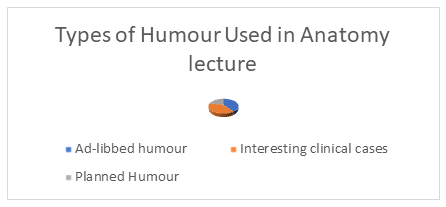
Humour related to sarcasm, mockery and irrelevant to the course material constitutes inappropriate humour during teaching and received 226 (87.59%) evaluation whereas all the participating students 258 (100%) were of opinion that unprofessional/Incompatible humour and negative interactions with teachers conveying aggressive or hostile messages would harass the students. However, students 203 (78.68%) emphasized the use of dark humour amongst the peer groups to cope with morbidity and stress during dissection in the dissection Hall. In term of the humour types, the students also evaluated the effectiveness of each humour type where Ad-libbed humour or Spontaneous humour 246 (95.34%) was considered to be the most effective form of humour used in teaching followed by interesting clinical cases during Early Clinical Exposure (ECE) 229 (88.75%) further followed by planned or non-spontaneous humour like cartoons or videos, opening jokes in the classrooms 135 (52.32%).
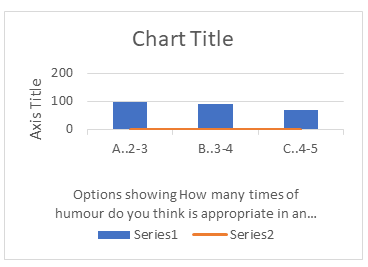
Most students emphasized that humour worked best in a small amount i.e. 2-3 times of humorous remarks (99/38.37%,) followed by 3-4 times of humorous remarks (91/ 35.27%) then 4-5 times of humorous remarks (68/ 26.35%) in an hour of anatomy lecture. Student’s responses on attitude towards the use of humour in the subject of anatomy are summarized in the (Table 1 and Table 2) and (Figure 1 and Figure 2).
| S.No | Particulars of Questions | Number of ‘Yes’ (%) | Number of ‘No’ (%) | Number of ‘Undecided’ (%) |
|---|---|---|---|---|
| 1 | Using Humour increases student’s interest in learning Anatomy | 23791.86% | 218.13% | Nil |
| 2 | Humour makes the student feel less anxious in recalling the muscle attachments on bones | 22486.82% | 3413.17% | Nil |
| 3 | Humour in the classroom helps the students to focus and concentrate better on the topic in the classroom | 21683.72% | 238.91% | 197.36% |
| 4 | Using humour helps the students to connect/recall the topic taught in the class at the time of revision // while revising that particular topic | 24293.79% | 103.87% | 62.32% |
| 5 | Humour improves the ability of the student to learn anatomy by creating a more comfortable and conducive learning environment in the classroom or lecture theatre | 258100% | Nil | Nil |
| 6 | Humour makes student’s learning experience more positive and enjoyable | 258100% | Nil | Nil |
| 7 | Use of Humour is helpful in improving | 258100% | Nil | Nil |
| 8 | The use of humour during classroom teaching distracts attention of the students | 124.65% | 24494.57% | 20.77% |
| 9 | Using humour seems to be wastage of time during teaching in the classroom | 145.42% | 24193.41% | 31.16% |
| 10 | Sarcasm, Mockery, Humour irrelevant to the course material constitutes inappropriate humour during teaching | 22687.59% | 3212.40% | Nil |
| 11 | Unprofessional humour and negative interactions with teachers conveying aggressive or hostile messages would harass the students. | 258100% | Nil | Nil |
| 12 | Students use Dark humour to cope with morbidity and stress during Dissection Hall | 20378.68% | 4617.82% | 93.48% |
| 13 | Ad-libbed humour or Spontaneous humour constitutes the most effective form of humour used in teaching | 24695.34% | 114.26% | 10.38% |
| 14 | Interesting clinical cases during ECE constitutes the most effective form of humour used in teaching | 22988.75% | 228.52% | 72.71% |
| 15 | Planned or non-spontaneous humour like cartoons or videos, opening jokes constitutes the most effective form of humour used in teaching | 13552.32% | 9536.82% | 2810.85% |
| S. No. | Particulars of Questions | Options to Choose the Response | ||
| A)- | B)- | C)- | ||
| 16 | How many times of humour do you think is appropriate in an hour of anatomy lecture | 99 | 91 | 68 |
| A) 2-3, B) 3-4, C) 4-5 | 38.37%, | 35.27%, | 26.35% |
Table 1: Student’s responses on attitude towards the use of humour in the subject of anatomy in the present study (2024).
Discussion
It is well known that theoretical lectures tend to be monotonous [15]. In a teaching hospital, Medical teachers have no professional training on how to teach and they typically fulfil the dual roles of clinician and educator pass on knowledge effectively to the students [16, 17]. It has been established that the use of humour in medical education improves learning enthusiasm, consciousness, efficiency and quality [6, 18]. Therefore effective teaching in medicine is essential to produce good quality doctors [19]. The opinions of medical students on employing humor in the theoretical lecture and what factors affect its usage have not yet been the subject of many studies. The purpose of this study was to determine attitudes toward using humor in the anatomy lectures. Humor is a natural icebreaker that helps connect the students regardless of their differences. All of this reduces classroom conflict and increases student attention and participation and make them self-directed learners. In the present study, 83.72% to 93.79% of students in the present study believed in the usefulness of humour in anatomy theory lectures in terms of increasing interest in learning Anatomy, making them less anxious in recalling the muscle attachments on bones or concentrate better on the topic, helps to connect to recall the topic taught in the class while revising that particular topic (Table 1). Whereas, in a study by Torok, et al. only 2% of students did not believe in the usefulness of humour in classrooms [20]. However, additional research by Kaplan and Pascoe, 1977 advocated the positive effects of laughter to remember content in the class [21]. The students 258 (100%) in the present study were of opinion that the use of humor created a conducive, comfortable and relaxed classroom atmosphere that makes the learning experience more positive and enjoyable and also very helpful in improving rapport between student and teacher. which is also supported by Liu, et al. 2017 in their study [14]. The views on use of humour during classroom teaching distracts attention of the students and seems to be a wastage of time during teaching have received very low evaluation like 12(4.65%) and 14(5.42%) respectively. No available literature was accessible in support of these views except Liu, et al. 2017 who stated that Humour which was irrelevant to the subject might be a waste of time and distract student’s attention [14].
In the present study, participants 226 (87.59%) considered mockery (ridicule), sarcasm, and humour irrelevant to the course material as inappropriate forms of humour that should not be used and is suppored by the views of Liu, et al. 2017. It is also stated that the use of offensive humour should not be allowed in the classroom because it harms student learning [22]. In the present study all the students 258 (100%) agreed that Unprofessional humour and negative interactions with teachers conveying aggressive or hostile messages would harass the students. which is in accordance with a study done by Wanzer and Torok, 2004 conveying aggressive, hostile or sexual messages would be considered inappropriate by students [16, 20]. Jayasuriya- Illesinghe, et al. also stated that negative interactions with teachers would harass students [23]. This is similar to the findings of Passi, who found that students felt embarrassed and wished to never have a class with teachers who said sexually offensive or sarcastic jokes [24]. In the present study, 203 (78.68%) emphasized the use of dark humour amongst the peer groups to cope with morbidity and stress during dissection in the dissection Hall.
During the act of dissection in anatomy dissection hall, it is perfectly acceptable to lighten the mood. Dark humour can be used as a tool to overcome those difficult situations that involves gruesome or “unnatural” interactions with deceased humans during dissection. At that time, humor seems to help those students who are under immense stress while doing dissection to build a bit of that emotional disconnect that is necessary to perform the dissection as a form of coping mechanism or in a way to release tension. For example, most black humor comes in the form of comparison of the tissue to other things; normally food, or students would compare a muscle to “pulled pork” or fat to cheese.” Lymph looking like black beans and laughing about how we will not be able to eat it again” [25]. Humerus bone has no humour or there is a funny part in our body itself-The Funny Bone. But it turns out that funny bone is not actually a bone but the ulnar nerve [26].
Wear, et al, 2009 highlighted the presence of unspoken rules that guide humour in healthcare settings. These rules include the hierarchy for initiation of humour [27]. Our findings support the presence of similar rules in dissection halls that implies the cadaveric donation as a true gift to teach the undergraduate medical students. Responsibility of respect towards these donors is considered as an important rule in anatomy dissection hall [28, 29].
In term of the humour types, ad libbed humour was observed to be the most effective humour type 246 (95.34%) followed by early clinical exposure 229 (88.75%) in teaching some of the anatomy topics and planned or non-spontaneous humour 135 (52.32%) was noted to be the least effective humour type, (Table 1). This is in contrast to a study by Liu, et al, 2017, where interesting clinical cases received a higher rating as compared to ad libbed humour. A study by Gifford and Varatharaj, 2010 also supported this view that interesting clinical case could make learning experience more enjoyable and retaining [30]. The majority of participants in this study 99 (38.37%) agreed that humour should be used two to three times during one hour theory class which is in accordance with the work done by Liu, et al 2017, who also found that 19 to 36 students observed 2 to 3 times use of humour is appropriate in a 45 min theory class [14].
Various researchers have made different categorizations of humor forms. Like textual forms (e.g., stories, jokes), pictorial forms (e.g., cartoons, comics), verbal forms (e.g., puns, word games and acronyms) and action/games (e.g., theatre, video, role play, contests) [31, 32]. Humour has also been identified as verbal humor, nonverbal humor and combined verbal and nonverbal humor [33]. Anatomy is a vast subject and difficult to memorize the relations, course and attachments of muscles, nerves, vessels and other structures. It has been shown that humor can lower blood pressure, stimulate the immune system, lessen discomfort, and reduce inflammation. Therapeutic humor is a concept that encourages the enjoyment of life’s absurdity or incongruity through joyful discovery, expression, or appreciation. It can be used to boost health or as a treatment add-on to help with recovery or coping. However, we should be familiar with the methods for utilizing humor in therapeutic settings, such as how to cultivate a sense of humor, use improvisation as a tool, be deliberate when using humor, avoid common pitfalls, and assess the risks and benefits of utilizing humor in therapeutic settings [34]. Positive thoughts cause neuropeptides to be released, which further strengthens the immune system. These are brain chemicals that have been shown to combat stress, anxiety, and other mental illnesses. When you think negatively, your body may experience hormonal changes that lead to increased stress levels, which then lower your immunity and the learning process also. A great thing is that you don’t have to be naturally funny to get good at using humor as humor is neither a skill nor a talent but a habit. To develop humor, the first step is to train your brain to have a funny focus. Sharpening your funny focus by developing humor habits follows the Hebbian theory that “neurons that fire together, wire together [35]. In fact, one study found that the more people use humor, the more they will rely on the temporal lobe, which facilitates spontaneous and remote or abstract associations, rather than the prefrontal cortex executive functioning to guide searches for humorous links [36]. You can develop this mindset by incorporating humor habits in your life. like Comedy Commute- where you surround yourself with humor and think about your sense of humor Instead of listening to the news, Cultivate a playful attitude - Set an alarm to take a break to watch a funny video, Create your own verbal humor: Follow funny. Like and follow funny pages on social media. In fact, people who take a break and watch a funny video are twice as productive when returning to work as those who took a break with no humor [37, 38, 39].
Conclusion
Anatomy being a vast subject that includes detailed examination of the anatomy of the parts involved, different relations of the organs present in situ, muscle attachments on bone, and the histological changes etc. We also know that Anatomy forms back-bone of all specialties because clinical skills are based upon anatomical knowledge, without which foundation of clinical knowledge could not be strengthened. Further, the organized teaching of clinically relevant Anatomy as a part of under-graduation curriculum is increasingly needed for various reasons in the current Competency Based Medical education (CBME) scenario. Keeping in mind the effectiveness of the system of anatomy instruction it seems logical that the subject should be learned with humor, and gives immense relevance to the learning process and also favorable acceptance of the method by the students of graduate and postgraduate courses as well as by consultants. The importance of using humour that is associated while the teaching topics has also been stressed by De Brito et al, 2016 and Chauvet and Hofmeyer, 2007 [40, 41]. Our study found that most students emphasized that humour should contribute to the teaching anatomy topics as humour increases their interest in learning Anatomy, makes them feel less anxious, focus better on the topic in the classroom. Use of humour creates a relaxed, more comfortable and conducive learning environment that makes the learning experience more positive and enjoyable and also very helpful in improving rapport between student and teacher. Keeping in mind the effectiveness of the system of anatomy instruction it seems logical that the subject should be learned with humor to enhance knowledge in students in lecture theatre and dissection hall.
Strength and limitations of the study
- This is the first questionnaire survey of medical students regarding use of humour in medical education.
- The study provides useful information of medical student’s opinions on using humour in the theoretical lecture and dissection hall.
- The study identifies appropriate and inappropriate humour behaviours.
- The main limitation of this study is that the study is on a relatively small study population.
- Teachers and students may have a different understanding about humour. So further studies are needed to explore the correlation of what teachers thought was funny and what students thought was funny.
References
-
Cahill KC, Ettarh RR (2008) Student attitudes to whole body donation is influenced by dissection. Anat Sci Edu 1(5): 212-216.
-
Hafferty FW (1998) Cadaver stories and the emotional socialization of medical students. J Health Soc Behav 29: 344-356.
-
Leung B (2004) Development of an objective humor appreciation measure (HAM). Paper presented at AARE 2004 International Education Research Conference, The University of Melbourne, Victoria, Australia.
-
Faulkner TO (2011) Is humor a useful classroom tool to motivate and help young Korean learners to remember? Unpublished Master’s Thesis, Birmingham, England.
-
Wanzer MB, Frymier AB, Wojtaszczyk AM, Smith T (2006) Appropriate and inappropriate uses of humor by teachers. Communication Education 55: 178-196.
-
Naftulin DH, Ware JE, Donnelly FA (1973) The doctor fox lecture: a paradigm of educational seduction. J Med Educ 48(7): 630-635.
-
Ziv A (2015) Teaching and learning with humor: experiment and replication. J Exp Educ 57: 5-15.
-
Birender A (2015) 7 steps to turn your life around with humor. Changes the conditions in and around you to let humor flourish.
-
Jamie L, Sandra O (2021) Peace of Mind: How to add humor to your life when nothing is funny. Health Fitness.
-
Martin RA, Puhlik DP, Larsen G, Gray J, Weir K (2003) Individual differences in uses of humor and their relation to psychological well-being: Development of the Humor Styles Questionnaire. J Res Pers 37: 48-75.
-
Proyer RT, Flisch R, Tschupp S, Platt, T, Ruch W (2012) How does psychopathy relate to humor and laughter? Dispositions toward ridicule and being laughed at, the sense of humor, and psychopathic personality traits. Int J Law Psychiatry 35: 263-268.
-
Buxman K (2000) Humor in critical care: no joke. AACN Clin Issues 11: 120-127.
-
Sutkin G, Wagner E, Harris I, Randolph S (2008) What makes a good clinical teacher in medicine? A review of the literature. Acad Med 83: 452-466.
-
Liu YP, Sun L, Wu XF, Yang Y, Zhang CT, et al. (2017) Use of humour in medical education: a survey of students and teachers at a medical school in China. BMJ Open 7(11): e018853.
-
Qiao YQ, Shen J, Liang X, Song D, Fang YC, et al. (2014) Using cognitive theory to facilitate medical education. BMC Med Educ 14: 547-548.
-
Wanzer MB, Frymier AB (1999) The relationship between student perceptions of instructor humor and students’ reports of learning. Commun Educ 48: 48-62.
-
Ziegler JB (1999) Humour in medical teaching. Med J Aust 171: 579-580.
-
Chiarello MA (2010) Humor as a teaching tool. Use in psychiatric undergraduate nursing. J Psychosoc Nurs Ment Health Serv 48: 34-41.
-
Mar CD, Glasziou P, Mayer D (2004) Teaching evidence based medicine. BMJ 329: 989-990.
-
Torok SE, McMorris RF, Lin WC (2004) Is humor an appreciated teaching tool?perceptions of professors’ teaching styles and use of humor. College Teaching 52(1): 14-20.
-
Kaplan RM, Pascoe GC (1977) Humorous lectures and humorous examples: Some effects upon comprehension and retention. J Educ Psychol 69: 61-65.
-
Banas JA, Dunbar N, Rodriguez D, Lui SJ (2011) A review of humor in educational settings: four decades of research. Commun Educ 60(1): 115-144.
-
Jayasuriya-IV, Nazeer I, Athauda L, Jennifer P (2016) Role models and teachers: medical students perception of teaching-learning methods in clinical settings, a qualitative study from Sri Lanka. BMC Med Educ 16: 1–8.
-
Passi V, Johnson S, Peile Ed, Wright S, Hafferty F, et al. (2013) Doctor role modelling in medical education: BEME Guide No. 27. Med Teach 35(9): e1422–e1436.
-
Dueñas AN, Kirkness K, Finn GM (2020) Uncovering Hidden Curricula: Use of Dark Humor in Anatomy Labs and its Implications for Basic Sciences Education. Medical Science Educator 30: 345-354.
-
Niharika P, Monika L (2022) Adding Humor to Life Adds Humor in Medical Students. Buzz Desire- A Fascinating journey 2(3): 5-9.
-
Wear D, Aultman JM, Zarconi J, Varley JD (2009) Derogatory and cynical humour directed towards patients:views of residents and attending doctors. Med Educ 43(1): 34-41.
-
Ferguson KJ, Iverson W, Pizzimenti M (2008) Constructing stories of past lives: cadaver as first patient:” clinical summary of dissection” writing assignment for medical students. The Permanente journal 12(2): 89-92.
-
Bohl M, Bosch P, Hildebrandt S (2011) Medical students perception of the body donort as “first patient’ or “teacher”: a pilot study. Anat Sci Educ 4(4): 208-213.
-
Gifford H, Varatharaj A (2010) The Elephant criteria in medical education: can medical education be fun? Med Teach 32: 195-197.
-
Shade AR (1996) License to laugh: Humor in the classroom. Greenwood Publishing, Connecticut, USA.
-
Chee AWS (2003) Humor in TEYL- reducing classroom anxiety.
-
Ziyaeemehr A, Kumar V (2014) The relationship between instructor humor orientation and students’ report on second language learning. International Journal of Instruction 7(1): 91-106.
-
Paul O (2020) How to Use Humor in Clinical Settings. AMA Journal of Ethics, Medical education 22(7): E588-E595
-
Hebb DO (2005) The Organization of Behavior: A Neuropsychological Theory. Psychology Press, New York, USA.
-
Amir O, Biederman I (2016) The neural correlates of humor creativity. Front Hum Neurosci 10: 597.
-
Cheng D, Wang L (2015) Examining the energizing effects of humor: the influence of humor on persistence behavior. J Bus Psychol 30(4): 759-772.
-
Wellenzohn S, Proyer RT, Ruch W (2018) Who benefits from humor-based positive psychology interventions? Front Psychol 9: 821.
-
Baumeister RF, Vohs KD, Tice DM (2007) The strength model of self-control. Curr Dir Psychol Sci 16(6): 351-355.
-
Brito CM, Silveira R, Mendonça DB, Regina HV (2016) Humor and laughter in health promotion: a clown insertion experience in the family health strategy. Cien Saude Colet 21: 553-562.
-
Chauvet S, Hofmeyer A (2007) Humour as a facilitative style in problem based learning environments for nursing students. Nurse Educ today 27: 286-292.
- Pattern of Breast Lesions in Ovu Inland, Delta State, South Southern Nigeria
- Morphometric Analysis of the Human Femur: Exploring Platymetric and Robusticity Indices Among the Nigerian Population
- Anatomical Variation of Arteria Lusoria: Clinical Implications for Dysphagia Lusoria and Surgical Risk
- Morphometric Study of the Vertebral Body and Pedicle of Typical Cervical Vertebrae Using Radiological Image
- Epigenetic Mechanisms Driving Human Evolutionary Changes
- Neuroprotective Effects of Ginkgo Biloba Extract on Bilateral Common Carotid Artery Ischaemic Stroke Induced in Wistar Rat