
Use of Nuclear Technique in the Study of the Soil-Plant Transfer Factor
Recent studies have demonstrated the importance of the soil-plant transfer factor in the absorption and translocation of chemical elements, thus, it is possible to evaluate a better decision-making in the consecutive plantations. To determine these values, the content of a chemical element present in the plant or part of it with the total content present in the same soil where it is grown is considered. The objective of this study was to determine the concentrations of the chemical elements present in soil, leaf and grains corn, by neutron activation analysis and to compare the different soil-plant transfer factors. The samples were collected in a property located in the region of Biquin has, MG, and irradiated in the TRIGA MARK I IPR-R1 CDTN / CNEN nuclear reactor. Thus, the concentrations of Br, Ce Fe, K, La, Na, Rb, Zn were determined. The soil-plant transfer factors for the elements found were varied, indicating a greater potassium absorption capacity (K).
Introduction
Recent studies have demonstrated the importance of the soil-plant transfer factor in the absorption and translocation of chemical elements. Through this analysis it is possible to evaluate and take the best decision about the actions related to consecutive plantations. The soil accumulates and concentrates the chemical elements, due to its retention capacity mainly in the superficial layers that corresponds to the biologically active part of the soil. Thus, the elements can be easily accessible to plant crops when this retention capacity is exceeded [1]. On the other hand, the concentration of elements in plants is varied. This difference of concentration, among other aspects, depends on the availability of the element in the soil, the species and the part of the plant that is analysed [2]. An empirical approach used in agricultural systems to evaluate the transfer of the elements from the soil to the plant species is the calculation of the soil-plant transfer factor (FTsoil-
plant). The FTsoil-plant corresponds to the total or partial amount of a chemical element present in the analysed plant species. These chemical elements come from first 20 cm in the soil [3]. The relation is defined by the equation:
FTsoil-plant = C plant / C total-soil (1) FTsoil-plant: soil-plant transfer factor Cplant: concentration of the chemical element in the plant or part thereof (mg/kg) Ctotal-soil: total chemical element concentration in the soil (mg/kg) For Kachenko, et al. (1980) [4] a high transfer factor points out a weak retention of the elements in the soil and the absorption capacity of the analysed plant species. Several analytical techniques can be applied on qualitative and quantitative determination of the composition of plants. The technique that was used in this research is the neutron activation analysis, because it presents advantages of being multielementar, determining chemical elements in a large range of concentrations, from traces to percentage and it does not require the dissolution of the sample - an essential condition to carry out other techniques. In the case of plants, organic matrix, the matrix does not activate during irradiation because it is composed of C, O, H, N that do not have suitable nuclear properties to be analysed by the technique as usually established. To be analysed by NAA they require special facilities, as Prompt Gamma Neutron Activation Analysis [5]. After about two months, the sample is considered as waste and not radioactive waste, according to CNEN-NN-3.01 "Basic Guidelines for Radiological Protection", Regulatory Position-3.01 / 001: 2011. The principle of activation analysis, NAA, consists in submit a sample to a neutron flux, in order to induce radioactive isotopes of the nuclei present in the original sample, a reaction known as activation [6]. In the agronomic area, several papers have been published, such as those of Jimba and Ige (1990) [7], which applied NAA to trace elements (Co, Zn, Fe and Cr) in some grains such as rice, soybean, corn and peanuts. The results suggested that a diet of these grains provides an adequate concentration of these essential elements. For Francisconi (2014) [8] also used the technique to determine the inorganic constituents and evaluated their concentrations in medicinal plants and their extracts. The relevance of these analyses is justified by the need to contribute to the recommendation of these plants as sources of these minerals in the diet. For Fernandes, et al. (1998) [9] also determined 18 essential and toxic elements in samples of different stages of sugarcane fermentation. Several researches have also been carried out on systems of cultivation of various plant products such as coffee [10], potato [11], beans [12], orange juice [13], mushrooms [14], fruit plants [15] and tomatoes [16]. Therefore, this work aimed to determine the chemical elements present in soil, leaf and grains corn, by neutron activation analysis, k0-method, and to compare the different soil-plant transfer factors.
Materials and Methods
In this study, it was used a maize crop area (Zea mays L.). The study area is located on a property in the municipality of Biquinhas, MG at 18º46'58 '' south latitude and 45º30'08 '' longitude west, at an average altitude of 629 meters. A systematic sampling was performed, that is, randomly soil and plant samples were collected on the first street of the field and zigzagging. The sampling was done in random plots, having as criterion the harvest period (maturation) of the fruits, the variety planted (5055 of Agroceres), slope and soil texture. Several soil samples were collected at 15 cm from the root of the corn plant, at a depth of 0 to 20 cm. They were inserted in identified plastic bags and sent to the sample preparation laboratory (CDTN / CNEN), where the soil was dried at room temperature until reaching constant weight. Next, the samples were milled, sieved and conditioned in sealed polyethylene bottles, becoming a composite sample. Approximately 200 mg aliquots were weighed into polyethylene vials suitable for irradiation. The procedure to collect the leaves consisted of sampling the leaves placed in the opposite position to corn cob and below the first cob of the plant [17]. The samples were stored in plastic bags and identified. In the laboratory at CDTN, they were washed with tap water and deionized water for the removal of any soil particles adhered. Then they slightly dried and weighed, inserted in plastic beakers and storage in freezer. In relation to corn, it was collected one corn cob per plant. The samples were stored in plastic bags, identified and sent to the laboratory, where they were threshed and the grains were washed with tap water and deionized water. They grains were dried and storage in the freezer. The samples of the leaves were lyophilized and weighed. The leaves were ground in Grindomix GM 200 grinder and storage in a flask. The corn kernels were packed without being crushed. For irradiation, aliquots of leaves were weighed, around 150 mg and packed in a polyethylene vial. The maize samples were weighed in triplicate and packed in the vial, with masses around 2.5 g. This mass of the samples was as expected for the application of the methodology of analysis of large samples, recently established at CDTN [18]. To be irradiated, the samples were followed by neutron flux monitors, Al-Au certified (0.1%), IRMM-530RA, supplied by the Institute of Reference Materials and Measurements (IRMM), Belgium. The monitors are disk-shaped with 0.6 mm diameter and 1 mm thickness [19, 20]. The irradiations were carried out in the TRIGA MARK-I IPR-R1 reactor, 100 kW, located at the Nuclear Technology Development Center - CDTN. The samples were irradiated in the rotary rack in the irradiation channel IC-7. In this position, the spectral parameters f and α are 22.32 and - 0.0022 respectively, and the thermal neutron flux, 6.35x10¹¹ neutrons cm-2 s-1 [21]. After irradiation, a sufficient time was waited in order to decay the shorter and interfering half-lives radionuclides. The gamma spectrometry was performed on a co-axial The chemical elements and their nuclear characteristics, i.e., their respective radioisotopes, their energies and half-lives, were analysed (Table 1).
HPGe detector, with 50% nominal efficiency, model GC 5019 CANBERRA, associated to electronics and a Genie 2K spectrum acquisition program, CANBERRA. The counts were performed on the characteristic gamma energies of the radiosotopes produced. For the determination of the area of the peak energy characteristic gamma, it was used the program Hyper Lab [22], specific for analysis of gamma spectra. For the calculation of the elemental concentration, the Kayzero for Windows® program [23] was used. In order to verify the accuracy and precision of the method, two reference samples were analyzed: one sample of tomato leaves (SRM 1573a) and another one of sediment (BCR-320R) using the same methodology used in soil samples, leaves and grains.
Results and Discussion
| Elements | Radioisotope | Energy (keV) | Meia Vida | ||||||||
|---|---|---|---|---|---|---|---|---|---|---|---|
| Br | 82Br | 554 | 1,47days | ||||||||
| Fe | 59Fe | 1099,3 e 1291,6 | 44,5 days | ||||||||
| K | 42K | 1524,7 | 12,4 hours | ||||||||
| La | 140La | 328 | 1,68 days | ||||||||
| Na | 24Na | 1368 | 14,9 hours | ||||||||
| Rb | 86Rb | 1077 | 18,7 days | ||||||||
| Zn | 65Zn | 1115,5 | 244 days |
Table 1: Elements determined by neutron activation; half-lives and energies of gamma radiation from radioisotopes considered for
Table 1: Elements determined by neutron activation; half-lives and energies of gamma radiation from radioisotopes considered for calculations (IAEA, 1990). Several elements were determined in the samples: Br, Ce, Fe, K, La, Na, Rb and Zn. Table 1 shows the results obtained for the elements in the different matrices studied (soil, leaf and corn kernels) with their respective standard deviations.
| Mean ± SD (mg kg-1) | |||||||||||
|---|---|---|---|---|---|---|---|---|---|---|---|
| Elements | |||||||||||
| [ ] Soil | [ ] Leaf | [ ]Grains | |||||||||
| Ce | 81 ± 3 | 0.31 ± 0.06 | < 0.11 | ||||||||
| Br | 5.9 ± 0.2 | 7.4 ± 0.3 | 0.30 ± 0.06 | ||||||||
| Fe | 44 ± 2* | 83 ± 5 | 13 ± 1 | ||||||||
| K | 17 ± 1* | 21 ± 1 | 3.0 ± 0.4* | ||||||||
| La | 21.9 ± 0.8 | 0.60 ± 0.02 | < 0.001 | ||||||||
| Na | 0.50 ± 0.02* | 50 ± 2 | 6 ± 1 | ||||||||
| Rb | 124 ± 5 | 26 ± 1 | 4.4 ± 0.4 | ||||||||
| Zn | 42 ± 4 | 14 ± 1 | 22 ± 4 |
Table 2: Concentration of soil, leaf and grain sample elements Table 3 displays the results obtained for soil-plant transfer fact
*, (mg g-1) Table 2: Concentration of soil, leaf and grain sample elements Table 3 displays the results obtained for soil-plant transfer factors. The elemental concentrations used for FTsol plant calculation were the average concentration of the chemical elements in the soil and the aerial part (leaves + grains). In the case of the determination of the FTsol plant for La and Ce, the concentration values of 0.001 and 0.11 mg kg-1, respectively, were used as the criterion (maximum value). It is necessary when the concentration measured in plants and soil is presented below of the limit of detection of the method (<0.001 and <0.11) mg kg-1.
| Elements | C soil | C vegetable | FT soil-plant | ||||||||
|---|---|---|---|---|---|---|---|---|---|---|---|
| Br | 5.99 | 7.73 | 1.3 | ||||||||
| Ce | 80.7 | 0.42 | 0.005 | ||||||||
| Fe | 44,270 | 96.2 | 0.002 | ||||||||
| K | 16.9 | 24.3 | 1.44 | ||||||||
| La | 21.9 | 0.6 | 0.03 | ||||||||
| Na | 448.8 | 55.5 | 0.12 | ||||||||
| Rb | 124 | 30.1 | 0.24 | ||||||||
| Zn | 41.9 | 36.1 | 0.86 |
Table 3: Soil-plant transfer factors for the elements analysed in neutron activation. Csoil : average concentration of the metal
1); n: number of samples. It can be seen in Graph 1 that the elements La and Ce presented minimum values for the soil-plant transfer factor. This low translocation of the elements is justified due to their low availability to plants, since they are not considered essential elements. Vilela 2015 [24] comments that La and Ce are not listed as essential or beneficial to plants, but they are responsible for stimulating plant metabolism and, consequently, the growth of corn plants.
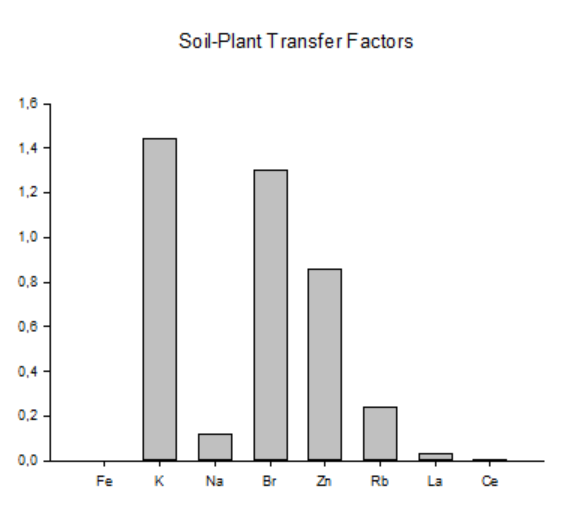
Iron (Fe) and sodium (Na) also showed low transfer values. Despite the high concentration of iron in the soil, its transfer to the aerial part of the species studied was low. This is possible by adsorption of Fe oxides and formation of chelates by organic matter. Galan and Romero (2008) [1] and Kabata-Pendias and Pendias (2000) [2], reports that plants influences Fe in its mobility, availability and its potential uptake. Regarding Na, Malavolta (1994) [25] reports that this element is accepted as an essential element for some species, usually, that make photosynthesis via C-4 carbon, in the case of corn. The elements K, Br and Zn presented the highest transfer values compared to the other elements. For Zn and K, these values are considered positive because they are essential for plant development. Zinc is a micronutrient of intermediate mobility in the phloem and its lower translocation depends on its availability in the vegetative part, because when in higher concentrations, it is complexed to organic compounds of low molecular weight [26]. According to Jurkowska and partners (1990) [27], higher content of this micronutrient in the vegetative tissue, higher is the translocation and accumulation in the grains. The same happens with the K; for this element, additionally it means higher production of corn. This is due to the greater transport and storage of photo assimilates in the grains, since the content of K tends to increase. So this element participates in the transport of sucrose and photo assimilates from the source to the drain [25]. It is in accordance with the data obtained in this work. The high concentration of Br obtained in this analysis suggests that this element may have come from pesticides used in the study area. Braibante (2012) [28] comments that about 115 chemical elements currently known, bromine is present in most agrotoxics, conferring specific characteristics of these products that are used in agriculture.
Conclusion
In the research it was possible to determine the elements Br, Ce, Fe, K, La, Na, Rb and Zn, and calculate the soil-plant Transfer Factors for them. Potassium was the one that presented a highest capacity of soil translocation to the aerial part of the plant. This confirmed the expected behaviour, once this element is a macro-constituent of the corn. In relation to Zn, a micro-constituent, it also presented high FT, even having low mobility. It suggested that the overall conditions were favourable to this.
Acknowledgments
To the Nuclear Technology Development Center / National Nuclear Energy Commission (CDTN / CNEN), by providing the laboratories and all the necessary structure for the development of this work and CAPES, for the scholarship.
References
-
Galan HE, Romero BA (2008) Contaminación de Suelos por Metales Pesados. Conferencia Contaminación de Suelos por Metales Pesados. Ver de la Soc Esp de Mineralogía MACLA 10: 48-60.
-
Kabata-Pendias A, Pendias H (2000) Trace Elements in Soils and Plants. 3rd (Edn.), CRC Press, Boca Raton, Florida, EEUU.
-
Orihuela DL, Hernandez JC, Weiland CM, Moreno CM (2008) Factores de Transferencia Suelos-Hojas del Ni en Melocotones. Posibles Alteraciones por la Bajada de pH del Suelo. Agricola Vergel 313: 35-40.
-
Kachenko AG, Sing B (2006) Heavy Metals Contamination in Vegetables Grow in Urban and Metal Smelter Contaminated Sites in Austrália. Water, Air, and Soils 169(1-4): 101-123.
-
Belgya T (2012) Prompt Gamma Activation Analysis at the Budapest Research Reactor. Physics Procedia 31: 99-109.
-
International Atomic Energy Agency (1990) Practical aspects of operating a neutron activation analysis laboratory. Vienna, pp: 7-32 (IAEA TECDOC – 564).
-
Jimba B, Ige T (1990) Concentrationof Cr, Fe, Co and Zn in some Nigerian food grains. J Rad and Nucl Chemistry 144(6): 447-452.
-
Francisconi LS (2014) Determinação de constituintes inorgânicos em plantas medicinais e seus extratos, Dissertação (Mestrado em Ciências na Área de tecnologia Nuclear). São Paulo: IPEN.
-
Fernandes EA, Nepomuceno N, Trevizam AB, Amorim HV (1998) From potential to reality: yeasts derived from ethanol production for animal nutrition. J Rad Nucl Chemistry 234(1-2): 113-118.
-
Fernandes EAN, Tagliaferro FS, Bacchi MA, Bode P, Turra C, et al. (2004) INAA as a tool to identify organically grown food. Transactions of the Americam Nuclear Society, La Grange Park 91: 847- 848.
-
Bacchi MA, Fernandes EAN (2003) Quantu-design and development of a software package dedicated to k0- standardized INAA. J Rad Nucl Chemistry 257(3): 577-582.
-
Santos LG, Fernandes EAN, Bacchi MA, Tagliaferro FS, Tsai SM (2006) Evaluation of conventional and organic beans by instrumental neutron activation analysis. J Rad Nucl Chemistry Budapest 270(1): 249- 252.
-
Turra C, Fernandes EAN, Bacchi MA, Tagliaferro FS, França EJ (2006) Differences between elemental compositionof orange juices and leaves from organic and conventional production systems. J Rad Nucl Chemistry 270(1): 203-208.
-
Marzano FN, Bracchi PG, Pizzet P (2001) Radioactive and conventional pollutants accumulated by edible muschrooms (Boletus sp.) are useful indicators of species origin. Envron Resh 85(3): 260-264.
-
Cid AS (2011) Evolução temporal da incorporação de 137Cs+, k+ e Na+ em plantas frutíferas tropicais e suas correlações com a fisiologia vegetal, Dissertação (Mestrado em Física). Rio de Janeiro: Universidade Federal Fluminense.
-
Ferrari AA (2008) Caracterização química de tomates (Lycopersion esculentum Mill.) empregando análise por ativação neutrônica instrumental, Dissertação (Mestrado) – Centro de Energia Nuclear na Agricultura. Piracicaba: Universidade de São Paulo.
-
Malavolta E, Vitti GC, Oliveira SA (1997) Avaliação do estado nutricional das plantas: princípios e aplicações. 2nd (edn.), Piracicaba: POTAFOS.
-
Menezes MABC, Jacimovic R (2006) “Optimised k0 – instrumental neutron activation method using the TRIGA MARK I IPR-R1 reactor at CDTN/CNEN, Belo Horizonte, Brazil”, Nucl Instrum Methods Phys Res Sect A 564(2): 707-715.
-
Menezes MABC, Palmieri HEL, Leonel LV, Nalini JRHA, Jacimovic R (2006a) Iron Quadrangle, Brazil: Elemental concentration determined by k0- instrumental neutron activation analysis. Part I: Soil samples. J Rad Nucl Chemistry 270(1): 117-121.
-
Menezes MABC, Palmieri HEL, Leonel LV, Nalini JRHA, Jacimovic R (2006b) Iron Quadrangle, Brazil: Elemental concentration determined by k0- instrumental neutron activation analysis. Part II: Kale samples. J Rad Nucl Chemistry 270: 111-116.
-
Menezes MABC, Jacimovic R (2014) “Implementation of a methodology to analyse cylindrical 5-g sample by neutron activation technique, k0 method, at CDTN/CNEN, Belo Horizonte, Brazil”, J Rad Nucl Chemistry 300(2): 523-531.
-
Institute of Isotopes (2009) Hyperlab V. User’s manual, Budapest.
-
(2011) Kayzero for Windows®, “User’s Manual, for reactor neutron activation analysis (NAA) using the k0 standardisation method”, Ver. 2.42. k0-Ware, Heerlen, The Netherlands.
-
Vilela LAF (2015) Cério, lantânio, neodímio e ítrio no crescimento de milho na presença e ausência de micorriza em casa de vegetação e da aplicação de mix desses elementos na produção de grãos em campo, Tese (Doutorado). Lavras: Universidade Federal de Lavras: UFLA.
-
Malavolta E (1994) Fertilizantes e seu impacto ambiental: micronutrientes e metais pesados, mitos, mistificação e fatos. Produ Química. São Paulo, p: 153.
-
Marschner H (1995) Mineral nutrition of higher plant. 2nd (Edn.), New York: Academic Press
-
Jurkowska H, Wisniowska-Kielian B, Rogoz A, Wojciechowicz T (1990) The effect of N-fertilization rate on the levels of mineral components in various plant species: Part II. Microelements. Rolnictwo Z 29: 51-64.
-
Braibante MEFA (2012) Química dos Agrotóxicos. Química Nova na Escola 34: 10-15.
- Enhancement of Vegetative Growth and Fruit Yield in Cucumber (Cucumis sativus L.) via Spiritual Blessing (Biofield) Energy Intervention
- Production of Açaí (Euterpe oleracea Mart.) under Different Agroforestry System Management Intensities in Amazonian Floodplain (Varzea) Forests
- Coffee and the Production Region: What is the Secret to the Expression "Quality"?
- Experiential Agripreneurship Training in Sub-Saharan Africa: Integrating a Business Incubator into Postgraduate Livestock Education at the University of Buea
- Advances in Agricultural High-Quality Development
- Linking Compost Residue to ABAGE in Plants - a Short Note