
The Efficiency of the Brazilian Dairy Sector: A productivity Analysis from 1974 to 2016
This article’s main objective is to evaluate the systemic competitiveness of the Brazilian dairy sector, from the point of view of efficiency, aiming to analyze some important relationships within the Brazilian economy, from 1998 to 2016. This paper focuses specifically on the efficiency of the sector evidencing potential competitiveness. The issues emphasized in this paper aim to present the evolution of dairy production, followed by a growth in productivity and potential competitiveness, which indicate the tendency of adjustments in the incentives of a government program. This is considered in the contexts of intensification or reduction across different periods. In order to condct this analysis, the ordinary least squares econometric (OLS) method was used. Data from the Municipal Livestock Survey of the IBGE were used for the years 1974 to 2016. The results obtained are quite illuminating and may direct important aspects in greater government incentives in the period from 1998 to 2016, where the productivity performance of the sector presented greater efficiency.
Introduction
The evolution of family agriculture for the development of a dynamic economy and for the construction of a more democratic society is already a concept practiced in capitalist countries of higher development. The importance given to family activities in these countries is strategic so that it boosts economic growth, providing a process of balanced transition from a rural economy to an agro-industrial based economy. In Brazil, the activity of family farming resists despite the precariousness and low level of development of human capital. Even the increase of the opportunity cost of family members does not necessarily lead to the elimination of family activity. However, the efficiency and viability of family activity is essential for a globalized and competitive world. The National Program for the Strengthening of Family Agriculture (PRONAF), created in 1996, has been changing every year in one of the most important public policies affecting Brazil's rural environment, especially since it is present in most of the country's municipalities, in addition to having allowed the greater democratization of credit promotion for a population that, until then, had had great restrictions on resources. However, throughout its evolution, the program has supported several types of assessments by different segments of society. Therefore, there were few academic analyses that sought to understand the impacts of this type of public policy on family farmers, and especially on local economies. The market alteration of the dairy sector in Brazil, and specifically in its economic, institutional and productive changes, presents a valuable empirical reality for an economic analysis. Thus, economic theory provides theoretical and analytical assumptions that, combined with the temporal reality of the object of study, serve as a basis for understanding the essential changes in the evolution process of agricultural production. The milk segment presents the conditions to support the theoretical apparatus the analysis presented in this work.
Systemic Competitiveness for Efficiency Optics
Competitiveness is determined by several factors and has a multidisciplinary nature. It is a dynamic process in which agents identify and interact in order to influence and adapt to the internal and external environment transformations of the sector, company, region or country. When we analyze the competitiveness theme, there are different approaches, particularly as described by Ferraz, Kupfer and Haguenauer, Fajnzylber, Possas and Carvalho, Porte, Coutinho and Ferraz [1, 2, 3]. This study considers competitiveness as "the ability of a company, sector, region or country to secure or extend, in a lasting and sustained manner, its position in the market", as stated by the Systemic dimension by political- institutional nature (economic policies) and seen from the perspective of Efficiency, thus reflecting the capacity of the sector, to produce goods and services at low prices and costs. Thus, this study considers factor remuneration and productivity. Porter, one of the references on competitiveness, exposes that this characteristic in a nation has a connection with the competence of its industry to innovate and to update itself [4]. In addition to innovation and upgrade, achieving high levels of productivity is important. High standard of living in a region is connected to the ability of firms to achieve high levels of productivity and continuously increase [5]. The government has an important influence on the national competitive advantage, although its function is decisively partial. Government policy will fail if it remains the only source of national competitive advantage. The most successful policies work in industries where the underlying national advantage decisions are present and where there is a greater government effort. Therefore, government can accelerate or increase the greater prospects of achieving competitive advantage (and vice versa), but it lacks the power to create its own advantage [2]. The issue is analyzed with greater emphasis on social aspects, which cover State action and the mobilization of society, a perspective that can be found in the concept of competitiveness that underlies the Competitiveness Study, an important and far-reaching approach as follows: Competitiveness can be seen as the productivity of companies linked to the capacity of governments, to the behavior of society and natural and built resources, and measured by national and international indicators, allowing to conquer and secure market slices [3]. The term competitiveness is related to the gains in productivity and quality provided by a mutual influence of internal and external factors that make economic production more efficient, such as infrastructure, education, health, innovation and economic policies. However, it can analyze competitiveness as the sum of greater productivity and quality results related to factors crucial for determining the competitive advantages of the companies or sector and, as a result, cooperate for the countries' own development. According to Esser et al., competitiveness encompasses four levels of variables that influence the competitive capacity of firms and countries, denominating systemic competitiveness, namely: the micro level, which assesses companies' ability to increase revenues; the meso level, which addresses industrial and regional competitiveness geared towards infrastructure and the competence to form networks and to achieve improvements in innovation systems; the macro level, related to national macroeconomic factors that influence the competitiveness of companies, such as interest rates and foreign exchange, balance of trade and payments and public debt; and target level, which deals with cultural factors in the country, such as the ability of society to reach agreements to achieve the ultimate goals [6]. However, it also considers the importance in the interaction between the four levels of competitiveness. In the macroeconomic field, the more competent the economic policy is in consolidating prices and promote growth, the better it will be for corporate competitiveness, with an emphasis on policies that adjust the reduction of the tax burden and the interest rate and that do not allow the appreciation exchange rate. Another important dimension for the competitiveness growth of countries is linked to public administration, followed by the federal government and local units of government (municipalities). It is important and necessary to ensure that the growth of systemic competitiveness is subject to actions that can increase the efficiency of public administration and the management of public policies throughout the national territory. Thus, the management apparatus of national states plays an important role in the economic development processes of countries. The greater or lesser centralization of public administration is more pronounced insofar as it can influence the quality of management and the greater acquisition and efficiency of public policies, which then influence the economic and social development of the countries themselves. Ferraz, Kupfer and Haguenauer suggest that competitiveness should not be seen only from the technical point of view; competitive standards and institutional standards should be included, since the environment exerts influence so that the sectors are more efficient and effective, but also so that they conform to the standards considered by society to be legitimate. Thus, Porter argues that the analysis of competitiveness, checking only in technical standards, becomes a problem that has its root in the inability of business managers to distinguish operational efficiency from strategy [7]. Therefore, management teams that emphasize productivity growth, quality and speed (such as total quality management, benchmarking, reengineering, and change management), can bring advances and operational gains, but are ultimately unskillful in order to guarantee a high support position from the company. Therefore, it is not sufficient for the organization to guarantee only operational efficiency, which in itself does not guarantee a corresponding standard of competitiveness. Therefore, Haguenauer admits that competitiveness can be observed on two optics, ex-post and ex-ante. Competitiveness on ex-post analysis conditions a firm, sector and / or organization as competitive in the market after analyzing its performance, the levels of participation and production, and formulates indicators such as market share (market share), which are responsible for measuring competitiveness [1]. Observing from the ex ante perspective, which takes into account the capacity or efficiency that the firm, sector and organization has in relation to the transformation of inputs into products, taking into account the competitiveness that this organization presents even before acting, the capacity, the potentiality that it possesses. In addition, Kupfer and Ferraz, et al. define competitiveness as an ex ante phenomenon based on the notion of efficiency of the productive process (or the input-output relationship), potential competitiveness, defined through productivity and competitors. Therefore, the most used indicators to evaluate competitiveness would be the price, the cost, the technical coefficients and the productivity parameters of the industry factors. However, competitiveness is defined by the ability of the producer to choose which techniques to use, according to the limitations of his resources, mainly financial, technological and managerial. Therefore, it is necessary to define some concepts of competition in family production to understand the analysis adopted in this article.
Milk Production in Brazil
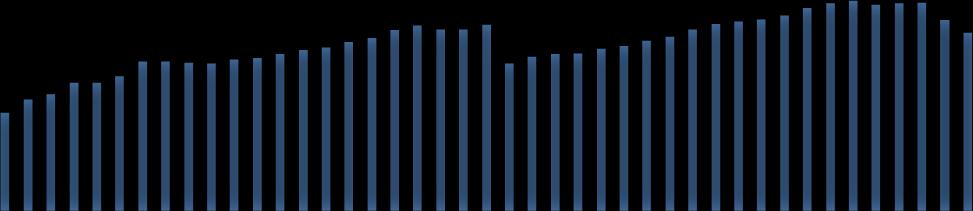
The herd of dairy cows in Brazil has presented modest growth in the last decade, presenting a decrease of 6% in the period, reaching a total of 209.49 8 million in 2006 to 196.788 million Cows milked in 2016 (figure 1). Milk production in Brazil hit a mark of 37 billion liters in 2016, showing an increase in production of 17% in the last ten years (figure 2). In this scenario, 75.5% of the supply of cow's milk products are consumed by the domestic market and only 24.5% of Brazilian production is directed to the international market. It is important to observe the growth of imports in 2016, showing a growth in the last ten years of 12.19% per year and showing a fall in the same period of 6.20%. In the face of the global crisis, milk production in Brazil grew in its productivity [8]. Comparing the twenty-year period of the IBGE's historical series (1995-2016), it can be observed that the increase in national production is explained by the adoption of technologies which raised productivity by decreasing the number of cows milked (Figure 1). The explanation is in the greater mechanization, indicating the adoption of technology which requires a special effort of the government in transferring knowledge to the producer to turn it into technology.
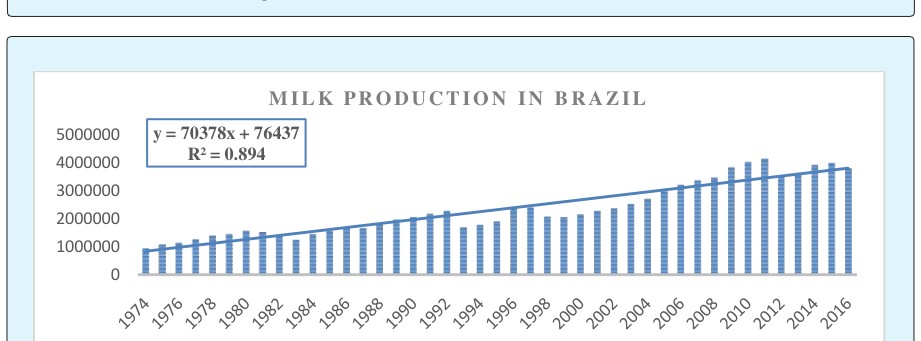

In 2015, based on the number of inhabitants of IBGE data, and subtracting exports, Brazilian per capita consumption was 170 kg per person per year, higher than the average global consumption that was around 32.4 kg per inhabitant per year. Despite the fact that per capita consumption has a larger volume than the world, there has been growth of 2.43% in the last five years. In the same year, the Brazilian cow's milk market was characterized by a growth in production, a strong reaction of increased productivity of the herd. There is strong demand and rising prices, due to the strong support for government programs [8].
Methodology
The study worked with data in a monthly time series, referring to the period from 1974 to 2016, totaling 43 observations. The research established some statistical tests to verify if the data sampled provided sufficient evidence to be able to accept the research hypothesis as true, being cautioned that the differences observed in the data are not merely random. The paper opted for regression, since correlation techniques do not involve an implicit assumption of causality, whereas regression techniques do. According to Stevenson, for an analysis of time series of data, the use of the term tendency proposes a smooth, long-term movement of the data, up or down [9]. Thus, the trend study indicates the direction of long-term movement in the time series. We can also observe models with independent dummy variables that can be used in time series. To verify changes in the intercept or slope of a function, allowing the identification of structural changes [10]. Thus, the effect of the national family agriculture program (Pronaf) on intercept and slope was tested simultaneously, representing an additive and multiplicative model. This article presents the Brazilian dairy sector, comprising 26 states, 1 district and 137 mesoregions, according to data from the Brazilian Institute of Geography and Statistics (IBGE). The data used refer to the Municipal Livestock Survey (PPM-IBGE) and Agricultural Census (IBGE) for the years 1974 to 2016. For the analysis, the econometric model was used in time series of minimum ordinary quarters (OLS), and in this work, is applied to decompose the growth of milk production (P) in the herd (VO), production value (PV) and the use of a Dummy variable (DAM) to explain performance from the government program known as PRONAF . This allows us to expose a scenario on the systemic competitiveness from the point of view of efficiency. This tool sought to identify the trend behavior of the production variable and verify structural change, as well as to compare the production pattern (cow's milk production) in the milk sector in the country. of multiple regression using the MQO method [11, 12]. Prod = β0 + β1VOrd + β2VProd + β3DUM + ɛ Where in, Prod= milk production in Brazil (1974 to 2016); β0 = intercept; β1VOrd = milked cows (1974 to 2016); β2VProd = value of production (1974 to 2016); β2 DUM = Diffuse variable of intercept difference referring to the structural change of the Pronaf (0=1974 to 1997; 1 = 1998 to 2016) 1996 year of consolidation of the program ɛ = error term. This model fits the scope of the survey as the angular coefficients βi measure the ratio of Y to its regressor, that is, the variation of Y corresponding to the given (small) percentage change in X. The analysis sought to verify whether the introduction of Pronaf caused a significant change in the trajectory of the variable milk production, triggering a new economic and competitive scenario for activity.
Results and Discussion
Pronaf and the Familiar Agriculture
The growing increase in the volume of resources approved annually for rural financing for family farmers signaled a change in practices of the State. In 1996, when it began its activities, the budget made available to PRONAF was R $ 6.35 billion, for the 2016/2017 Plan, the Federal Government made available the release of R$ 30 billion to finance family agriculture3. It is important to mention that until the mid-1990s, the financing of the smallholder was limited almost exclusively to the resources managed by the Special Credit for Agrarian Reform Program (PROCERA), whose scope was specific and limited, due to the fact that Land reform. According to the Ministry of Agriculture, small farmers were classified as mini producers, putting them at a disadvantage, since they had to compete with the large landowners, who historically were the main agricultural credit borrowers. The data processing is observed as part of systemic competitiveness when used as a way of strengthening the milk production chain, and it is important to mention the Southeastern region where the largest Brazilian milk production is found. The most recent statistics show that Brazil has 4.4 million family agriculture establishments, which represent 84.4% of Brazilian establishments and include about 12.3 million people linked to family agriculture. This plays a very important role in the economy of small towns, where family farms provide numerous jobs in the commerce and services of these small towns. According to the last Census of Livestock, among the family farmers, dairy farming has been one of the main activities that has developed, accounting for 24.9% of establishments classified as family economy in the country [13]. 58.1% of the gross value of the total production comes from milk. However, it is necessary to analyze quantitatively whether there was structural change in the production of the Brazilian dairy sector after PRONAF, and the degree of changes in production over the ensuing years.
- Model: MQO, using the observations 1974-2016 (T = 43)
- Coefficient
- Standard error t-reason p-value const
- −1,91406e+06
- 329518
- −5,809
- <0,0001
- ***
- VOrd
- 0,161887
- 0,0186627
- 8,674
- <0,0001
- ***
- PosPronaf (DAM)
- 561094
- 119411
- 4,699
- <0,0001
- ***
- VProd
- 419,188
- 0,740643
- 5,660
- <0,0001
- ***
Table 1: Dependent variable: Prod; ***(P<0,01).
| Mean var. dependent | 2312693 | D.P. var. dependent | 934572,7 | ||||
|---|---|---|---|---|---|---|---|
| Soma resid. squares | 3,10e+12 | E.P. of regression | 281945,7 | ||||
| R-quadrado | 0,915488 | R-square squared | 0,908987 | ||||
| F(3, 39) | 1,408,237 | P-value(F) | 5,79e-21 | ||||
| Log of the likelihood | −598,5423 | Akaike's Criteria | 1,205,085 | ||||
| Schwarz Criterion | 1,212,129 | Hannan-Quinn Criterion | 1,207,683 | ||||
| rô | 0,401807 | Durbin-Watson | 1,166,300 |
Table 2: Prepared by the author through data from the IBGE/SIDRA. In the period from 1998 to 2016, after the PRONAF program, the
Table 2: Prepared by the author through data from the IBGE/SIDRA. In the period from 1998 to 2016, after the PRONAF program, the variables VOrd, DAM and VProd illustrated positive behavior when we related the milk production according to the estimation, observed by the parameters βi all significant at a level of 1%. The R² explains, with a percentage of 91% and R² adjusted with a percentage of 90%, the Durbin-Watson test used to identify the presence of autocorrelation (dependence) in the residuals of a regression analysis. However, by checking the table, Durbin-Watson concludes that at 1% significance of the observed variables the test does not reject H0 (independence). When observing the coefficient for the period after PRONAF the year of 1998, it is observed that it presented structural change in the production variable. This was calculated by the significance of the Dummy intercept coefficient after PRONAF. In other words, after PRONAF there were significant changes in milk production, showing a change in the inclination of the trend line of the production variable, a result that may be associated with strong performance in the sector's productivity, considering that the sector becomes competitive based on the efficiency [14, 15, 16, 17].
Conclusion
The importance that the milk production sector has acquired in the country in the last four decades is undeniable. Production increased by 400% and milk consumption by 240%, with repercussions on economic and social performance. Continuing the dairy activity in Brazil is a great challenge because it is necessary to guarantee profitability to compete with other activities and to establish the producer in the field. The strongest point on the expressive evolution of Brazilian dairy farming comes from the market itself. While the actual price of milk paid to the producer has declined over four decades, and the value of production has dropped from 0.20 liters in 1974 to 0.10 liters, milk production has increased with fewer milked cows. What explains this apparent contradiction is productivity, which grew 245.6% in 1974-2016. In this context, the role of technical assistance and rural extension cannot be dissociated, which sometimes has its rhythm of action broken by political attitudes, at both federal and state levels, opening institutional bottlenecks that require decades to be rebuilt. Competitive intelligence must also be linked to agricultural and agrarian policies with managers with technical competence for public office, and less interference from ideological distortions that lead the primary to become secondary in actions that generate serious administrative discontinuities. This research, although it has achieved its initial objectives, analyzing the evolution and competitiveness of the Brazilian milk production chain based on an analysis of the systemic competitiveness on the efficiency perspective, is still primary when it comes to diagnosing the competitiveness of the agroindustrial system in its fullness. Therefore, it is pertinent that in future work, analyzes of the other links involved in the constitution of the system should be made with a view to identifying possible bottlenecks, and a more detailed analysis of the milk production chain in Brazil is also necessary.
References
-
Haguenauer (1989) Competitividade: Conceitos e Medidas. (Texto para discussão nº211), UFRJ/IEI, Rio de Janeiro.
-
Porter MEA (1993) vantagem competitiva das nações.
-
Coutinho LG, Ferraz JC (1994) Estudo da competitividade da indústria brasileira.
-
Porter ME (1990) The competitive advantage of nations. Harvard Business Review 68(2): 73.
-
Porter ME (1990) What is national competitiveness. Harvard Business Review 68(2): 84-85.
-
Esser, Klaus (1994) Competitividad sistémica: competitividad internacional de las empresas y políticas requeridas. Berlim: Instituto Aleman de Desarrollo.
-
Porter ME (1999) Competição-on competition: estratégias competitivas essenciais. Harvard Review Book.
-
https://sidra.ibge.gov.br/pesquisa/ppm/tabelas.
-
Stevenson WJ (1981) Estatística aplicada à administração. São Paulo: Harper & Rowdo Brasil pp: 490.
-
Misso FM, Jacobi LF (2007) Variáveis dummys: Especificações de modelos com parâmetros variáveis. Ciência Natura 29(1): 111-135.
-
Hair JF (2005) Análise Multivariada de dados. Porto Alegre: Bookman.
-
Guajarati D (2006) Econometria básica. Rio de Janeiro: Elservier.
-
Guilhoto JJM, Silveira FG, Ichihara SM, Azzoni CRA (2006) importância do Agronegócio Familiar no Brasil. Revista de Economia e Sociologia Rural 44(3).
-
Batalha MO, Buainain AM, Filho HMS (2005) Tecnologia da gestão e agricultura familiar. São Carlos: Gestão do agronegócio pp: 1-19.
-
Kageyma A (2004) Desenvolvimento rural: conceito e medida. Brasília: Cadernos de Ciência & Tecnologia 21(3): 379-408.
-
Silva JG (1997) O novo rural brasileiro. Belo Horizonte: Revista Nova Economia 7(1): 43-81.
-
Wilkinson J, Mior LC (1999) Setor informal, produção familiar e pequena agroindústria: interfaces. Rio de Janeiro: Estudos Sociedade e Agricultura 13: 5-28.
- Enhancement of Vegetative Growth and Fruit Yield in Cucumber (Cucumis sativus L.) via Spiritual Blessing (Biofield) Energy Intervention
- Production of Açaí (Euterpe oleracea Mart.) under Different Agroforestry System Management Intensities in Amazonian Floodplain (Varzea) Forests
- Coffee and the Production Region: What is the Secret to the Expression "Quality"?
- Experiential Agripreneurship Training in Sub-Saharan Africa: Integrating a Business Incubator into Postgraduate Livestock Education at the University of Buea
- Advances in Agricultural High-Quality Development
- Linking Compost Residue to ABAGE in Plants - a Short Note