
Consumer Awareness of the Benefits of Whole Grain Products and Influence on Purchasing Habits
The aim of the work was to determine how much consumers are aware of the benefits of whole grain products, and whether and how this awareness affects their buying habits. Primary data were collected through a survey questionnaire (non-random sample), then processed in Excel and presented graphically. The results show that the majority of respondents are aware of the benefits of whole grain products and that this awareness greatly influences their purchasing habits. In addition, consumers are influenced by lifestyle, product taste, health benefits, tasting, advertising, price and other people's opinion about the product, etc. Those who answered that they do not consume whole grain products cited the high price as the main reason. They have received information about the benefits of whole grain products from family, relatives, friends, acquaintances, Internet experts and colleagues, but they still lack information. Also, promotion largely creates consumer awareness. Price reduction, tasting, improved taste and promotion would contribute to greater realization of whole grain products. Creating educational campaigns about the benefits of whole grain products would encourage consumers to buy more of them, which would increase their production and have a positive impact on public health.
Introduction
Since ancient times, man has used cereals in his diet. The whole cereal grain was ground and flour was obtained [1]. In modern times, the focus is exclusively on bread and pastries, obtained from the grains where the grain envelope has been removed [2]. Cereals were widely used for the production of animal feed [3]. Only some traditional agricultural farms have preserved recipes for preparing dishes from whole grains.
One of the basic principles of proper nutrition is the daily consumption of whole grain products, which are rich in nutrients and exhibit health effects. The use of white flour products causes serious diseases [4]. The use of whole grains in the diet gives the human body energy (due to the high content of carbohydrates), lubricates the joints, removes poisons and helps in detoxification [5].
The content of nutrients in whole grain flour is significantly higher compared to flour obtained only from the endosperm [6].
Since today much attention is paid to health and nutrition, whole grain products are gaining importance. The questions are whether consumers are aware of it, what are the benefits of whole grains and whether consumer awareness affects their buying habits. Consumers often base their purchasing decisions on the opinions of their fellow citizens, and this can significantly affect their perception of products. Therefore, it is important to find out how and what factors motivate consumers to buy a product. It is important for trading companies to know what determines consumer behavior in order to create effective marketing strategies. Nwazodoni S, et al. [7] point out that marketing strategy is tools for improving the marketing efficiency and overall performance of smallholder agricultural enterprises.
In this regard, this paper focuses on the identification of factors that influence consumers’ awareness of whole grains and their purchasing habits.
Literature Review
From the technological aspect, cereals are divided into two groups, whole and refined cereals. Today, products made from whole grains are more and more in demand. This is because the whole grain products are richer in fiber, minerals, antioxidants, carbohydrates and vitamins [2, 8]. On the other hand, refined cereals are those from which almost all valuable ingredients from the raw material have been removed (except endosperm or starch), in order to extend the shelf life of the main component or improve its sensory characteristics [9]. Starch can cause serious health problems in humans, because it becomes mucus in the human body [10].
Whole grain products, apart from being nutritious, also have an additional function. Whole grain products help reduce the risk of disease and fight disease [8, 11]. A whole grain product can be recognized by its fiber content, and the more fiber, the more whole grain in the product [12].
A marketing manager must know the consumer’s willingness to buy a whole grain product, which depends on the person’s motivation and current purchasing power. The consumer’s perception of the relationship between price and quality also has an impact on making a purchase decision. Consumer price awareness is important, distinguishing between price-oriented attitudes and purchasing attitude, which does not depend only on price [13, 14, 15].
Consumer behavior includes pre-purchase, during- purchase and post-purchase activities [16]. The goal is to understand what influences consumers, and for that it is necessary to understand the factors that influence the purchase. Companies must study consumer behavior to predict or learn their reactions to marketing strategies [17].
Consumer behavior during shopping largely depends on their characteristics, i.e. way of life, the situation in the environment and the nature of the product. As people, products and the environment are constantly changing, consumer behavior is a constantly changing process [18].
Purchase decisions are influenced by Safitri I [19]; Zivkovic R, et al. [20]:
- Human values,
- Income,
- The price of the product/substitute,
- Cultural patterns,
- Social class,
- The personality itself.
Psychological factors are very important for the buying process, because a lot depends on how a person perceives products, prices and the environment. In order to reduce the probability that the customer will react negatively to the product, the communication strategy and the appearance of the product must be designed to meet consumer expectations [21]. A person’s lifestyle, beliefs, environment, activities and hobbies vary with age. For older people, consumption for social purposes is not as important as for the younger population [22].
Attitudes towards a product or brand are usually expressed in a negative or positive consumer rating. One of the main influences on people’s attitudes is the mass media, which influence their attitudes on a daily basis. People’s attitudes towards different products are influenced by several factors, such as product price, marketing campaigns, motivation, etc. [23].
Various external factors also influence consumer behavior. Social status determines a person’s position in the family, workplace, circle of friends, etc [22]. Social relationships are influenced by different groups, family, social class and culture. People from different social classes consume different products and value products differently [24]. Today, various groups are common on social networks through which people advise each other about various products and services.
Consumer behavior is also influenced by the family. Parents have a great influence on children, and spouses have a great influence on adults. Men have more influence in technical fields, and in most other fields women have more influence [21].
Social media has a major impact on consumer behavior. On social media, companies can also track consumer preferences and research feedback on their products. In order for marketing strategies to be functional and successful, it is necessary to know how to use their key factors to create a successful marketing campaign. The key factors are the necessity to understand the various social networks and how they work, knowing the motives behind the use of social networks by users, and understanding their preferences [25].
Various websites help consumers to communicate with each other and share their experiences. In this way, when one consumer expresses an opinion online, such as satisfaction or dissatisfaction with a product or service, other consumers take it into account. Social groups influence consumer behavior through the need to belong [26]. The more information is available, the greater the probability that the consumer will evaluate how the product will satisfy his need before the purchase itself [27].
Consumers consume products not only because they are necessary, but also because some products are a status symbol. Consumption due to status affects the consumer’s buying behavior in such a way that he buys a product or service with the aim of belonging to the same status group as the customers of the given product or service [28].
Changes in society’s beliefs affect consumer behavior. For example, modern trends impose increasing awareness of health and fitness. There is more and more medical research suggesting that people can live healthier and longer lives if they eat right and exercise regularly. These studies have changed the attitude of some consumers towards food and their lifestyles. Thus, medical research has revealed that society has changed the perception of a healthy lifestyle, and this has implications for consumer purchasing behavior and the marketing strategy of trading companies [29].
In order to better understand consumer buying behavior, it is necessary to find out what knowledge the consumer has acquired. It is good for trading companies to know which marketing strategies activate the acquired knowledge of potential customers. Often, a consumer can decide whether to buy a product based on the outcome of consuming the product [29].
Consumer behavior is influenced by advertising, by raising their awareness of the product, intrigues them, they begin to develop an emotional connection with the product, reminds them, and creates loyalty or aversion depending on the extent to which the advertised product meets the expectations of customers [15, 30]. Market research often focuses on consumer awareness and brand beliefs.
Consumers have different levels of product awareness, which they can use to interpret new information and make purchasing [29].
One of the main factors influencing consumer buying behavior is the price of the product. Reducing production and logistics costs leaves room for lowering product prices, which will benefit all parties in the long run, whether they are intermediaries, producers or consumers [21, 31].
In some cases, it can take two to three years from the production decision to the end of the production cycle. That is why it is important for manufacturers to be informed about trends in market indicators and consumer buying habits before making a decision on production.
Objective, Method and the Research Sample
The aim of the research was to determine how much consumers are aware of the benefits of whole grain products and whether and how this awareness affects their behavior when considering and making a purchase decision. For trading companies, it is of great importance to determine consumer behavior, as well as the factors influencing the purchase decision, in order to design adequate marketing strategies.
General scientific methods were used in the research. Among the special methods, questionnaires, graphic methods, etc. are used.
The sample included men and women aged 25 to 65, a total of 165 participants based on convenience (non-random sample). The survey questionnaire was sent by e-mail to friends, acquaintances and those who were recommended to us.
The survey was conducted on May 17, 2023. Until May 29, 2023. The questionnaire is structured in three parts. The first part examined consumer awareness of whole grain products, the second part examined factors influencing purchasing behavior, and the third part contained demographic questions.
The research was conducted in the Republic of Serbia, where the respondents came from cities (76%) and rural areas (24%).
Research Results and Discussions
Respondent Profile
Most respondents were 25-35 years old (53%). 32% of respondents were between 35 and 45 years old, and the remaining 15% were 45-65 years old. The majority of respondents are persons with a net monthly income of less than 500 euros (51.5%). 38.8% answered that their income is between 501 and 1,000 euros per month, and the rest (9.7%) earn more than 1,000 euros per month. Most of the respondents are younger people under 35 with a secondary education. 57% of respondents were women, and 43% were men. The majority of respondents have secondary education (47%), followed by persons with higher or higher education with 16.6% of respondents, respondents with secondary vocational education, 19.1% and primary education, 17.3%.
Consumer Awareness of the Benefits of Whole Grain Products
The first research question was designed to find out consumer awareness of the statements shown in Figure 1.
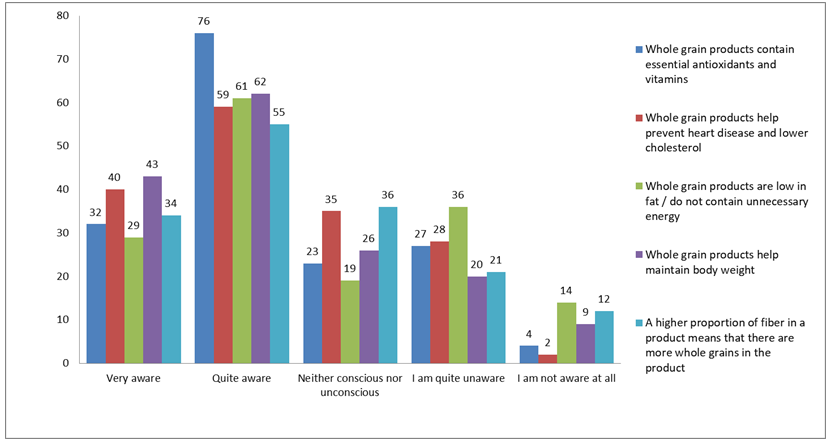
The statements are based on the beneficial properties of whole grains, from the literature. In the case of the statement that whole grain products contain antioxidants and vitamins, the most common response was ‘very aware’ and ‘fairly aware’. Regarding the second statement that whole grain products help reduce the incidence of heart disease and lower cholesterol, most respondents said they were aware of this. However, only two people were not aware of this benefit at all. Furthermore, most respondents were very aware of the benefits of low-fat whole grains that do not contain unnecessary energy. However, as many as 14 respondents were not aware of this at all. Most respondents answered that they are very aware of the fact that whole grain products are a good tool for maintaining body mass. Ruiz-Zaldibar C, et al. [32] point out that healthy lifestyles have been promoted a lot lately and one of the indicators of health is the ideal body mass. However, nine respondents were not aware of this fact at all. Although a large number of people said they were aware that the higher the fiber content of the products, the more whole grains in the product, a significant number said they were not aware of this at all. Also, in the case of all the statements, there were respondents who were not aware of them. However, in general, most respondents are aware of the benefits of consuming whole grain products.
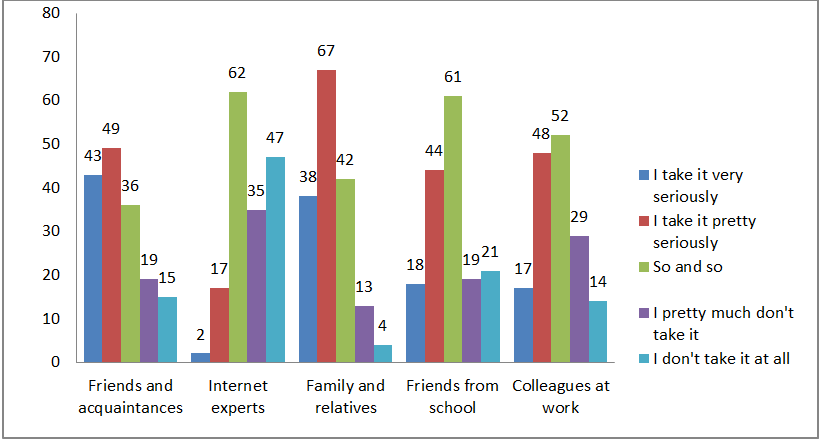
The fact that one of the characteristics on the basis of which consumers create general awareness about products is communication with different people (Figure 2).
43 respondents answered that they take into account the advice of friends and acquaintances. Second, the advice of family and relatives is highly taken into account, this option was chosen by 38 respondents. 18 respondents highly respect the advice of schoolmates, while 17 of them highly respect the advice of work colleagues. Only two people highly value the advice of Internet experts. The largest number of respondents (47) answered that they do not take into account the advice of experts from the Internet at all.
The advice of family and relatives is not taken into account by 4 people, and the advice of friends and acquaintances is not taken into account by 15 respondents at all. However, a large number of respondents answered that they take into account the advice of family, relatives, friends, acquaintances and work colleagues. We can state that consumers largely receive information from other people about whole grain products.
Tasting is one of the ways for consumers to get to know the product [33]. Respondents were asked whether they would try the products before buying and whether they bought them for tasting, and the responses are shown in Figure 3.
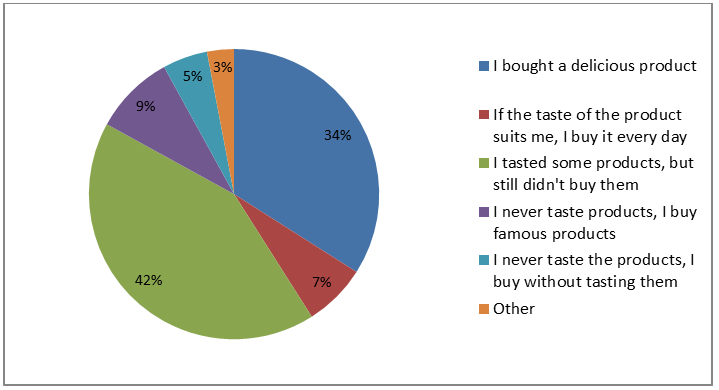
42% of respondents said they had sampled the products but had not yet purchased them. In second place with 34% is the answer that customers bought tasty products. 9% of respondents stated that they do not taste products, but buy what is already known. Also, 7% of respondents state that if the taste suits them, they consume the product every day.
When asked what would improve the consumption of whole grain products, one of the common answers was better taste. We can state that tasting dishes made from whole grain products would help raise consumer awareness and demand for the products.
One of the most important marketing tools is promotion [15]. We asked consumers how advertising for new products affects them. The responses show that if they remember the ad, it will also motivate them to buy the product (Figure 4).
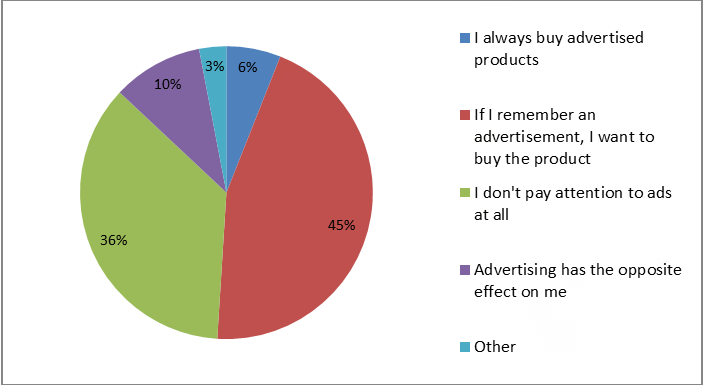
Research has confirmed that the more a product is advertised, the more it is purchased, which is consistent with previous research [34, 35]. As many as 45% of respondents answered that they wanted to buy the product if they remembered the ad. Only 6% of respondents answered that they always buy advertised products. However, 36% of respondents do not pay attention to advertising at all. The results show that advertising has a great impact on consumers. Creating advertisements focusing on the nutritional and health benefits of whole grain products could increase consumer interest.
Identifying Factors Influencing Consumer Buying Behavior
Consumer behavior is influenced by a large number of factors, which are highlighted in the theoretical framework. We investigated which characteristics of whole grain products are the most important for consumers (Figure 5).
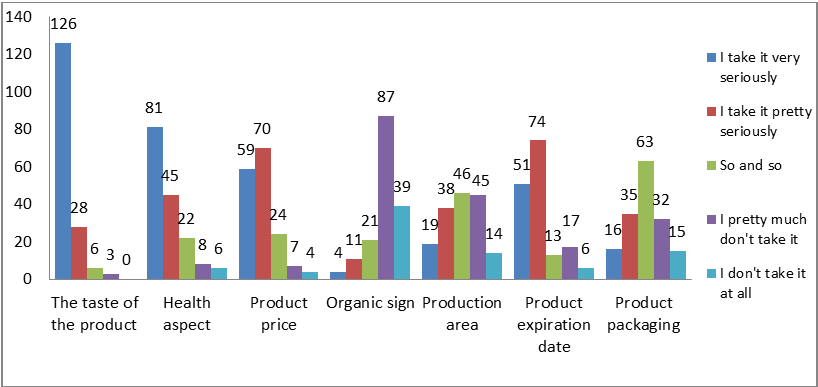
Based on the research, the taste of the product is considered the most important (126 respondents). In second place is the health aspect of the product, which is probably a consequence of the constant promotion of healthy lifestyles. The majority of respondents did not consider it important that the product is organic. The “product price” option received a lot of “very important” and “fairly important” responses. Although the consumer is aware of the benefits of whole grain products, the purchase is largely influenced by price, which coincides with the results of [36]. In addition to the price of the product, the expiration date was also important to the respondents, while the packaging and the area of production were less important aspects.
Most of the respondents answered that they are influenced if they see a product with a good offer in the store. Likewise, a large part of respondents make an impulsive choice in the store. Only 16% of respondents fill out a shopping list beforehand. At the point of sale, it is also possible to influence purchasing decisions. Consumers say that compelling advertising motivates them to buy a product.
In addition, the question whether consumers prefer products with a discount campaign or not was answered. 48% of respondents prefer discounted products, but only 10% of them always prefer discounted products. Only 5% of respondents never prefer discounted products. The majority of respondents who prefer discounted products are between 45 and 55 years old and have an income of up to €500.
However, even some respondents whose net income exceeds €1,000 prefer discounted products. Respondents said that the price of the product is important to them, which has been confirmed in previous research [37, 38, 39]. More attention could be focused on defining the price that consumers are willing to pay.
Respondents were asked what would motivate them to consume more whole grain products. Of the 154 respondents who responded, 78 said they would consume whole grain products if they were cheaper. 27 respondents would motivate more intensive advertising. People would also be motivated to consume products with better taste, a desire to lead a healthy lifestyle and an appropriate expiration date.
Conclusion
The research focused on consumer awareness of whole grain products and the impact of awareness on their purchasing habits.
Whole grain products are rich in nutrients and have a health effect. Consumers are generally aware of the benefits of whole grain products and this awareness greatly influences their purchasing habits. However, this is not the only aspect that consumers consider when purchasing whole grain products. In other words, consumers may be aware of the product and want to buy it, but awareness alone is not a sufficient motive for purchase.
The results also indicate that consumers are influenced by lifestyle, taste of the product, health benefits, tasting, advertising, price and opinion of family and acquaintances about the product, etc. Those who answered that they do not consume whole grain products cited the high price as the main reason. A large number of respondents answered that they take into account the advice of family, relatives, friends, acquaintances and work colleagues when considering the decision to buy whole grain products. Respondents answered that they would consume more products from whole grains if they had more information about their benefits, as well as recipes for preparing meals from whole grain grains.
Guided by the results, we can say that lowering the price, tasting, improved taste and promotion would contribute to a greater realization of whole grain products. By creating campaigns about the benefits of whole grains, those who were previously unaware would also become more aware. Therefore, we suggest creating marketing campaigns about the benefits of consuming whole grains, so that existing consumers are more aware, and abstainers are also intrigued.
References
-
Borneo R, León AE (2012) Whole grain cereals: functional components and health benefits. Food & function 3(2): 110-119.
-
Žeželj M, Demin M (2004) Trendovi u korišćenju žitarica. Časopis za procesnu tehniku i energetiku u poljoprivredi/ PTEP 8(3-4): 95-97.
-
Black JL (2016) Cereal Grains as Animal Feed. In: Wrigley C, Corke H, et al. (Eds.), Encyclopedia of Food Grains, 2nd (Edn.), Academic Press, pp: 215-222.
-
Kock N (2015) Wheat flour versus rice consumption and vascular diseases: Evidence from the China Study II data. Cliodynamics 6(2): 130-146.
-
Seal CJ, Courtin CM, Venema K, de Vries J (2021) Health benefits of whole grain: Effects on dietary carbohydrate quality, the gut microbiome, and consequences of processing. Comprehensive Reviews in Food Science and Food Safety 20(3): 2742-2768.
-
Levrat-Verny MA, Coudray C, Bellanger J, Lopez HW, Demigné C, et al. (1999) Wholewheat flour ensures higher mineral absorption and bioavailability than white wheat flour in rats. British journal of nutrition 82(1): 17- 21.
-
Nwazodoni S, Adekunle P (2022) Evaluation of the Strategies and Constraints to Marketing Quantity Surveying to the Public. Journal of Agronomy Technology and Engineering Management 5(5): 803-807.
-
Miletić I, Šobajić S, Đorđević B (2008) Functional foods and their role in the improvement of health status. Journal of Medical Biochemistry 27(3): 367-370.
-
Stojanović J (2021) Žitarice–blago dostupno svima.
-
Barros F, Alviola JN, Rooney LW (2010) Comparison of quality of refined and whole wheat tortillas. Journal of Cereal Science 51(1): 50-56.
-
Hrg S (2017) Utjecaj prehrane bogate cjelovitim žitaricama na metaboličke faktore rizika kod zdravih osoba i osoba s blagim stupnjem metaboličkoga sindroma. Časopis za primijenjene zdravstvene znanosti 3(2): 285-294.
-
Filipović N, Kaluđerski G, Šarić DM (2000) Wheat preparation for making wholemeal bread. Acta periodica technologica 31: 273-280.
-
Murthi BPS, Rao RC (2012) Price awareness and consumers’ use of deals in brand choice. Journal of Retailing 88(1): 34-46.
-
Thabit T, Raewf M (2018) The evaluation of marketing mix elements: A case study. International Journal of Social Sciences & Educational Studies 4(4): 100-109.
-
Patimah S, Hasyim M, Al Sukri S, Hadayanti, Hendrajaya D (2023) Analysis The Influence of Price, Promotion, Distribution, Product Quality and Brand Image on Purchase Decision of Cereal Product. JEMSI 9(1): 179- 185.
-
Jones S (2014) The Six Stages of the Consumer Buying Process and How to Market to Them. Bussines 2 community.
-
Trivedi K, Trivedi P, Goswami V (2018) Sustainable marketing strategies: Creating business value by meeting consumer expectation. International Journal of Management Economics and Social Sciences 7(2): 186- 205.
-
Đelošević I, Dević Ž, Spasojević B (2017) Do attitudes predict consumer’s behavior?. Ekonomski signali: poslovni magazin 12(1): 31-40.
-
Safitri I (2018) The Influence of Product Price on Consumers’ Purchasing Decisions. Review of Integrative Business and Economics Research 7(2): 328-337.
-
Živković R, Gajić J (2021) Consumer behavior. In: 2nd (Edn.), University Singidunum, Belgrade, Serbia.
-
Milić M (2018) Ponašanje potrošača. Univerzitet za poslovni inženjering i menadžment, Banja Luka, Bosnia and Herzegovina, pp: 1-278.
-
Perreau F (2016) The Consumer Factor Consumer Insights, Market Research, Consumer Behavior & Neuromarketing.
-
Mamula T (2012) Role of marketing metrics in strategic brand management. Marketing 43(1): 49-61.
-
Beiró MG, Bravo L, Caro D, Cattuto C, Ferres L, et al. (2018) Shopping mall attraction and social mixing at a city scale. EPJ Data Science 7: 1-21.
-
Gardašević J, Ćirić M, Carić M (2018) Understanding the Motives for Using Social Networks in the Function of Improving Communication with Consumers, Marketing 49(4): 311-320.
-
Ioanas E (2020) Social media and its impact on consumers behavior. Jurnal Analisa Kesehatan 1(1).
-
Stanojević M (2011) Marketing on social networks. Society 5(10): 165-180.
-
Management Study Guide (2016) What is Status Consumption and Why it is Important for Marketers of Premium Goods?.
-
Peter JP, Olson JC (2008) Consumer Behavior and Marketing Strategy. Mc Graw Hill, pp: 130.
-
Starčević S (2006) Possibilities for application of comparative advertising and its effects. Economic Annals 51(171): 90-102.
-
Vidmar K (2017) Information systems and costs of modern marketing. (Doctoral dissertation, Josip Juraj Strossmayer University of Osijek. Faculty of Economics in Osijek), Osijek, Croatia.
-
Ruiz-Zaldibar C, Serrano-Monzó I, Lopez-Dicastillo O, Pumar-Méndez MJ, Iriarte A, et al. (2021) Parental self-efficacy to promote Children’s healthy lifestyles: a pilot and feasibility study. International Journal of Environmental Research and Public Health 18(9): 4794.
-
Grzybowska-Brzezińska M, Rudzewicz A, Kowalkowski A (2013) Sensory marketing and customers’ decisions on the food market. Socio-economic Research Bulletin 3(50): 38-43.
-
Martin BA, Bhimy AC, Agee T (2002) Infomercials and advertising effectiveness: An empirical study. Journal of consumer marketing 19(6): 468-480.
-
Yang Q, Liu S, Li Y, Kang H (2022) A Matching Study on the Influence of Advertised Information Expression and Product Type on Consumer Purchase Intention. Frontiers in Psychology 13: 859959.
-
Szakály Z, Kiss M (2023) Consumer acceptance of different cereal-based “healthy foods”. Developing Sustainable and Health Promoting Cereals and Pseudocereals, pp: 467-488.
-
Ćirić M, Prodanović R (2013) Positioning strategy of organic food products. Economics: theory and practice 6(3): 33-48.
-
Yusuf SM, Nurhilalia, Putra AHPK (2019) The Impact of Product Quality, Price, and Distribution on Satisfaction and Loyalty. Journal of Distribution Science 17(10): 17- 26.
-
Zhao H, Yao X, Liu Z, Yang Q (2021) Impact of pricing and product information on consumer buying behavior with customer satisfaction in a mediating role. Frontiers in psychology 12: 720151.
- Enhancement of Vegetative Growth and Fruit Yield in Cucumber (Cucumis sativus L.) via Spiritual Blessing (Biofield) Energy Intervention
- Production of Açaí (Euterpe oleracea Mart.) under Different Agroforestry System Management Intensities in Amazonian Floodplain (Varzea) Forests
- Coffee and the Production Region: What is the Secret to the Expression "Quality"?
- Experiential Agripreneurship Training in Sub-Saharan Africa: Integrating a Business Incubator into Postgraduate Livestock Education at the University of Buea
- Advances in Agricultural High-Quality Development
- Linking Compost Residue to ABAGE in Plants - a Short Note