
Considering Use-Inspired Design and Tangible Impacts in the Agricultural Sector
The impending mid-century global food crisis, driven by population growth and exacerbated by complex factors such as transitioning to clean energy, shifting food preferences, and data quality concerns, presents unparalleled challenges. Sustainable agriculture, defined as meeting current needs without compromising those of future generations, is a top global priority in meeting these challenges. This article explores the concept of use-inspired design in agriculture, highlighting its significance in translating scientific knowledge into actionable solutions for farmers and policymakers. Successful implementation of useinspired design requires interdisciplinary collaboration and engagement with end-users to ensure context-specific solutions. Organizational change leadership and management approaches are essential in guiding significant initiatives that include use-inspired design approaches. Key strategies include effective communication involving influential change champions and promoting collaboration across scientific disciplines and industry sectors. Creating a culture that values collaboration and societal engagement motivates scientists and managers to approach their work with a broader perspective, remaining open to feedback and adaptable to evolving societal needs and challenges. Ultimately, use-inspired design facilitated using organizational change approaches encourages scientists to conduct research and managers to make science-based decisions that contribute to solving contemporary global challenges, such as the coming food crisis, and ensuring tangible differences for society.
Introduction
The Coming Food Crisis
The impending mid-century global food crisis is an unprecedented challenge, necessitating substantial cereal Commentary and meat production increases driven by population growth [1]. Policymakers require accurate information to meaningfully address this issue, recognizing the co- complexities of transitioning to clean energy sources, shifting global food preferences, and data quality concerns [1]. The term sustainable development, introduced in the 1987 World Commission on Environment and Development report Our Common Future, emphasized the vital role of agriculture in policy decision-making [2]. Pursuing
sustainable development implies striving to meet current resource needs while conserving resources for the needs of future generations. Challenges such as climate anomalies and disruptions in the hydrologic cycle are already affecting crop production Hubbart JA, et al. [3], Kutta E, et al. [4], necessitating technological advancements in plant and animal production efficiencies [5, 6, 7]. Addressing these challenges demands global collaboration and leadership commitment to tangible outcomes that meet the needs of society [1, 8].
Use-Inspired Design Solutions in the Agricultural Sector
Use-inspired design, a concept rooted in the philosophy of translational research, plays a crucial role in harnessing scientific knowledge to develop practical solutions that society wants and needs [8]. The following text will explore the concept of use-inspired design’s significance in agriculture and provide real-world (tangible) examples of application. The word tangible in this context implies advances in scientific understanding or management practices that meet the immediate needs of human society. A multidisciplinary, collaborative, inclusive, and equitable approach is essential to address these challenges in the agricultural sector. Use-inspired design acts as a bridge, facilitating the translation of scientific knowledge into actionable solutions for farmers, policymakers, and other stakeholders [9, 10, 11]. Indeed, research shows that scientists and managers who apply a use-inspired design approach more aptly promote sustainability and provide actionable solutions for society.
Sustainable agriculture is a global priority, and use- inspired design is crucial in achieving this goal. Integrating scientific discovery into the (use-inspired) design of farming practices and technologies can enable the development of sustainable agricultural systems that reduce environmental impact, enhance resource efficiency, and promote long-term food security [9]. Use-inspired design fosters innovation by encouraging the adaptation of existing knowledge and practices and the development of new solutions. It allows rapid integration of emerging technologies and practices into the agricultural sector to address emerging challenges. An example of use-inspired design is precision agriculture [12]. Precision agriculture involves the application of advanced technologies such as global positioning satellites (GPS), remote sensing, and data analytics to optimize farming practices. By collecting data on soil conditions, weather, crop health, and more, precision agriculture allows farmers to make informed decisions about planting, irrigation, fertilization, and pest control. These data increase crop yields and resource efficiency and reduce environmental impact [13]. Similarly, modern crop breeding has benefited immensely from use-inspired design principles. By combining traditional breeding techniques with genomic research, scientists can develop crop varieties with improved yield, pest and disease resistance, and resilience to changing environmental conditions. This approach accelerates the development of new crop varieties that address specific regional needs and challenges [7].
Use-inspired design has also been instrumental in developing integrated pest management (IPM) strategies [14]. IPM combines ecological principles, biological control methods, and targeted chemical interventions to manage pests while minimizing environmental harm. This approach reduces the reliance on conventional pesticides and promotes sustainable pest control practices [15]. Collaborative efforts between researchers, farmers, policymakers, and industry stakeholders are crucial for the success of use-inspired design initiatives in agriculture. For example, interdisciplinary teams can gather expertise from various fields, ensuring that solutions are scientifically sound, practical, and context- specific [8, 11]. Continuous and ongoing engagement with end-users is essential to understanding their evolving needs and preferences, leading to more effective solutions. To support and advance the use-inspired design approach in agriculture, it is necessary to invest in research funding, infrastructure, and education. Governments, academic institutions, and private organizations should prioritize projects that align with the principles of use-inspired design, including all pertinent stakeholders willing to engage and participate in developing and implementing use-inspired, tangible design outcomes.
Cultivating Stakeholder Buy-In: An Organizational Change Initiative Approach
Organizational change leadership and management approaches provide useful scaffolding to guide and manage significant organizational change initiatives [16, 17, 18, 19, 20, 21, 22]. These approaches recognize that successful change (e.g., use- inspired design) transcends implementing new processes or technologies; it necessitates addressing the intricate human and cultural factors that influence an organization’s ability to adapt and prosper. When applied correctly, a change management approach ensures that research projects, programs, and initiatives address the needs of stakeholders and that buy-in is obtained in the process. This approach is crucial for producing research and management with tangible impact. The process begins by crafting a clear and compelling vision of the desired outcome. Then, in the context of agricultural production, the communication gap must be bridged between scientific research, agriculture management practices, and farmer’s and society’s needs to meet the coming global food crisis. Stated differently, a vision must first be developed and articulated, the organizational change method must be fully navigated, and use-inspired design needs will be met with success.
Effectively communicating a change initiative vision to stakeholders, including scientists, researchers, managers, policymakers, funding agencies, and the public, is a fundamental imperative. Clear communication aligns efforts toward a common goal and garners stakeholder buy-in and engagement [16, 18, 22] (Figure 1). The involvement of influential Change Champions, such as respected scientists who endorse the vision, can persuade peers to adopt a broader perspective on research significance. Collaboration across disciplines is essential, fostering research with tangible applications as a core objective. In this process, strategic messaging plays a critical role. Utilizing a strategic or master plan to translate complex scientific findings into accessible language facilitates understanding among policymakers and the public. Empowering researchers through professional development activities in communication, policy advocacy, and collaboration equips them to engage with stakeholders effectively, enhancing their capacity to drive impactful change. Shifting success metrics beyond academic achievements to encompass practical applications, collaborations, policy influence, and public engagement incentivizes researchers to align their work with real-world needs.
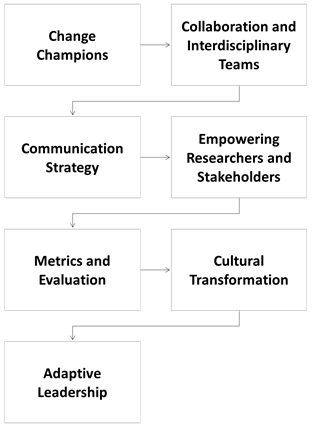
Creating a culture that values collaboration, interdisciplinarity, and societal buy-in and engagement motivates researchers to approach their work with a broader perspective. An adaptive leadership approach will be most effective in the ongoing change process, with researchers remaining open to feedback and adaptable to evolving societal needs and challenges, ensuring continuous progress in advancing impactful, tangible scientific outcomes. This approach resembles the adaptive management concept used in environmental and land-management sciences [23, 24, 25].
It’s worth noting that various approaches can be employed to align with society’s science and research needs. It is not the objective of this article to detail them all but to present an adaptable and transferable method widely accepted across industries (including agriculture). Notably, the approach recognizes the multifaceted complexity of sound science and societal acceptance and provides a strategic framework to effect meaningful change amid diverse perspectives. Ultimately, it encourages scientists to conduct valuable use-inspired research and actively contribute to solving contemporary global challenges, ensuring a positive difference in society while continually striving towards sustainable development of agricultural practices.
Synthesis and Conclusions
The looming mid-century global food crisis presents an unprecedented challenge driven by population growth and requiring substantial cereal and meat production increases. Challenges like climate change anomalies already impact crop production, necessitating technological advancements in plant and animal production efficiencies. Use-inspired design, rooted in translational research, acts as a bridge, translating scientific knowledge into actionable solutions. Organizational change leadership and management approaches can be pivotal in guiding significant use-inspired outcomes, recognizing the human and cultural factors influencing adaptation. Effective change management communicates a clear vision to stakeholders, involves influential change champions, and fosters the buy- in and engagement of stakeholders. Strategic messaging, researcher empowerment, and shifting success metrics incentivize researchers to align their work with real-world needs. Creating a culture valuing collaboration and societal engagement motivates researchers to approach their work with a broader perspective. An adaptive leadership approach ensures continuous progress in advancing impactful, tangible outcomes. Ultimately, organizational change and use-inspired design approaches encourage scientists and managers to contribute to solving global challenges while making tangible positive differences for the stakeholders they serve.
Funding
This work was supported by the USDA National Institute of Food and Agriculture, Hatch project accession number 1011536, McIntire Stennis accession number 7003934, and the West Virginia Agricultural and Forestry Experiment Station. Additional funding was provided by the USDA Natural Resources Conservation Service, Soil and Water
Conservation, Environmental Quality Incentives, Program No: 68-3D47-18-005, the Environmental Protection Agency, Grant No. D-96362401-0, and a portion of this research was supported by Agriculture and Food Research Initiative Competitive, Grant No. 2020-68012-31881 from the USDA National Institute of Food and Agriculture. The results presented may not reflect the sponsors’ views, and no official endorsement should be inferred. The funders had no role in study design, data collection and analysis, the decision to publish, or the preparation of the manuscript.
Acknowledgments
The author appreciates the feedback of anonymous reviewers, whose constructive comments improved the article.
References
-
Wise TA (2013) Can we feed the world in 2050? A scoping paper to assess the evidence. Global Development and Environment Institute Working Paper.
-
Brundtland GH (1987) Presentation of the Report of World Commission on Environment and Development to African and International and Non-governmental Organizations. Nairobi, Kenya; World Commission on Environment and Development.
-
Hubbart JA, Guyette R, Muzika RM (2016) More than Drought: Precipitation Variance, Excessive Wetness, Pathogens and the Future of the Western Edge of the Eastern Deciduous Forest. Sci Total Environ 566-567: 463-467,
-
Kutta E, Hubbart JA (2019) Observed climatic changes in West Virginia and opportunities for agriculture. Regional Environmental Change 19: 1087-1099.
-
Derno M, Nürnberg G, Kuhla B (2019) Characterizing the metabotype and its persistency in lactating Holstein cows: An approach toward metabolic efficiency measures. Journal of Dairy Science 102(7): 6559-6570.
-
Moe P (1981) Energy Metabolism of Dairy Cattle. Journal of Dairy Science 64(6): 1120-1139.
-
Tester M, Langridge P (2010) Breeding technologies to increase crop production in a changing world. Science 327(5967): 818-822.
-
Stokes DE (2011) Pasteurs quadrant: Basic science and technological innovation; Brookings Institution Press.
-
Massari S (2021) Transforming research and innovation for sustainability: Transdisciplinary design for future pathways in agri-food sector, pp: 315-326.
-
Prost L, Berthet ET, Cerf M, Jeuffroy MH, Labatut J, et al. (2017) Innovative design for agriculture in the move towards sustainability: scientific challenges. Research in Engineering Design 28: 119-129.
-
Massari S (2021) The challenge of transdisciplinarity: Design methods for agri-food innovation and sustainability. Transdisciplinary Case Studies on Design for Food and Sustainability, pp: 1-22.
-
Abobatta WF (2021) Precision Agriculture. Precision Agriculture Technologies for Food Security and Sustainability.
-
Gebbers R, Adamchuk VI (2010) Precision agriculture and food security. Science 327(5967): 828-831.
-
Ha TM (2014) A Review on the Development of Integrated Pest Management and Its Integration in Modern Agriculture. Asian Journal of Agriculture and Food Sciences 2(4).
-
Kogan M (1998) Integrated pest management: historical perspectives and contemporary developments. Annu Rev Entomol 43: 243-270.
-
Kotter JP (2012) Leading Change; Harvard Business Press: Harvard Business School, Brighton, Massachusetts.
-
Kotter JP (2007) Leading change: Why transformation efforts fail. In: Museum Management and Marketing Routledge, pp. 20-29.
-
Hubbart JA (2023) Organizational Change: Considering Truth and Buy-In. Administrative Sciences 13(1): 3.
-
Hubbart JA (2023) Organizational Change: The Challenge of Change Aversion. Administrative Sciences 13(7): 162.
-
Hubbart JA (2022) The Coming Food Crisis: A Moment for Organizational Change at a Global Level. International Journal on Agriculture Research and Environmental Sciences 3: 3.
-
Gilley A, Gilley JW, McMillan HS (2009) Organizational change: Motivation, communication, and leadership effectiveness. Performance Improvement Quarterly 21(4): 75-94.
-
Hassan AT (2018) Organizational Change Management: A Literature Review. CGN: Case Studies.
-
Heathcote IW (2009) Integrated watershed management: principles and practice; John Wiley & Sons.
-
Hubbart JA (2020) Integrated Water Resources Research: Advancements in Understanding to Improve Future Sustainability. Water 12(8): 2208.
-
Prodanovic P, Simonovic SP (2010) An Operational Model for Support of Integrated Watershed Management. Water Resources Management 24: 1161-1194.
- Enhancement of Vegetative Growth and Fruit Yield in Cucumber (Cucumis sativus L.) via Spiritual Blessing (Biofield) Energy Intervention
- Production of Açaí (Euterpe oleracea Mart.) under Different Agroforestry System Management Intensities in Amazonian Floodplain (Varzea) Forests
- Coffee and the Production Region: What is the Secret to the Expression "Quality"?
- Experiential Agripreneurship Training in Sub-Saharan Africa: Integrating a Business Incubator into Postgraduate Livestock Education at the University of Buea
- Advances in Agricultural High-Quality Development
- Linking Compost Residue to ABAGE in Plants - a Short Note