
Development of a Charcoal-Heated Egg Incubator for Family Poultry Farming
The high cost and the epileptic nature of electricity supply in Nigeria has adversely affected the rate of poultry farming which resulted in high cost of poultry products. Hence, the need to have an alternative energy source that is renewable, inexhaustible, readily available, cheap and storable. The developed charcoal-heated egg incubator consists of two distinct units which are the heating and incubating units. The heating unit consists of two charcoal burners which generate heat and the heated air in the heating chamber flows through a pipe by natural drift through the incubating chamber where the eggs are kept for incubation to take place. The objective of this study is to develop a charcoal heated egg incubator with a temperature regulatory device and carry out the performance evaluation. The developed charcoal heated egg incubator had workability efficiency of 63%.
Introduction
Poultry farming can be referred to as the domestication of birds such as chickens, turkeys, geese and ducks for the purpose of meat, eggs and commercial purposes while Family poultry is a small-scale poultry farming by households engaging family labour and employing the use of locally available feed resources and shelter for poultry rearing [1, 2]. People are directly or indirectly involve in poultry production than any other agricultural enterprise [3]. Family poultry in Nigeria represents approximately 94% of total poultry farming, and this accounts for almost 40% of the estimated value of livestock resources in the country [4, 5]. Traditional small-scale chick production system is most economically produced by natural incubation with a broody hen laying on a clutch of eggs and the most vital factor of incubation is the constant temperature required for its development over a specific period [6, 7]. The fast increasing population of Nigeria has culminated to higher consumption of poultry products. Hence, natural incubation is inadequate to meet up with the gross demand and consumption of poultry products. Some of the limitations of natural incubation as identified by Olaoye IO [8] and Abiola SS [9] includes the few number of eggs incubated per hen, high cost of feeding and veterinary services. Artificial incubation avails the opportunity of incubating more eggs per incubation period, reduction of veterinary services and eliminating loss of eggs from rodents and reptiles [10]. However, the major limitation of artificial incubation in Nigeria is lack of sustainable power generation and high cost of imported incubators [11, 12].
Most incubators in Nigeria are powered from the National electricity grid which is epileptic and unreliable and imported electricity generating sets which are expensive with prevailing high cost of fuel [13, 14]. However, the use of charcoal energy which is considered cheap for incubation had not been adequately utilized. Charcoal energy is a cost free energy, it’s cheap, readily available, a sustainable and reliable source which is renewable and inexhaustible. The source of energy for artificial incubation is a major challenge in churning out chickens for poultry production. Today, the high cost and epileptic nature of electricity supply especially in Nigeria decelerates the jet-speed of poultry farming [3, 15]. Consequently, resulting in high cost of poultry products. Hence, the need to have an alternative energy source that is renewable, inexhaustible, readily available, cheap, convertible, harvestable and storable [16, 17]. The incorporation of charcoal as a renewable energy source for egg incubation would make poultry egg incubation more successful, cheap, easier and environmentally friendly [18, 19].
The objective of this study is to develop a charcoal heated egg incubator with a temperature regulatory device and carry out performance evaluation on the developed incubator. Making it affordable and less problematic for family poultry farming and low-income farmers to increase production significantly by reducing egg scarcity and wastage. Thus, alleviating the related problems associated with incubating facilities. Figures 1 & 2 shows the daily changes in the weight and form of developing chick embryo and the various stages of egg development [20, 21, 22].
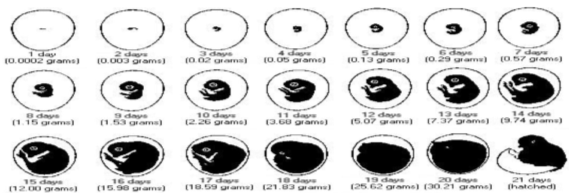
Source: Lourens A, et al. [17]. Figure 1: Daily changes in the weight and form of a developing chick embryo.
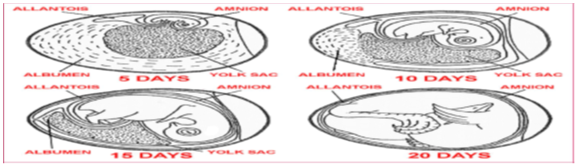
Source: Lourens A, et al. [17]. Figure 2: Egg development stages.
Materials and Methods
The materials for the design and fabrication of charcoal heated egg incubator includes mild steel angle bar, 3mm square pipe, quarter rod, cardboard material, 2mm mild steel plate, fiber glass, electrodes, pairs of hinges and bolts, door handle, temperature gauge, bucket of paint (green), burner, charcoal, 4 by 2 galvanized iron sheet [23].
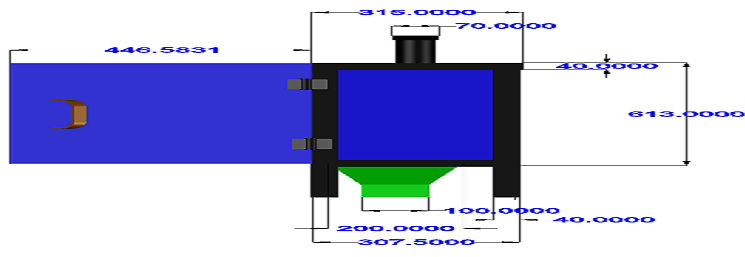
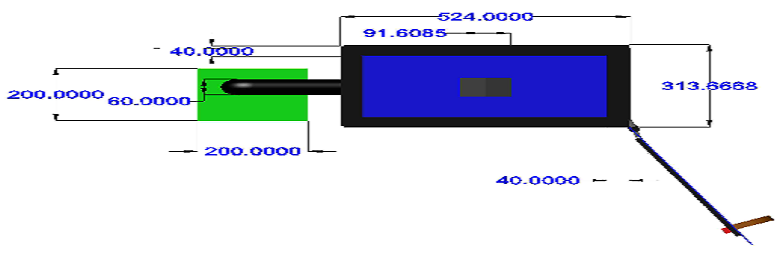
Mild steel angle bar was used for the body frame. The dimension used for the body frame using the angle bar is 805mm on vertical and 524mm on the horizontal side.
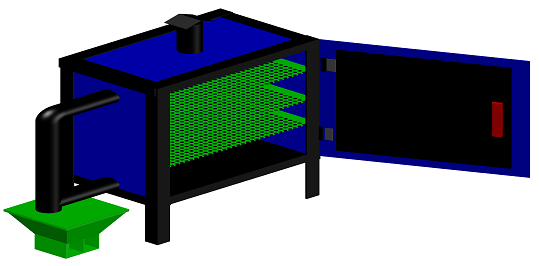
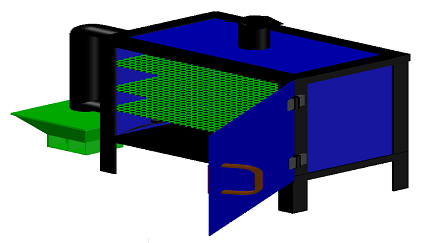
Cardboard material was used as an insulating material due to the fact that it is a poor conductor of heat. It is used for the walls of the incubator chamber to minimize heat loss to the surroundings with heat conductivity of 0.064J/sm2 (0c/m) at 300 Celsius. The temperature monitor/gauge indicates the temperature of the incubating chamber. The indication of this temperature being attained inside the chamber enables one to know the temperature at which the egg incubates. With this one can either increase or reduce the temperature of the chamber. Reducing or increasing the flame can attain series of temperature. The heat distribution plate is a mild steel plate of 2mm thickness. This plate prevents the possibility of direct heating of the eggs by the burner. In this process, the possibility of burning the eggs with direct frame is eliminated. The plate also acts as heat spreader to the surrounding air in the incubating chamber. The galvanized pipe is a pipe of 4mm thickness that was used as chimney and channel that heat flows through to the incubating chamber. Mild steel quarter rod is a rod with 5mm thickness, which was used to hold the tray in the incubating chamber for proper circulation of hot air in the drying chamber. The egg incubator using charcoal as a source of heat consists of two distinct unit while the second is the incubating chamber. The heating unit consists of two charcoal burner (combustion device) which generates heat by burning the wicks. The heated air in the heating chamber flows through a pipe by a natural drift through the space created beside walls of the incubating chamber where the eggs are kept for the incubating process to take place [24].
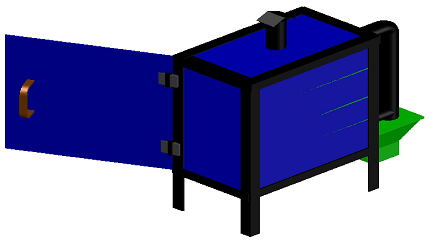
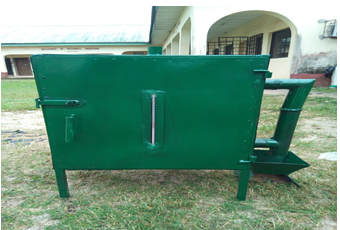
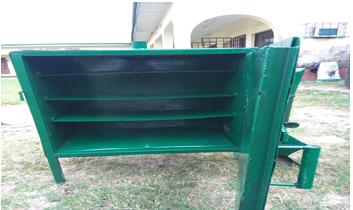
The egg incubator consists of three trays which are linked between the two walls of the incubating chamber with wood for easy movement of hot air. The heat generated by the combustion device is then forced by natural drift through the air channel and then to the chimney after heating the back walls of air channel to the incubating chamber. The heat in the hot air is conducted through the walls of air channel to the incubating chamber whose temperature is indicated by a temperature regulator (thermometer). The door is lagged as well as the walls of the incubator itself to minimize heat loss to the surrounding. Figures 3-5 shows the designed isomeric views while Figures 6 & 7 shows the outer and inner views of the developed charcoal heated incubator [25].
Design Calculation of Charcoal Heated Egg Incubator
The stoichiometric analysis for the combustion of charcoal a hydrocarbon is as follows:
$$ \mathrm {C H} _ {2 8} + 2 0 \mathrm {O} _ {2} \rightarrow \mathrm {C O} _ {2} + 1 4 \mathrm {H} _ {2} \mathrm {O} $$ The equation above represents a complete combustion equation for charcoal
Determination of Fuel-Air Ratio
$$ \mathrm {C H} _ {2 8} + 2 0 \mathrm {O} _ {2} \rightarrow \mathrm {C O} _ {2} + 1 4 \mathrm {H} _ {2} \mathrm {O} $$ $$ (1 2) + (2 8 \times 1) + (2 0 \times 2 \times 1 6) \rightarrow (1 2) + (2 \times 1 6) + (1 4 \times 2) + (1 4 \times 1 6) $$
40 640 44 252 = + → +
This implies that 404g of CH28 combined with 640g of O2 to yield 44g of CO2 and 252g of H2O. Dividing all through by 40 will give:
Therefore, 1kg of charcoal needs 16kg by mass of air for complete combustion. the volume of air needed for complete combustion of 1kg of charcoal is calculated as follows:
$$\rho = m/v$$
$$v = m/g$$
Where, $\rho$ = density of air
$$M = \text{mass of air}$$
$$V = \text{volume of air}$$
$$\text{Mass of air} = 16\text{kg}$$
$$\text{Density (g)} \text{ of air} = 1.393608\text{kg/m}^3$$
$$= 1.3\text{kg/m}^3$$
Therefore, $v = m/g$
$$16/1.3 = 12.31\text{m}^3$$
**Calorific Value (Heating Value) of Charcoal**
The calorific value of charcoal is 29.0mj/kgOC/hr and energy released by complete combustion charcoal per second is:
$$= \frac{29.0 \times 10^6}{60 \times 60}$$
$$Q = 8055.6\text{J/s}$$
$$Q = 8055.6\text{watts}$$
The amount temperature inside the incubator is therefore; $T_3 = 100^\circ\text{C}$
Thickness of the metal wall is $2\text{mm} = 0.002\text{m}$
Conductivity (K2) of mild steel material used for the inside chamber wall at $= 100^\circ\text{C} = 43.24\text{sm}^2$ ($c/\text{m}$).
To get the interface temperature $T_4$, we have:
$$T_3 - T_4 = \frac{Q(x_2 - x_1)}{K_2A_d}$$
Therefore, $-T_4 = \frac{Q(x_2 - x_1)}{K_2A_d} - T_3$
Taking $A = 1$
$$-T_4 = \frac{8055.6(0.002)}{43.24} - 100$$
- $T_4 = -99.02$
- $T_4 = 99.022^\circ\text{C}$
Before determining the thickness of insulation, the interface temperature $T_5$ is needed. The conductivity of cardboard insulation is $0.64\text{J/sm}^2$ ($^\circ\text{C/m}$) at a temperature of 30oC.
Taking $T_5$ to be 25o C, we have:
$$X_3 - X_2 = 0.64 \frac{(99.02 - 25)}{8055.6} = 0.002\text{mm}$$
Theoretically, insulation with cardboard of 2mm thickness is appropriate.
N/B: The actual conductivity of cardboard insulation = $0.37\text{btu/hrft}^2$
Converting the value to $J/\text{sm}^2$ ($^\circ\text{C/m}$)
$$0.37 \times 1.7296 = 0.639952 \text{J/sm}^2$$
$$= 0.64 \text{J/m}^2$$
**Efficiency of the Incubator**
The efficiency of the incubator can be expressed in terms of total energy generated, how much of this is utilized and how much is lost.
$$\text{Efficiency} = \frac{\text{Energy utilized}}{\text{Total energy generated}} \times \frac{100}{1}$$
$$= \frac{\text{Heat generated} - \text{Heat lost}}{\text{Heat generated}} \times \frac{100}{1}$$
Total energy generated (heat generated) = 8055.6J
Energy lost through conduction on the wall of the (incubator) to the outside is:
$$Q_{cd} = \frac{1 + 0.002 + 0.002 + 0.002}{30} \frac{43}{0.1} \frac{43}{43}$$
$$\frac{75}{0.033 + 0.0000465 + 0.02 + 0.0000465}$$
$$\frac{75}{0.053093}$$
$$= 1412.62\text{J/S or Watts}$$
The heat lost to outside air due to convention.
$$Q_{CV} = h(T_6 - T_7)$$
$h = 800\text{W/M}^2$
T7 can be taken to be the room temperature
$$Q_{cv} = 800 \text{ (25 - 23)}$$
$= 1600\text{J/S or watts}$
The heat lost to the outside due to radiation
$$Q_{rd} = q(T_6^4 - T_7^4)$$
$= 5.672 \times 10^{-8} \text{ (254 - 234)}$
$= 5.672 \times 10^{-8} \text{ (110784)}$
$= 0.0062837\text{watts}$
The heat can be neglected since it is negligible, then total heat lost due to convention and conduction is given as:
$$= Q_{CV} + Q_{cd}$$
= 1600 + 1412.62 = 3012.62 watts Thus, the efficiency of the incubator can then be estimated as:
Heat generated Heat lost 100 Heat generated 1 − ×
$$ = \frac {8 0 5 5 . 6 - 3 0 1 2 . 6 2}{8 0 5 5 . 6} \times \frac {1 0 0}{1} $$
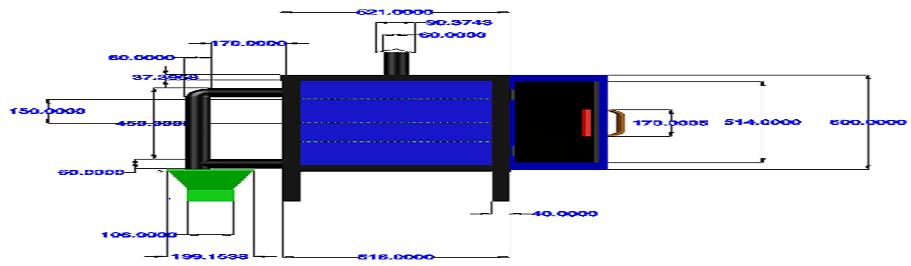
= 63% Figures 8-10 shows the dimensional orthographic views of the designed charcoal heated incubator.
Results and Discussion
At the end of construction of the incubator, performance test was done to determine its efficiency. Chicken egg which require 21 days of incubation were used in carrying out the test on the incubator. A total of 23 days were spent for the testing of the incubator. The first two (2) days were used for sanitation, fumigation and running of the incubator to allow for the detection and possible rectification of defects before eggs were set. A total of 6 eggs were set on two levels of trays (each containing three eggs) while the incubation process started immediately. On the seventh day of incubation, the eggs were candled to find out the fertile eggs. This process of exposing the egg to a beam of candle light is done to see if the eggs are shrimp, which connotes fertility. On the other hand if the egg is infertile, it will not show any shrimp [19]. It was discovered that 3 eggs each from the top and the bottom tray were fertile, thus a total of 6 fertile eggs.
On the 12th day one egg was picked from the top and bottom trays and broken to determine the level of the embryonic development. It was discovered that the embryo has developed features like, eyes, beak, feathers, wings, legs etc. The level of the embryonic development at this stage was clearly noted. An egg from the top tray was broken and it was observed and noted that there was no sign of embryonic development, this shows that it is infertile. On the 18th day of incubation, a fertile egg from the bottom tray was broken to observe the level of embryonic development. There were pronounced embryonic development in the fertile egg. Lastly, on the 21st day, which was the expected day for complete incubation of chicken eggs, the remaining two eggs hatched on that day. The result indicates that the incubator developed was successful as it has given an optimum climatic condition for incubation which is similar to that of natural conditions for incubation. More so, it is cheap, easy to operate and portable. It can be produced in mass and can be operated by non-skilled personnel. Table 1 shows the mean temperature, mean relative humidity and turning angle of the developed charcoal heated incubator.
| Mean Temperature (°C) | Mean Relative Humidity (%) | Mean Clockwise and Anti clockwise turning (Every 4hrs) | |
|---|---|---|---|
| 1 | 37 (±2.0) | 55 (±1.5) | 47, -47 |
| 2 | 38 (±1.0) | 50 (±2.0) | 48, -48 |
| 3 | 40 (±0.5) | 55 (±1.0) | 45, -45 |
| 4 | 36 (±3.0) | 60 (±1.2) | 46, -46 |
| 5 | 37 (±2.0) | 50 (±2.4) | 47, -47 |
| 6 | 38 (±1.5) | 55 (±1.0) | 48, -48 |
| 7 | 37 (±1.0) | 60 (±0.5) | 46, -46 |
| 8 | 39 (±0.5) | 55 (±2.0) | 45, -45 |
| 9 | 38 (±2.0) | 60 (±1.5) | 47, -47 |
| 10 | 37 (±3.2) | 60 (±0.8) | 48, -48 |
| 11 | 36 (±2.0) | 55 (±2.2) | 47, -47 |
| 12 | 38 (±2.5) | 50 (±2.5) | 46, -46 |
| 13 | 37 (±3.0) | 55 (±1.8) | 45, -45 |
| 14 | 39 (±2.2) | 60 (±1.0) | 46, -46 |
| 15 | 40 (±0.5) | 50 (±2.0) | 46, -46 |
| 16 | 37 (±2.0) | 60 (±0.5) | 48, -48 |
| 17 | 36 (±3.2) | 55 (±2.4) | 47, -47 |
| 18 | 37 (±2.4) | 50 (±2.0) | 46, -46 |
| 19 | 38 (±1.6) | 55 (±1.5) | 45, -45 |
| 20 | 37 (±2.5) | 60 (±0.5) | 47, -47 |
| 21 | 36 (±3.0) | 60 (±1.0) | 48, -48 |
Table 1: The Mean Temperature, Mean Relative Humidity and Turning Angle of the Developed Charcoal Heated Incubator.
Observations were made from 1st day to the 21st day and various developmental progresses were noted and observations were on the regulation of temperature. It takes the incubator one hour to strike minimum temperature of 36ºC and three hours to get to the maximum temperature of 40ºC using thermometer to measure the temperature. The two, most common word used by poultry are fertility and hatchability and to arrive at the mathematical percentages, we have: Percentage of fertility which is the percentage of the fertile eggs in the developed incubator.
Number of fertileegg Fertility Thenumber of eggset for production =
3.8 100
From thetest wehave:Fertility
$$ r = \frac {3 . 8 \times 1 0 0}{6 1} = 6 3 $$ It is imperative that the fertility and hatchability percentage must be kept high to avoid considerable financial losses most especially when the incubator is run. It is as a commercial venture serving the open market at a targeted production level to maximize profit. For optimal performance of the incubator it is advised that there must be a maintenance schedule. To enhance profit various does and don’ts should be observed visa-vis the cleanliness of the incubator, and selection of eggs, temperature of storage should be 12ºC – 15ºC and 70 – 75% humidity. Eggs should never be stored for more than 14 days as hatchability probability begins to decline significantly after 14 days. It is important that before setting of eggs the eggs must be allowed to attend room temperature of (20oC –26oC). The incubator should be situated at a place where ventilation is free and air circulation is adequate.
Conclusion
The charcoal heated egg incubator was constructed with workability of 63% efficiency. The incubator replicates the conditions of natural incubation. Therefore, is recommended for hatching of chicken and other poultry products. The portability, sensitivity, reliability and simplicity of machine’s operation proved to be a dependable egg incubator for family poultry production.
References
-
Hagen M (2010) Artificial incubation applied to small numbers of artificial bird eggs. Reviews 20(1): 10-20.
-
Shittu S, Abubakar SM, Jimoh NO, Abubakar SM (2017) Development of an automatic bird-egg incubator. Research and Reviews: A Journal of embedded systems and applications 5(1): 1-10.
-
Sani RM, Tahir I, Kushwaha S (2000) Economics of poultry production in Bauchi State: A case study of Bauchi LGA. Nigeria J of Animal Production 27(1): 109 -113.
-
Ajani AS, Olusoji AO, Egbeyale GB, Adeniji MO (2020) Design and construction of automated eggs incubator for small scale poultry farmers. International Journal of Technical Research and Science 7(2): 1-10.
-
Benjamin AA, Oye ND (2012) Modification of the design of poultry incubator. International Journal of Application in Engineering and Management 4(1): 1-10.
-
Benjamin N, Oye ND (2012) Modification of the design of poultry incubator. International Journal of Application in Engineering and management 1(4): 90-102.
-
Adegbulugbe TA, Atere AO, Fasanmi OG (2013) Development of an automatic electric egg incubator. International Journal of scientific and Engineering Research 6(2): 9-16.
-
Olaoye IO, Lawal BM, Ibrahim SO, Sanusi BA (2013) An electrically operated incubator for household. Green Journal of Science, Engineering and Technological Research. 3(5): 160-165.
-
Abiola SS (2008) Effects of turning frequency of hen’s eggs in electric table type incubator on weight loss, hatchability and mortality. African Journal of Biotechnology 7(3): 31-43.
-
Elibol O, Brake J (2004) Identification of critical periods for turning broilers hatching eggs during incubation. Poultry Science 45(1): 631-637.
-
Bellman O, Wilard F (2001) Lighting the stage: Art and Practice. In: 3rd (Edn.), The Control Console, Broadway Press, Inc.
-
Adewumi BA, IA Fawape, Arogunjo AM (2001) Design, construction and testing of an optical device for the determination of egg fertility. GJPAS 7(1): 117-120.
-
Demuth JP (2001) The effects of constant and fluctuating incubation temperatures on sex determination, growth, and performance in the tortoise Gopherus polyphemus. Can J Zool 79: 1609-1620.
-
Alabi RA, Isah AO (2002) Poultry production constraints. The case of Esan-West LGA of Edo State Nigeria. AJLE 1: 58-61.
-
Yildirim I (2004) Effects of different hatcher temperatures on hatching traits of broiler embryos during the last five days of incubation. South African Journal of Animal Science 34(4): 211-216.
-
Lourens A (2001) The importance of air velocity in incubation. World Poult 17: 29-30.
-
Lourens A, Van den Brand H, Meijerhof R, Kemp B (2005) Effect of eggshell temperature during incubation on embryo development, hatchability and post-hatch dev. Poult Sci 84: 914-920.
-
Okonkwo WI (2012) Characterization of a photovoltaic powered poultry egg incubator. 4th International Conference on Agriculture and Animal Science 47: 90- 102.
-
Agboola AK (2013) Increasing livestock production in Nigeria: Development of cost effective models for big egg incubator. International Journal of Emerging Technology and Advanced Engineering 3(3): 707-716.
-
Arocha CG, Simonyan KJ, Paul T (2021) Performance evaluation of a motorized ginger rhizomes peeling machine. Journal of Agricultural Engineering 46(4): 84- 96.
-
Asian UE, Paul T (2022) Some physical properties of Taro cocoyam relevant to the design of its processing machines. Scientific Journal of Agricultural Engineering 47(4): 48-57.
-
French NH (1997) Modeling incubation temperature: the effects of incubator design, embryonic development and egg size. Poultry Sci 76: 124-133.
-
Nwakuba NR, Ndukwe S, Paul T (2021) Influence of product geometry and process variables on drying energy demand of vegetables. Journal of Food Process Engineering 136: 1-16.
-
Orhevba BA, Bankole OS, Paul T (2019) Influence of heat treatment on microbial quality of Tigernut-soymilk blends. Umudike Journal of Engineering and Technology (UJET) 4(2): 1-8.
-
Simonyan Kj, Onu OO, Kadurumba CH, Okafor-Yadi O, Paul T (2022) Design and development of a multi tasks motorized ginger rhizomes juice expression machine. Scientific Journal of Agricultural Engineering 47(3): 56- 66.
- Enhancement of Vegetative Growth and Fruit Yield in Cucumber (Cucumis sativus L.) via Spiritual Blessing (Biofield) Energy Intervention
- Production of Açaí (Euterpe oleracea Mart.) under Different Agroforestry System Management Intensities in Amazonian Floodplain (Varzea) Forests
- Coffee and the Production Region: What is the Secret to the Expression "Quality"?
- Experiential Agripreneurship Training in Sub-Saharan Africa: Integrating a Business Incubator into Postgraduate Livestock Education at the University of Buea
- Advances in Agricultural High-Quality Development
- Linking Compost Residue to ABAGE in Plants - a Short Note