
A Policy Brief on the Application of Artificial Insemination (AI) in Lanao del Sur
This paper is a policy brief regarding the application of the Artificial Insemination (AI) as a mode of reproductive technology in Lanao del Sur. Lanao del Sur is one of the provinces in the Bangsamoro Autonomous Region in Muslim Mindanao (BARMM), the dwelling of Meranao tribes who practice Islam as their religion. The province has favorable climatic conditions for agricultural productions both in crops and animals’ production. Lanao del Sur is a landlocked province and is agriculturally rich having a well-suiting climate and extensively arable land, and it has a growing inventory of livestock such as carabao, cattle, goat, duck and chicken. This policy brief was based on the research findings conducted regarding the perceptions and acceptance of the AI among livestock growers. The goal of this policy brief is to provide baseline data about the farmers perceptions on AI and formulate a research-based policy recommendation to help the LGU, implementing agencies and the farmers for effective and efficient implementation of AI program in the province. The6 following are the salient points: 1) Meranao livestock growers’ perceptions about using Artificial Insemination (AI). 2) Capacitating the farmers towards adoption of artificial insemination, and breeding programs. 3) Ensuring efficiency of livestock production among farmers. 4) Increase the livestock production in Lanao del Sur.
Introduction
Artificial insemination (AI) has been practiced for more than decades all over the world instead of natural mating in many species of animals because of the many benefits it can gain, such as increased safety of the animals and producer, increased production efficiency and better genetics, and reduce many of the risks involved with breeding. However, despite of the benefits it can give, majority of the Meranao farmers in Lanao del Sur are still using natural mating. According to a survey conducted, Artificial Insemination (AI) is not usually known and practice by the livestock raisers in Lanao del Sur due to some reasons such as; no knowledge about AI and it is not promoted in their municipality [1]. Lanao del Sur is a landlocked province and is agriculturally rich having a well-suiting climate and extensively arable land, and it has a growing inventory of livestock such as carabao, cattle, goat, duck and chicken. However, in spite of that, livestock farming is still in marginal status. Thus, the goal of this policy brief is to provide baseline data about the farmers perceptions on AI and formulate a research-based policy recommendation to help the LGU, implementing agencies and the farmers for effective and efficient implementation of AI program in the province.
Research & Survey Results
Results from the Philippines Statistics Authority (PSA) [2] about Carabao production in the Philippines indicates a decline of -1.2 percent from its previous year’s same period count of 2.77 million heads. From this result, BARMM where Lanao del Sur is one of its provinces rank 3rd from the bottom in Carabao production (Figure 1).
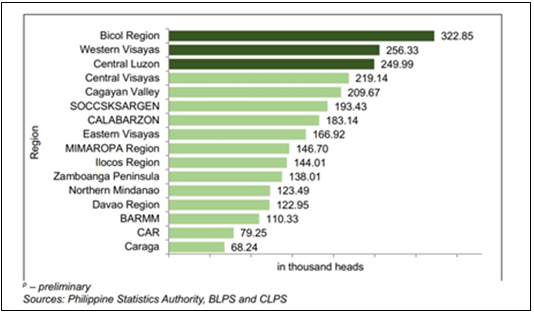
Since livestock production in the province is still in marginal status, the government tied up the NDA to help augment the livestock production. The NDA has distributed liquid nitrogen tanks containing cattle semen for breeding to the local government, and 10 dairy cattle to local farmers from the Hanes Integrated Farm and Agri-Marketing Cooperative (HIFAMCO). This project is a crucial component of NDA’s livestock program, which focuses on improving animals using artificial insemination [3]. However, the success of this project lies among the Local Government Units (LGU) and farmers acceptability towards AI. Thus, it is necessary and crucial to determine the perceptions of the farmers towards AI to ensure acceptability of the said project provided by the NDA.
A cross-sectional descriptive survey among 203 Meranao livestock farmers in selected 9 municipalities in Lanao del Sur was conducted Valdez AV, et al. [1] to determine the reproductive method use by the livestock growers and obtained their perceptions towards Artificial Insemination (AI). Based on the data gathered, the livestock growers in Lanao del Sur who responded in the survey were not aware about AI, and the status of AI in their municipality is very low or not promoted, since they strongly disagree in terms of awareness and status. However, they are willing to accept and try AI for their livestock farming. Farmers adoptions of AI is influence by different factors such as their lack of knowledge resulted to some misconceptions about AI, but they are willing to adopt AI as long as they will be educated about the technology. AI success rate was influence by various factors such as the technician profile, and practices of AI technician, and the attitudes of the farmers [4, 5].
Research-Based Policy Recommendations
From the results of the survey, the following research- based policy were forwarded:
- To ensure the acceptability of AI program among farmers, seminar workshops must be extended to them introducing AI, the mechanics, and the benefits of using AI in livestock production, and to make them keep abreast of the advances in dairy and livestock farming.
- The LGU, municipal Agriculture, and universities must improve service access and delivery of information towards modern reproductive technology to rural farmers through extension programs services. All agencies concerns must be properly coordinated to effectively and efficiently deliver the services.
- The LGU and municipal Agriculture must provide at least 3 regular AI technician in each municipality, and assigned a local agriculturist or its’ counterpart in every barangay to help farmers livestock productions.
- The program or project implementers of AI must be incentivized to motivate them to work effectively. Merits and rewards must be given in every success project/ program that they implemented.
- The LGU must provide constant assistance (agriculturist, cash, or in kind) to capacitate the livestock growers and closely monitor them.
Conclusion
This paper is a policy brief formulation based on the research survey conducted to provide baseline data about the farmers perceptions on AI and formulate a research- based policy recommendation to help the LGU, implementing agencies and the farmers for effective and efficient implementation of AI program in the province. From the survey results, five research-based policy are recommended to successfully implement the AI technology in the province. It was noted in the results of the survey that the livestock growers are very eager to learn the technology and willing to adopt such technology with the condition that they will be oriented and expose to training or seminars about AI. Thus, the recommended research-based policy is very crucial to guide the Local government Units (LGU), Department of Agriculture, and other related agencies to design a project and programs regarding the implementation of the AI in the province.
References
-
Valdez AV, Amba O, Jumalon RA, Dimalna HD, Gomampong AM, et al. (2023) Farmers Perceptions on Artificial Insemination (Al): A Mixed Method Design. European Journal of Theoretical and Applied Sciences 1(3): 299-323.
-
Philippines Statistics Authority (PSA) (2023) Carabao Situation Report April to June.
-
Santos J (2023) NDA provides equipment, livestocks to improve Lanao Del Sur’s dairy industry. National News. Manila Bulletin.
-
Soriano AP, Celestino EF, Urpiano EM (2021) Application of Artificial Insemination (Al) as a Breeding Method for Goat Herd Build Up in Region 3, Philippines. The CLSU International Journal Of Science & Technology 5(2): 1-7.
-
Abigaba R, Sianangama PC, Nyanga PH, Mwenya WNM, Mwaanga ES (2022) Attitudes and preferences of traditional farmers toward reproductive biotechnology application for improved indigenous Pig production in Zambia. World 15(2): 403-413.
- Enhancement of Vegetative Growth and Fruit Yield in Cucumber (Cucumis sativus L.) via Spiritual Blessing (Biofield) Energy Intervention
- Production of Açaí (Euterpe oleracea Mart.) under Different Agroforestry System Management Intensities in Amazonian Floodplain (Varzea) Forests
- Coffee and the Production Region: What is the Secret to the Expression "Quality"?
- Experiential Agripreneurship Training in Sub-Saharan Africa: Integrating a Business Incubator into Postgraduate Livestock Education at the University of Buea
- Advances in Agricultural High-Quality Development
- Linking Compost Residue to ABAGE in Plants - a Short Note