
A Conceptual Approach to the Ecological Footprint as an Indicator of the Environmental Sustainability of Business: A Short Note
This study aims to create a conceptual framework for the ecological footprint as an indicator of the environmental sustainability of business based on a relevant literature review. A theoretical-based conceptual framework study used journal articles searched on reliable internet sources. Based on the literature review, five advantages can be highlighted as a) Identifying Opportunities for Improvement, b) Supporting Informed Decision-Making, c) Demonstrating Corporate Responsibility, d) Contributing to Long-Term Environmental Well-Being, and e) Aligning with Regulatory Compliance. Therefore, measuring ecological footprints can offer advantages and valuable insights. Businesses need to approach it cautiously and consider the potential limitations and complexities associated with this approach. The present proposed conceptual approach could provide a comprehensive view of a business's resource consumption, waste generation, and greenhouse gas emissions, allowing for a quantifiable assessment of its environmental impact and progress towards sustainability goals.
Chee Kong Yap1*, Chee Seng Leow2 and Wing Sum Vincent Leong2
Introduction to Ecological Footprints
The concept of sustainable development has become increasingly important in the economic life of business entities. One of the key indicators of environmental sustainability in business is the ecological footprint. Accountants use ecological footprinting to measure the biological capacity needed for human activities. The firm may increase environmental performance and efficiency by developing environmental management systems and strategies [1]. The ecological footprint measures the impact of human activities and consumption on the environment. It considers resource use, waste generation, and greenhouse gas emissions. The ecological footprint provides a balanced picture of the environmental impact of business activities. It can be considered as one of the key elements for obtaining a comprehensive understanding of the overall sustainability of a business [1, 2, 3, 4, 5].
Business owners may evaluate their resource consumption and environmental effects by analysing their ecological footprint and developing plans to minimise their footprint and promote sustainability. Businesses may use this knowledge to make sustainable decisions that benefit the world [6, 7, 8, 9, 10, 11]. Measurements of ecological footprints help firms find areas for improvement and lessen their environmental effect. Businesses may measure their ecological footprint to assess their resource consumption and environmental effect and develop strategies to minimise their footprint and promote sustainability. Businesses
need this knowledge to make sustainable, planet-friendly decisions. A standardised ecological footprint allows organisations to compare their environmental performance to industry benchmarks and best practices [12, 13, 14, 15, 16, 17, 18, 19, 20, 21, 22, 23].
Many companies are going green. With the right talents, businesses can produce more value with less input. In previous empirical investigations, organisations with eco-efficient operations were rated more. Thus, company efficiency and excellence will improve [2]. Al-Najjar B, et al. [2] studied the relationship between eco-efficiency, environmental legislation, and corporate value in the UK from 1999 to 2008. Different definitions of ‘eco-efficiency’ revealed novel environmental–financial performance insights. They found that eco-efficient enterprises in the UK had greater market values than those without environmental policies. Hence, they recommended that firms become involved in environmental policies since adopting them will positively impact firm value.
This study aims to create a conceptual framework for the ecological footprint as an indicator of the environmental sustainability of business based on a relevant literature review.
The Advantages of Measuring Ecological Footprints in Business
Based on the literature review [1, 2, 3, 4, 5, 6, 7, 8, 9, 10, 11, 12, 13, 14, 15, 16, 17, 18, 19, 20, 21, 22, 23]. Five advantages can be highlighted below. These initiatives demonstrate a growing global recognition of the importance of measuring and reducing ecological footprints in business. By aligning with international efforts and best practices, businesses can position themselves as responsible stewards of the environment and contribute to global sustainability goals.
- Identifying Opportunities for Improvement: Measuring a business’s ecological footprint allows for identifying areas where environmental impact can be reduced [24, 25, 26, 27, 28]. By quantifying resource consumption, waste generation, and greenhouse gas emissions, businesses can pinpoint opportunities for improvement and develop targeted strategies to enhance sustainability [13, 17, 20, 21, 22].
- Supporting Informed Decision-Making: Understanding their ecological footprint enables businesses to make informed decisions aligned with their sustainability goals. This data-driven approach empowers companies to prioritize initiatives that significantly impact the environment and align with their business objectives [29, 30].
- Demonstrating Corporate Responsibility: By actively measuring and working to reduce their ecological footprint, businesses demonstrate a commitment to corporate social responsibility. This can enhance their reputation, appeal to environmentally conscious consumers, and attract socially responsible investors [31, 32].
- Contributing to Long-Term Environmental Well- Being: Measuring and reducing ecological footprints is a proactive way for businesses to contribute to the long- term health and well-being of the planet. By mitigating their environmental impact, businesses preserve natural resources and ecosystems for future generations [33, 34].
- Aligning with Regulatory Compliance: As environmental regulations evolve, measuring and reducing ecological footprints can help businesses align with these regulations and avoid potential non- compliance issues. Proactively addressing environmental impact may also favour businesses for future regulatory changes [35, 36].
Trend of Literature on Ecological Footprints
On 12 February 2024, using the keyword ‘Ecological footprint’, 1738 papers were reached using the Scopus database, which had high relevancy, between 1992 and 2024. Bibliometric analyses are an established method to evaluate research literature, particularly in scientific fields benefiting from computational data treatment and witnessing increased scholarly output [37]. VOSviewer is a software that generates a clear graphical representation of bibliometric maps, especially for extensive datasets [38]. To highlight the trends of studies conducted on the topic of ‘Ecological footprint’, from 1992-2024 (on 1738 papers from the Scopus database), we performed a bibliometric analysis using the VOSviewer software (VOS stands for visualization of similarities – see www.vosviewer.com). Scopus comprises many significant research papers and offers integrated analysis tools for creating informative visual representations [39]. VOSviewer was employed to analyze each keyword, calculating links, total link strengths, and co-occurrences with other keywords.
This gives a holistic overview of the past research based on keywords’ co-occurrences with ‘Ecological footprint’ (Figure 1). The top panel Figure 1 shows the major clusters based on 1000 keywords (with 8 clusters). The analysis reveals a discernible prominence reflecting four significant clusters based on 50 keywords that can be identified based on visualization in Figure 1 (bottom panel). Cluster 1 includes alternative energy, carbon dioxide, carbon emission, economic development, economic growth, energy use, environmental degradation, environmental economics, environmental policy, environmental quality, gross domestic product, Kuznets curve, natural resources, and renewable energy. Many researchers (>2020) have recently focused on studies such as economic growth, investments, alternative energy, environmental quality, the Kuznets curve, environmental degradation, environmental economics, carbon emission, renewable energy, carbon dioxide, etc (Figure 1; bottom panel).
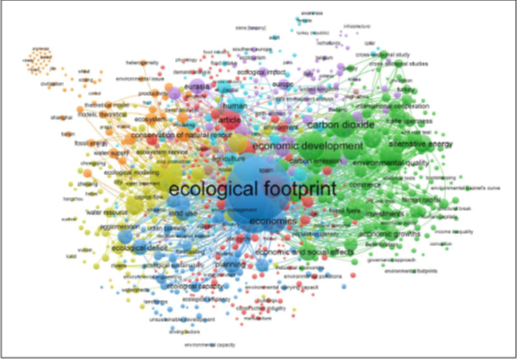
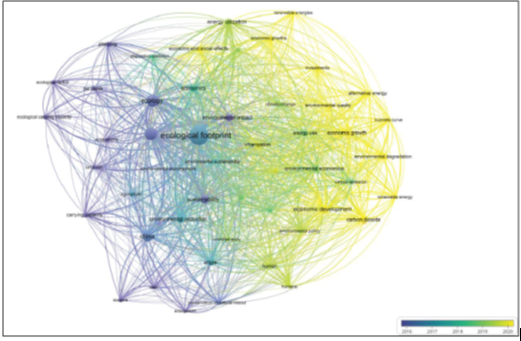
Figure 1: A bibliometric analysis of research themes on ‘Ecological footprint’. Top Panel: Visualization of the paper network confirming the main themes of research. Bottom Panel: Evolution of research trends between 1992 and 2024 based on the Scopus database. The colours in the top panel indicate the 1000 keywords/themes of research the papers are discussing, while the colours (based on 50 major keywords/themes) in the bottom panel indicate the year of publication, based on the Scopus database searched on 12 February 2024.
Proposed Conceptual Approach for Ecological Footprint in Business
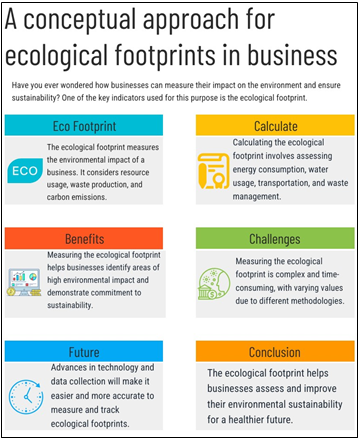
A proposed conceptual approach for ecological footprint in business is shown in Figure 2. This approach comprises eco-footprints (concept), benefits (advantages), calculations (impact assessments), challenges (limitations), and future (the use of artificial intelligence (AI)). To effectively implement the measurement of ecological footprints, businesses can start by conducting a comprehensive assessment of their operational activities, resource usage, and waste generation. This involves collecting data on energy consumption, water usage, material inputs, and emissions across the entire value chain.
Once the data is collected, businesses can utilize established methodologies such as Life Cycle Assessment and Carbon Accounting to quantify their ecological footprint. These methodologies provide a systematic approach to measuring and analyzing the environmental impact of products, services, and organizational operations [3, 20, 21, 22, 23].
Furthermore, businesses can seek guidance from sustainability experts and environmental consultants to ensure the accuracy and reliability of their ecological footprint measurements. Collaboration with industry peers and relevant stakeholders can also provide valuable insights and best practices for ecological footprint management.
Ecological footprint measurement is popular in sustainable business operations, yet it has drawbacks. Quantifying a business’s different environmental consequences is difficult. The ecological footprint includes resource use, waste creation, and greenhouse gas emissions, which are difficult to assess. Different methodology and assumptions can also lead to inaccurate ecological footprint data interpretation, affecting a business’s environmental effect [12, 13]. Standardised ecological footprint comparisons between firms may not offer a clear picture of their sustainability efforts. Businesses operate in diverse industries with varying operational scales and activities, making establishing a universal benchmark for ecological footprint comparisons difficult. This can lead to misinterpretations and misrepresentations of a business’s environmental performance, potentially undermining its actual efforts towards sustainability [13].
In light of these challenges, while measuring ecological footprints can offer valuable insights, businesses need to approach it cautiously and consider the potential limitations and complexities associated with this approach. Alternative approaches and complementary metrics may be necessary to provide a more holistic understanding of a business’s environmental sustainability. The ecological footprint is a valuable indicator to assess the environmental sustainability of business practices [14, 15, 16, 17, 18, 19, 20].
Conclusion
According to the present literature analysis, five benefits are identifying opportunities for improvement, supporting informed decision-making, demonstrating corporate responsibility, contributing to long-term environmental well-being, and aligning with regulatory compliance. Businesses should be careful and recognise their limitations and difficulties. The suggested conceptual method might quantify a business’s environmental effect and sustainability progress by showing its resource use, waste output, and greenhouse gas emissions. Thus, evaluating a company’s ecological footprint provides valuable data and encourages environmental sustainability. It helps companies lessen their environmental impact and meet changing requirements and consumer needs. Several countries have regulated and monitored corporations’ environmental footprints. Despite the challenges of analysing firms’ ecological footprints, the advantages and global movement towards sustainability make it necessary. By measuring and managing their ecological footprints, businesses may enhance environmental stewardship, foster sustainable innovation, and make the planet healthier for future generations. Finally, the ecological footprint is essential to a company’s environmental sustainability.
References
-
Holland L (2003) Can the principle of the ecological footprint be applied to measure the environmental sustainability of business?. Corporate Social Responsibility and Environmental Management 10(4): 224-232.
-
Al‐Najjar B, Anfimiadou A (2012) Environmental policies and firm value. Business Strategy and the Environment 21(1): 49-59.
-
Wiedmann T, Lenzen M, Barrett J (2009) Companies on the Scale. Journal of industrial ecology 13(3): 361-383.
-
Ashraf I, Zehraa S (2020) Sustainable Consumption and Production: An Analysis of Implementation of Pakistan’s Policy Framework of SDG-12. IDEA 4(1): 114-129.
-
Walker B, Redmond J (2014) Changing the Environmental Behaviour of Small Business Owners: The Business Case. Australian Journal of Environmental Education 30(2).
-
Barrett J, Scott A (2001) The Ecological Footprint: A Metric for Corporate Sustainability. Corporate Environmental Strategy 8(4): 316-325.
-
Patsiaouras G, Saren M, Fitchett J (2014) The Marketplace of Life? An Exploratory Study of the Commercialization of Water Resources through the Lens of Macromarketing. Journal of Macromarketing 35(1).
-
Laurenti R, Martin M, Stenmarck Å (2018) Developing Adequate Communication of Waste Footprints of Products for a Circular Economy—A Stakeholder Consultation. Resources 7(4): 78.
-
Khan SAR, Razzaq A, Yu Z, Miller SK (2021) Retracted: Industry 4.0 and circular economy practices: A new era business strategies for environmental sustainability. Business strategy and the environment 30(8): 4001- 4014.
-
Pratono AH (2021) Reinterpreting excellence for sustainable competitive advantage: the role of entrepreneurial culture under information technological turbulence.
-
Campopiano G, Minola T, Sainaghi R (2016) Students climbing the entrepreneurial ladder.
-
Batar M (2022) Efficient Web-Based Application Development for Carbon Footprint Calculation: Example of Burdur Province. Celal Bayar University Journal of Science 18(1): 33-39.
-
Muthu SS (2014) Ways of measuring the environmental impact of textile processing: an overview. Assessing the Environmental Impact of Textiles and the Clothing Supply Chain, pp: 32-56.
-
Zhang QG, Huang Y, Wang S, Chen S (2018) Temporal Dynamics and Spatial Distribution of Water Pollution Footprint in Jiangxi Province from 2004 to 2015.
-
Xiong H, Yi L, He J (2022) Construction and Application of the Evaluation System of Natural Resources Asset Accountability Audit of Officials: A Case Study of Jiangxi, China. Sustainability 14(1): 528.
-
Moscovici D, Dilworth R, Mead J, Zhao S (2015) Can sustainability plans make sustainable cities? The ecological footprint implications of renewable energy within Philadelphia’sGreenworksPlan. Sustainability: Science, Practice and Policy 11(1): 32-43.
-
Burritt R (2004) Environmental management accounting: roadblocks on the way to the green and pleasant land. Business strategy and the environment 13(1): 13-32.
-
Bektur Ç (2023) The role of economic freedom in achieving the environmental sustainability for the highest economic freedom countries: testing the environmental Kuznets curve hypothesis. Research square.
-
Syrovátka M (2020) On sustainability interpretations of the Ecological Footprint. Ecological Economics 169: 106543.
-
Özari Ç, Can E (2023) Financial Performance Evaluating and Ranking Approach for Banks in Bist Sustainability Index Using Topsis and K-Means Clustering Method. Academic Journal of Interdisciplinary Studies 12(1).
-
McBain D (2015) Is Social Footprinting Relevant to Industrial Ecology?. Journal of industrial ecology 19(3): 340-342.
-
Karmaker SC, Hosan S, Rahman M, Sen KK, Saha BB (2021) Dynamic Linkage Between Biomass Energy Consumption and Ecological Footprint: A Panel Analysis for BRICS Countries.
-
Sonuç N (2020) Environment, Tourism and Sustainability (Ecotourism Management, Environment and Sustainable Tourism).
-
Kitzes J, Galli A, Bagliani M, Barrett J, Dige G, et al. (2009) A research agenda for improving national Ecological Footprint accounts. Ecological Economics 68(7): 1991- 2007.
-
Fiala N (2008) Measuring sustainability: Why the ecological footprint is bad economics and bad environmental science. Ecological economics 67(4): 519-525.
-
Wackernagel M, Monfreda C, Schulz NB, Erb KH, Haberl H, et al. (2004) Calculating national and global ecological footprint time series: resolving conceptual challenges. Land use policy 21(3): 271-278.
-
Ruževičius J (2010) Ecological footprint as an indicator of sustainable development. Economics and Management 15(3): 711-718.
-
Hurley J, Horne R, Grant T (2007) Ecological footprint as an assessment tool for urban development. 3rd State of Australian Cities National Conference, Adelaide, Australia.
-
Collins A, Flynn A (2007) Engaging with the ecological footprint as a decision-making tool: Process and responses. Local Environment 12(3): 295-312.
-
Wiedmann T, Barrett J (2010) A review of the ecological footprint indicator—perceptions and methods. Sustainability 2(6): 1645-1693.
-
Székely F, Knirsch M (2005) Responsible leadership and corporate social responsibility:: Metrics for sustainable performance. European Management Journal 23(6): 628-647.
-
Szigeti C, Szennay Á, Lisányi Endréné Beke J, Polák- Weldon JR, Radácsi L (2021) Challenges of Corporate Ecological Footprint Calculations in the SME Sector in Hungary: Case Study Evidence from Six Hungarian Small Enterprises. Agroecological Footprints Management for Sustainable Food System pp: 345-363.
-
Verhofstadt E, Van Ootegem L, Defloor B, Bleys B (2016) Linking individuals’ ecological footprint to their subjective well-being. Ecological Economics 127: 80-89.
-
Zhang J, Zhan FB, Wu X, Zhang D (2021) Partial Correlation Analysis of Association between Subjective Well-Being and Ecological Footprint. Sustainability 13(3): 1033.
-
Murshed M, Rahman MA, Alam MS, Ahmad P, Dagar V (2021) The nexus between environmental regulations, economic growth, and environmental sustainability: linking environmental patents to ecological footprint reduction in South Asia. Environmental Science and Pollution Research 28(36): 49967-49988.
-
Udemba EN (2020) A sustainable study of economic growth and development amidst ecological footprint: New insight from Nigerian Perspective. Science of the total environment 732: 139270.
-
Ellegaard O, Wallin JA (2018) The bibliometric analysis of scholarly production: how great is the impact. Scientometrics 105: 1809-1831.
-
Van Eck N, Waltman L (2010) Software survey: VOSviewer, a computer program for bibliometric mapping. Scientometrics 84: 523-538.
-
Guz AN, Rushchitsky JJ (2009) Scopus: A system for the evaluation of scientific journals. Int Appl Mechan 45: 351-362.
- Enhancement of Vegetative Growth and Fruit Yield in Cucumber (Cucumis sativus L.) via Spiritual Blessing (Biofield) Energy Intervention
- Production of Açaí (Euterpe oleracea Mart.) under Different Agroforestry System Management Intensities in Amazonian Floodplain (Varzea) Forests
- Coffee and the Production Region: What is the Secret to the Expression "Quality"?
- Experiential Agripreneurship Training in Sub-Saharan Africa: Integrating a Business Incubator into Postgraduate Livestock Education at the University of Buea
- Advances in Agricultural High-Quality Development
- Linking Compost Residue to ABAGE in Plants - a Short Note