
Integrated Management Program against Cattle Ticks: Current Status in Mexico
Ticks and mosquitoes, as vectors of diseases, pose a significant threat to global animal and human health. The primary control method for ticks has been the use of chemical products. However, this approach has led to severe issues such as acaricideresistant ticks and environmental pollution. Given these challenges, the potential of immunological control using tick proteins emerges as a promising alternative to manage tick populations, offering hope in the battle against these parasites. Other alternatives, such as pasture management, biological control, and the use of resistant livestock, are also helpful for implementing integrated control programs. Applying strategic treatment schedules with synthetic chemical acaricides to control the parasitism of R. microplus in Mexico can contribute to obtaining better live weight gains in growing cattle by preventing high infestation levels with this tick. This review briefly summarizes the current situation regarding the alternatives to control R. microplus ticks in Mexico that can be implemented to design an integrated management program.
Development
The tick Rhipicephalus microplus, commonly known as the “cattle tick,” is the most critical ectoparasite in tropical and subtropical areas of the world [1]. The adult female tick of this species can reach a considerable size, exhibiting a robust body, short legs, and strong legs. Likewise, R. microplus is of great economic relevance due to the economic and productive losses it generates in bovine productions, besides being a transmitter of diseases such as babesiosis and anaplasmosis (Figure 1A) [2, 3]. On the other hand, the Amblyomma mixtum tick is the second species of economic and productive importance in cattle. It is recognized for having an ornamented shield, highly developed mouthparts that generate deep wounds in the skin, and considerable lesions. It reaches a more significant size compared to R. microplus. Its relevance lies in its ability to affect the health of various hosts, since compared to R. microplus (monoxenous life cycle), these ticks need three hosts to complete their cycle, making their control more difficult in addition to transmitting certain diseases, such as rickettsiosis and ehrlichiosis (Figure 1B) [4, 5].
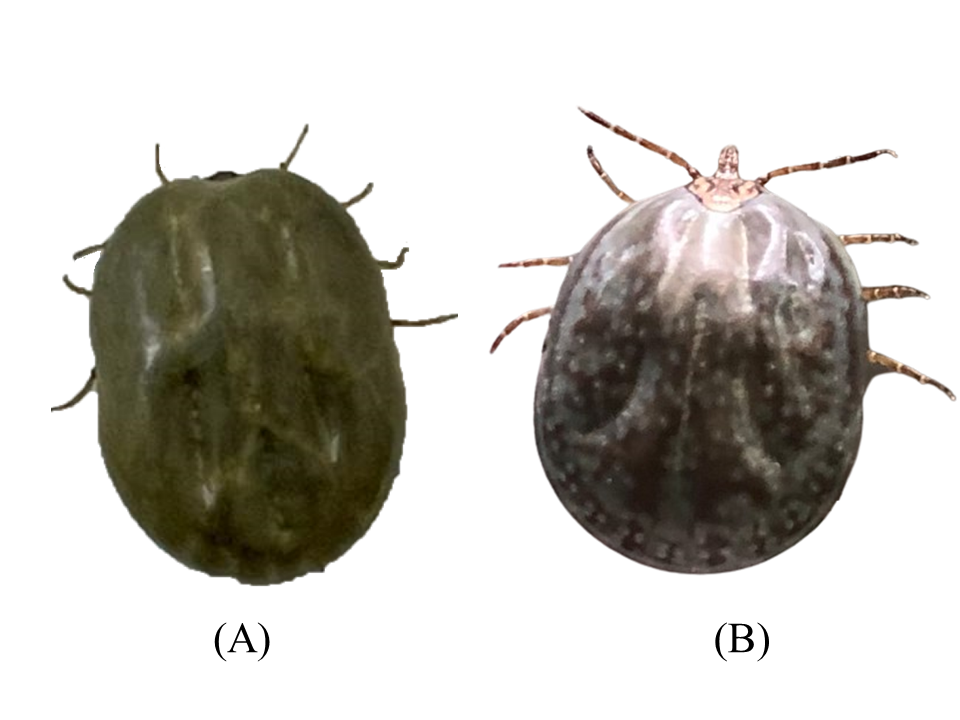
Both ticks are usually found in livestock regions coexisting in pastures and areas with dense vegetation, where there are environmental conditions that favor their development, which increases parasitism in cattle under extensive conditions because they can share the same host [6, 7].
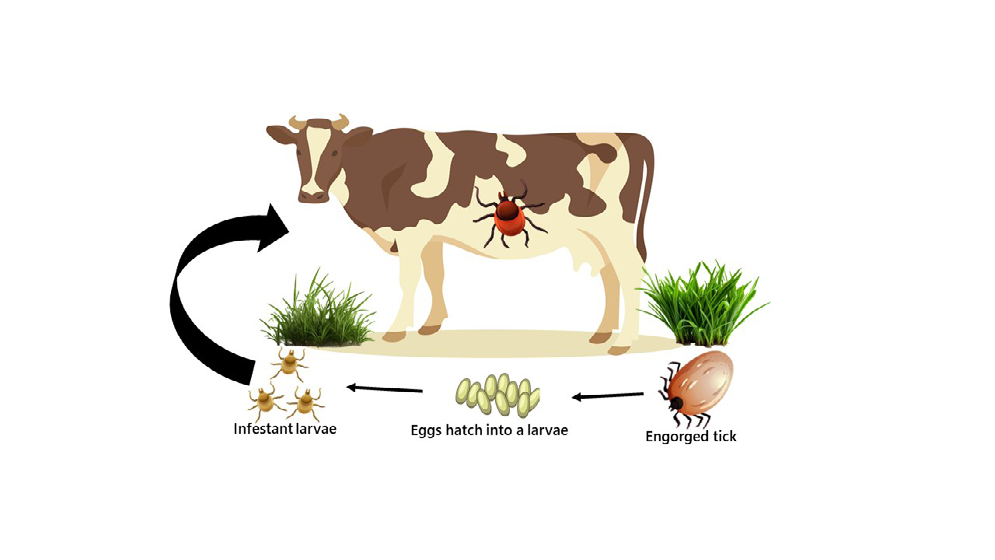
The life cycle of R. microplus and A. mixtum includes four stages: egg, larva, nymph, and adult, where the parasitic phase develops on cattle and the non-parasitic or free-living phase takes place in pastures or on the ground (Figure 2) [8]. These tick species are known for their fast reproduction and ability to infest different animal species, being noteworthy the importance of designing effective control strategies to reduce the negative impacts on the health and productivity of cattle, in addition to reducing tick populations found in pastures [9, 10, 11].
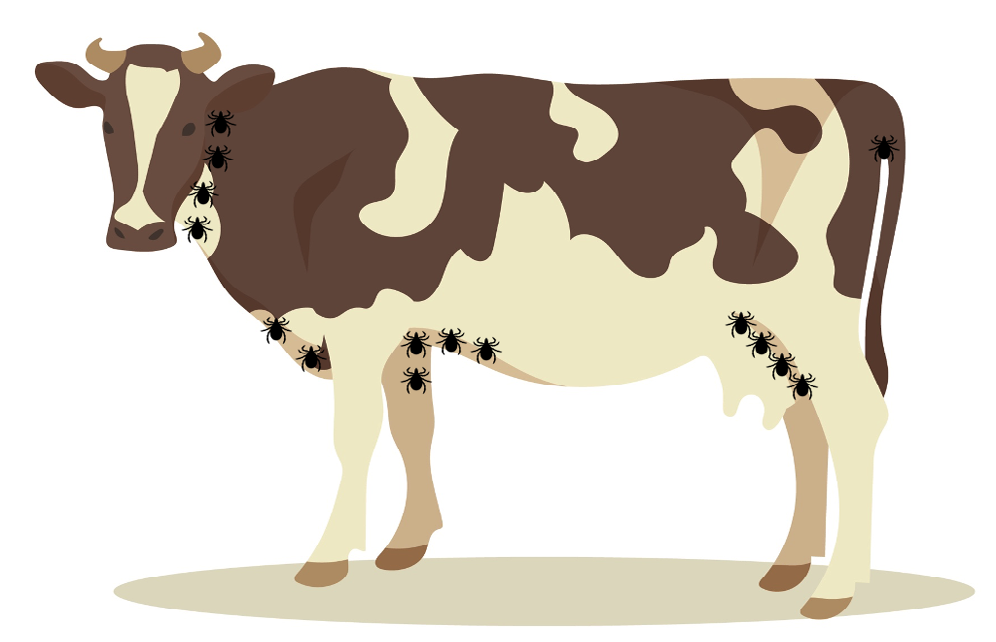
Ticks have specific preferences when attaching to the skin of cattle, seeking shelter from the sun and thin-skinned hosts. These locations include: inside and behind the ears, crotch, tail, belly, between the udder or testicles, anus and vulva (Figure 3). In cases of severe infestations, ticks can be found all over the animal’s body [12]. In addition to the visual observation of ticks on the parasitized animal, other signs may be present, such as:
- Decreased milk and meat production.
- Deterioration of skin (skin lesions and crusts).
- Weakness
- Anemia
- Growth retardation
- Death of the animal
The diagnosis of ticks in cattle is generally made by clinical observation and laboratory techniques. Clinical observation involves checking for the presence of ticks directly on the skin of cattle and signs associated with infestation. In addition, trained professionals may examine tick samples under a microscope to identify the species [13].
Among the laboratory tests available, it is recommended to detect tick populations resistant to different families of ixodicides in laboratories authorized by the National Service of Agro-Alimentary Public Health Safety and Quality (SENASICA) through the larval package test, larval dip test, adult dip test and, based on those results, use those ixodicides that are effective through sound management practices or through a comprehensive control scheme to prolong the useful life of those ixodicides. It is essential that an experienced veterinarian perform a detailed clinical examination and, if necessary, carry out complementary tests to confirm the presence of resistant ticks in the cattle herd [13, 14].
Currently, in Mexico, the control of these ectoparasites is carried out through the use of ixodicides belonging to different chemical families, such as organophosphates, pyrethroids, amidines, macrocyclic lactones, phenylpyrazolones and tick development inhibitors (Table 1). These products are applied by different methods such as spraying, dipping, topical application (pour-on), and parenteral injections. Although chemical control has contributed to profitable animal production, it has some notable disadvantages. The misuse of ixodicides has led to the selection of resistant tick populations, progressively decreasing their efficacy and increasing the costs associated with the control program within the cattle herd [10]. In addition, environmental contamination is generated due to the residues of these chemicals, as well as restrictions for the commercialization and consumption of the meat and milk produced due to the withdrawal times of these active ingredients in treated animals [15, 16].
| Application | Trademark | Company | |
|---|---|---|---|
| Organophosphates | |||
| Coumaphos | Plunge dips, Hand spays | Asuntol L® | Elanco® |
| Coumaphos | Plunge dips, Hand spays | Co-Ral Flowable® | Elanco® |
| Synthetic pyrethroids | |||
| Cypermethrin | Plunge dips, Hand spays | Barricade® | Zoetis® |
| Cypermethrin | Plunge dips, Hand spays | Ticoff® | Lapisa® |
| Cypermethrin | Pour On | Cipermil Pour On® | Ourofino® |
| Flumethrin | Plunge dips, Hand spays | Bayticol baño® | Elanco® |
| Flumethrin | Pour On | Bayticol Pour On® | Elanco® |
| Deltamethrin | Plunge dips, Hand spays | Butox® | MSD Animal health® |
| Amidines | |||
| Amitraz | Plunge dips, Hand spays | Bovitraz® | Elanco® |
| Amitraz | Plunge dips, Hand spays | Bombard® | Zoetis® |
| Amitraz | Plunge dips, Hand spays | Gamitraz® | Zoetis® |
| Amitraz | Plunge dips, Hand spays | Nokalt® | Ourofino® |
| Amitraz | Plunge dips, Hand spays | Taktik® | MSD Animal health® |
| Amitraz | Plunge dips, Hand spays | Trak® | Lapisa® |
| Macrocyclic lactones | |||
| Ivermectin 1% | Injectable | Ivomec® | Boehringer® |
| Ivermectin 1% | Injectable | Baymec Prolong® | Elanco® |
| Ivermectin 1% | Injectable | Ivermectin 1%® | Sanfer® |
| Ivermectin 1% | Injectable | Ivomec-F® | Boehringer® |
| Ivermectin 1% | Injectable | Iver LA® | Ourofino® |
| Ivermectin 3.15% | Injectable | Virbamec Platinum® | Virbac® |
| Ivermectin 3.15% | Injectable | Zeramec Platinum® | Virbac® |
| Ivermectin 3.15% | Injectable | Ivomec Gold® | Boehringer® |
| Ivermectin 3.15% | Injectable | Ivermectina 3.15% L.A.® | Sanfer® |
| Ivermectin 3.15% | Injectable | Dectiver Premium® | Lapisa® |
| Ivermectin 4% | Injectable | Master LP® | Ourofino® |
| Doramectin | Injectable | Trucid® | Elanco® |
| Doramectin | Injectable | Dectomax® | Zoetis® |
| Moxidectin | Injectable | Cydentin NF® | Zoetis® |
| Moxidectin | Injectable | Cydentin Onix® | Zoetis® |
| Phenylpyrazole | |||
| Fipronil | Pour On | Ectoline® | Boehringer® |
| Fipronil | Pour On | Effipro Bovis® | Virbac® |
| Tick development inhibitor | |||
| Fluazuron | Pour On | Acatak® | Virbac® |
Table 1: Acaricides Authorized for Tick Control in Mexico.
Ixodicide resistance refers to the ability of ticks to develop tolerance to the chemicals used for their control through recommended doses for each chemical family; when an ixodicide is used intensively, it creates an intense selection pressure that eliminates susceptible individuals [17]; 80% of the cases of resistance emergence in the tick population within the cattle herd have been associated mainly with two factors [10]:
- Indiscriminate application: Inadequate application of chemicals, poor dosage (under or overdosage), use of homemade mixtures of different products, no rotation of chemical families, and the use of products not intended for cattle.
- Number of applications: Perform multiple ixodicide treatments per year.
The main problems associated with ixodicide resistance are production losses associated with high infestations, increased presence of transmitted diseases, economic losses due to unnecessary or ineffective acaricide treatments, disease treatment, and restrictions on selling animals for export [13].
Among the good practices to delay the presentation of resistance in bovine production units, it is recommended to: • Perform ixodicide treatments only when necessary, i.e., only when the infestation is such that the condition and health of the animals are affected.
- Do not use homemade mixtures or products not intended for cattle use.
- Strictly follow the ixodicide manufacturer’s instructions, dosage, and recommendations.
- Identify the tick genus to be treated (with advice from a veterinarian) and choose the best control strategy.
- Avoid using mixtures of products from different chemical families.
- Perform at least two resistance diagnostic tests per year.
- Change chemical families annually or after resistance diagnosis (with the advice of a veterinarian).
It is important to note that integrated management has recently been shown to effectively control tick infestations in cattle. This approach involves the combination of various control methods that are easy to apply, accessible, and have no adverse effects on the environment (Table 2) [15]. Failure to control tick infestation is associated with exclusive reliance on one method, incorrect dosage, application of compounds, the introduction of animals poorly adapted to specific climatic and productive management conditions, and poor grazing and pasture management practices. Consequently, a diversified and well-monitored approach is crucial for successfully controlling tick infestations in cattle. One example that has been done previously and has shown promising results is using vaccines in conjunction with chemical acaricides [18].
| Description | |
|---|---|
| Selection of resistant animals | Due to phenotypic and immunological characteristics, Zebu cattle breeds (*Bos indicus*) have naturally resisted tick infestations. These include coat type, well-developed piloerector muscle, skin thickness, and a more efficient immune response after the first infestation than *B. taurus* cattle (Jonsson et al., 2014; Biegelmeyer et al., 2015). |
| Pasture and paddock management | The objective is to reduce ticks by rotating and resting paddocks and using repellent vegetation such as *Melinis multiflora* to prevent or delay their encounter with a host (Preciado et al., 2004). |
| Biological control | Natural predators such as spiders, ants, rodents, fungi, wasps, and nematodes are used to reduce the tick population in their natural environment (Samish et al., 2004; Sonenshine et al., 2006). |
| Plant extracts | Several plant extracts have been evaluated under laboratory conditions as potential biopesticides against ticks at different life cycle stages, including adults, larvae, and eggs. The Neem tree (*Azadirachta indica*) stands out as an example since its leaf and seed extracts have identified 24 active principles with acaricidal properties (Isea-Fernández et al., 2013). |
| Vaccines | Natural immunity against ticks in cattle manifests as hypersensitivity when they attach to the animal. Vaccines, on the other hand, generate artificial immunity through the production of antibodies. In vaccinated cattle, feeding ticks can die on the animal or the ground, affecting their reproductive capacity. A commercial vaccine available in Mexico reduces the number of adult ticks, their weight, and reproductive capacity as long as it is used within an integrated control program (Fuente et al., 2007; (de la Fuente et al., 2007a,b)). |
Table 2: Control Methods Can Be Used In Integrated Management to Control Ticks in Cattle.
Conclusion
These findings highlight the importance of considering an integrated management approach for tick control and support the search for more control strategies for control programs in different regions of Mexico, reducing tick populations and acaricide treatments.
References
-
Vivas RIR, Jonsson NN, Bhushan C (2018) Strategies for the control of Rhipicephalus microplus ticks in a world of conventional acaricide and macrocyclic lactone resistance. Parasitology Research 117(1): 3-29.
-
Taylor M (2007) Veterinary Parasitology. In 3rd (Edn). Blackwell Publishing, London, UK, pp: 697.
-
Calvano MPCA, Brumatti RC, Garcia MV, Barros JC, Andreotti R (2019) Economic efficiency of Rhipicephalus microplus control and effect on beef cattle performance in the Brazilian Cerrado. Experimental & Applied Acarology 79(3-4): 459-471.
-
Almazán C, Torres AT, Rodríguez LT, Céspedes NS, Estrada MO (2016) Biological aspects of Amblyomma mixtum (Koch, 1844) in northeastern Mexico. Scientific Tasks in Chiapas 11: 10-19.
-
Domínguez MA, Salas DR, Montes SS, Lagunes RS, Saito GR, et al. (2021) Morphometrics of Amblyomma mixtum in the State of Veracruz, Mexico. Pathogens10(5): 533.
-
Pascoe EL, Marcantonio M, Caminade YC, Foley JE (2019) Modeling potential habitat for Amblyomma tick species in California. Insects 10(7).
-
National Institute of Forestry, Agricultural and Livestock Research Northeast Regional Research Center Ebano Experimental Site (2007) The Boophilus microplus tick and its management in the Huasteca plain. Technical brochure No: 14.
-
Díaz MAA, Salas AF (2021) Entomopathogenic fungi for tick control in cattle livestock from Mexico. Frontiers in Fungal Biology 2: 657694.
-
Mastropaolo M, Saavedra LFB, Guglielmone AA (2014) The ticks (Acari: Ixodida: Argasidae, Ixodidae) of Bolivia. Ticks Tick Borne Dis 5(2):186-194.
-
Mondal DB, Sarma K, Saravanan M (2013) Upcoming of the integrated tick control program of ruminants with special emphasis on livestock farming system in India. Ticks Tick Borne Dis 4(1-2): 1-10.
-
Díaz MAA, Salas AF (2022) Rotational Grazing Modifies Rhipicephalus microplus Infestation in Cattle in the Humid Tropics. Animals (basel) 13(5): 915.
-
Opara MN, EZEH NO (2011) Ixodid ticks of cattle in borno and yobe states of northeastern Nigeria: breed and coat colour preference. Investigación Animal Internacional 8(1): 1359-1365.
-
Servicio Nacional de Sanidad, Inocuidad y Calidad Agroalimentaria (SENASICA) (2020) Resistance to tickicides.
-
Vivas R (2015) Techniques for the Diagnosis of Parasites with Importance in Public and Veterinary Health. In 1st (Edn). Autonomous University of Yucatán, mexico.
-
Vivas RIR, Díaz MAA, Arevalo FR, Sanchez HF, Santamaria VM, et al. (2006) Prevalence and potential risk factors for organophosphate and pyrethroid resistance in Boophilus microplus ticks on cattle ranches from the State of Yucatan, Mexico. Veterinary Parasitology 136(3–4): 335- 342.
-
Vivas RIR, Aguilar JAR, Chi MMO, Cogollo LCP, Martínez IT, et al. (2014) Integrated tick control in cattle farming. Ecosystems and agricultural resources 1(3): 295-308.
-
George JE, Pound JM, Davey RB (2004) Chemical control of ticks on cattle and the resistance of these parasites to acaricides. Parasitol 129: S353-S366.
-
Vivas RIR, Román JRI, Cogollo LCP, Aguilar JAR, Cruz GTR, et al. (2010) Use of macrocyclic lactones for the control of the Rhipicephalus (Boophilus) microplus tick in cattle. Archives of Veterinary Medicine 42(3): 115-123.
-
Biegelmeyer P, Nizoli LQ, da Silva SS, dos Santos TRB, Dionello NJL, et al. (2015). Bovine genetic resistance effects on biological traits of Rhipicephalus (Boophilus) microplus. Veterinary Parasitology 208(3-4): 231-237.
-
de la Fuente J, Canales AC, De La Lastra P, Katherine JM, Kocan M (2007) A ten-year review of commercial vaccine performance for control of tick infestations on cattle. Animal Health Research Reviews 8(1): 23-28.
-
Fernández GAI, Rodríguez IER, Paz AJH (2013) Tick- killing activity of Azadirachta indica A. Juss. (nim). Cuban Journal of Medicinal Plants 18(2): 327-340.
-
Samish M, Ginsberg H, Glazer I (2004) Biological control of ticks. Parasitology 129(S1): S389-S403.
-
Sonenshine DE, Kocan KM, de la Fuente J (2006) Tick control: further thoughts on a research agenda. Trends in Parasitology 22(12): 550-551.
- Enhancement of Vegetative Growth and Fruit Yield in Cucumber (Cucumis sativus L.) via Spiritual Blessing (Biofield) Energy Intervention
- Production of Açaí (Euterpe oleracea Mart.) under Different Agroforestry System Management Intensities in Amazonian Floodplain (Varzea) Forests
- Coffee and the Production Region: What is the Secret to the Expression "Quality"?
- Experiential Agripreneurship Training in Sub-Saharan Africa: Integrating a Business Incubator into Postgraduate Livestock Education at the University of Buea
- Advances in Agricultural High-Quality Development
- Linking Compost Residue to ABAGE in Plants - a Short Note