
Radon Concentration Potential and Radiological Health Risks in Benue South Groundwater Sources
The attendant health consequences arising from both the consumption of thawed radon and the inhalation of released radon air and its progenies emanating from the various drinking water sources in our community underscores the relevance of the current research. This pioneering study attempts to evaluate the Rn-222 concentration, the annual committed effective dose (ACED) and the related health risk factors of randomly selected 26 water samples from Apa and Agatu Local Government Areas (LGAs), Benue South, Nigeria. The results of the analysis via liquid scintillation counter, revealed the highest radon values of 13.3651.065 Bq/l and 18.2481.740 Bq/l for well water samples higher than the action level of 11.1 Bq/l by USEPA were found in the villages of Apa and Agatu LGAs respectively, while 5.5510.479 Bq/l lower than the tolerance limit was recorded for the surface water samples. The annual committed effective doses estimated for the different ICRP age groups (3 months, 1 year, 5 years, 10 years, 15 years and above 17 years) were below the acceptable 1 mSv/y baseline but displayed a significant and consistent rise with the age and water consumption frequency of the populace. Excess life cancer risks (ELCR) and the induced lung cancer cases per year per million persons (LCC) for ingestion and inhalation of radon by the inhabitants of the study areas were calculated. ELCRing and ELCRinh mean values of the radionuclide showed different variations below the standard reference line. The average values recorded for the lung cancer cases due to ingestion and inhalation of radon (LCCing) and (LCCinh) and the probability of an individual developing cancer over a lifetime exposure to radioactive element (ELCR) were found to be significantly lower than the suggested 170 – 230 per year per million persons and 0.29 mSv/y global mean value respectively. This implies that the evaluated radon parameters for ingestion and inhalation in the study areas do not pose any immediate radiological health effects to members of the public but periodic monitoring of the quality of the groundwater sources should be encouraged
Introduction
The management of groundwater quality in conformity with globally accepted radiation protection and safety best principles is very important in minimizing the danger to the healthiness of all living things. The prevalence of lung cancer cases attributable to the consumption of radionuclides particularly radon (222Rn) in drinking water and the inhalation of released radon gas from drinking water sources has become a major global concern in recent times. The life-threatening health challenges posed by the lung cancer incidence rate predominantly in under-developed and developing countries of the world is alarming and worrisome, and hence the reason for the current research focus by the global community on radiation carcinogenesis [1]. Radon exposure has been identified as the second cause of lung cancer after active smoking and the first in non-smokers [2, 3]. Surviving lung cancer sickness has approximately 13-17% survival rate which signifies the deadliness of the disease. This awareness has alerted the United Nations Environmental Protection Agency (USEPA) and the World Health Organization (WHO) to routinely publish numerous recommendations to sensitize their citizens to the danger of radon exposure. It is also on good record that female mortality due to lung cancer has doubled deaths linked with breast cancer across the globe [3, 4, 5]. Report has also shown that 13.4% of deaths from lung cancer has been attributed to radon exposure. In addition, radon exposure has been linked to several deaths resulting from lung cancer in different parts of the world like the UK Clement [6] and Europe Darby [7].
Radon is a natural radionuclide, an inactive gas that is naturally found in the radioactive decay series of thorium (232Th) and uranium (236U) usually found in soil or rock. This inert gas with a relatively long half-life (3.8 days) is not involved in any chemical reaction and can stay reasonably long in the atmosphere. During radioactivity, radon decays into radioactive particles called radon progeny that can enter the human body through the consumption or inhalation of radon [8]. When energetic α, β particles and gamma radiation from the decay series are breathed, it can damage the lung epithelium by generating oxygen anions and hydrogen that produce mutations and other DNA lesions [9]. Long-time exposure to commonly found radioactive elements such as Radium (226Ra), Thorium (232Th), Potassium (40K), Radon (222Rn), and its daughter nuclides in drinking water, food or air constitutes major contamination of man’s internal organs and increases the risk of lung cancer. High ionizing radiation sources that deliver such exposure can lead to the induction of lung cancer [1].
Exposure to ionizing radiation by humans can come in two forms; either by cosmic ray source and terrestrial source via natural radionuclides in water, soil, food and air. It has been reported radiation doses to humans from natural radiation are approximately 85% annually with radon exposure accounting for more than half of the radiation doses [10]. The epidemiological research reported by the World Health Organization revealed radon exposure causes 3-15% lung cancer deaths making it the second most deadly carcinomatous agent worldwide [3].
In reality, it is difficult to control and manage human exposure to ionizing radiations from natural sources because they are naturally occurring radioactive elements. But, for the safety of public health and the enormous danger to life posed by radon exposure, international regulatory agencies like International Commission on Radiological Protection (ICRP), United Nations Environmental Protection Agency (USEPA) and World Health Organization (WHO) have suggested different efficient action level plans against Rn- 222 risks. The proposed safety limits for the minimization of Rn-222 risks in drinking waters are; UNSCEAR 4-40 Bq/l, USEPA 11.1 Bq/l, WHO 100 Bq/l; 1.0 mSv/y, 0.1 mSv/y and 100 µSv/y as the recommended effective doses by USEPA, WHO, and UNSCEAR respectively [3, 11, 12].
Previous research was primarily devoted to radon concentration measurement in drinking water sources with little or no attention to the associated health hazards [13, 14, 15, 16, 17] and on the basis of the available literature from the present study locations, no study of this nature has been conducted in these communities. It is therefore. Hypothetically believed that Rn-222 activity may be present in groundwater sources (wells and streams) used for drinking in this environment because the water sources from rocks and soils are carriers of radon radionuclides. For this reason, the current work is undertaken to investigate the radon contamination in drinking water sources as well as the water quality for health risks assessment including annual committed effective doses(ACED), excess lifetime cancer risks (ELCR) and lung cancer cases (LCC) to forestall probable negative health issues to human, animals and plants.
Materials and Methods
Study Area
Apa and Agatu LGAs of Benue State where the present research was conducted were created in 1991 and 1996, with their headquarters located in Ugbokpo and Obagaji respectively. The LGAs are bounded by four (4) different ethnicities, Nasarawa State to the North, Gwer West to the East, Otukpo to the South and Kogi State to the West respectively. The study areas have a total population of 266,900, the people are predominantly farmers and account for over 80% of fish produced in Benue State The presence of the long stretch of river Benue in Agatu LGA has enhanced their agricultural activities in both wet and dry season farming through irrigation. The major sources of water for both human and animal consumption in the study locations are well water, boreholes and surface stream water. Activities such as indiscriminate refuse disposal, agrochemical application, hospitals and manmade exercise have high capabilities of polluting the water source. This possibility necessitated the justification for investigation of the water sources for possible negative health effects on humans, animals and plants. A total of twenty-six (26) water samples from diverse sources were collected at different locations during the dry season via stratified random sampling techniques and analysed. The exact positioning of the varied sampling points was recorded using the Global positioning system (GPS) (Figures 1a & 1b).
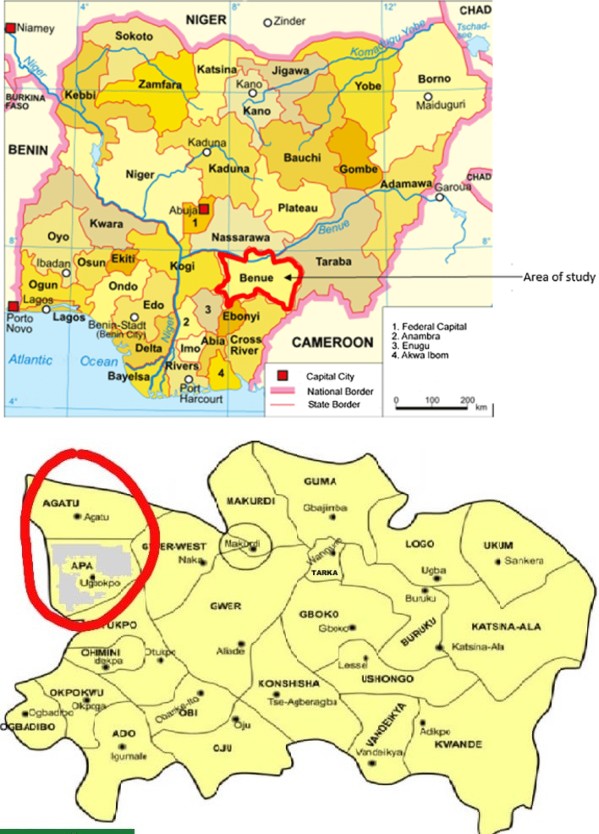
Figure1a: Map of Nigeria showing Benue State.
Figure 1b: Map of Benue State showing the study locations.
Materials
In this research, recommended standard best practices using the following materials as described by the American Society for Testing and Materials (ASTM) were adopted.
Liquid scintillation analyser – (Packard Tri-Card – LSA-1000TR) (2) Scintillation vial - 20ml with cap (3) Distilled water (4) Plastic sample collection bottles (200ml and 100ml capacity) (5) Disposable hypodermic syringe (10ml and 20ml capacity) with 38mm hypodermic needle (6) Surgical hand gloves (7) Adjustable scintillation cocktail dispenser (8) Radium solution (9) Insta-gel (10) Indelible mark and abro masking tape (11) Global Positioning System (GPS) (12) Biro and paper.
Methods
The water samples were first prepared by adding a mixture of 10 ml of each of the water samples and an Instagel Scintillation cocktail to the scintillation vial. The vial was sealed tightly and shaken thoroughly for some minutes to extra radon (222Rn) in the water phase into the organic scintillator.
The prepared water samples were analysed using the Tri-Carb 3110 Liquid Scintillation Counter from Perkin Elmer company, located at the Centre for Energy Research and Training (CERT), Ahmadu Bello University Zaria, Kaduna State, Nigeria. Efficiency calibration of the counting system for the activity concentration was carried out using IAEA 226Ra standard Solution before the actual analysis.
Estimation of parameters: The 222Rn activity concentration was determined using Equation (1)
$$WR_n(Bql^{-1}) = \frac{100(SC - BC)\exp(\lambda t)}{(CF)(D)}$$
where $WR_n$ is the radon concentration in water samples; SC and BC are the sample and background counts respectively; CF is the calibration factor and D is the decay correction factor.
The annual committed effective dose (ACED) to different ICRP age grades as well as ACED for ingestion and inhalation by the inhabitants were calculated from the measured values of radon concentration in water ($WR_n$) using Equations (2), (3) and (4) respectively.
$$ACED(mSvy^{-1}) = WR_n \times IW \times EDC$$
$$WD_{ing}(mSvy^{-1}) = WR_n \times CW \times DCF_{ing}$$
$$WD_{inh}(mSvy^{-1}) = WR_n \times R_AW \times O \times DCF_{inh} \times F$$
where IW is the water intake rates by the different ICRP age groups; WDing and WDinh are the annual committed effective doses for ingestion and inhalation respectively; WRn is the radon concentration in water ($Bq/1$); CW is the water consumption rate per individual; DCFing is the dose conversion factor for internal radiation exposure for ingestion of radionuclide $(3 \times 10^{-10} Sv/y)$; RAW is the ratio of radon in the air to radon in water (10-4); O is the occupancy factor (7000 hy-1); F is the equilibrium factor (0.4) and DCFinh is the dose conversion factor for radon inhalation $(9 \times 10^{-9} Sv/y)$.
For evaluation of health hazards, the likelihood of developing lung cancer over lifetime exposure to a hazardous cancer-causing agent (222Rn) referred to as excess lifetime cancer risks (ELCR), and the numerical lung cancer cases (LCC) per year per million people were determined. Using equations (5) and (6) the excess lifetime cancer risks (ELCR) for ingestion and inhalation respectively were calculated. An increase in ELCR will correspond to a possible rise in the number of people that tends to contract lung, prostrate, stomach and breast cancer.
$$ELCR_{ing} = WD_{ing} \times RF \times DL$$
$$ELCR_{inh} = WD_{inh} \times RF \times DL$$
where DL is the typical life expectancy duration of 70 years and RF is the stochastic cancer risk factor per Sievert $(5 \times 10^{-2})$.
The lung cancer cases (LCC) per year per million persons due to ingestion and inhalation of the radionuclide were equally determined based on equations (7) and (8) respectively.
$$LLC_{ing} = WD_{ing} \times 18 \times 10^{-6}$$
$$LLC_{inh} = WD_{inh} \times 18 \times 10^{-6}$$
where $18 \times 10^{-6}$ is the risk factor for lung cancer induction.
Results and Discussion
The results of the evaluated radon concentration (Bq/l), their respective annual committed effective doses, excess lifetime cancer risks and lung cancer cases in the study areas are presented in Table 1.
| Locations | Sample ID | 222Rn (Bq/l) | Wding mSv/y | Wdinh nSv/y | ACED (mSv/y) to ICRP age groups | Excess life cancer risks (ELCR) | Lung cancer cases (LCC) | |||||||
|---|---|---|---|---|---|---|---|---|---|---|---|---|---|---|
| Groundwater samples: Hand-dug well in Apa LGA | ||||||||||||||
| 3 Months | 1 Year | 5 Years | 10 Years | 15 Years | >17 Years | ELCRing 10-5 Sv/y | ELCRinh Sv/y | LCCing pSv/y | LCCinh mSv/y | |||||
| Iga okpaya | APW1 | 7.9533 | 58.0592 | 20.0423 | 0.008 | 0.0103 | 0.0119 | 0.0139 | 0.0239 | 0.029 | 20.3 | 70.1481 | 10.44 | 3.6076 |
| Olete | APW2 | 8.7072 | 63.5625 | 21.9421 | 0.0087 | 0.0113 | 0.0131 | 0.0152 | 0.0261 | 0.0318 | 22.4 | 76.79735 | 11.52 | 3.9496 |
| Ologbeche | APW3 | 7.0857 | 51.7253 | 17.8559 | 0.0071 | 0.0092 | 0.0106 | 0.0124 | 0.0213 | 0.0259 | 18.2 | 62.4957 | 9.36 | 3.2141 |
| Oiji | APW4 | 6.2115 | 45.3443 | 15.6531 | 0.0062 | 0.0081 | 0.0093 | 0.0109 | 0.0186 | 0.0227 | 15.75 | 54.7859 | 8.1009 | 2.8176 |
| Idada | APW5 | 4.9199 | 35.9152 | 12.3981 | 0.0049 | 0.0064 | 0.0074 | 0.0086 | 0.0148 | 0.018 | 12.6 | 43.3934 | 6.48 | 2.2317 |
| Ugbokpo I | APW6 | 13.365 | 97.5649 | 33.6799 | 0.0134 | 0.0174 | 0.02 | 0.0234 | 0.0401 | 0.0488 | 34.3 | 117.8797 | 17.64 | 6.0624 |
| Ugbokpo II | APW7 | 12.6112 | 92.0616 | 31.7802 | 0.0126 | 0.0164 | 0.0189 | 0.0221 | 0.0378 | 0.046 | 32.2 | 111.2307 | 16.56 | 5.7204 |
| omafu | APW8 | 3.7711 | 27.5294 | 9.50329 | 0.0038 | 0.0049 | 0.0057 | 0.0066 | 0.0113 | 0.0138 | 9.8 | 33.2615 | 5.04 | 1.7106 |
| Olojo | APW9 | 11.1842 | 81.6447 | 28.1842 | 0.0112 | 0.0145 | 0.0168 | 0.0196 | 0.0336 | 0.0408 | 28.7 | 98.6447 | 14.76 | 5.0732 |
| Omelemu | APW10 | 4.8266 | 35.2339 | 12.163 | 0.0048 | 0.0063 | 0.0072 | 0.0084 | 0.0145 | 0.0176 | 12.25 | 42.5705 | 6.3 | 2.1893 |
| MIN | 3.7711 | 27.5294 | 9.5033 | 0.0038 | 0.0049 | 0.0057 | 0.0066 | 0.0113 | 0.0138 | 9.8 | 33.2615 | 5.04 | 1.7106 | |
| MAX | 13.365 | 97.5649 | 33.6799 | 0.0134 | 0.0174 | 0.02 | 0.0234 | 0.0401 | 0.0488 | 34.3 | 117.8797 | 17.64 | 6.0624 | |
| MEAN | 8.0636 | 58.8641 | 20.3202 | 0.0081 | 0.0105 | 0.0121 | 0.0141 | 0.0242 | 0.0294 | 20.65 | 71.1207 | 10.62 | 3.6576 | |
| STD | 3.3685 | 24.5903 | 8.4887 | 0.0034 | 0.0044 | 0.0051 | 0.0059 | 0.0101 | 0.0123 | 8.6333 | 29.7104 | 4.44 | 1.5278 | |
| STD Error | 1.0652 | 7.7761 | 2.6844 | 0.0011 | 0.0014 | 0.0016 | 0.0019 | 0.0032 | 0.0039 | 2.7301 | 9.3952 | 1.4041 | 0.4831 | |
| Locations | Sample ID | 222Rn (Bq/l) | Wding mSv/y | Wdinh mSv/y | ACED (mSv/y) to ICRP age groups | Excess life cancer risks (ELCR) | Lung cancer cases (LCC) | |||||||
| Groundwater samples: Hand-dug well in Agatu LGA | ||||||||||||||
| 3 Months | 1 Year | 5 Years | 10 Years | 15 Years | >17 Years | ELCRing 10-5 Sv/y | ELCRinh Sv/y | LCCing pSv/y | LCCinh mSv/y | |||||
| Oshigbudu I | AGW1 | 16.54 | 120.74 | 41.6808 | 0.0165 | 0.0215 | 0.0248 | 0.0289 | 0.0496 | 0.0604 | 42.35 | 145.8828 | 21.78 | 7.5025 |
| Obagaji I | AGW2 | 18.0881 | 132.04 | 45.5819 | 0.0181 | 0.0235 | 0.0271 | 0.0317 | 0.0543 | 0.066 | 46.2 | 159.5367 | 23.76 | 8.2047 |
| Obagaji II | AGW3 | 18.2427 | 133.17 | 45.9716 | 0.0182 | 0.0237 | 0.0274 | 0.0319 | 0.0547 | 0.0666 | 46.55 | 160.9006 | 23.94 | 8.2749 |
| Oshigbudu II | AGW4 | 9.0744 | 66.243 | 22.8674 | 0.0091 | 0.0118 | 0.0136 | 0.0159 | 0.0272 | 0.0331 | 23.1 | 80.0359 | 11.88 | 4.1161 |
| Enumgba | AGW5 | 8.6261 | 62.97 | 21.7377 | 0.0086 | 0.0112 | 0.0129 | 0.0151 | 0.0259 | 0.0315 | 22.0005 | 76.082 | 11.34 | 3.9128 |
| Ogam | AGW6 | 10.6205 | 77.53 | 26.7637 | 0.0106 | 0.0138 | 0.0159 | 0.0186 | 0.0319 | 0.0388 | 27.3 | 93.673 | 14.04 | 4.8175 |
| Enicha | AGW7 | 4.0362 | 29.464 | 10.1711 | 0.004 | 0.0052 | 0.0061 | 0.0071 | 0.0121 | 0.0147 | 10.15 | 35.5989 | 5.22 | 1.8308 |
| Usha I | AGW8 | 4.8449 | 35.368 | 12.2091 | 0.0048 | 0.0063 | 0.0073 | 0.0085 | 0.0145 | 0.0177 | 12.25 | 42.7319 | 6.3 | 2.1976 |
| Usha II | AGW9 | 5.1454 | 37.561 | 12.9664 | 0.0051 | 0.0067 | 0.0077 | 0.009 | 0.0154 | 0.0188 | 13.3 | 45.3824 | 6.84 | 2.334 |
| Oweto | AGW10 | 7.1507 | 52.2 | 18.0199 | 0.0072 | 0.0093 | 0.0107 | 0.0125 | 0.0215 | 0.0261 | 18.2 | 63.0697 | 9.36 | 3.2436 |
| MIN | 4.0362 | 29.464 | 10.1711 | 0.004 | 0.0052 | 0.0061 | 0.0071 | 0.0121 | 0.0147 | 10.15 | 35.5988 | 5.22 | 1.8308 | |
| MAX | 18.2427 | 133.172 | 45.9716 | 0.0182 | 0.0237 | 0.0274 | 0.0319 | 0.0547 | 0.0666 | 46.55 | 160.9006 | 23.94 | 8.2749 | |
| MEAN | 10.2369 | 74.7293 | 25.797 | 0.0102 | 0.0133 | 0.0154 | 0.0179 | 0.0307 | 0.0374 | 26.145 | 90.2893 | 13.446 | 4.6435 | |
| STD | 5.5028 | 40.1704 | 13.867 | 0.0055 | 0.0072 | 0.0083 | 0.0096 | 0.0165 | 0.0201 | 14.0853 | 48.5346 | 7.2439 | 2.4961 | |
| STD Error | 1.7401 | 12.703 | 4.38515 | 0.0017 | 0.0023 | 0.0026 | 0.003 | 0.0052 | 0.0064 | 4.4542 | 15.348 | 2.2907 | 0.7893 | |
| Locations | Sample ID | 222R (Bq/l) n | Wding mSv/y | Wdinh mSv/y | ACED (mSv/y) to ICRP age groups | Excess life cancer risks (ELCR) | Lung cancer cases (LCC) | |||||||
| Surface water samples: Streams in Apa and Agatu LGAs | ||||||||||||||
| Locations | Sample ID | 222R n (Bq/l) | Wd mSv/y ing | Wd inh mSv/y | 3 Months | 1 Year | 5 Years | 10 Years | 15 Years | >17 Years | ELCRing 10-5 Sv/y | ELCRinh Sv/y | LCCing pSv/y | LCCinh mSv/y |
| Iga okpaya | APS1 | 4.9892 | 36.4209 | 12.5727 | 0.005 | 0.0065 | 0.0075 | 0.0087 | 0.015 | 0.0182 | 12.6 | 44.0045 | 6.48 | 2.2631 |
| Oiji | APS2 | 5.5507 | 40.5198 | 13.9876 | 0.0056 | 0.0072 | 0.0083 | 0.0097 | 0.0167 | 0.0203 | 14.35 | 48.9566 | 7.38 | 2.5178 |
| Amoke | APS3 | 4.3272 | 31.5882 | 10.9044 | 0.0043 | 0.0056 | 0.0065 | 0.0076 | 0.013 | 0.0158 | 11.2 | 38.1654 | 5.76 | 1.9628 |
| Ugbokpo | APS4 | 4.9223 | 35.9331 | 12.4043 | 0.0049 | 0.0064 | 0.0074 | 0.0086 | 0.0148 | 0.018 | 12.6 | 43.4151 | 6.48 | 2.2328 |
| Oshigbudu | AGS5 | 4.4428 | 32.4328 | 11.196 | 0.0044 | 0.0058 | 0.0067 | 0.0078 | 0.0133 | 0.0162 | 11.2 | 39.186 | 5.76 | 2.0153 |
| Obagaji | AGS6 | 2.1818 | 15.9273 | 5.4982 | 0.0022 | 0.0028 | 0.0033 | 0.0038 | 0.0065 | 0.008 | 5.6 | 19.2437 | 2.88 | 0.9897 |
| MIN | 2.1818 | 15.9273 | 5.4982 | 0.0022 | 0.0028 | 0.0033 | 0.0038 | 0.0065 | 0.008 | 5.6 | 19.2437 | 2.88 | 0.9897 | |
| MAX | 5.5507 | 40.5198 | 13.9876 | 0.0056 | 0.0072 | 0.0083 | 0.0097 | 0.0167 | 0.0203 | 14.35 | 48.9566 | 7.38 | 2.5178 | |
| MEAN | 4.4023 | 32.137 | 11.0939 | 0.0044 | 0.0057 | 0.0066 | 0.0077 | 0.0132 | 0.0161 | 11.2583 | 38.8285 | 5.79 | 1.9969 | |
| STD | 1.1723 | 8.5578 | 2.9542 | 0.0012 | 0.0015 | 0.0018 | 0.0021 | 0.0035 | 0.0043 | 3.0061 | 10.3396 | 1.5459 | 0.5318 | |
| STD Error | 0.4786 | 3.4937 | 1.206 | 0.0005 | 0.0006 | 0.0007 | 0.0008 | 0.0014 | 0.0017 | 1.2272 | 4.2211 | 0.6311 | 0.2171 |
Table 1: Activity concentration, ACEDs to different ICRP age groups, ELCR and LCC in the study areas.
Radon Activity Concentration in Drinking Water from the Study Area
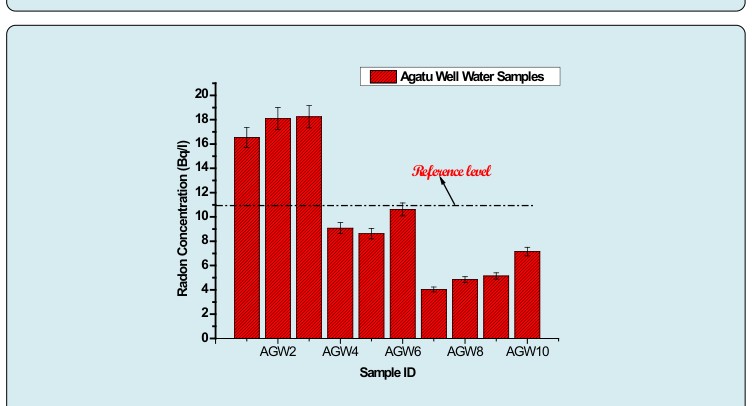
The measured Rn-222 concentration for the 26 samples of water taken from diverse locations in the study areas is presented in Table 1. The maximum value of Rn- 222 concentration (18.2427 ± 1.7401 Bq/l) was recorded at the APW6 sampling point (Ugbokpo I), while the minimum value of radon concentration (2.1818 ± 0.4786 Bq/l) was detected at the AGS6 sampling location (Obagaji). The distribution of Rn-222 concentration of the collected water samples from the various study locations are as displayed in Figures 2-4 respectively. The observed variations of radon concentration in the studied water samples could be attributed to different factors such as the depth of the aquifers, Uranium deposit, hydrogeological composition, climatic conditions as well as mobility and solubility of the radionuclides [18, 19].
The analysis of the water samples on the categories of the different drinking water sources showed higher values of Rn-222 concentration in well water samples (Figures 2 and 3) compared to the Rn-222 values in the stream surface water sources (Figure 4). The recorded lower Rn-222 concentration values in the surface water source are expected due to the potential outgassing of radon radionuclides into the atmosphere. According to international health regulatory organizations such as WHO, USEPA, and UNSCEAR, the activity concentration of radon in drinking water is required to be lower than 100 Bq/l, 11.1 Bq/l and 4-40 Bq/l respectively for the water quality to be safe for consumption. In this work, the Rn-222 concentration in APW6, APW7, AGW1, AGW2 and AGW3 sampling stations as shown in Figures 2 and 3, is lower than the limits recommended by WHO and UNSCEAR but higher than the USEPA guideline of 11.1 Bq/l. The recorded average values of radon concentration in all the water samples falls within the acceptable reference limit.
The results of Rn-222 concentration in the various water sources from the study locations were compared with other reported work across the globe. The average activity concentration of Rn-222 measurement in the present work is lower than the average radon concentration in drinking water recorded [20, 21, 22, 23] but higher compared to the activity concentration reported in Ahmad [24]; Le [18]; Rani [25].
Annual Committed Effective Dose (ACED) for Ingestion and Inhalation
The Annual committed effective dose (ACED) is described as the measure of the activity of the radionuclide concentration that goes into the respiratory or gastrointestinal tract from the surrounding. Ingestion and inhalation of radon radionuclides are the only two established entry routes radon radionuclide can get into the human body. The calculated annual committed effectively due to ingestion and inhalation for the study sample sites in the present research are shown in (Table 1). The ACED in well water samples due to ingestion and inhalation of Rn- 222 radioactivity ranged from 27.5294 to 133.1700 ± 7.4733 µSv−1 and 9.5033 to 45.9716 ± 7.4733 µSv−1respectively. The estimated mean dose of Rn-222 from the sample water intake for ingestion was found to be 66.7964 ± 7.4733 µSv−1 while the corresponding average dose from the intake of Rn-222 in well water sources via inhalation was recorded at 23.0586 ± 2.5799 µSv−1. Meanwhile, the annual committed effective dose for ingestion and inhalation of radon from the surface water source were found in the region of 15.927 − 40.5198 ± 3.4937 µSv−1 with an average value of 32.1370 ± 3.4937 µSv−1 and 5.4982 − 13.9876 ± 1.2060 µSv−1 with the mean value of 11.0939 ± 1.2060 µSv−1 respectively. It can be observed from the results that the obtained values of ACED due to ingestion and inhalation of radon from well water are significantly higher than the dose received from consuming surface water samples in the study locations. This variation can be attributed to enhanced redistribution of Rn-222 concentration and its decay products which increases with depth in a deep soil and rocks water sources than surface water sources. When the values of the present work were compared with other related reported work around the world, the results were observed to be significantly lower compared to those recorded in Nigeria [26, 27], Ghana [21], India [28], Yamen [20], but slightly higher than the reported values in Iran [29] and Malaysia [30].
The calculated values of the annual committed effective dose for the different age groups presented in Table 1 followed an interesting pattern. The results showed that the values of ACED for well water samples from Apa LGAs were varied between 0.0038 and 0.0134 ± 0.0011 µSv−11 for 3 months old, 0.0049 and 0.0174 ± 0.0014 µSv−1 for 1 year old, 0.0057 and 0.0200 ± 0.0016 µSv−1 for 5 years old, 0.0066 and 0.0234 ± 0.0019 µSv−1 for 10 years old, 0.0113 and 0.0401 ±0.0032 µSv−1 for 15 years old and 0.0138 and 0.0488 ± 0.0039 µSv−1 for age above 17 years, for Agatu LGAs well water samples, the ACED for the different age dependent groups were ranged from 0.0040 to 0.0182 ± 0.0017 µSv−1 for 3-month-old, 0.0052 to 0.0237 ± 0.0023 µSv−1 for 1 year old, 0.0061 and 0.0274 ± 0.0026 µSv−1 for 5 years old, 0.0071 to 0.0319 ± 0.0030 µSv−1 for 10 years old, 0.0121 and 0.0547 ± 0.0052 µSv−1 for 15 years old and 0.0147 to 0.0666 ± 0.0064 µSv−1 for age greater than 17 years old. The age- based classifications of the ACED for surface water samples in the study locations were found in the region of 0.0022 and 0.0056 ± 0.0005 µSv−1 for 3 months old, 0.0028 and 0.0072 ± 0.0006 µSv−1 for 1 year old, 0.0033 and 0.0083 ± 0.0007 µSv−1 for 5 years old, 0.0038 and 0.0097 ± 0.0008 µSv−1 for 10 years old, 0.0065 and 0.0167 ± 0.0014 µSv−1 for 15
years old and 0.0080 and 0.0203 ± 0.0017 µSv−1 for the age group above 17 year old. It can be observed that the ACED values for both the well and surface sampling points in this study were found to be lower than the value of 0.1 mSv/y threshold for Rn-222 concentration in water proposed by the World Health Organization for human consumption and therefore the water sources in these communities might be considered safe for domestic applications [31]. Additionally, the ACED values for the various water samples indicated a consistent rise with age and the volume of water consumed by individuals despite the sensitivity of the children.
Analysis of Excess Life Cancer Risks (ELCR)
According to Temaugee [32], lung cancer diseases arising from exposure to radioactive nuclides may take several years to develop, manifest and can only be detected through epidemiological mechanisms. The gap between radiation exposure and cancer detection (latent period) in an individual is very wide. Sometimes noticeable manifestations of cancer can come into effect only at an advanced age. Hence, excess life cancer risks are defined as the likelihood that an individual will develop cancer in his lifetime of radiation exposure [33]. In this study, the respective ELCR mean calculated for ingestion and inhalation of Rn-222 in the water samples as indicated in Table 1 are (20.6500 ± 2.7301 µSv−1 and 71.1207 ± 9.3952 µSv−1) for well water samples in Apa LGAs, (26.1450 ± 4.4542 µSv−1 and 90.2893 ± 15.3480 µSv−1) for well water samples in Agatu LGAs and (11.2583 ± 1.2272 µSv−1 and 38.8285 ± 4.2211 µSv−1) for surface water samples from the study locations. An average values of 20.6500 and 71.1207, 26.1480 and 90.2893, and 38.8285 and 5.7900 were recorded for Apa, Agatu well water samples and surface water samples respectively with well water samples from Agatu having the highest mean values and therefore have more ELCR and pose more danger to the inhabitants of the community. However, the evaluated values are generally found below the global standard value of 0.29 mSv/y prescribed by radiological protection agencies [31, 34]. The obtained results equally suggested a low possibility of an adult above 70 years developing cancer over a lifetime from the consumption of the sampled water from the community.
Analysis of Lung Cancer Cases (LCC)
The water samples from the study locations were analysed for possible risks of lung cancer cases emanating from the ingestion and inhalation of Rn-222 in the water samples. The LCC values for ingestion and inhalation from Apa LGA water samples were ranged between 5,0400-17.6400 and 1.7106- 6.0624 with an average value of 10.6200 and 3.6576 per million persons per year respectively, 5.2200-23.9400 and 1.8308-8.2749 with mean value of 13.4460 and 4.6435 per million persons per year respectively for Agatu LGA. The LCC for ingestion and inhalation for the surface water samples from the two areas were found in the region of 77 and 99 with an average value of 98 per million persons per year. The calculated LCCs in the present work were found to be lower than 170-230 maximum limit range recommended by ICRP.
Conclusion
The present work was conducted to investigate the activity of radon concentration, the annual committed effective doses and the health implication arising from the consumption of water from the study areas. A total of 26 samples were taken from two water sources (wells and surface water) that are considered to be the major sources of drinking water in the study locations and analysed for their healthy quality. The value of activity concentration of radon (Rn-222) from well water sources was higher than those from surface sources. The values of well water in some sampling locations were more than the USEPA recommended level of 11.1 Bq/l and less than the range of 4-40 Bq/l proposed by the UNSCEAR. The high variation in the values of the well water compared to the surface water values could be due to the depth of the wells as well as the redistribution of radon activity in underground water than the possible aeration of radon gas in the atmosphere associated with surface water. Although, the calculated values of the annual committed effective dose for ingestion were found to be higher than that of inhalation, however, the values in both cases were far below the recommended threshold value of 0.1mSv/y by WHO. Additionally, the lower values ELCR and LCC below the recommended standard limit of 0.29 mSv/y and rang (170- 230 per million persons per year) suggested a low probability of an adult approaching 70 years developing cancer over their lifetime from the consumption of the water sources. Hence, the present research does not reveal any immediate health effects arising from the ingestion and inhalation of radon in drinking water sources in the study areas.
References
-
Little JB (2000) Radiation carcinogenesis. Carcinogenesis 21(3): 397-404.
-
Lantz PM, Mendez D, Philbert MA (2013) Radon, smoking, and lung cancer: the need to refocus radon control policy. American Journal of public health 103(3): 443-447.
-
Organization WH (2009) WHO handbook on indoor radon: a public health perspective: World Health Organization.
-
De Angelis R, Sant M, Coleman MP, Francisci S, Baili P, et al. (2014) Cancer survival in Europe 1999–2007 by country and age: results of EUROCARE-5—a population- based study. The lancet oncology 15(1): 23-34.
-
Siegel R, Ma J, Zou Z, Jemal A (2014) Cancer statistics, 2014. CA: a cancer journal for clinicians 64(1): 9-29.
-
Clement CH, Tirmarche M, Harrison J, Laurier D, Paquet F, et al. (2010) Lung cancer risk from radon and progeny and statement on radon. Annals of the ICRP 40(1): 1-64.
-
Darby S, Hill D, Auvinen A, Barros-Dios J, Baysson H, et al. (2005) Radon in homes and risk of lung cancer: collaborative analysis of individual data from 13 European case-control studies. BMJ 330(7485): 223.
-
Yoon JY, Lee JD, Joo SW, Kang DR (2016) Indoor radon exposure and lung cancer: a review of ecological studies. Annals of Occupational and environmental medicine 28(1): 1-9.
-
Narayanan P, Goodwin EH, Lehnert B (1997) α particles initiate the biological production of superoxide anions and hydrogen peroxide in human cells. Cancer Research 57(18): 3963-3971.
-
Organization WH & WHO (2004) Guidelines for drinking- water quality (Vol. 1): World Health Organization.
-
UNSCEAR S (2000) Effects of ionizing radiation, Exposures from Natural Radiation Sources, Annex B. United Nations, New York.
-
USEPA (1999) United States Environmental Protection Agency, Office of Water: 40 CFR Parts 141, and 142: National Primary Drinking Water Regulations; radon-222: proposed rule: US Environmental Protection Agency Washington, DC.
-
Alomari AH, Saleh MA, Hashim S, Alsayaheen A, Abdeldin I (2019) Activity concentrations of 226 Ra, 228 Ra, 222 Rn and their health impact in the groundwater of Jordan. Journal of Radioanalytical and Nuclear Chemistry 322: 305-318.
-
Garba N, Rabirsquo N, Dewu B, Sadiq U, Yamusa Y (2013) Radon assessment in ground water sources from Zaria and environs, Nigeria. International Journal of physical sciences 8(42): 1983-1987.
-
Kessongo J, Bahu Y, Inácio M, Peralta L, Soares S (2020) Radon concentration potential in Bibala municipality water: Consequences for public consumption. Radiation Physics and Chemistry 173: 108951.
-
Mostafa M, Olaoye M, Ademola A, Jegede O, Saka A, et al. (2022) Measurement of radon concentration in water within Ojo axis of Lagos State, Nigeria. Analytica 3(3): 325-334.
-
Sharma S, Kumar A, Mehra R, Kaur M, Mishra R (2018) Assessment of progeny concentrations of 222 Rn/220 Rn and their related doses using deposition-based direct progeny sensors. Environmental Science and Pollution Research 25(12): 11440-11453.
-
Le CH, Huynh NPT, Le QB (2015) Radon and radium concentrations in drinkable water supplies of the Thu Duc region in Ho Chi Minh City, Vietnam. Applied Radiation and Isotopes 105: 219-224.
-
Shu’aibu HUK, Khandaker MU, Baballe A, Tata S, Adamu MA (2021) Determination of radon concentration in groundwater of Gadau, Bauchi State, Nigeria and estimation of effective dose. Radiation Physics and Chemistry 178: 108934.
-
Abdurabu WA, Ramli AT, Saleh MA, Heryansyah A (2016) The activity concentrations of 222Rn and corresponding health risk in groundwater samples from basement and sandstone aquifer; the correlation to physicochemical parameters. Radiation Physics and Chemistry 127: 34- 41.
-
Asare-Donkor NK, Poku PA, Addison ECDK, Wemengah DD, Adimado AA (2018) Measurement of radon concentration in groundwater in the Ashanti region of Ghana. Journal of Radioanalytical and Nuclear Chemistry 317: 675-683.
-
Duggal V, Sharma S, Mehra R (2017) Radon levels in drinking water of Fatehabad district of Haryana, India. Applied Radiation and Isotopes 123: 36-40.
-
Malik M, Rabaiee N, Jaafar M (2015) Determination of radon concentration in water using RAD7 with RAD H2O accessories. AIP Conference Proceedings 1657(1): 120005.
-
Ahmad N, Jaafar MS, Alsaffar MS (2015) Study of radon concentration and toxic elements in drinking and irrigated water and its implications in Sungai Petani, Kedah, Malaysia. Journal of radiation research and applied sciences 8(3): 294-299.
-
Rani A, Mehra R, Duggal V (2013) Radon monitoring in groundwater samples from some areas of Northern Rajasthan, India, using a RAD7 detector. Radiation protection dosimetry 153(4): 496-501.
-
Kandari T, Aswal S, Prasad M, Bourai A, Ramola R (2016) Estimation of annual effective dose from radon concentration along Main Boundary Thrust (MBT) in Garhwal Himalaya. Journal of radiation research and applied sciences 9(3): 228-233.
-
Rilwan U, Yahaya I, Musa M, Galadima O, Waida J, et al. (2022) Investigation of Radon-222 in Water from Loko Town in Nasarawa, Nasarawa State, Nigeria. J Oncology and Cancer Screening 4(2): 1-7.
-
Sharma S, Mehta K, Narang S, Kumar A (2020) Dose estimation from the exposure to radon, thoron and their progeny concentrations in the environs of Kangra area, Himachal Himalayas, India. Groundwater for sustainable development 11: 100409.
-
Shahbazi-Gahrouei D, Saeb M (2008) Dose assessment and radioactivity of the mineral water resources of Dimeh Springs in the Chaharmahal and Bakhtiari Province, Iran. Nukleonika 53(1): 31-34.
-
Nuhu H, Hashim S, Sanusi MSM, Saleh MA (2020) Radon activity concentration measurements in water sources from Perak state Malaysia. Journal of radiation research and applied sciences 13(1): 665-671.
-
WHO G (2011) Guidelines for drinking-water quality. World health organization 216: 303-304.
-
Temaugee S, Daniel T, Oladejo K, Daniel S (2014) Assessment of public awareness of the detrimental effects of ionizing radiation in Kontagora, Niger State, Nigeria. International Journal of Science and Technology 4(7): 2224-3577.
-
Ugbede FO, Echeweozo EO (2017) Estimation of annual effective dose and excess lifetime cancer risk from background ionizing radiation levels within and around quarry site in Okpoto-Ezillo, Ebonyi State, Nigeria. The land 7(12): 74-79.
-
ICRP (2014) Radiological protection against radon exposure. ICRP Publication 126. Ann ICRP 43(3): 45-57.
- Cancer Diagnosis from RNA Sequence of Blood Cells by Using AI
- Field Cancerization in Oral Cavity, Case Report and Review of Literature. Oncologic Program Salud Integral Hospital, Managua, Nicaragua
- Identification of B Lymphocytes in Cancer Patient’s Blood
- A Case Report of a Breast Cancer Patient Developing Pneumonitis as a Result of Abemaciclib Therapy
- Immune Checkpoint Therapeutics for Today’s Fight and Beyond
- The Amalgamated Sophomore-Gonadoblastoma