
Comparing the Quality of Life of Caregivers for Patients with Hematologic and Solid Malignancies in Kuwait: A Cross-Sectional Study
Cancer incidence is escalating globally, and the Middle East, including Kuwait, is no exception. This study delves into a comparative analysis of the Quality of Life (QOL) experienced by caregivers for patients with hematologic and solid malignancies in Kuwait. The prevalence of cancer in Kuwait is rising, becoming the second leading cause of death after cardiovascular diseases. Colorectal and breast cancer are predominant forms, with an increased occurrence in females. Notably, haematological malignancies, rooted partly in consanguineous marriages, exhibit a distinct prevalence pattern, accounting for a significant proportion of deaths. Kuwait has made substantial investments in bone marrow transplantation programs to address this issue. To understand the impact of caregiving on the QOL of individuals supporting cancer patients, a cross-sectional study was conducted. Caregivers were recruited from the Kuwait Cancer Control Centre outpatient clinics between February 25 and March 25, 2020. Caregivers’ QOL was assessed using the Caregiver Quality of Life Cancer Index (CQoLC) through face-to-face interviews. The study aimed to determine if caregivers were adequately informed before their patients’ discharge and analyse reasons for non-participation. Previous research on caregiver QOL has predominantly focused on Western societies, while this study addresses the Kuwaiti context. The expectation is that findings will contrast with Western studies due to unique cultural and societal dynamics, where women play a pivotal role in caregiving. While males may experience reduced QOL due to work-home time constraints, female caregivers in Arab countries tend to be efficient, albeit with potential skill deficiencies. The study enrolled 117 caregivers, with 65 supporting patients with solid malignancies and 52 caring for hematologic malignancy patients. The demographic characteristics of caregivers were analysed, revealing trends related to age, gender, marital status, employment, education, and living arrangements. Caregivers of solid malignancy patients displayed higher levels of burden compared to hematologic malignancy caregivers, with emotional strain, worry, and sadness being significant factors. While there was a notable refusal rate among potential participants, the study’s insights are valuable. To enhance the QOL of caregivers, especially those supporting outpatient cases, targeted interventions such as palliative care and training programs are crucial. The economic burden on caregivers necessitates policiesaddressing financial support. The findings of this study contribute to the ongoing efforts to improve the QOL of caregivers in Kuwait, thereby alleviating the multifaceted challenges posed by cancer and its care. This research underscores the importance of tailoring interventions to the specific cultural, social, and economic context of Kuwait to optimize caregiver well-being and patient outcomes.
Introduction
The Middle East battles the cancer menace like any other region in the world. Reports from the World Health Organisation reveal an increasing incidence rate, with current cases expected to double within the next decade. In Kuwait, the disease is the second leading cause of death after cardiovascular illnesses, claiming 19.2/100,000 deaths [1]. The incidence in females is higher than in males, with 1/8 males compared to 1/7 females developing cancer by the age of 75 [1] Colorectal and breast cancer take the top spot as the most prevalent forms in the country [2]. From a statistical perspective, there is a significant difference in the number of cases of solid and haematological malignancies in Kuwait. According to Al Shemmari and Ameen [3] haematological malignancies account for approximately 20.5/100,000 deaths annually in this country. The two assert that 80% of this type of cancer arises from consanguineous marriages, which is a common practice in Kuwait. For specificity, the authors state that lymphoid malignancies are the most common type of haematological cancer and they account for 3.5/100,000 and 2/100,000 deaths for men and women, respectively. As a result, the government of Kuwait has invested significant resources in bone marrow transplantation (BMT) programs where citizens are treated at zero costs. Nonetheless, for non-citizens, the price if allogeneic BMT could be as high as $150,000. It has to be noticed that the incidence of colorectal cancer in Kuwait is increasing as it became the second killer in Kuwait after breast cancer. Breast cancer is the leading cause of death due to cancer in Kuwaiti females while lung is the first leading cause of death due to cancer in Kuwaiti males, according to the 2015 annual health report from the national centre for health information in Kuwait [1]. The obstinacy of cancer has forced loved ones of patients to provide care giving at home to reduce hospital costs. This research is a cross-sectional study to investigate the quality of life of caregivers of such patients, based in Kuwait. The investigation will be based on the response of caregivers, recruited between February 25 and March 25, 2020, of patients attending KCCC outpatient clinics. Respondents who are not willing to provide their information, besides non-Kuwaitis, will be exempted from the research. The Caregiver Quality of Life Cancer Index (CQoLC) will be used to determine the quality of life (QOL) of the caregivers’ through face-to-face interviews. It will also be evaluated whether the caregivers were adequately informed before their loved ones had left the hospital. Limitation of the work may include refusing in participation in the questionnaire, this will be calculated, and the reasons will be analysed. Previous studies on understanding the condition of life of caregivers of hematologic and solid malignancies have focused on Western societies. Experience of caregivers in the Western societies might differ substantially from the realities caregivers in Kuwait face. It is thus expected that the data collected will provide a contrast to these studies, especially considering women are the primary caregivers in Kuwait. Lim HA, et al. [4] recent studies indicate that while the QOL of male caregivers to hematologic and solid malignancies patients is poor due to the time-constriction of work and home. Women, who are the primary caregivers in Arab countries, are efficient in these services to their family members, without experiencing loss of QOL. Kamel AA, et al. [5] argue that the level of female caregivers’ satisfaction is low, due to the lack the necessary skills for assisting their loved ones. The study proposes the offering of “care-giving training” to women before they are entrusted with the task, so they may have the competence to provide the required assistance. This conclusion is inspired by the fact that cases of both solid and haematological malignancies are high in the country.
Method
In this study CQoLC questionnaires were administered to family members and the caregiver. The potential study subjects selected at the time of appointment, and handed a questionnaire if they approved the study. For clarity, the questionnaire was completed at the time of the meeting when all the stakeholders were present. Based on a score of 0
to 4, the survey entailed questions regarding psychological, financial, and support effect from relatives to patients. Data entry, management and analyses performed on IBM SPSS Statistics version 24.0. The questions were added in for categories: burden, disruptiveness, positive adaptation, and financial question groups. The burden group included questions about the feeling of sadness, frustration, and worrying about the death of the patients. Whereas, the disruptiveness group included questions related to daily routine disturbance, and any obstacles the caregiver might face. The positive adaptation group contained questions about how the caregivers are feeling in relation to the caring for the patient needs, and how guilty and optimistic they are about their patients’ future. Finally, the financial group included questions related to the financial pressure that the caregivers might suffer from. All these questions scores were calculated and compared between the two groups of cancers.
Statistical Methods
Quantitative variables were summarized in the form of mean ± standard deviation (SD), qualitative variables using frequency and percentage. Student t-test used to compare the CQOLC total score of caregivers from the two groups, solid cancers caregivers and haematological malignancies caregivers. Comparing the caregivers characteristics tested by Chi2 or Fisher’s exact test whenever appropriate. Differences were considered to be of statistical significance if p value was ≤ 0.05.
Limitations of the Work
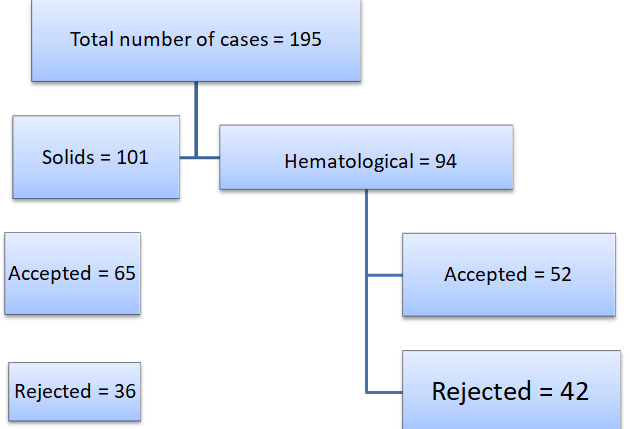
Non responsive participants as most of them were busy or found the study useless. The number of non-responsive participants with solid cancer was 36 whereas it was 42 non responsive participants with haematological cancers (Figure 1).
Results
A total of 117 family caregivers were included in the present study, 65 caregivers of patients with solid malignancies with a percentage of 55.6% of the total, and 52 caregivers of patients with haematological malignancies with a percentage of 44.4% of the total. Table 1 illustrates the demographic characteristics of the cancer caregivers. It could be clearly seen from the table that the majority of the caregivers are aged younger than 35 years, while caregivers who are older than 55 years are the minority. Men took a higher part in caregiving than women according to this study. Most of the caregivers who participated in the study were married with a percentage of 80.34% of the total number of participants, the rest were single, widowed or divorced. Table 1 shows that most of the participants work for a full day, which might interrupt their daily routine and change priorities. While the minority of the caregivers worked for a half day, and this helped save much of their time. The majority of the participants had university degrees so that could be helpful in understanding the disease and its complications. 62.39% of caregivers are living with their patients, thus their data could be more accurate in relation to their experience in the care for the patient. It can be noticed from Table 2 that there are some numbers of caregivers of solid malignancies with primary school degrees while there were non in heamotological cancers caregivers. Furthermore, 24 participants of heamatological malignancies caregivers were not living with their patients with a percentage of 46.2%, whereas in solids malignancies the number was 20 with a percentage of 30.8%. Table 3 comparing the mean score for the burden group was 31.23±8.83, the distuptiveness group was 17.36±4.78, the positive adaptation group was 14.15±3.01, and for the financial group was 0.46±1.16. The score of burden in the solid patients’ care givers was higher than the haematological patients’ caregivers the difference was found to be of high statistical significance. Seventy eight persons refused to participate in the study, 42 of them were in haematological malignancies. It can be noticed that the burden group is significant, depending on the questions included in that group, care givers are more likely to be nervous, sad and worried with an increase in their mental strain level. Furthermore, they have difficulty in dealing with their loved one’s physical and mental changing.
| Variable | Frequency (%) | |
|---|---|---|
| Age | 35 < | 39 ( 33.3% ) |
| 35-45 | 35( 29.9% ) | |
| 45-55 | 32( 27.3% ) | |
| 55 > | 11( 9.4% ) | |
| Age mean ±SD | 40.52 ±10.26 | |
| Gender | Men | 94 ( 80% ) |
| Women | 23 ( 20% ) | |
| Marital status | Married | 94 ( 80% ) |
| Single, divorced or widowed | 23 ( 20% ) | |
| Employment status | Full day | 89 ( 76.06% ) |
| Half day | 6 ( 5.12% ) | |
| Retired | 15 ( 12.82% ) | |
| Unemployed | 7 ( 5.98% ) | |
| Education | Secondary school | 4 ( 3.41% ) |
| High school | 27 ( 23.07% ) | |
| University | 86 ( 73.5% ) | |
| Live with the patient | Yes | 73 ( 62.3% ) |
| No | 44 ( 37.6% ) |
Table 1: The demographic characteristics of the caregivers (n=117).
| Solid (n=65) | Haematological (n=52) | Chi2 | p value | |||
|---|---|---|---|---|---|---|
| Frequency | % | Frequency | % | |||
| Gender | 0.011 | 0.197 | ||||
| Male | 52 | 80% | 42 | 80.76% | ||
| Female | 13 | 20% | 10 | 19.23% | ||
| Marital status | 1.661 | 0.475 | ||||
| Married | 54 | 83.10% | 40 | 76.90% | ||
| Single, divorced or widowed | 11 | 16.90% | 12 | 23.10% | ||
| Employment status | 6.594 | 0.079 | ||||
| Full day | 46 | 70.80% | 43 | 82.70% | ||
| Half day | 6 | 9.20% | 0 | 0% | ||
| Retired | 10 | 15.40% | 5 | 9.60% | ||
| Unemployed | 3 | 4.60% | 4 | 7.70% | ||
| Education | 3.713 | 0.161 | ||||
| Secondary school | 4 | 6.20% | 0 | 0% | ||
| High school | 16 | 24.60% | 11 | 21.20% | ||
| University | 45 | 69.20% | 41 | 78.80% | ||
| Live with the patient | 2.914 | 0.124 | ||||
| Yes | 45 | 69.20% | 28 | 53.80% | ||
| No | 20 | 30.80% | 24 | 46.20% |
Table 2: Additional demographic characteristics of the caregivers (n=117).
| Solid (n=65) | Haematological (n=52) | t value | p value | |||
|---|---|---|---|---|---|---|
| Mean | SD | Mean | SD | |||
| Financial | 0.415 | 1.17 | 0.519 | 1.16 | 0.478 | 0.634 |
| Burden | 35.31 | 3.88 | 26.13 | 8.83 | 6.973 | <0.001** |
| Disruptiveness | 17.91 | 4.33 | 16.67 | 4.78 | 1.463 | 0.146 |
| Positive adaptation | 14.18 | 3.04 | 14.1 | 3.01 | 0.157 | 0.875 |
Table 3: Comparison of mean total CQOLC scores of the caregivers of solid and haematological cancer patients.
Discussion
The Middle East, including Kuwait, has experienced a significant increase in the incidence of solid and haematological malignancies in recent years. These malignancies have become a major public health concern, necessitating a deeper understanding of the contributing factors and their consequences on the quality of life for affected individuals. Solid malignancies, such as breast, lung, colorectal, and prostate cancers, have seen a rise in incidence rates in the Middle East. Lifestyle changes, including the adoption of Westernized diets and sedentary behaviour, have been identified as potential risk factors for the development of these cancers [6]. Environmental factors, such as exposure to carcinogens in the air and workplace, have also been implicated. Additionally, an aging population contributes to the increasing prevalence of solid malignancies, as age is a known risk factor for cancer development [7]. On the other hand, haematological malignancies, including leukaemia, lymphoma, and multiple myeloma, have also shown an upward trend in the Middle East, including Kuwait. Genetic predisposition, exposure to certain chemicals, viral infections, and environmental factors have been linked to the development of haematological malignancies [8]. For example, the prevalence of hepatitis B and C infections in the region has been associated with an increased risk of developing certain types of haematological cancers [8].
The impact of these malignancies on the quality of life for individuals in the Middle East, particularly in Kuwait, is substantial. Cancer, regardless of its type, can have a profound effect on physical, emotional, and social well- being. The physical symptoms associated with cancer, such as pain, fatigue, and loss of appetite, can significantly impact daily activities and overall functioning [9]. Furthermore, the side effects of cancer treatments, such as chemotherapy and radiation therapy, can further compromise the quality of life by causing hair loss, nausea, and weakened immune function [9].
Emotionally, cancer can lead to psychological distress, anxiety, depression, and a sense of uncertainty about the future [10]. The emotional burden of living with cancer can be overwhelming for patients and their families, necessitating psychological support and counselling services [10]. Socially, the stigma associated with cancer in some Middle Eastern societies can result in isolation and discrimination, exacerbating the emotional toll on individuals affected by the disease [11]. Moreover, the economic burden of cancer is a significant concern. Cancer treatments, including surgery, chemotherapy, and radiation therapy, can be expensive, placing a financial strain on patients and their families [10]. In some Middle Eastern countries, the lack of comprehensive health insurance coverage further complicates access to and affordability of quality cancer care.
The quality of life of caregivers for patients with hematologic and solid malignancies in Kuwait can be improved to reduce the prevalence of chronic symptoms experienced with patient. It is important that the QOL be improved to ensure patient recovery rapidly and improve their admission frequency. According to the analysis performed, most of the patients caregivers have reduced functioning outcomes, such as emotional functioning and role functioning [12]. Fatigue and reduced appetite is also another serious symptom patient manifest from during their treatment process due to lack of efficient caregivers. As such, it is important that specialized palliative care be introduced ahead of times during the development of haematologic and solid malignancies to improve the quality of life for their caregivers.
Over the past few years, Kuwait has experienced an increase in the need to augment their palliative care to cater to the growing number of patient admission. More importantly, the corresponding growth is because of increased life expectancy in Kuwait as well as the number of elderly patients. Most European countries in comparison to Kuwait have rapidly increased their specialized palliative teams to meet the needs of their ever-growing patient [13]. Nonetheless, Kuwait health care has also increased their scope of palliative care to admit cancer patients, solid malignancies, and hematologic diseases [12]. They have been able to achieve this because of the increased frequency of patient diagnosed with cancer.
The quality of life of caregivers with Hematologic and solid malignancies in Kuwait warrants more attention especially in outpatient compared to inpatient caregivers [14]. It is clearly noticed that patients in the health care units are gravely impaired in contrast to outpatients [15, 16]. However, their inpatient caregivers have improved functional outcomes compared to outpatient caregivers. In addition to that, caregivers of the outpatients are more likely to be annoyed from the changing of their daily routine and time management, which disrupts their roles in life affecting their quality of life.
According to a study measured the quality of life of family caregivers of cancer patients in Singapore and globally, caregivers in Singapore and Asia had lower CQOLC total scores than their Western counterparts. Moreover, Caregivers who were male, of Chinese ethnicity, had parental relationships with their care recipient, were found to have impaired QOL [17]. It is very important to measure the QOL of the cancer caregivers, so we can improve the method used in helping the patients and their caregivers to cope with the disease progress [18].
References
-
Basmy A, Mohannadi S, Awadi A (2012) Some epidemiological measures of cancer in Kuwait national cancer registry data from 2000-2009. Asian Pac J Cancer Prev 13(7): 3113-3118.
-
Elbasmi A, Asfour A, Nesf Y, Awadi A (2010) Cancer in Kuwait magnitude of the problem. Gulf J Oncolog 1(8): 7-14.
-
Shemmari SH, Ameen R (2017) Kuwait bone marrow transplantation activities. Hematol Oncol Stem Cell Ther 10(4): 308-310.
-
Lim HA, Tan JYS, Chua J, Yoong RKL, Lim SE, et al. (2017) Quality of life of family caregivers of cancer patients in Singapore and globally. Singapore Med J 58(5): 258-261.
-
Kamel AA, Mohammed H (2014) Evaluation of home caregiving program by Jordanian stroke patients’ caregivers Qualitative study. Journal of Natural Sciences Research 4(22): 25-33.
-
Abdeen Y, Zidan N, Elsabah M, Alkhanbouli J (2019) Risk factors for breast cancer among Jordanian women a case-control study. Eastern Mediterranean Health Journal 25(4): 231-238.
-
Zalabani AH, Hamdan NA, Saeed AA, Hassan YA (2017) The prevalence of physical activity and its socioeconomic correlates in Kingdom of Saudi Arabia A cross-sectional population-based national survey. Journal of Taibah University Medical Sciences 12(3): 208-215.
-
Almutairi M, Almutairi A, Alshammari F, Almutairi Z, Aldossary N, et al. (2021) Colorectal cancer in Saudi Arabia Incidence survival and quality of life. Clinical Colorectal Cancer 20(2): e191-e201.
-
Hamad A, Dawood K, Fawaz I, Almohareb F, Mohsen I (2018) Hematological malignancies in Saudi Arabia A retrospective analysis of a tertiary care hospital registry over a 10-year period. Annals of Saudi Medicine 38(1): 22-30.
-
Mousavi SM, Gouya MM, Ramazani R, Davanlou M, Hajsadeghi N, et al. (2012) Cancer incidence and mortality in Iran. Annals of Oncology 24(11): 2829- 2837.
-
Abdul-Rasool H (2019) Cancer in Iraq Incidence trends and the role of viral infections. Journal of Oncology, pp: 1-11.
-
Hui D, Kim SH, Roquemore J, Dev R, Chisholm G, et al. (2014) Impact of timing and setting of palliative care referral on quality of end‐of‐life care in cancer patients. 120(11): 1743-1749.
-
Dawood KM, Dawood AS, Shammari FA, Matouq H (2022) Trends in the Incidence of Colorectal Cancer in Kuwait A 10-Year Retrospective Study. Asian Pacific Journal of Cancer Prevention 23(1): 133-138.
-
Mutawa AM, Duwairi QA (2021) Quality of Life of Caregivers of Cancer Patients in Kuwait A Cross-Sectional Study. Middle East Journal of Cancer 12(3): 335-344.
-
Joudi FS, Asfour A (2021) Cancer incidence in Kuwait A comprehensive report. Journal of Epidemiology and Global Health 11(1): 1-8.
-
Awadhi S, Alshammari F (2022) Bone Marrow Transplantation in Kuwait Current Trends and Future Perspectives. Journal of Stem Cell Research and Therapy 12(1): 1-6.
-
Lim H, Tan J, Chua J, Yoong R, Lim S, et al. (2017) Quality of life of family caregivers of cancer patients in Singapore and globally. Singapore Medical Journal 58(5): 258-261.
-
Mutawa AM, Bloushi MA, Duwairi QA (2022) Factors Influencing Caregiver Quality of Life in Kuwait A Qualitative Analysis. International Journal of Environmental Research and Public Health 19(5): 2696.
- Cancer Diagnosis from RNA Sequence of Blood Cells by Using AI
- Field Cancerization in Oral Cavity, Case Report and Review of Literature. Oncologic Program Salud Integral Hospital, Managua, Nicaragua
- Identification of B Lymphocytes in Cancer Patient’s Blood
- A Case Report of a Breast Cancer Patient Developing Pneumonitis as a Result of Abemaciclib Therapy
- Immune Checkpoint Therapeutics for Today’s Fight and Beyond
- The Amalgamated Sophomore-Gonadoblastoma