
Role of Smoking and Alcoholism in Prostate Cancer
Prostate cancer is one of the commonly diagnosed cancers in men worldwide. This disease is considered to be multifactorial in nature bearing a number of predisposing factors. Smoking and alcoholism are associated with a number of cancers including the prostate cancer. Therefore, this study was conducted on 100 subjects including 50 histopathologically proven patients of prostate cancer and 50 apparently healthy controls. The habit of smoking and alcoholism was enquired about and recorded in all the study participants. The data was analyzed using appropriate statistical methods. It was observed that among patients, 32 patients (64%) were smokers while among controls, 22% (n=11) were smokers. Smoking was found to be associated with the cases of prostate cancer in statistically highly significant manner (p=2.22 X 10⁻⁵). Among both the groups, 12% were found to be alcoholic (p=1). All the alcoholics in both the groups were smokers too, therefore, 6 subjects out of 50 (12%) were in the habit of both smoking and alcoholism in both the groups (p=1). Therefore, it may be concluded that smoking has a positive association with prostate cancer
Introduction
Prostate cancer is the second most frequently diagnosed cancer of men and the fifth most common cancer overall [1]. It has become the leading cause of death in metropolitan cities of India. As per the data of Delhi Cancer Registry, prostate carcinoma is the second most frequently diagnosed cancer among males in Delhi accounting for 6.78% of all malignancies [2]. Prostate cancer is multifactorial. The principal attributing etiological factors include hormonal imbalance and increased oxidative stress. One of the other risk factors is age. Most autopsy series show a positive correlation of prostate cancer incidence and age. Race is also a pre-disposing factor for the prostate cancer, African Americans being at greater risk. A variety of dietary risk factors also have been identified including a high intake of proteins, total fat, saturated fat etc [1]. Personal habits like alcohol and tobacco use are also found associated with a number of cancers along with numerous other adverse health consequences [1].
Regarding alcohol consumption, there is a strong scientific consensus that alcohol drinking can cause several types of cancer [3]. The National Toxicology Program of the US Department of Health and Human Services includes alcohol in the list of human carcinogens. As per the research work conducted to establish an association between alcohol consumption and the risk of other cancers, it has been reported that some cancers like cancers of the ovary, stomach, uterus, and bladder etc. either have no or inconsistent association with alcohol use. While, it has been reported to be associated with increased risks of melanoma and of prostate and pancreatic cancers [4]. Alcohol beverages may increase cancer risk by a number of mechanisms. Acetaldehyde, metabolic product of alcohol is a toxic substance and can damage both deoxyribonuleic acid (DNA) and proteins. Alcohol metabolism generates reactive oxygen species (ROS) which can, further, oxidize macromolecules like DNA, proteins, and lipids in the body. It also impairs the metabolism of a variety of nutrients that may be associated with cancer risk, including vitamin A, folate, vitamin C, vitamin D, vitamin E and carotenoids etc. In addition, alcohol consumption has been reported to increase blood levels of the sex hormone estrogen. Alcoholic beverages may also contain a variety of carcinogenic contaminants that are introduced during the process of its fermentation and production, such as nitrosamines, asbestos fibers, phenols, and hydrocarbons etc [5].
Smoking is also a risk factor for development of many types of cancer whether it is in the form of cigarette smoking or tobacco smoking. Besides producing free radicals and toxic chemicals, smoking has been associated with higher levels of plasma testosterone and lower levels of bioavailable estradiol in men increasing their risk of developing prostate cancer [6]. There is epidemiologic evidence that people who use both alcohol and tobacco are at significantly greater risk of developing some cancers like that of the oral cavity, pharynx, larynx, and esophagus as compared to the people who use either alcohol or tobacco alone. In fact, for oral and pharyngeal cancers, the risks associated with using both alcohol and tobacco are multiplicative; that is, they are greater than would be expected from adding the individual risks associated with alcohol and tobacco together [7]. Therefore, this study was planned to find an association of smoking and alcoholism with prostate cancer.
Materials and Methods
For this study, 50 newly diagnosed patients of histopathologically proven carcinoma prostate were compared with 50 age and sex matched healthy controls. Diagnosis of carcinoma prostate was established by detailed history, clinical examination and histopathological examination. Informed consent was taken from each individual for participating in this study. Patients suffering from any other cancer or any other prostatic illness were excluded from the study. The personal habits especially, smoking and alcoholism were enquired about in detail and recorded. The data was statistically compared and analyzed using chi-square test.
Results
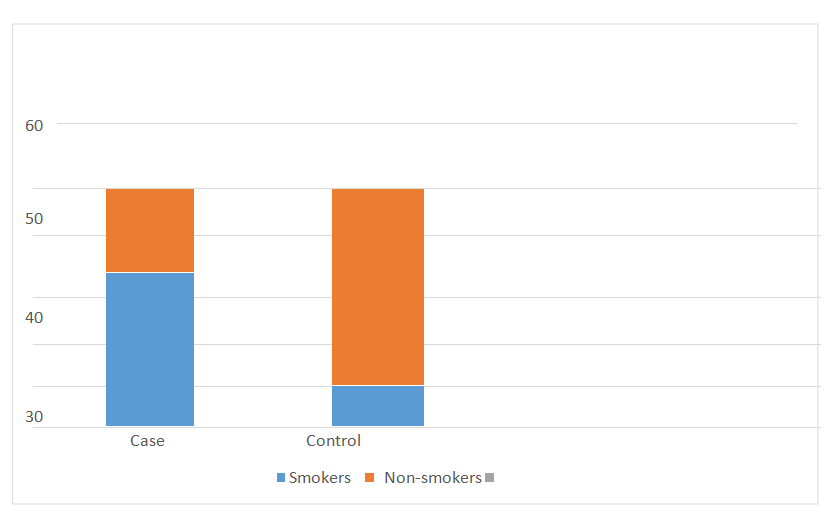
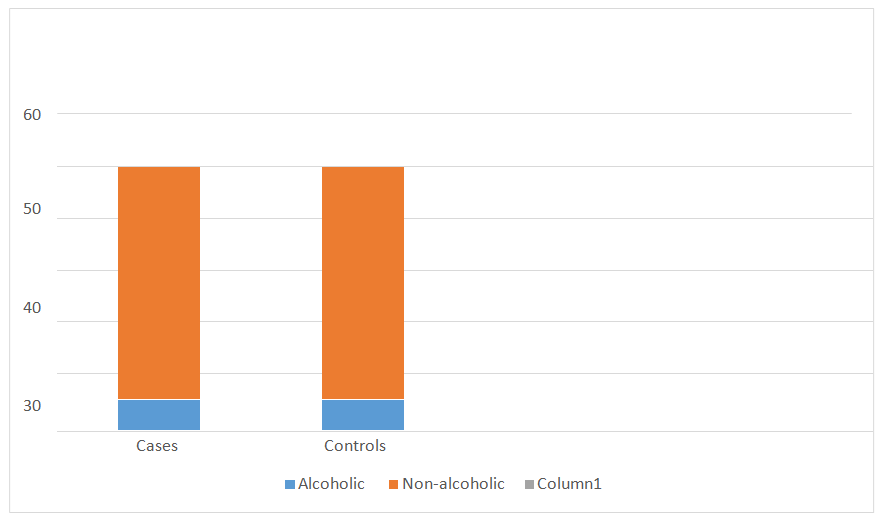
The mean age of cases was 67.86±9.91 years (45-86 years) and that of controls was 65.48±6.28 years (50- 78 years). Out of 50 cases, 10 (20%), 2 (4%), 13 (26%) and 25 (50%) presented in stage A, B, C and D of prostate cancer respectively. Among these patients, 29 (58%) had Gleason score ≤7 and 21 (42%) had >7. Among patients, 32 patients (64%) were smokers while among controls, 22% (n=11) were smokers. Smoking was found to be associated with the patients of prostate cancer in a statistically highly significant manner (p=2.22 X 10⁻⁵). Among all the patients, 6 patients (12%) were alcoholic. Similarly, 12% of the controls (n=6) were alcoholics. While applying chi-square test, the association of alcoholism with cases was not found to be significant at all (p=1). All the alcoholics in both the groups were smokers too, therefore, 6 subjects out of 50 (12%) were in the habit of both smoking and alcoholism in both the groups (p=1).
Discussion
Among prostate cancer patients, 64% were smokers while in controls, 22% were smokers signifying the association of prostate cancer with smoking. The association of smoking with different cancers has been well established [8, 9, 10]. But its role in prostate cancer is conflicting in various studies. Smoking causes an increase in serum levels of testosterone, sex hormone binding globulin (SHBG) and a decrease in bioavailable estradiol in men. Various studies have reported a positive correlation between cigarettes smoked/ day and serum total androstenedione and total and free testosterone in men. The testosterone and its more potent metabolite dihydrotestosterone are necessary for growth and cellular proliferation of prostate which could be associated with the prostate cancer. On the other hand, estrogens act on hypothalamus and pituitary to suppress the secretion of gonadotropin and thereby, reduce testicular androgen production. A number of potential carcinogens are present in cigarette like aldehydes, benzene, berrylium, lead etc [6, 11]. Jacob, et al. reported in their study that smoking was positively associated with liver cancer, bladder and kidney cancer, pancreatic cancer, lymphoma etc while negatively associated with skin cancer, prostate cancer, multiple myeloma, breast cancer and cancer of corpus uteri [9]. Khani, et al. found that tobacco smoking is associated with increased risk of lung cancer, upper aerodigestive tract, esophagus, stomach, prostate, pancreatic cancer etc. while may have a protective role in thyroid cancer, skin cancer and Kaposi’s sarcoma. The cause might be the immunologic effect of smoking [8]. In the European countries, almost every one of five cancers is caused by smoking. These estimates come from a population with substantial number of women and young people in the habit of smoking [10]. Jimenez-Mendoza, et al. [11] suggested in their study that the association between smoking and prostate cancer was complex and might depend on the smoking intensity over the life course. In another study by Plackson, et al. [6] it has been seen that smoking is a risk factor for prostate cancer and current smokers appear to be at moderately increased risk than non-smokers. In a study by Huncharek, et al. [12] a modest, although consistent, 9 to 30% increase in both incident and fatal cancer was reported with smoking. The present study also implies a significant association of prostate cancer with smoking. In both cases and controls, only 12% of subjects were alcoholic as well as smokers. On applying chi-square test, the association of either alcoholism only or both smoking and alcoholism with prostate cancer was not statistically significant at all (p>0.05). Drinking alcohol is a contributor to the overall cancer burden. In 2018, the American Society of Clinical Oncology stated that more than 5% of new cancer cases were attributable to alcohol consumption. Although this claim is found to be conflicting in literature. In Japan, cancer risk appeared to be lowest at zero alcohol consumption with a modest increase in overall cancer risk at light to moderate levels of total life time alcohol consumption [13]. Zhao, et al. [14] reported that the relative risk of morbidity and mortality in prostate cancer significantly increased at low volume alcohol consumption compared to abstinence and a statistically significant dose-response relationship for the first time was observed. Sesso, et al. [15] also found a positive association between total alcohol consumption and the risk of prostate cancer in a cohort of older males. There was a dose-response effect upto <3 drinks/day that weakened among men consuming more than or equal to 3 drinks/day. The results of the present study do not support the association of alcoholism with prostate cancer and this may be attributed to small sample size. Therefore, it may be concluded that smoking has a positive association with prostate cancer while for establishing the role of alcoholism in this disease, further studies with large sample size are required.
References
-
Aaron LT, Franco O, Hayward SW (2016) Review of Prostate Anatomy and Embryology and the Etiology of BPH. Urol Clin North Am 43(3): 279-288.
-
Jain S, Saxena S, Kumar A (2014) Epidemiology of prostate cancer in India. Meta Gene 2: 506-605.
-
(IARC) Working Group on the Evaluation of Carcinogenic Risks to Humans (2010) Alcohol consumption and ethyl carbamate Exit Disclaimer. IARC Monographs on the Evaluation of Carcinogenic Risks in Humans 96: 3-1383.
-
Zhao J, Stockwell T, Roemer A, Chikritzhs T (2016) Is alcohol consumption a risk factor for prostate cancer? A systematic review and meta-analysis. BMC Cancer 16(1): 845.
-
Bagnardi V, Rota M, Botteri E, Tramacere I, Islami F, et al. (2015) Alcohol consumption and site-specific cancer risk: A comprehensive dose-response meta-analysis. British Journal of Cancer 112(3): 580-593.
-
Plaskon LA, Penson DF, Vaughan TL, Stanford JL (2003) Cigarette Smoking and Risk of Prostate Cancer in Middle- Aged Men. Cancer Epidemiol Biomarkers Prev 12(7): 604-609.
-
Hashibe M, Brennan P, Chuang SC, Boccia S, Castellsague X, et al. (2009) Interaction between tobacco and alcohol use and the risk of head and neck cancer: Pooled analysis in the International Head and Neck Cancer Epidemiology Consortium. Cancer Epidemiol Biomarkers Prev 18(2): 541-550.
-
Khani Y, Pourgholam-Amji N, Afshar M, Otroshi O, Sharifi- Esfahani M, et al. (2018) Tobacco smoking and cancer types: a review. Biomed Res Ther 5: 2142-2159.
-
Jacob L, Freyn M, Kalder M, Dinas K, Kostev K (2018) Impact of tobacco smoking on the risk of developing 25 different cancers in the UK: a retrospective study of 422010 patients followed for up to 30 years. Oncotarget 9(25): 17420-17429.
-
Agudo A, Bonet C, Travier N, Gonzalez CA, Vineis P, et al. (2012) Impact of cigarette smoking on cancer risk in the European Investigation into cancer and nutrition study. J Clin Oncol 30(36): 4550-4557.
-
Jimenez-Mendoza E, Vazqez-Salas RA, Barrientos- Gutierrez T, Reynales-Shigematsu LM, Labra-Salgado IR, et al. (2018) Smoking and prostate cancer: a life course analysis. BMC Cancer 18(1): 160-70.
-
Huncharek M, Haddock KS, Reid R, Kupelnick B (2010) Smoking as a risk factor for prostate cancer: a meta- analysis of 24 prospective cohort studies. Am J Public Health 100(4): 693-701.
-
Zaitsu M, Takeuchi T, Kobayashi Y, Kawachi I (2020) Light to moderate amount of lifetime alcohol consumption and risk of cancer in japan. Cancer 126(5): 1031-1040.
-
Zhao J, Stockwell T, Roemer A, Chikritzhs T (2016) Is alcohol consumption a risk factor for prostate cancer? A systematic review and meta-analysis. BMC Cancer 16(1): 845-857.
-
Sesso HD, Paffenbarger Jr RS, Lee IM (2001) Alcohol consumption and risk of prostate cancer: The Harvard Alumni Health Study. Int J Epidemiol 30(4): 749-755.
- Cancer Diagnosis from RNA Sequence of Blood Cells by Using AI
- Field Cancerization in Oral Cavity, Case Report and Review of Literature. Oncologic Program Salud Integral Hospital, Managua, Nicaragua
- Identification of B Lymphocytes in Cancer Patient’s Blood
- A Case Report of a Breast Cancer Patient Developing Pneumonitis as a Result of Abemaciclib Therapy
- Immune Checkpoint Therapeutics for Today’s Fight and Beyond
- The Amalgamated Sophomore-Gonadoblastoma