
Synthesis, Anti-Inflammatory and Antimicrobial Evaluation of Novel 2-phenyl-3-((4-phenylthiazol-2-yl) amino)thiazolidin-4- One Derivatives
In order to explore the therapeutic potential of thiazolidinone based analogues, five novel 2-phenyl-3-((4-phenylthiazol-2-yl) amino)thiazolidin-4-one derivatives (7a-e) were synthesized using multistep synthetic methodology. Structural elucidation of all synthesized molecules was performed by using IR and 1H NMR spectral reports. All molecules were accessed for their anti-microbial potential against a panel of four bacterial strains and one fungal strain. Results of in vitro antimicrobial data revealed compounds 7c and 7d as most potent antibacterial agent towards E. coli, S. aureus and B. subtilis with MIC values of 6.25 µg/mL while Compounds 7a, 7b and 7e as most active antifungal agents against tested fungal species i.e., R. oryaze (MIC = 3.125 µg/mL). Further, in vitro anti-inflammatory potential was evaluated for synthesized molecules in which compound 7d have powerful anti-inflammatory profile with IC50 value of 1.27 µg/Ml.
Introduction
Heterocyclic compounds are present as core structural skeleton in many pharmaceutical drugs by which widely explored by scientists as lead molecules in numerous areas of pharmaceutical sectors [1]. In this, cyclic word of heterocyclic refers to minimum mono-ring system available in molecular structure, while hetero word specifies the atom except carbon as part of the ring [2, 3]. Now a days, most vitally explored heterocycles includes five- or six-membered rings which mainly comprises of N, O and S like heteroatoms. The best recognized common heterocyclic compounds are pyrazole, thiophene, pyrrole, furan, pyridine and piperidine etc. Introduction of nitrogen and sulphur atoms to attain biologically active isosteres is a prominent structural variation to achieve maximal potency [4, 5, 6]. Also, insertion of nitrogen and sulphur in the different cyclic structures attained the physical as well as chemical nature which is not similar as compared with their other bio-isosteres [7, 8]. Hence, endocyclic N, S bearing heterocyclic compounds presented the diverse range of therapeutic implications with minimal side-effects associated with them. Nitrogen and sulphur containing heterocyclic motif usually have varied biological actions and act like structural nucleus in different marketed drugs as well clinical trial molecules [9, 10]. Further, certain approved drugs under different classes have structurally varied nitrogen and sulphur containing heterocyclic rings and commonly used nucleus in anti-inflammatory and CNS acting agents [11, 12]. Thiazolidinone is a well-known five-membered heterocyclic ring having nitrogen and Sulphur hetero atoms positioned at 1st and 3rd position, respectively and separated via one carbon atom. It is also known as five membered tetrahydro-thiazole-4-one ring and having molecular formula C3H5NOS [13, 14, 15]. Thiazolidinone structure consist of no endocyclic double bond and exhibit basic properties. It is also used as a prominent isostere of heterocyclic rings including imidazole, pyrazole, tetrazole, isoxazole, triazole, oxazole and many more to modulate their physicochemical properties and biological profile [16, 17]. There are several thiazolidinone based approved medicinal agents such as Ponesimod, Ralitoline, Etozoline and so on, as shown in Figure 1 [18, 19]. Ponesimod is an effective selective sphingosine 1-phosphate receptor 1 (S1P1) agonist which is approved in year 2021 and generally employed in the treatment of relapse multiple sclerosis in adult persons. Also, various adverse effects are associated with the use of ponesimod drug including bradycardia, breathing difficulties along with significant elevation in hepatic enzymes etc. [20]. Further, Ralitoline is another thiazolidinone based medication used mainly in the eradication of epilepsy. It is one of the effective antiepileptic drugs having thiazolidinone skeleton which acts via selective inhibition against sodium channel [21]. Moreover, Etozoline is also thiazolidinone analogue used as diuretics in almost European countries. It is sold under brand names Elkapin and Etopinil. But several adverse reactions were elicited by Etozoline by virtue of which it was recalled from European market [22].
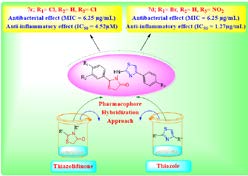
As per available literature reports, Thiazolidinone proved itself as one of the promising heterocyclic five-membered scaffolds with interesting antimicrobial as well as anti-inflammatory effect [23, 24]. In this research paper, we explored the synthesis of novel thiazolidinone clubbed thiazole hybrid derivatives and evaluated them as potent anti-bacterial, antifungal and anti-inflammatory agents.
Materials and Methods
General methods
All the chemicals were purchased from Sisco research laboratory (SRL) and Spectrochem. All the reactions were carried out in oven-dried borosilicate glassware either at room temperature or using refluxing assembly. Thin layer chromatography (TLC) was carried out by utilizing silica gel G and used mobile phase of Ethyl acetate: n-Hexane in the solvent ratio of 6:4 followed by visualization of spots with the help of iodine chamber to monitor the progress for all synthetic steps involved. The melting points were determined by open capillary tube on Decibel melting point apparatus and results were observed in degrees Celsius. The IR spectra was obtained to get information about functional groups present in synthesized derivatives by using KBr pellet technique and Perkin Elmer IR spectrophotometer. Proton (1H) Nuclear Magnetic Resonance (1H-NMR) spectra were recorded using Brucker Avance II 400 MHz spectrometer for solutions in CDCl3, and values are reported in parts per million (ppm), downfield from Tetramethyl silane (TMS) as an internal standard.
General methods for the synthesis of thiazolidinone bearing compounds
4-thiazolidinones are synthesized via reaction of Schiff bases with thioglycolic acid or thioacetyl chloride in the presence of appropriate solvent and temperature conditions.
The proposed compounds were synthesized using a synthetic procedure involving 3 steps. Each step acts as a starting material or intermediate for the next step and finally, the proposed compounds were obtained.
General procedure for the synthesis of (E)- 2-benzylidenehydrazine-1-carbothioamide derivatives (3a-c)
In a clean and dried conical flask, equimolar mixture of unsubstituted or para, meta substituted benzaldehyde (1a-c, 0.1mol) and thiosemicarbazide (2, 0.1mol) was taken in absolute ethanol (20 ml) as shown in scheme 1. To the reaction mixture, 2-3 drops of acetic acid was transferred, the content were refluxed for 6-7 hours at 80 oC until the completion of the reaction as evidenced by TLC. After the completion, the mixture was allowed to stand at room temperature for 1h and the precipitated solid was filtered out. The precipitated mass washed with cold water and dried. After drying, recrystallization was performed for (3a- c) to get sufficient purity and used directly as such for the next step.
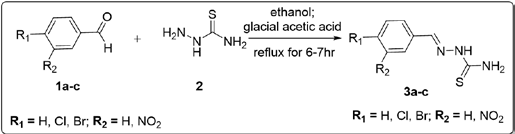
Scheme 1: Synthesis of (E)-2-benzylidenehydrazine-1-carbothioamide derivatives (3a-c).
General procedure for the synthesis of (E)-2- (2-benzylidenehydrazinyl)-4-phenylthiazole derivatives (5a-e)
To a solution containing equimolar amount of (E)-2- benzylidenehydrazine-1-carbothioamides (3a-c, 0.001mol) and unsubstituted or para-¬substituted phenacyl bromides (such as phenacyl bromide, 4-chloro-phenacyl bromide, 4-bromo-phenacyl bromide, 4-nitro-phenacyl bromide,
0.001mol) in hot ethanol and trimethyl amine was added as basic catalyst to afford the (E)-2-(2-benzylidenehydrazinyl)- 4-phenylthiazole derivatives (5a-e) as shown in scheme 2. The reaction mixture was allowed to reflux at water bath for a period of 8 hours till the completion of reaction as indicated by TLC by using mobile phase (Ethyl acetate: n-Hexane; 3:7). After completion, recrystallization of the crude product provided the various titled compounds (5a-e) in good yields.
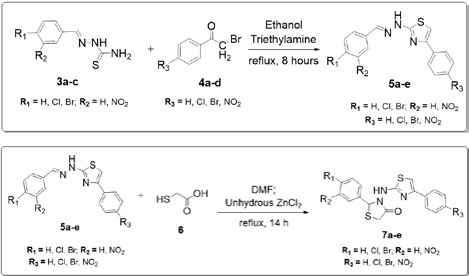
Scheme 2: Synthesis of various (E)-2-(2-benzylidenehydrazinyl)-4-phenylthiazole derivatives (5a-e).
General procedure for the synthesis of 2-phenyl- 3-((4-phenylthiazol-2-yl) amino) thiazolidin-4- one derivatives (7a-e)
In reaction flask, a solution of thiazole derivatives (5a- e, 0.01mol) and thioglycolic acid (0.1ml) was taken in DMF (50 ml) and catalytic amount of anhydrous zinc chloride was added in the particular chemical reaction. Then, content of reaction flask was refluxed for appropriate time (14 hours) until the desired final compounds were not obtained as shown in scheme 3. The progress of the reaction was confirmed by TLC in mobile phase of Ethyl acetate: n-Hexane (3:7). Then, crushed ice was added to reaction flask with continuous shaking to obtain precipitates in satisfactory yield followed by filtration. Washed the crude product thoroughly with water and dried. Recrystallization of the crude solid from ethanol afforded the final compounds (7a-e) in good yield after purification. Various physicochemical parameters of synthesized final compounds (7a-e) is presented in Table 1.
Scheme3: Synthesis of various 2-phenyl-3-((4-phenylthiazol-2-yl) amino) thiazolidin-4-one derivatives (7a-e).
| Graphical abstract | R 1 | R 2 | R 3 | Melting point(oC) | Ravalue f | % Yield |
|---|---|---|---|---|---|---|
| 7a | H | H | Cl | 80 | 0.88 | 78 |
| 7b | H | H | Br | 96 | 0.76 | 88 |
| 7c | Cl | H | Cl | 87 | 0.66 | 86 |
| 7d | NO 2 | H | Br | 76 | 0.65 | 88 |
| 7e | H | NO 2 | Br | 74 | 0.77 | 82 |
Table 1: Physicochemical data of various synthesized final compounds (7a-e).
aSolvent system = (Ethyl acetate: n-Hexane; 3: 7) Table 1: Physicochemical data of various synthesized final compounds (7a-e).
2-(4-chlorophenyl)-3-((4-phenylthiazol-2-yl) amino)thiazolidin-4-one (7a)
Yield: 78%, Dark brown solid, Mp: 80 oC, Mol. wt.: 387, Mol. formula: C18H14ClN3OS2. IR (KBr) cm-1: 3432 (2o amine), 3059.88 (aromatic C-H str.), 2926 (aliphatic C-H str.), 1632 (C=O of amide), 1599 (C=N), 1571 (C=C), 826.07 (C-Cl). 1H-NMR (500 MHz, CDCl3): δ 4.09 (s, NH, 1H), 7.79-7.81(d, Ar-H, 4H) 7.75 (s, Ar-H, 4H), 7.28 (s,Thiazole-H,1H), 6.34 (s, 1H, TZD-H), 3.75 (s, 2H, TZD-H).
2-(4-bromophenyl)-3-((4-phenylthiazol-2-yl) amino)thiazolidin-4-one (7b)
Yield: 86%, Dark brown solid, Mp: 96 oC, Mol. wt.: 431, Mol. formula: C18H14BrN3OS2. IR (KBr) cm-1: 3434.10 (2o amine), 3050 (aromatic C-H str.), 2925.21 (aliphatic C-H str.), 1653(C=O of amide), 1567 (C=N), 1537 (C=C), 826 (C-Br) 1H-NMR (500 MHz, CDCl3): δ 4.09 (s, NH, 1H), 8.04- 7.75(d, Ar-H, 4H) 7.37 (s, Ar-H, 4H), 7.28 (s,Thiazole-H,1H) 6.88 (s, 1H, TZD-H), 3.76 (s, 2H, TZD-H).
2-(4-chlorophenyl)-3-((4-(4-chlorophenyl) thiazol-2-yl)amino)thiazolidin-4-one (7c)
Yield: 86%, Dark brown solid, Mp: 87 oC, Mol. wt.: 421, Mol. formula: C18H13Cl2 N3OS2. IR (KBr) cm-1: 3434.10 (2o amine), 3050 (aromatic C-H str.), 2925.21 (aliphatic C-H str.), 1653(C=O of amide), 1567 (C=N), 1537 (C=C), 826 (C-Cl). 1H-NMR (500 MHz, CDCl3): δ 4.13 (s, NH, 1H), 7.75-8.04 (d, Ar-H, 8H), 7.32 (s, Thiazole-H, 1H), 6.58 (s, 1H, TZD-H), 3.71 (s, 2H, TZD-H).
2-(4-bromophenyl)-3-((4-(4-nitrophenyl) thiazol-2-yl)amino)thiazolidin-4-one (7d)
Yield: 88%, Yellow solid, Mp: 76 oC, Mol. wt.: 476, Mol. formula: C18H13BrN4O3S2. IR (KBr) cm-1: 3432.11 (2o amine), 3048 (aromatic C-H str.), 2925 (aliphatic C-H str.), 1655 (C=O of amide), 1593 (C=N), 1574 (C=C), 731 (C-Br). 1H-NMR (500 MHz, CDCl3): δ 4.08 (s, NH, 1H), 7.68-8.04 (d, Ar-H, 8H), 7.29 (s, Thiazole-H, 1H), 6.88 (s, 1H, TZD-H), 3.79 (s, 2H, TZD-H).
3-((4-(4-bromophenyl)thiazol-2-yl)amino)-2- (3-nitrophenyl)thiazolidin-4-one (7e)
Yield: 82%, Yellow solid, Mp: 74 oC, Mol. wt.: 476, Mol. formula: C18H13BrN4O3S2. IR (KBr) cm-1: 3250 (2o amine), 3031 (aromatic C-H str.), 2930 (aliphatic C-H str.), 1661 (C=O of amide), 1565 (C=N), 1528 (C=C), 750 (C-Br). 1H-NMR (500 MHz, CDCl3): δ 4.11 (s, NH, 1H), 7.14-8.15(d, Ar-H 8H), 7.14 (s, Thiazole-H, 1H), 6.71 (s, 1H, TZD -H), 3.72 (s, 2H, TZD-H).
Antimicrobial activity
In this in vitro study, standard serial dilution method was utilized to perform antibacterial as well as antifungal evaluation of synthesized molecules. Hereby, Ciprofloxacin was used as reference antibacterial agent while Fluconazole was taken as reference antifungal agents to perform antibacterial and antifungal studies, respectively. Antibacterial activity was evaluated against two gram- positive (S. aureus, B. subtilis) and two gram-negative (E. coli, P. aeruginosa) bacterial strains while one fungal strain (R. oryzae). To evaluate the proposed molecules for their antibacterial as well as antifungal potential, broth dilution approach was used to determine Minimum inhibitory concentration (MIC). A stock solution having concentration of 1000 μg/mL was formulated in DMSO followed by its further dilution to afford test sample of 100 μg/mL. Furthermore, this test sample is diluted more to obtain several concentrations viz. 50, 25, 12.50, 6.25, and 3.125 μg/ mL through the addition of Sabouraud Dextrose broth (SBD, 1 mL) and Nutrient broth (NB, 1 mL) for antibacterial and antifungal study, respectively. Moreover, the appropriate bacterial and fungal strains were injected via culture tubes and then incubated for 24 hours and 5 days and 48 hours at 37 °C for tested bacterial species and Rhizopus oryzae, respectively. Finally, turbidity analysis was carried out to evaluate the microbial growth inhibition and hence, MIC values was calculated by considering the turbidity inhibition by lowest concentration.
Anti-Inflammatory Activity
In in vitro study, diclofenac sodium was taken as standard drug to perform anti-inflammatory evaluation for synthesized compounds. Hereby, certain dilutions (500, 250, 125, 62.25 and 31.25 μg/mL) were prepared for produced thiazolyl thiazolidinone hybrid derivatives while dimethyl sulfoxide (DMSO) was taken as solvent. From prepared dilutions, 1ml of each resulting solution was transferred in separate test tubes and labelled properly. Further in each vial, add 1.4 ml of recently formulated phosphate buffer having pH of 6.4 followed by 0.1ml egg albumin (obtained from fresh egg) for 15 minutes at 37±2ºC. After that, resultant test tubes were heated at 70ºC for 5 minutes. Moreover, test tubes were cooled at room temperature followed by detection of their absorbance by UV spectroscopy at 660 nm wavelength. % Inhibition of protein denaturation was calculated through following formula: [Abs of control−Abs of sample/ Abs of control]×100 By using various percentage inhibition, IC50 values for the same were calculated and results were compared with positive control Diclofenac sodium to evaluate their anti- inflammatory potential.
Results and Discussion
Chemistry
The synthesis of various 2-phenyl-3-((4-phenylthiazol- 2-yl)amino)thiazolidin-4-one analogues were produced through multistep reaction. Firstly, equimolar mixture of thiosemicarbazide and substituted benzaldehyde was taken in absolute ethanol followed by addition of catalytic amount of acetic acid and the assembly was maintained over reflux for 3-4 hours at 80°C. In second step, synthesized thiosemicarbazone derivatives (3a-c) were used as starting material and reacted with substituted phenacyl bromide in the presence of ethanol as solvent and catalytic addition of triethylamine to give several thiazole derivatives (5a- e). In the last step, these thiazole derivatives were taken in reaction flask with thioglycolic acid in DMF and anhydrous ZnCl2 as catalyst to afford final compounds (7a-e). The purity of synthesized various final compounds was confirmed by TLC. The spots were visualized in the iodine chamber and Rf (retention factor) value was calculated. All synthesized compounds were soluble in DMSO and ethanol. structural elucidation was determined by FTIR and 1H NMR data. All compounds exhibited N-H stretching in the range of 3250-3432 cm-1, stretching of cyclic amide ranged between 1632-1661 cm-1 while C-X stretching (X=Cl, Br) appeared in between 720-826 cm-1. The presence of aliphatic functionality was confirmed by the (C-H) stretching between the region 2925-2930 cm-1 while stretching between 3030- 3050 cm-1 corresponds to aromatic (C-H). All compounds possess the characteristic singlet over δ value of 4.09 ppm in 1H NMR spectrum which corresponds to proton of amine. Also, two singlets ranging from 3.71-3.76 ppm and 6.34- 6.88 ppm indicates the presence of cyclic CH2 and CH of thiazolidinone, respectively. The NMR data were already presented in experimental section while other supporting spectrum were included in supported information.
Antimicrobial activities of 2-phenyl-3-((4- phenylthiazol-2-yl)amino)thiazolidin-4-one derivatives (7a-e)
Broth dilution approach was employed for testing the antibacterial activity (MIC) towards four bacterial strains viz: Staphylococcus aureus, Bacillus subtilis, Escherichia coli and Pseudomonas aeruginosa while R. oryaze was taken as fungal strain. Whereas, Ciprofloxacin and Fluconazole were selected as reference drug to evaluate the antibacterial and antifungal activity, respectively. The activity is reported as minimum inhibitory concentration values presented in µg/ mL for the tested candidates as determined by using broth micro dilution method. The results of antibacterial and antifungal activity are summarized in Table 2. Results of in- vitro antibacterial study revealed all tested molecules (7a-e) presented good to potent inhibitory action towards bacterial species. It was observed that almost synthesized compounds were presented significant antibacterial profile having MIC values ranged between 6.25 to 25 µg/mL. Among the series, compound 7c and 7d exhibited superior antibacterial potency against both gram-positive bacterial species (S. aureus and B. subtilis) having MIC values of 6.25 µg/mL. Whereas, except compounds 7a and 7e, almost compounds showed promising inhibition towards P. aeruginosa and E. coli, respectively with MIC values ranged between 6.25 –12.5 µg/mL. It was also observed that 7c and 7d exhibited comparable inhibitory potential against tested gram-positive species, as than that of Ciprofloxacin. In vitro antibacterial data of all synthesized molecules (7a-e) and standard drug Ciprofloxacin as MIC values (µg/mL) are demonstrated in Figure 2.
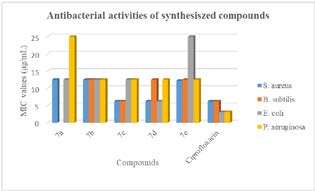
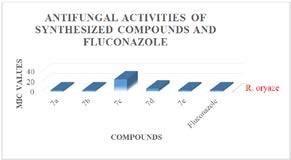
Further, antifungal results explored compounds 7a, 7b and 7e as most active antifungal agents which elicited equipotent inhibitory action against tested fungal strain R. oryzae with MIC values of 3.125 μg/mL, as compared to standard antifungal drug Fluconazole (MIC = 3.125 μg/mL). Compound 7d was found to be second most active analogues amongst the synthesized series with MIC value of 6.25 μg/ mL while 7c possessed least antifungal potency (MIC = 25 μg/mL). In vitro antifungal data of all synthesized molecules (7a-e) and standard drug Fluconazole as MIC values (µg/mL) are demonstrated in Figure 3.
From the antimicrobial activity features, it can be wind up that nature of substituent attached to the phenyl ring at 2nd position of thiazolidinone ring and 4th position of thiazole moiety has crucial impact on the antibacterial profile. Substitution at the 2nd position of the thiazolidinone moiety with phenyl group (either 4-nitro or 4-halo group) was getting more effective and well tolerated for the antibacterial activity. Introduction of electron attracting substituents (such as –Cl and –NO2) at the para-position of phenyl ring attached to 4th position of thiazole core enhanced the antibacterial activity.
| S. No. | Compounds | S. aureus | B. subtilis | E. coli | P. aeruginosa | R. oryaze |
|---|---|---|---|---|---|---|
| 1 | 7a | 12.5 | 12.5 | 12.5 | 25 | 3.125 |
| 2 | 7b | 12.5 | 12.5 | 12.5 | 12.5 | 3.125 |
| 3 | 7c | 6.25 | 6.25 | 12.5 | 12.5 | 25 |
| 4 | 7d | 6.25 | 12.5 | 6.25 | 12.5 | 6.25 |
| 5 | 7e | 12.25 | 12.5 | 25 | 12.5 | 3.125 |
| 6 | Ciprofloxacin | 6.25 | 6.25 | 3.125 | 3.125 | ---- |
| 7 | Fluconazole | ---- | ---- | ---- | ---- | 3.125 |
Table 2: In vitro antimicrobial activity (MIC values) of the synthesized compounds (μg/mL).
7.3. Anti-inflammatory activities of 2-phenyl- 3-((4-phenylthiazol-2-yl)amino)thiazolidin-4- one derivatives (7a-e) Anti-inflammatory potential of the synthesized derivatives (7a-e) was demonstrated as IC50 values through protein denaturation method using egg albumin assay. In this aspect, percentage inhibition was also determined at different concentration levels such as 31.125, 62.5, 125, 250 and 500 µg/mL. It was observed that most of synthesized thiazolidinone analogues exhibited good to potent anti- inflammatory effect along IC50 values scaled between 1.27 – 5.52 µg/mL, as than that of standard anti-inflammatory agent Diclofenac sodium (IC50 = 4.28 µg/mL) as shown in Figure 4.
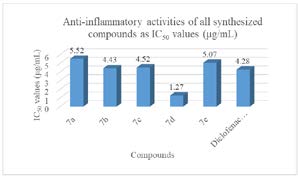
Results of in vitro anti-inflammatory activity disclosed compound 7d as most potent anti-inflammatory agent with IC50 value of 1.27 µg/mL and percentage inhibition value of 57.24% at concentration of 500 µg/mL. Results of anti-inflammatory activity are summarized in Table 3. Structure activity relationship data highlighted that electron withdrawing substitutions at phenyl ring at 2nd and 4th position of thiazolidinone and thiazole scaffolds, respectively resulted to give most potent compounds. It was observed that halo-substitutions like as chloro or bromo at 2nd position of thiazolidinone ring tend to rise anti-inflammatory potential very significantly. Whereas, subjection of Nitro functionality over 4th position of thiazole ring enhanced the anti- inflammatory action.
| S. No. | Compounds | % Inhibition | IC 50 | ||||
|---|---|---|---|---|---|---|---|
| 500 | 250 | 125 | 62.5 | 31.125 | (µg/mL) | ||
| µg/mL | µg/mL | µg/mL | µg/mL | µg/mL | |||
| 1 | 7a | 80.31 | 64.96 | 58.63 | 50.86 | 40.43 | 5.52 |
| 2 | 7b | 29.93 | 24.04 | 24.36 | 20.37 | 17.41 | 4.43 |
| 3 | 7c | 79.33 | 66.34 | 60.63 | 52.86 | 48.43 | 4.52 |
| 4 | 7d | 57.24 | 45.72 | 40.47 | 33.44 | 18.35 | 1.27 |
| 5 | 7e | 42.68 | 29.37 | 27.3 | 20.39 | 14.85 | 5.07 |
| 6 | Diclofenac Sodium | 75.31 | 62.96 | 56.63 | 48.86 | 44.43 | 4.28 |
Table 3: In vitro anti-inflammatory activity (IC50 values) of the synthesized compounds (μg/mL).
Conclusion
In conclusion, we have synthesized 5 new 2-phenyl-3- ((4-phenylthiazol-2-yl)amino)thiazolidin-4-one derivatives (7a-e) and determined their physicochemical (melting point) and spectral characterization using FT-IR and 1H-NMR spectroscopy. Outcomes of antimicrobial disclosed that some of tested compounds presented good to potent inhibition against the tested microbial species. Some of the tested compounds displayed either comparable or potent activities than standard drug Ciprofloxacin and Fluconazole against the tested bacterial and fungal strains, respectively. Among synthesized series, compounds 7c and 7d showed equipotent antibacterial activity while derivatives 7a, 7b and 7e exhibited comparable antifungal effect as than that of standard drugs used. Further, anti-inflammatory data revealed compound 7d as more promising agent than standard anti-inflammatory drug Diclofenac sodium.
Acknowledgements
The authors acknowledge the Vice Chancellor, Guru Jambheshwar University of Science & Technology, Hisar for his constant support and motivation.
References
-
Kalaria PN, Karad SC, Raval DK (2018) A review on diverse heterocyclic compounds as the privileged scaffolds in antimalarial drug discovery. Eur J Med Chem 158: 917-936.
-
Gupta P, Gupta JK (2015) Synthesis of Bioactive Imidazoles: A Review. Chem Sci J 6: 1-12.
-
Saini MS, Kumar A, Dwivedi J, Singh R (2013) A Review: Biological Significances of Heterocyclic Compounds. Int J Pharma Sci Res 4: 66-77.
-
Arora P, Arora V, Lamba HS, Wadhwa D (2012) Importance of Heterocyclic Chemistry: A Review. Int J Pharm Sci Res 3: 2947-2954.
-
Thanikachalam PV, Maurya RK, Garg V, Monga V (2019) An insight into the medicinal perspective of synthetic analogs of indole: A review. Eur J Med Chem 180: 562- 612.
-
Dipankar B, Hirakmoy C, Asish B, Abhijit C (2011) 2-Pyrazoline: a pharmacologically active moiety. Int Res J Pharm App Sci 1: 68-80.
-
Verma A, Joshi S, Singh D (2013) Imidazole: Having Versatile Biological Activities. J Chem 1-12.
-
Chopra P, Sahu J (2020) Biological Significance of Imidazole-Based Analogues in New Drug Development. Curr Drug Discov Technol 17(5): 574-584.
-
Abid M, Bhat AR, Athar F, Azam A (2009) Synthesis, spectral studies and antiamoebic activity of new 1-N-substituted thiocarbamoyl-3-phenyl-2-pyrazolines. Eur J Med Chem 44(1): 417-425.
-
Lv PC, Li DD, Li QS, Lu X, Xiao ZP, et al. (2011) Synthesis, molecular docking and evaluation of thiazolyl-pyrazoline derivatives as EGFR TK inhibitors and potential anticancer agents. Bioorg Med Chem Lett 21: 5374-5377.
-
Ozdemir Z, Kandilci HB, Gumusel B, Calis U, Bilgin AA (2008) Synthesis and studies on antidepressant and anticonvulsant activities of some 3-(2-thienyl)pyrazoline derivatives. Archiv Der Pharmazie 341(11): 701-707.
-
Abid M, Bhat AR, Athar F, Azam A(2009)Synthesis, spectral studies and antiamoebic activity of new 1-N-substituted thiocarbamoyl-3-phenyl-2-pyrazolines. Eur J Med Chem 44(1): 417-425.
-
Yang XC, Zhang PL, Kumar KV, Li S, Geng RX, et al. (2022) Discovery of unique thiazolidinone-conjugated coumarins as novel broad spectrum antibacterial agents. Eur J Med Chem 232:114192.
-
Sahu S, Upadhyay PK, Mishra P (2021) An Insight into 4-Thiazolidinones. J Pharm Res Int 33:162-174.
-
Hu Y, Li CY, Wang XM, Yang YH, Zhu HL (2014) 1, 3, 4-Thiadiazole: synthesis, reactions, and applications in medicinal, agricultural, and materials chemistry. Chem Rev 114: 5572-5610.
-
Meanwell NA (2017) A synopsis of the properties and applications of heteroaromatic rings in medicinal chemistry. Adv Het Chem 123: 245-361.
-
Zhang HZ, Gan LL, Wang H, Zhou CH (2017) New progress in azole compounds as antimicrobial agents. Min Rev Med Chem 17(2): 122-166.
-
Jain AK, Vaidya A, Ravichandran V, Kashaw SK, Agrawal RK (2012) Recent developments and biological activities of thiazolidinone derivatives: A review. Bioorg Med Chem 20: 3378-3395.
-
Kryshchyshyn A, Kaminskyy D, Karpenko O, Gzella A, Grellier P, et al. (2019) Thiazolidinone/thiazole based hybrids–New class of antitrypanosomal agents. Eur J Med Chem 174: 292-308.
-
D’Ambrosio D, Freedman MS, Prinz J (2016) Ponesimod, a selective S1P1 receptor modulator: a potential treatment for multiple sclerosis and other immune- mediated diseases. Ther Adv Chronic Dis 7(1): 18-33.
-
Fischer W, Bodewei R, Satzinger G (1992) Anticonvulsant and sodium channel blocking effects of ralitoline in different screening models. Naunyn-Schmiedeberg’s Archiv Pharmacol 346: 442-452.
-
Aziz MN, Patel A, Iskander A, Chini A, Gout D, et al. (2022) One-pot synthesis of novel 2-imino-5-arylidine- thiazolidine analogues and evaluation of their anti- proliferative activity against MCF7 breast cancer cell line. Molecules 27(3): 841.
-
Cascioferro S, Parrino B, Carbone D, Schillaci D, Giovannetti E, et al. (2020) Thiazoles, their benzofused systems, and thiazolidinone derivatives: versatile and promising tools to combat antibiotic resistance. J Med Chem 15: 7923-7956.
-
Oubella O, El Mansouri AE, Fawzi M, Bimoussa A, Laamari Y, et al. (2021) Thiazolidinone-linked1, 2, 3-triazoles with monoterpenic skeleton as new potential anticancer agents: Design, synthesis and molecular docking studies. Bioorg Chem 115: 105184.
- Acido Labile or Gastro Irritant Apis and Enteric Release in Galenic Practice: An Overview
- A Study on Knowledge, Attitude and Practice of Hand Hygiene among Healthcare Professionals at a Tertiary Care Hospital, India
- Influence of Inoculum Concentration on In Vivo Incubation Period of Emmia lacerata, Pathogenesis and Management of Wilt in Pepper (Capsicum annuum L.)
- Vanilla’s Chemistry
- Marine Anti-Cancer Compounds and Adverse Effects of Global Warming on Oceans: An Overview
- Serological Investigation of Chikungunya Virus Antibody among Malaria-Suspected Febrile Patients in Some Healthcare Facilities in Rivers State