
Nimotuzumab in the Treatment of Severe Pneumonia due to COVID-19. Presentation of a Case
Introduction: Severe pneumonia due to COVID-19 has a high mortality, one of the therapeutic alternatives may be Nimotuzumab. Objective: To describe the clinical, humoral and radiological evolution of a patient with severe pneumonia due to COVID-19. Case Presentation: 77-year-old female patient with a history of Bronchial Asthma and COPD, psychiatric disorders who develops severe pneumonia (RALE 4 points) in the course of SARS-Cov-2 infection and after medical treatment with the Nimotuzumab monoclonal antibody is recovered. Symptoms, complementary and radiographs are shown before and after medical treatment. Conclusions: Nimotuzumab can be a therapeutic alternative in patients admitted to intensive care affected with moderate and severe pneumonia due to COVID-19.
Introduction
The new coronavirus infection emerged in China in 2019, specifically in Wuhan, coronavirus type 2 is produced, which is why it was called severe acute respiratory syndrome (SARS-CoV-2) [1]. COVID-19 is a disease that causes fever, cough, and respiratory difficulty. The most serious forms of the disease mainly affect people over 60 years of age, with associated comorbidities, sometimes requiring ventilatory support, in the stage In three cases, a state of hyperinflammation develops as a result of the exaggerated response of the individual’s immune system, which can cause death [2].
Monoclonal antibodies (mAB) are glycoproteins that are obtained from the combination of a stem cell and a B lymphocyte clone. They are used for the treatment of different diseases as well as in clinical diagnosis due to their high sensitivity [3]. MABs are artificial proteins that act like human antibodies in the immune system, those ending in – umab are made of completely human proteins [3]. Cimaher or Nimotuzumab is a humanized antibody that recognizes the Epidermal Growth Factor Receptor with high affinity, blocks the binding of the ligand to the EGF-R and therefore inhibits the growth of tumor cells of epithelial origin in Vitro and in vivo and has an effect antiangiogenic, antiproliferative and proapoptotic in those tumors that overexpress EGF-R [4, 5]. There is currently no specific treatment for the treatment of SARS-CoV-2 infection in severe and critical patients. Due to its properties, there are few studies that support the use of Nimotuzumab. Its use was determined in this case.
Case Presentation
Information of the patient
- Demographic information: female, white, 77 years old, history of bronchial asthma, COPD and psychiatric disorders.
- Main symptoms: shortness of breath, asthenia, anorexia, malaise.
- Personal, family and psychosocial history: widowed, lives alone, Kaft index (Assessment of daily activities): 0 (Mild or absent disability), Barthel index: 100 (totally independent), Lawton and Brody Scale: 8 points (totally independent) Clinical Findings. Mucous membranes: normal color and moist. Subcutaneous Cellular Tissue: not infiltrated. Respiratory System: Decreased chest expandability, decreased breath sounds with crackling rales in both lung fields. Respiratory rate 28 breaths per minute (resp/mto), arterial oxygen saturation (SO2) 88%, SO2/FIO2 ratio: 220. Cardiovascular: Rhythmic heart sounds of good pitch and tachycardia.
Laboratory Exams
TAS: 140 mmHg, TAD: 90 mmHg, MAP: 106 mmHg. Diagnostic evaluation: several complementary tests are carried out after the physical examination, including the rapid antigen test for SARS-Cov-2, which is positive, and RT- PCR SARS-CoV-2 confirmed positive the next day, due to the severity of the patient, he decides to transfer and admission to the intensive care unit for COVID-19.
Diagnostic Criteria
1. SARS-Cov-2(Covid-19) infection a) Acute respiratory failure requiring high flow supplemental oxygen 15 liters per minute and Ventury type device with FiO2 50%. b) Moderate bronchopneumonia according to Radiographic Assessment of Lung Edema (RALE) score 4 points. 2. COPD exacerbation. 3. Decompensated systodiastolic hypertension. 4. Compensated bronchial asthma. 5. Old age.
| Variables | Results |
|---|---|
| White blood cell count (4.5 to 10 X109) | 13 |
| Polymorphs (50 to 70%) | 80 |
| Lymphocytes (25 to 40%) | 20 |
| Neutrophils/lymphocytes ratio (less than 3) | 4 |
| Global lymphocyte count (+1500 or 1.5x10⁹ ) | 2,6 |
| Global platelet count150 to 350 X 109 mm3 | 240 |
| Systemic immunity-inflammation index (platelets x neutrophils/lymphocytes)(300 to 612) | 960 |
| Protein C (up to 10 mg/L) | 37 |
| D-dimer(- 10ng/ml) | 17 |
| LDH (200 to 400 U/l) | 780 |
| RT-PCR SARS-COV-2* | Positive (23/04/2022) |
Table 1: Results of the supplements before the use of Nimotuzumab.
Imaging Estudies
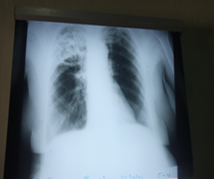
Radiological Report: Diffuse radiopacity is observed that takes the upper and basal right lobe with the appearance of nodular reticular infiltrate more accentuated in the upper lobe, sparing the middle lobe, left lung field Basal radiopacity of interstitial appearance with compensatory emphysema of the rest of the left lung field. Do not rule out pulmonary TB. Injury stratification 75% of the CPD and 25% of the CPI.
(Radiographic Assessment of Lung Edema (RALE) score.): 4 points moderate pneumonia.
Therapeutic Interventions
• Pharmacological treatment. 1. Meronen (1 gram) 1 intravenous bulb every 12 hours. 2. Dexamethasone (4mg) 6 mg intravenously every 24 hours 3. Nifedipine (10mg) 1 tablet every 8 hours 4. Hydrochlorothiazide (25mg) 1 tablet 5. Fraxiheparin (or, 6ml) 1 daily subcutaneous syringe. 6. Aerosol therapy every 6 hours (alternate A and B) A. Saline Solution______3cc Salbutamol 0.5% ____ 1cc B. Saline Solution _____3cc Ipratropium bromide ___1cc 7. Metamizol (600mg) 1 intravenous ampoule every 8 hours if hyperthermia, myalgia or arthralgia.
• Other treatments used 1. High flow oxygen support 15 liters per minute with Ventury type device with FiO2 50%. 2. 1st day: Nimotuzumab or Cimaher (50mg) 4 bulbs in 250 ml of 0.9% saline solution for 2 hours. 3. 4th day: Nimotuzumab or Cimaher (50mg) 2 bulbs in 250 ml of 0.9% saline solution for 2 hours. 4. 7th day: Nimotuzumab or Cimaher (50mg) 4 bulbs in 250 ml of 0.9% saline solution for 2 hours.
Follow-up and Clinical Results
Complementary
| Variables | Results |
|---|---|
| White blood cell count (4.5 to 10 X109) | 9 |
| Polymorphs (50 to 70%) | 70 |
| Lymphocytes (25 to 40%) | 30 |
| Neutrophils/lymphocytes ratio (less than 3) | 2,3 |
| Global lymphocyte count (+1500 or 1.5x10⁹ ) | 2,7 |
| Global platelet count150 to 350 X 109 mm3 | 220 |
| Systemic immunity-inflammation index (platelets x neutrophils/lymphocytes)(300 to 612) | 551 |
| Protein C (up to 10 mg/L) | 10 |
| D-dimer(- 10ng/ml) | 4 |
| LDH (200 to 400 U/l) | 250 |
| RT-PCR SARS-COV-2* | Negative (07/05/2022) |
Table 3: Complementary results after 3 doses of Nimotuzumab.
Imaging Estudies
Radiological report: Improvement of the radiological picture of bronchopneumonic lesions in both lung fields.
| Clinical Results | Results |
|---|---|
| SO 2 | 97 |
| FIO 2 | 21 |
| Relationship SO /FIO 2 2 | 461 |
| Symptoms | Asymptomatic |
Table 2: Clinical results after 3 doses of Nimotuzumab.
Discussion
This case is an elderly patient in serious condition with moderate pneumonia secondary to a SARS-Cov-2 infection, treated in an intensive care unit at our hospital. Negative PCR and resolution of the humoral and radiological symptoms were observed on day 14 of treatment. The results show a different therapeutic modality for the treatment of severe pneumonia admitted to intensive care units. Pneumonia caused by SARS-Cov-2 is characterized by an increase in the concentration of T helper 17 lymphocytes (Th17) and interleukin 17A (IL 17A) in the lungs, stimulating the production of proinflammatory interleukins such as: IL6, IL8, IL12, generating the release by neutrophils of tumor necrosis factor, proteolytic enzymes, damage to type 2 pneumocytes, a surfactant deficiency causing alveolar collapse, in addition the release of tumor necrosis factor increases the permeability of the pulmonary capillary Liquid is transferred, causing pulmonary edema and an increase in the thickness of the alveolar membrane, which results in a disorder of ventilation perfusion (hypoxia), in addition, an exaggerated migration of fibroblasts occurs, generating early pulmonary fibrosis, a decrease in cell function. Also apoptotic with the decrease of cobalt-dependent metalloproteases, losing control of local inflammation and angiogenesis.
Nimotuzumab can improve the coagulation disorder that occurs with COVID-19, and could reverse lung fibrosis, since the Epidermal Growth Factor receptor is a protein that participates in the proliferation and repair of tissue damaged by the virus [4].
Researchers such as Hwang YC, et al. [6] have urgently begun to develop mAB-based kits for the detection of distress produced by SARS-CoV-2 and mAB drugs for therapeutic use in COVID-19.
Fernandez Ruiz M, et al. [7] in this single-center observational study, show that Tocilizumab appeared to be useful and safe as an immunomodulatory therapy for severe COVID-19 pneumonia.
Masotti L, et al. [8] in their research express that Tocilizumab has been shown to improve outcomes in patients with severe respiratory failure associated with pneumonia related to SARS-CoV-2, age ≥ 65 years, procalcitonin ≥ 0.14 ng. /mL, room air pulse oximetry oxygen saturation ≤ 90%, and computed tomography ground-glass opacity involvement ≥ 50% were independent factors associated with poor outcome.
Syam AF, et al. [9] in a case report show that the patient treated with tocilizumab, a monoclonal antibody that is an antagonist of the IL-6 receptor, the binding between tocilizumab and the IL-6 receptors effectively inhibits and controls the Cytokine storm syndrome In addition, tocilizumab has several adverse effects that require close monitoring.
In a clinical trial carried out by Filgueira LM, et al. [10] in serious and critical patients, they demonstrate that itolizumab was able to reduce IL-6 concentrations and that patients with baseline IL-6 levels below 200 pg did not report adverse events. /ml showed prompt clinical and radiological recovery.
Future lines of research will be to show the mechanism of action by which Nimotuzumab is effective in the control of severe pneumonia secondary to SARS-Cov-2 infection.
Conclusions
Nimotuzumab can be a therapeutic alternative in patients admitted to intensive care affected with moderate and severe pneumonia by Covid-19.
Ethical Considerations
The authors declare that this study was approved by the Scientific Council of the participating institutions. The research was conducted in accordance with the principles of medical ethics, the Declaration of Helsinki. We proceeded according to current institutional and national ethical standards. In the event that this manuscript contains images or personal information of patients, they authorized the disclosure of this information.
Conflicts of interest
All authors declare that they have no conflict of interest.
Financing
No funding was received to carry out the research or publish the manuscript.
Authorship Contribution
- Conceptualization, RMP
- Data curation RMP
- Formal analysis RMP
- Acquisition of funds RMP
- Research RMP
- Methodology RPM
- Project Management RMP
- Resources RMP
- Software RPM
- Monitoring RMP
- Validation RMP
- Display RMP
- Drafting (original draft) RMP
- Writing (revision and editing) RMP
References
-
Acosta G, Escobar G, Bernaola G, Alfaro J, Taype W, et al. (2022) Characterization of patients with severe COVID-19 treated in a national reference hospital in Peru. Rev Peru Meas Experience public health 37(2): 253-258.
-
Bravo AR, Valera MJ (2020) SARS-CoV-2 and the acute respiratory syndrome (COVID-19) pandemic. Ars Pharm 61(2): 63-79.
-
Ramirez JFF, Bernal HG, Leon EUM, Martinez CUI (2019) Uses of monoclonal antibodies in medicine. ESTR 6(11): 25-28.
-
Nimotuzumab (2015) 50 mg bulb. Pharmacod disclosure. Rev Cubana Farm 49(4).
-
Mora RAE, Fernandez NL (2019) Use of Nimotuzumab in a patient with anaplastic astrocytoma. Rev Cuban Med 58(4): e507.
-
Hwang YC, Lu RM, Su SC, Chiang PY, Ko SH, Ke FY, et al. (2020) Monoclonal antibodies for COVID-19 therapy and SARS-CoV-2 detection. Journal of biomedical science.
-
Ruiz MF, Medrano FL, Asin MAPJ, Maestro GC, Bueno H, et al. (2021) Tocilizumab for the treatment of adult patients with severe COVID-19 pneumonia: A single- center cohort study. Journal of medical virology 93(2): 831-842.
-
Masotti L, Landini G, Panigada G, Grifoni E, Tarquini R, et al. (2022) Predictors of poor outcome in tocilizumab treated patients with Sars-CoV-2 related severe respiratory failure: A multicentre real world study. International immunopharmacology 107:108709.
-
Syam AF, Pitoyo CW, Suhendro S, Zulkarnain B, Indrasari ND, et al. (2021) Tocilizumab as a Treatment for ‘Cytokine Storm Syndrome’ in COVID-19: A Case Report. Acta Med Indonesiana 53(2):194-201.
-
Filgueira LM, Cervantes JB, Lovelle OA, Herrera C, Figueredo C, et al. (2021) An anti-CD6 antibody for the treatment of COVID-19 patients with cytokine-release syndrome: report of three cases. Immunotherapy 13(4): 289-295.
- Hydrogen Peroxide Scavenging by Methanolic Extracts of Coriander: An In Vitro Antioxidant Study
- Aromatherapy in Palliative Care: A Fragrant Quest for Relief
- Empowering Women, Securing Futures: Contraception’s Role in Socioeconomic Progress in India
- Effect of Crospovidone, Croscaramellose Sodium in Combination on the Drug Release of Anti diabetic Medication in Tablet Form
- Knowledge, Attitudes, Anxiety, and Preventive Behaviors Regarding Covid-19 Affliction among Healthcare Workers in Pakistan
- “Competitive Landscape and Brand Equivalents: Implications for ANDA (Abbreviated New Drug Application) Approval”