
Joint Hypermobility Syndrome: 2 Cases from the Capital of the Cherokee Nation and Review of Literature
Joint Hypermobility Syndrome (JHS) includes a spectrum of disorders that can be difficult to differentiate. Often overlapping or nonspecific symptoms can confound the diagnosis. The prevalence of JHS is much higher than the hypermobility variant of EDS (hEDS), although the latter is being diagnosed more especially with Brighton criteria that incorporate the Beighton score [1]. While other connective tissue disorders resulting in joint hypermobility may have specific genetic markers, the hEDS so far does not. This often requires clinicians to have a high index of suspicion for hEDS, or it may go undiagnosed, therefore leaving particularly young patients with a chronic debilitating disease without answers for their symptoms. Here we present two cases of JHS from the capital of the Cherokee Nation diagnosed relatively late compared to the average age at diagnosis.
Introduction
Ehlers-Danlos Syndrome (EDS) is a group of collagen formation disorders which stem from a constellation of different genetic mutations. While many subtypes of EDS have known genetic mutations mapped, hEDS does not. Many other classification symptoms have been proposed; however, the most widely accepted is the Brighton Criteria for JHS and Villefranche criteria to further classify into hEDS.
Nevertheless, hEDS is estimated to be the most common form of EDS, occurring in at least 1/5000 people, making up between eighty to ninety percent of all EDS cases, and affecting two-hundred fifty-five million people [1]. Most often, hEDS is diagnosed in children under fifteen years in approximately seventy-five percent of diagnosed patients [2]. Predominantly, this condition is most often found in those of Asian and African ethnicity and is inherited in an autosomal dominant pattern [3]. The most common presenting symptoms of hEDS include pain and hypermobility of frequently mobilized structures and joints, namely the neck, shoulders, elbows, hips, knees and ankles [2].
Case Reports
Case 1
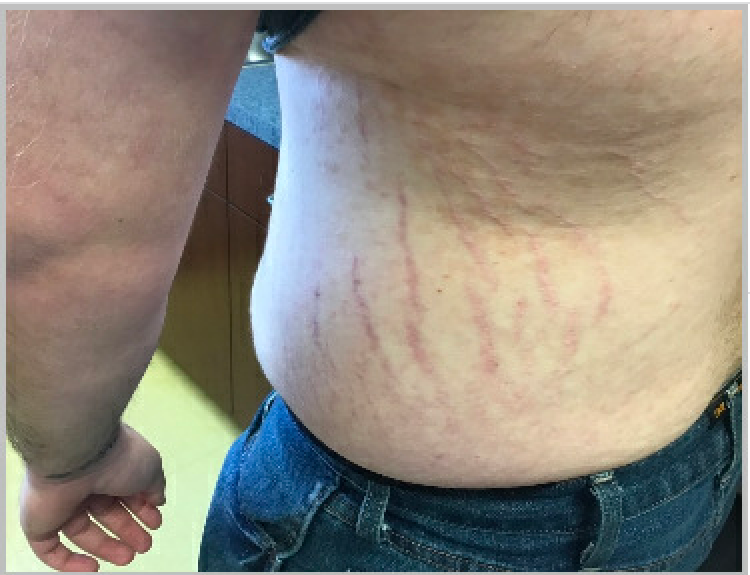
The patient is an 18-year-old male with a previous medical history of celiac disease, left ventricular hypertrophy and valvular heart disease who presented to the rheumatology clinic with initial concerns regarding painful joints. At that time, the patient noted his symptoms, predominantly with problems with food allergies and multiple sports-related injuries throughout his childhood. These injuries included the tearing of his shoulder-labrum and calf muscles, as well as suffering numerous joint dislocations. Previous clinical workup before presentation to the clinic included low vitamin B12 and folate levels, elevated homocysteine level, and the gene mutation for methyl tetrahydrofolate reductase C677T, and A1298C. Of note, the following studies were negative: celiac antibodies, fibrillin 1, HLA-B27, antinuclear antibodies, cyclic citrullinated peptide antibodies, double-stranded DNA antibodies, hepatitis B surface antigen, hepatitis C antibody, rheumatoid factor, ribonucleoprotein antibodies, Smith antibodies, complement C3 and C4 levels, Jo 1 antibodies, 14.3.3 ETA, QuantiFERON TB Gold, centromere antibodies, Scl 70, SSA, SSB, and RNA polymerase III antibodies and HLA B51. The musculoskeletal examination was negative for active clinical synovitis in the peripheral joints at several follow-up visits Figure 1.
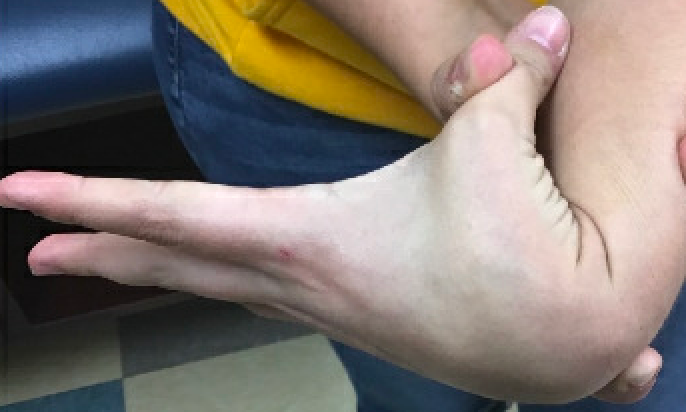
Initially, with a possibility of undifferentiated seronegative inflammatory polyarthropathy, hydroxychloroquine was started as empiric disease modifying anti-rheumatic drug (DMARD) therapy. Further evaluation for possible hemochromatosis was obtained given his positive family history, though it resulted negative. Patient’s sister was also experiencing similar symptoms and was subsequently diagnosed with JHS. Given this patient’s symptoms in conjunction with his first-degree relative being positive for EDS, it was recommended he undergo genetic analysis for other variants of EDS as well. DMARD therapy was discontinued.
Case 2
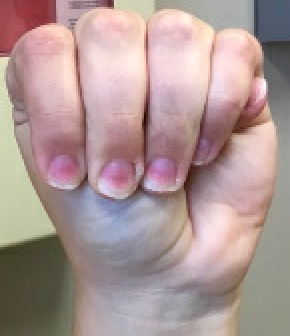
A 20-year-old female presented to the rheumatology clinic for evaluation of constant muscle pain in her neck, lower back, bilateral shoulders, lower extremities, ankles, and feet over the past five years. The patient noted that the pain was exacerbated with movement and improved with sleep. The patient denied any numbness, tingling, or weakness. The patient’s physical examination was free of tenderness or swelling of all her joints. Initial ANA was positive at 1:40, with the rest of rheumatologic serology workup negative. On follow-up, the patient endorsed hypermobile joints, including wrists, fingers, elbows, knees, and ankles. The patient was also noted to be able to perform the thumbs sign, finger sign, wrist sign, squatting sign, but was able to hyperextend her knees. Given the patient’s symptoms and hypermobility, she was diagnosed with JHS. DMARD therapy was deferred at this time as a shared informed clinical decision.
Discussion
Previously termed benign joint hypermobility syndrome and indistinguishable from type III or hEDS, JHS is characterized as a heritable connective tissue disorder in which patients experience joint instability and pain which can predispose to soft tissue injury [4]. In patients with suspected JHS, a series of 5 screening questions compiled by Hakim et al is helpful. This questionnaire inquires about double-jointedness, frequent shoulder or kneecap dislocations, or ability to perform certain maneuvers such as touching one’s thumb to one’s forearm, contortion, or ability to place one’s entire palm on the ground without bending one’s knees. Answering affirmatively to 2 of the 5 questions has an 84% sensitivity and 85% specificity for JHS [5]. Another scoring system, the Beighton score categorizes one’s ability to complete 5 maneuvers and is graded on a 9-point scale, with the 5 maneuvers involving passive hyperextension (>10 degrees) of the elbows, passive dorsiflexion and hyperextension (>90 degrees) of the 5th metacarpophalangeal joint, passive opposition of the thumb to the flexor surface of forearm, passive hyperextension (> 10 degrees) of the knee, and ability to place one’s entire palm on the ground without bending one’s knees [6]. The Beighton score is featured in the Brighton criteria, which weighs both major (involving Brighton score and presence of arthralgia) and minor criteria (which factors Beighton score, arthralgia, history of joint dislocations, soft tissue rheumatism, Marfanoid habitus, skin abnormalities, oculofacial features, and history of herniation/prolapse [7]. Management of JHS is primarily aimed at reducing risk of injury and in addressing symptoms, such as pain and associated fatigue with patients benefiting from multidisciplinary care, including healthy lifestyle changes, counseling and physiotherapy [8]. Further research is needed in the genetics and therapeutics of JHS.
Conflict of Interest
The authors have no conflicts of interest to report.
References
-
Tinkle B, Castori M, Berglund B, Cohen H, Grahame R, et al. (2017) Hypermobile Ehlers-Danlos syndrome (a.k.a Ehlers-Danlos syndrome type III and Ehlers-Danlos syndrome hypermobility type): Clinical description and natural history. Am J Med Genet C Semin Med Genet 175(1): 48-69.
-
Song B, Yeh P, Nguyen D, Ikpeama U, Epstein M, et al. (2020) Ehlers-Danlos syndrome: an analysis of the current treatment options. Pain Physician 23(4): 429- 438.
-
Hakim AJ, Sahota A (2006) Joint hypermobility and skin elasticity: the hereditary disorders of connective tissue. Clin Dermatol 24(6): 521-533.
-
Fairweather D, Bruno KA, Darakjian AA, Bruce BK, Gehin JM, et al. (2023) High overlap in patients diagnosed with hypermobile Ehlers-Danlos syndrome or hypermobile spectrum disorders with fibromyalgia and 40 self- reported symptoms and comorbidities. Front Med (Lausanne) 10: 1096180.
-
Kumar B, Lenert P (2017) Joint hypermobility syndrome: recognizing a commonly overlooked cause of chronic pain. Am J Med 130(6): 640-647.
-
Cohen A, Sela MC, Ran LZ, Rushinek H, Talisman S, et al. (2023) Increased prevalence of generalized joint hypermobility observed in patients with recurrent temporomandibular joint dislocation. J Oral Maxillofac Surg. Published online 2023: 0278-2391.
-
Baeza Velasco C, Pailhez G, Bulbena A, Baghdadli A (2015) Joint hypermobility and the heritable disorders of connective tissue: clinical and empirical evidence of links with psychiatry. Gen Hosp Psychiatry 37(1): 24-30.
-
Atwell K, Michael W, Dubey J, James S, Martonffy A, et al. (2021) Diagnosis and management of hypermobility spectrum disorders in primary care. J Am Board Fam Med 34(4): 838-848.
- Origin, Evolution, and Functional Impact of Short Insertion- Deletion Variants in Human Genomes: A Review
- Harnessing Molecular Glues for Next-Generation Vaccine, Cancer and Cardiovascular Disease Drug Development: A Comprehensive Review
- Lateral Cervical Epidermal Inclusion Cyst in a Paediatric Patient: A Rare Case Report
- Malarial Plasmodium Falciparum with Hepatitis B and C Virus Infections among Blood Donors in Ife Central Local Government Area, Ile Ife, Osun State, Nigeria
- Withanolides and Withaferin A- What’s next in Ashwagandha Research
- Designing of Dual Pulse Photoacoustic Tomography for Imaging of Drug-Response and Tumor Growth