
Acute Oral Toxicity of Hydrofluoric Acid Controlled with Gq-300® Additive Fixed Dose Procedure-Acute Oral Toxicity -Ocde420
This paper demonstrates the tolerable acute oral toxicity of a solution composed of Hydrofluoric acid (HF) at 24% concentration and GQ-300® as a controlling additive. The literature describes pure HF as a liquid, corrosive, colorless, fuming, (identifying CAS number 7664-39-3). GQ-300®, additive consisting of a strongly acidic chemical composition and safe for human use, obtained by the mixing of strong acids with the aim of achieving a balanced mixture of acids which allows, by means of additivation, the control and safe handling of other strong and corrosive acids commonly used in water treatment, cleaning of scale of silicates, in sites with contents of silicates to enhance recovery of metal, non-metal mining and hydrocarbon such as oil and gas. Since there is no precise information about the toxicity of this mixture, or it is expected that the test material is toxic, the study of oral toxicity uses varying volumes of fixed oral doses of three solutions of different concentrations of HF Controlled with the GQ - 300® additive Administered in rats in order to know the tolerable acute toxicity of the mixture. Obtaining as a result that the HF mixture controlled with GQ-300®, administered to rats wistar by mouth in a volume of 20 µl with a range of 275 to 289 mg/kg, have a tolerable dose of acute toxicity greater than the pure HF to 48% , which means that this GQ controller minimizes the toxic action of the HF.
Yasmin-Morales1*, Yepsys-Montero2, Andres-Osorio2, Lewis Pozo3,
David Martucci3 and William Jimenez3
582742403166/3160; Fax: 582742403156; Email: dancar2men@gmail.com (or) yasminm@ula.ve Keywords: Acute; Additivation; Controller; Hidrofluoric Acid; GQ-300; Toxicity
Introduction
Hydrofluoric acid (HF) is a weak inorganic acid with a dissociation constant (KA) of 3.45 highly dangerous, corrosive, of acute and penetrating odour, is produced from the chemical reaction between calcium fluoride and sulfuric acid to produce HF gas that When cooled, it is Investigation Paper stored as a colorless liquid, with a density similar to that of water [1, 2]. The most widely known property of the HF is to attack glass, enamels, cement, rubber, leather, metals (especially iron), and organic compounds [3]. In oil Refineries It is used to obtain high octane gasoline through the process of renting the HF [4]. Your identification Card CAS number 7664-39-3 [5]. It is one of the most dangerous acids, so it should be handled with great caution. With serious health effects according to their route of administration: Inhalation causes respiratory Irritations, can cause bronchitis bronchopneumonia pulmonary edema. Dermal wounds of difficult healing, ocular: Burns blindness (irreversible optic nerve injury), orally burns in esophagus and stomach, severe pain, with risk of perforation, vomiting spasms [3]. The absorption by mouth is associated with a high mortality rate, due to the severe hypokalemia that occurs, demonstrated by the electrocardiographic changes with prolongation of the QT wave, in addition to this, other alterations have been found in the Electrocardiogram as ventricular fibrillation and polymorphic ventricular tachycardia [6]. Additionally, fluorine is direct-toxic, activating adenylate cyclase resulting in an increase in the formation of cyclic adenosine monofosfato that produces cardiac irritability [7].
The Product GQ-300 is an intellectual property of Globalquimica A.L.C.A. Consists of a Strong and Corrosive Acid Controller Additive. It Is characterized as a balanced azeotropic mixture of acids, which once in equilibrium, facilitates its use as an additive to modify properties of other strong acids, as it induces equilibrium in acid strength in dissolution, KA or acid ionization constant of Every strong acid you want to control. Among the changes of properties, which induces in other acids that it controls, are the reduction of vapors, change of the freezing point by variation of its azeotropic activity and the reduction of hydroniums ions [8]. All this balance facilitates the safe use of highly dangerous acids with these new properties, in industries: food, drugs, mining operations, metallurgy, naval operations, agriculture, extraction and treatment of Hydrocarbons, Arms and water treatment industry, among others.
Extreme pH acids are capable of producing severe injuries in live tissues similar to those produced by heat and are called chemical burns by caustics. The chemical characteristics inherent in the substance determine the type and extent of tissue damage that they can produce [9]. It Must be kept in mind that strong and corrosive acids such as Sulfuric Acid, Hydrochloric, Hydrofluoric etc, are low PH; that is to say. their negative logarithms of the concentration of hydrogen ions is extremely low which gives them a higher concentration of Hydrogens and exposure to agents with extreme acidity PH < 2 is associated with severe tissue damage.
Yasmin-Morales, et al. Acute Oral Toxicity of Hydrofluoric Acid Controlled with Gq-300® Additive Fixed Dose Procedure-Acute Oral Toxicity -Ocde420. Adv Clin Toxicol 2019, 4(2): 000152.
In order to mitigate the impact of risks by using large volumes of strong and corrosive acids throughout the industrial area where they are used, and especially in the metal, Non-metallic and energetic mining operations, the Product GQ-300, It has a wide range of applications allowing to maintain its low pH, its concentration of hydrogen but minimizing the risks to the extreme exposure of the acidity and preventing the tissue damage.
According to the foregoing, evaluate the acute oral toxicity of the hydrofluoric acid mixture with the GQ- 300® controller. Since there is no precise information about the toxicity of this mixture, or it is expected that the test material is toxic, the study of oral toxicity uses varying volumes of fixed oral doses of three solutions of different concentrations of HF Controlled with the GQ - 300® additive administered in rats with the aim of discovering the tolerable acute exposure of the solution of hydrofluoric acid with GQ - 300® controller and its action in the mix.
Materials and Methods
The Initial observation test was carried out with the half of the maximum volume of liquid that can be administered in a single dose to rats of 500 microliters (µl), increasing or decreasing the volume according to the toxic effects that the experimental animals demonstrated, dying animals, or animals obviously sore, showing signs of severe and long-lasting anguish, will be killed humanely, and considered equally as those who died immediately in the study, Likewise there will not be administration of pure, highly toxic corrosive substances as hydrofluoric acid to 24% of concentration that is known to be orally lethal according to their Technical Data Sheets for the protection of the animals, therefore the references made in notes ½ of the CAS Number will be used as reference control. The HF solutions controlled with GQ - 300® additive were labeled according to their individual concentrations of HF: HF with GQ - 300® additive (02) 73.4%, HF with GQ - 300® additive (03) 67%, and HF with GQ - 300® additive 56.7% (04).
The animals used for testing were female Wistar rats at 6 weeks of age, kept in sterile conditions, used three animals per experimental group HF (02), HF (03), HF (04), using 05 dose levels for a total of 45 Wistar rats and 05 experimental control rats that will be administered the volume of GQ – 300 solution equal to the other experimental rats, the other component of the mixture (hydrofluoric acid) is not used as control because it is highly toxic, its CAS card is to be used as reference, this is acceptable according to the Protocol OCDE 420, 425 [10, 11], and the globally harmonized system of classification and labelling of products chemical (SGA) in its fourth edition United Nations New York and Geneva 2011 [14]. All the procedures used in this study were approved by the committee of ethics in animal research (CEBIOULA117/18) of the Council of Scientific, Humanistic, Technologic and Artistic Development of the University of Los Andes, Merida, Venezuela, which were in compliant with international standards of animal care and veterinary medical practice.
(02), HF(03), HF(04), these were colorless, fuming, transparent liquids, for each experimental Group the volumes of oral administration were 500 µl, 200 µl,100 µl, 50 µl y 20 µl, the administered is directly, via plastic canulas inserted in insulin syringes. It is important to note that the administration protocol for fixed volumes in a unique dose of 500µL and 200µL, were utilized in parallel as volumes for initial observation where two wide ranges of volumes were it was expected to find the initial toxic findings of the substances, notwithstanding these volumes caused death in 100% of the administered population. The difference was the time of death even when survivability was very short in these two groups, the results of these two experimental groups are shown on Tables 1-3. The study continues with administration of a lower fixed volume than the initial Group, taking as a fixed dose and single dose of 100µl, where immediate toxic effects were immediate and death occured at 2 hours of having administered the test articles to three groups. With these results the administration volume was lowered further for the HF(02), HF(03), HF(04) solutions to half of the previous administered volume given that death was not instantaneous, but even with this dose of 50µl symptoms of acute toxicity were markedly present and similar to those observed with previous volumes administered, the animals of the 3 groups were observed for 4 hours and then sacrificed due to high levels of suffering and toxicity of the animals, and finally a fixed and single dose of 20µl was administered where signs of slightly tolerable toxicity were demonstrated with half of the animals succumbing to death and the surviving animals sacrificed at the 7 day point after administration, results shown on Tables 4-6, It is important to note that a control Group was maintained that was only receiving the same volumes as the others but only of the GQ-300® product [10].
The study begins with two fixed volumes of different solutions, the high volume 500 µl and the low volume 200 µl. After observing the lethal effects in these groups with these administered volumes according to protocol OCDE 420, another group will be utilized decreasing the administered volumes due to effects caused at 100µl and 50µl if the toxic effects continue the volumen for administration to other animal groups Will decrease with 20µl obtaining survivability of 50% of the animals. As such the study was conducted in decreasing form from the fixed volumen of the test article. The animals were maintained in the care unit #2 of the ULA University Vivarium at a temperature of 22ºC (+ 3ºC) and a relative humidity of 30% - 70%, Illumination: cycle of 12 hours of light and 12 hours of darkness. Feeding and hydration ad Libitum, feeding was suspended 12 hours prior to administration of the test substances, they were organized in cages by experimental Group with n=03.
Study Conditions
The administration of fixed volumes was realized in a unique dose for the experimental groups by quantitiy of administered volumen, in a decreasing manner with HF
| Tox | Tox | |||||||||||||||||||||||||
|---|---|---|---|---|---|---|---|---|---|---|---|---|---|---|---|---|---|---|---|---|---|---|---|---|---|---|
| Animal | Severity | Type of Damage | Death | |||||||||||||||||||||||
| Start | Stop | |||||||||||||||||||||||||
| Mild | Moderate | Severe | Death | |||||||||||||||||||||||
| 01 HF(02) 148 grams V=500 µl | X | After 5 minutes caused instant death with a volume of oral administration 0.5 cc = 500µl | 5- min | Death | 5 - min | |||||||||||||||||||||
| 02 HF(02) 147grams V=500 µl | X | After 5 minutes caused instant death with a volume of oral administration 0.5 cc = 500µl | 5- min | Death | 5- min | |||||||||||||||||||||
| 03 HF(02) 127grams V=500 µl | X | After 5 minutes caused instant death with a volume of oral administration 0.5 cc = 500µl | 5- min | Death | 5 - min | |||||||||||||||||||||
| 01 HF(02) 150grams V=200 µl | X | Difficulty breathing, drooling, body weakness, possibly by trachea wheezing, convulsions within half an | 5- min | Death | 30- min |
Table 1: Effects of Hydrofluoric Acid “Controlled with GQ-300®” HF (02) HF (03) HF (04) Solutions with fixed volumes of 500 y 200
Yasmin-Morales, et al. Acute Oral Toxicity of Hydrofluoric Acid Controlled with Gq-300® Additive Fixed Dose Procedure-Acute Oral Toxicity -Ocde420. Adv Clin Toxicol 2019, 4(2): 000152.
- hour of the dosing, dies
- It presents the same clinical manifestations but takes more time to die, at one hour after administering the
- 02 HF(02)
- 167grams
- V=200 µl
- X dose.
- Difficulty breathing, drooling, body
- 03 HF(02) weakness, possibly by trachea wheezing, convulsions within half an
- 133grams
- V=200 µl
- X hour of the dosing, dies
- 01 HF(03)
- V=500 µl
- X
- After 5 minutes caused instant death
- 5min
- Death
- 5 min
- 153grams
- 02 HF(03)
- V=500 µl
- X
- After 5 minutes caused instant death
- 5min
- Death
- 5min
- 184grams
- 03 HF(03)
- V=500 µl
- X
- After 5 minutes caused instant death
- 5min
- Death
- 5-min
- 138grams
Table 2: Effects of Hydrofluoric Acid “Controlled with GQ-300®” HF (02) HF (03) HF (04) Solutions with fixed volumes of
| Tox | ||||||||||||||||||||||||||
|---|---|---|---|---|---|---|---|---|---|---|---|---|---|---|---|---|---|---|---|---|---|---|---|---|---|---|
| Animal | Severity | Type of Damage | Tox Start | Death | ||||||||||||||||||||||
| Stop | ||||||||||||||||||||||||||
| Mild | M | oderat | e | S | ever | e | Death | |||||||||||||||||||
| 01 HF(03) 154 grams V=200 µl | X | Manifestation of pain, body weakness, tachycardia, these animals increased weakness of the animal over time | 5 minutes | Death | 2 hours | |||||||||||||||||||||
| 02 HF(03) 118grams V=200 µl | X | Equal to the previous manifestations | 5 minutes | Death | 2 hours | |||||||||||||||||||||
| 03 HF(03) 152grams V=200 µl | X | Equal to the previous manifestations | 5 minutes | Death | 2 hours | |||||||||||||||||||||
| 01 HF(04) 161grams V=500 µl | X | After 5 minutes caused instant death | Immediate | Death | 5 min | |||||||||||||||||||||
| 02 HF(04) 168grams V=500 µl | X | After 5 minutes caused instant death | Immediate | Death | 5 min | |||||||||||||||||||||
| 03 HF(04) 132grams V=500 µl | X | After 5 minutes caused instant death | Immediate | Death | 5 min | |||||||||||||||||||||
| 01 HF(04) 106grams V=200 µl | X | They presented serious clinical manifestations, bodily weakness, retching, wheezing | Immediate | Death | 20min | |||||||||||||||||||||
| 02 HF(04) 142grams V=200 µl | X | They presented serious clinical manifestations, bodily weakness, retching, wheezing | Immediate | Death | 20 min | |||||||||||||||||||||
| 03 HF(04) 157grams V=200 | X | They presented serious clinical manifestations, bodily | Immediate | Death | At 1 hour |
Table 3: Clinical Signs of Toxicity Hydrofluoric Acid “Controlled With GQ-300®” HF (02) HF (03) HF (04) Volume OF 500 Y 200µl. So
Yasmin-Morales, et al. Acute Oral Toxicity of Hydrofluoric Acid Controlled with Gq-300® Additive Fixed Dose Procedure-Acute Oral Toxicity -Ocde420. Adv Clin Toxicol 2019, 4(2): 000152.

| Mucous | |||||||||||||||||||
|---|---|---|---|---|---|---|---|---|---|---|---|---|---|---|---|---|---|---|---|
| Animals | Behavior | SCV | S.Respiratorio | S. Locomotor | Irritación | ||||||||||||||
| Membranes | |||||||||||||||||||
| General | Motor weakness | Decrease in blood supply | Difficulty | Slow | Ocular, gastric, regurgitations | Reddish Mouths |
Table 4: Clinical Signs of Toxicity Hydrofluoric Acid “Controlled With GQ-300®” HF (02) HF (03) HF (04) Volume OF 500 Y 200µl. So
| Animals | Necropsy Findings | Pathological findings | |||||
|---|---|---|---|---|---|---|---|
| Animals with administration of 500 and 200 µl volumes. In general the two groups | They presented features of burns in the stomach wall, filled with air, irritated gastric mucosa, perforation of the stomach with emptying intestines of the liquid | Damage at the stomach level, intestine, trachea | |||||
| Low blood supply at the abdominal level | |||||||
| Signs of Burns at the abdominal level |
Table 5: Postmortem Signs of Toxicity, Hydrofluoric Acid “Controlled With GQ-300®” HF (02) HF (03) HF (04) volume of 500 y 200µl
| Animals | Behavior | SCV | S | . Respiratory | S. Locomotor | Irritación | Mucous Membranes | ||||||||||||
|---|---|---|---|---|---|---|---|---|---|---|---|---|---|---|---|---|---|---|---|
| The Three Groups | Majority of time spent in resting state, lethargy. | Decrease in blood supply | Slow Breathing | Few and Slow Movement | Ocular, gastric regurgitations | Low salivation, decreased intake of food and water |
Table 6: CLINICAL Signs of Toxicity Hydrofluoric Acid “Controlled With GQ-300®” HF (02) HF (03) HF (04) Volume of 20µl Source Mor
| Tox | Durati | ||||||||||||||||||||||||
|---|---|---|---|---|---|---|---|---|---|---|---|---|---|---|---|---|---|---|---|---|---|---|---|---|---|
| Animal | Severity | Type of Damage | Tox Start | ||||||||||||||||||||||
| Stop | on. | ||||||||||||||||||||||||
| Mild | Moderate | Severe | Death | ||||||||||||||||||||||
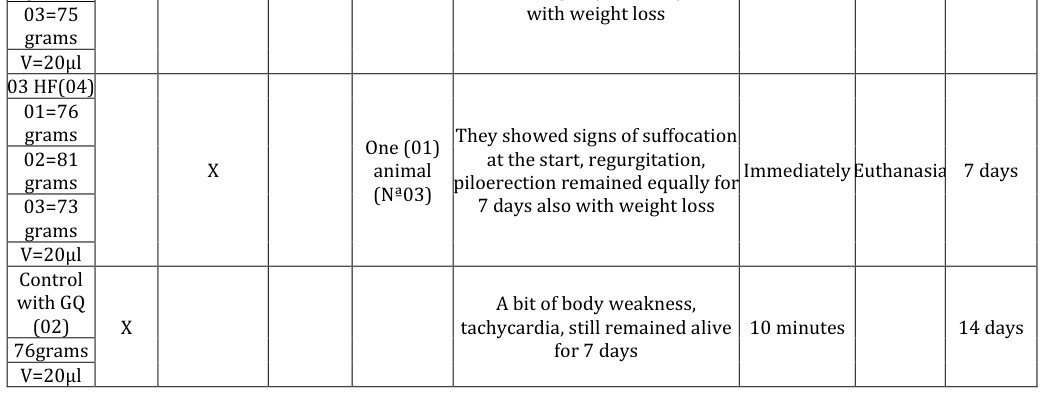
| HF(02) | X | One (01) animal (Nª02) | They expressed unrest upon administering the subsequent dose lethargy, body weakness, tachycardia, piloerection, found lethargic after two hours continue the same for 7 days but with considerable weight loss. | Immediately | Euthanasia | 7 days | |||||||||||||||||||
| 01=84 grams | |||||||||||||||||||||||||
| 02=79 grams | |||||||||||||||||||||||||
| 03=76 grams | |||||||||||||||||||||||||
| V=20µl | |||||||||||||||||||||||||
| HF(03) | X | Two (02) Animales | They showed signs of suffocation at the beginning, a little shortness of breath, they were slower than | Immediately | Euthanasia | 7 days | |||||||||||||||||||
| 01=79 grams |
Table 7: Effects of Hydrofluoric Acid “Controlled With GQ-300® HF (02) HF (03) HF (04) Volume of 20µl Source Morales, et al. 2019
Yasmin-Morales, et al. Acute Oral Toxicity of Hydrofluoric Acid Controlled with Gq-300® Additive Fixed Dose Procedure-Acute Oral Toxicity -Ocde420. Adv Clin Toxicol 2019, 4(2): 000152.
(01,03) the HF Group (02), piloerection remained equally for 7 days also
| Animals | Necropsy Findings | Pathological findings | |||||
|---|---|---|---|---|---|---|---|
| In General All Groups | Presented burn scars on stomach wall, empty stomach, intestines with signs of burns, grayish color, and gastric mucousa irritated brownish yellow color. | Presented damage at the level of the stomach, intestines, trachea | |||||
| Scars of Burns at the abdominal level |
Table 8: Postmortem Signs Of Toxicity Hydrofluoric Acid “Controlled With GQ-300®” HF (02) HF (03) HF (04) volume of 20µl Source M
The present study was realized with the objective of discovering the tolerable acute toxicity of an HF – Hydrofluoric Acid solution with the controlling agent GQ- 300®, that has as a function of use, the ability to control or diminish the toxic effects of pure HF – Hydrofluoric Acid, for which it is necessary to evaluate the estimated acute toxicity (EAT) with lethal dose 50 (LD50) of this solution. The pure HF at 48% concentration, has a Safety
| Substance | CAS No. | Exposure Route | EAT | ||||||||
|---|---|---|---|---|---|---|---|---|---|---|---|
| Hydrogen Fluoride | 7664-39-3 | Oral | 5 mg/Kg | ||||||||
| Hydrogen Fluoride | 7664-39-3 | Skin | 5 mg/Kg | ||||||||
| Hydrogen Fluoride | 7664-39-3 | Inhalation: Gas | 100 ppmV/4h |
Table 9: Estimated Acute Toxicity (EAT) of HF – Hydrofluoric Acid at 48% concentration. Taken from HF 48% Rotipuran® (REACH) Safe
Table 7: Estimated Acute Toxicity (EAT) of HF – Hydrofluoric Acid at 48% concentration. Taken from HF 48% Rotipuran® (REACH) Safety Data Sheet modified by 2015/830/UE Then, according to the observation of the experimental results obtained from the development of the OCDE420 protocols, we can infer that three (3) solutions with HF, Yasmin-Morales, et al. Acute Oral Toxicity of Hydrofluoric Acid Controlled with Gq-300® Additive Fixed Dose Procedure-Acute Oral Toxicity -Ocde420. Adv Clin Toxicol 2019, 4(2): 000152.
are substances which presented evidence of acute toxicity in an active toxic level with a dose of 22 mg/kg of body weight in a fixed volume of 20 µl for oral administration as described in Table 8.
| Study | HF Concentratio | n | G | Q-300 Concentratio | n | Estimated Acute | Average Body Weigh | t | |||||||||
|---|---|---|---|---|---|---|---|---|---|---|---|---|---|---|---|---|---|
| ETA | |||||||||||||||||
| Group | in mg | in mg | Toxicity (Eat) | (RATS) | |||||||||||||
| HF02 | 16.15 mg | 5.85 mg | 22mg/kg body weight | 80 g | 275mg/kg | ||||||||||||
| HF03 | 14.74 mg | 7.26 mg | 22mg/kg body weight | 78 g | 282mg/kg | ||||||||||||
| HF04 | 12.47 mg | 9.53 mg | 22mg/kg body weight | 76 g | 289mg/kg |
Table 10: Acute ORAL Toxicity-Maximum Tolerable dose of Controlled HF with GQ-300® Source Yasmin Morales 2019 The Solution of HYDR
Table 8: Acute ORAL Toxicity-Maximum Tolerable dose of Controlled HF with GQ-300® Source Yasmin Morales 2019 The Solution of HYDROFLUORIC ACID “CONTROLLED WITH GQ-300®” administered orally to Wistar rats of six weeks of age at a rango of 275 to 289 mg/kg of concentration, did not cause immediate death, they survived. Nonetheless, they presented some signs of toxicity during the 4 days following administration, but maintaining survivability for 7 days, at which time they were euthanized following ethics protocols [10, 11]. In agreement with what was established in the standard OCDE420 [12] with a fixed volume, single dose solution of hydrofluoric acid - HF controlled with GQ - 300® and an LD50 of 22 mg/kg of body weight, this solution is classified as a toxic substance type B.
These experimental results also permit Classification under Global Harmonized System (SGA) Edition IV of United Nations, New York and Geneva 2011 [14, 15], to classify the Hydrofluoric Acid solution controlled with GQ-300® in a single dose range of 22mg/kg to a volume less than or equal to 20µl with an acute oral toxicity in categories (03), and acute organ toxicity category (03), Category (3) danger to health, toxic in case of ingestión.
By comparing these classifications of acute oral toxicity of hydrofluoric acid - HF solutions (02) 73.4%, HF (03) 67%, HF (04) 56.7 concentration and controlled with GQ - 300®, with those of the hydrofluoric acid - pure HF to 48% of concentration and not controlled, We conclude that the GQ-controlled HF - 300®, has a more tolerable acute toxicity per single dose, which means that this GQ - 300® controlling agent minimizes the toxic effect of hydrofluoric acid - HF.
With these results, the study meets the objective of the present study, that was to show that the controlled hydrofluoric acid with the GQ - 300®, additive can provide the most safe handling of the acid hydrofluoric- HF that today is in the market, as well as allowing a reversible effect, in case of accident, which hydrofluoric acid - HF does not offer when not controlled.
Yasmin-Morales, et al. Acute Oral Toxicity of Hydrofluoric Acid Controlled with Gq-300® Additive Fixed Dose Procedure-Acute Oral Toxicity -Ocde420. Adv Clin Toxicol 2019, 4(2): 000152.
References
-
Wedler V, Guggenheim M, Moron M, Künzj W, Meyer V (2005) Extensive Hydrofluoric Acid Injuries: A Serious Problem. Trauma 58(4): 852-857.
-
Kirkpatrick J, Enion D, Burd D (1995) Hydrofluoric acid burns: a review. Burns 21(7): 483-493.
-
(2017) Prevention service, Natural environment, University of Valencia. Prevention RV.
-
Michael B, Michael KS (2007) Alquilación del Ácido Fluorhídrico. Revista ABB. Houston, Texas, pp: 23-26.
-
Carl Roth (2015) proveedor de la ficha de datos de seguridad con registro Nº 2015/830/UE del HF 48% cuyo nombre comercial (Rotipuran®).
-
Björnhagen V, Höjer J, Karlson-Stiber C, Seldén A, Sundbom M (2003) Hydrofluoric Acid-Induced Burns and Life-Threatening Systemic Poisoning-Favorable Outcome After Hemodialysis. Journal of Toxicology 41(6): 855-860.
-
Vohra R, Velez L, Rivera W, Benitez F, Delaney K (2008) Recurrent life-threatening ventricular dysrhythmias associated with acute hydrofluoric acid ingestion: Observations in one case and implications for mechanism of toxicity. Clinical Toxicology 46(1): 79-84.
-
Martucci D (2016) Patent Pending Globalquimica A.L C.A “Solución salina fuertemente ácida y segura para recuperación de minerales e hidrocarburos mediante fractura de yacimientos”.
-
Martucci D (1986) US Patent 4675120 “Methods of using strong acids modified with acid solutions”.
-
OECD (2000) Guidance Document on Acute Oral Toxicity. Environmental Health and Safety Monograph Series on Testing and Assessment No.24, pp: 1-24.
-
OECD (2000) Guidance Document on the Recognition, Assessment and Use of Clinical Signs as Humane Endpoints for Experimental Animals Used in Safety Evaluation. Environmental Health and Safety Monograph Series on Testing and Assesment No 19.
-
(2011) Manual del Sistema Globalmente Armonizado (SGA), 4th (Edn.), Naciones Unidas New York y Ginebra. Yasmin-Morales, et al. Acute Oral Toxicity of Hydrofluoric Acid Controlled with Gq-300® Additive Fixed Dose Procedure-Acute Oral Toxicity -Ocde420. Adv Clin Toxicol 2019, 4(2): 000152.
-
Peña CE, Carter DE, Fierro AF (2001) TOXICOLOGIA AMBIENTAL, Evaluación de Riesgos y Restauración Ambiental, The University of Arizona, pp: 1-204.
-
Manual del Sistema Globalmente Armonizado (SGA). (2011) 4th (Edn.), Naciones Unidas New York y Ginebra.
-
Manual TOXICOLOGIA AMBIENTAL (2001).Evaluación de Riesgos y Restauración Ambiental, The University of Arizona.
- Pattern of Gonadal Hormones in Oral Testosterone-Supplimented Male Wistar Rats with Diabetes-Induced Hypogonadism
- Re-Evaluation of the Genotoxicity of Currently Used Food Dyes in Mouse Multiple Organs Via Continuous Administration by Drinking Using the Comet Assay
- Pharmacogenetics of Type 2 Diabetes Mellitus: Linking Genetic Variability to Drug Efficacy and its Cardiovascular Outcomes
- Exploratory Proteomic Profiling of SARS-CoV-2 Infected THP-1 Macrophages Reveals Alterations in Inflammatory Response and Cellular Metabolism
- Study of Genotoxicity of Hepatocarcinogens in Multiple Organs in Mice by Feeding and Drinking Using the Comet Assay
- Spirulina Polypeptides Inhibit the Growth of Human Lung Tumor (H460) Cells