
Iodine Value in Partially Hydrogenated Castor Oil (Ricinus Oil) as determined by AOCS Official Method Cd 1-25 (Wijs’ Method)
The Iodine Value (Iodine Number) is an important analytical characteristic of fats and oils. The iodine (I2) required saturating the fatty acids present in 100 grams of the oil or fat. Iodine is essential element of human nutrition. A third of the global population has insufficient iodine intake and is at risk of developing Iodine Deficiency Disorder. Oils rich in saturated fatty acids have low iodine value, while oils rich in unsaturated fatty acids (α- linoleic acid) have high iodine value. Several variations of iodine value have been developed, although Iodine Monobromide Method or Hanus Metod, Iodine Monochloride Method or Wijs’ Method, and Pyridine Bromide Method or Iodine-Mercuric Chloride in alcohol (Hubl). The based on American Oil Chemists’ Society (AOCS) Cd 1-25 describes the determination of the iodine value (a measure of unsaturation) in Partially Hydrogenated Castor Oil (COH); the specification is 28-32 g I2/100 g sample.
Introduction
Castor oil occurs in the seed of the castor plant, ricinus communis L. (Eurphorbiaceae Family), growing in most tropical and subtropical areas. Castor seeds are toxic, containing a highly poisonous protein, ricin, and highly allergenic material. Castor oil is non-toxic, a renewable resource, and biodegradable [1]. Castor oil is viscous, a colorless to pale yellow and non-drying vegetable oil with a bland taste and it is sometimes used as purgative [2]. Its boiling point is 313°C (595°F) and its density is 961 kg/m3 [3]. It is a triglyceride in which approximately ninety percent of fatty acid chains are ricinoleic acid. Oleic acid linoleic acids are the other significant components [4]. Castor oil is essentially triricinolein, which is a triglyceride of ricinoleic acid, CH3(CH2)5CH(OH)CH2CH=CH(CH2)7COOH. The expected iodine value for castor oil is 83-88 g/100g I2, and for hydrogenated castor oil it is 28-32 g/100gI2 based on AOCS Cd 1-25 Wijs’ Method. The American Oil Chemists Society (AOCS) methods are widely used for contrast purposes in the trade of oils and fats. The traditional method for determining iodine value (AOCS official method Cd 1-25), make use of solvent carbon tetrachloride. In a number of countries this solvent is now banned for use in laboratories because of its carcinogenic properties. Consequently this method of analysis has been modified using cyclohexane as a solvent (AOCS) recommended practice Cd 1b-87 [5].
Hydrogenated Castor Oil (HCO) occurs as a fine, almost white or pale yellow powder or flakes. Hydrogenated castor oil as the oil obtained by hydrogenation of virgin castor oil. Empirical formula C57C90H110 and molecular weight is 939.50 g/mol. Some of Synonyms are castorwax; castorwax MP 70, Castorwax 80; Croduret; ricini oleum hydrogenatum. HCO is refined, bleached, hydrogenated, and deodorized Castor Oil [6]. Chemical name of hydrogenated castor oil is Glyceryl- tri-(12-hydroxystearate). Structural formula has been below (Figure 1):
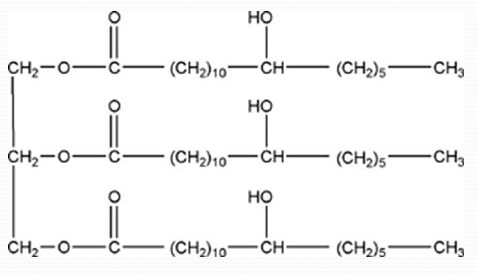
The hydrogenated castor oil is prepared by the hydrogenation of castor oil using a catalyst. Hydrogenated
Pharmacopeia Specifications (Table 1)
castor oil is used in oral and topical pharmaceutical formulations and is generally regarded as an essentially nontoxic and nonirritant material. In topical formulations, hydrogenated castor oil is used to provide stiffness to creams and emulsions [7]. In oral formulations, hydrogenated castor oil is used to prepare sustained -release tablet and capsule preparations; [8, 9] the hydrogenated castor oil may be used as a coat or to form a solid matrix. The hydrogenated castor oil is additionally used in paints, waxes, lite grease, additives, extended release agent, stiffening agent, tablet and capsule lubricant. Hydrogenated castor oil in a glycerol- phthalic anhydride alkyl that was acrylated performed quite favorably in an automotive topcoat system [10]. The objective was to combine the general resistance, hardness, and polishing properties of the acrylic with the flow, surface wetting and pigment dispersion properties of the alkyd [1]. Hydrogenated castor oil is additionally used to lubricate the die wall of the tablet process [11, 12].
| Test | PhEur 6 | USP 32-NF27 | AOCS Cd 1-25 |
|---|---|---|---|
| g I /100g sample 2 | g I /100g sample 2 | g I /100g sample 2 | |
| Iodine Value | ≤ 5 | ≤ 5 | 28-32 |
Materials and Methods
Chemicals
- Iodine Monochloride [7789] ACS reagent, 1.10 ± 0.1 I/Cl ratio basis (Aldrich Catalog 402990 or equivalent) reagent grade.
- Glacial Acetic Acid, (Certified ACS), Fisher Scientific
- Cyclohexane (Certified ACS), Fisher Chemicals
- Potassium Iodide, KI: Sigma- Aldrich ACS reagent, ≥ 99 %, CAS Number 7681-11-1.
- Potassium Periodate, KIO3, ACS reagent, ACROS Organics, Fiser Scientific
- Soluble Starch
- Sulfuric Acid, H2SO4; ACS grade, Pharmaco-Aaper
- Hydrogenated Castor Oil Reference Standard. United States Pharmacopeia (USP)
- Reference Standard; USP-1096837
- Sodium thiosulfate, Na2S2O3, Sigma-Aldrich CAS Number 10102-17-7.
- Hydrogenated Castor Oil was obtained from Morre-Tec Ind. NJ-USA.
- Recently boiled and cooled distilled or deionized water.
Apparatus
• 500 mL Erlenmeyer flask with ground glass stopper (may use Teflon tape) or Iodine flasks, 250 mL (8.5 fl.
oz.)
- 2 graduated cylinders capable of containing 100mL, 50 mL, 10 mL, 5 mL, and 3 mL Class A
- Pipets.
- 100 mL graduated cylinder
- Analytical balance capable of weighing to the nearest 0.1mg
- Stir bars
- 50 mL Class A Burette, in 0.1 divisions, with a tolerance of ±0.05mL.
- Hotplate
- Pipet, 20 mL
- Volumetric flask: 100 mL, 200 mL, 250 mL
- Filter paper, Whatman No. 41H, or equivalent
- All glassware used must be clean and dry [13, 14].
Solutions
- Wij’s solution: Set up the analytical balance in the hood, turn the hood on. Put a 200 mL glass stoppered volumetric flask (without the stopper) on the balance and tare it. Open the top access door, and use a spatula to add Iodine Monochloride until about 2.3 g have been added. Immediately close the access door, record the weight, then open the access door and add the stopper. Remove the flask from the balance; add 140 mL glacial acetic acid using a graduated cylinder. (The exact concentration of Iodine Monochloride need not be known. Extra solution is prepared so that 25.0 mL aliquots can be pipeted directly from the stoppered flask.)
- Prepare 1: 4 acetic acid: cyclohexane in a 250 mL erlenmeyer flask by adding 20 mL glacial acetic acid and 80 mL cyclohexane (use graduated cylinders). Mix well by swirling.
- 15% KI solution: (for 5 runs make enough for 6 runs). Dissolve 16.5 g KI in enough water to make 110 g solution.
- Dissolve about 0.85 g KIO3 (weighed analytically) in water in a 100 mL volumetric flask and bring to volume with water: 20 mL of this solution will require 30 to 40 mL thiosulfate solution.
- Starch solution is prepared by mixing 1 g soluble starch with sufficient cold water to make a thin paste. Add, while stirring, to 100 mL of boiling water. Mix and cool and store in a screw top bottle in the refrigerator. Use only the clear solution.
• Aqueous Sodium Thiosulfate volumetric standard solution (VS) 0.1 N, Na2S2O3, prepared by dissolving 24,9 g of sodium sodium thiosulfate in distilled water and diluting to1liter. Accurately standardized vs potassium dichromate primary standard as follows normal standardization procedure.
Standardization of Na2S2O3
Pipet 20.0 mL of KIO3 solution into a 125 mL Erlenmeyer flask and stir in about 1 g KI. Add 20 mL DI water. Add about 1 mL H2SO4. Immediately titrate the dark brown solution with Na2S2O3 to a straw yellow color. Add 2 pipets full (about 4 mL) of starch solution. Continue the titration until the purple color just disappears and the solution becomes colorless. Calculate the Na2S2O3 concentration using the titration equations (Table 2). IO3 - + 5I- ---> 3I2 and 3I2 + 6S2O3 2- --> 6I- + 3S4O6 2- (i.e. 6 mmol S2O3 2- per mmol IO3 -). Perform a duplicate and take the average.
| Iodine Value Expected | Sample Weight | Weighing Accuracy g | |
|---|---|---|---|
| 100% Excess g | 150% Excess g | ||
| Less than 3 | 10 | 10 | ± 0.001 |
| 3 | 10.576 | 8.4613 | 0.005 |
| 5 | 6.346 | 5.077 | 0.0005 |
| 10 | 3.173 | 2.5384 | 0.0002 |
| 20 | 1.5865 | 0.8461 | 0.0002 |
| 40 | 0.7935 | 0.6346 | 0.0002 |
| 60 | 0.5288 | 0.4321 | 0.0002 |
| 80 | 0.3966 | 0.3173 | 0.0001 |
| 100 | 0.3173 | 0.2538 | 0.0001 |
| 120 | 0.2644 | 0.2115 | 0.0001 |
Experiment
The iodine value determination involves a tree step operation:
- Reaction of sample with iodine monochloride, Wijs’ solution in excess according to R-C=C-R + ICl → R-Cl-CCl-R
- Reaction of the excess of Wijs’ solution with potassium iodide according to ICl + I- → I2 + Cl-
- Determination of the amount of released iodine according to I2 + 2 S2O3 2- → 2I- + S4O6 2- According to this three-step operation, the titration is a back titration with a blank.
Procedure
- Take 0.35 g standard Castor oil (weighed analytically) as follows. Use a clean Pasteur pipette to transfer about 1 mL to a clean 20 mL screw top vial (w/o cap) and stand a 1000 uL micropipet tip (blue color) in the vial. Tare the analytical balance with this. Use a micropipette set at 250 uL to make two transfers of oil to the 500 mL flask. Re-weigh the vial and tip and record the mass of standard taken. Take 1 g partially hydrogenated castor oil (weighed analytically). Weigh the solid sample in a tared plastic weighing boat and transfer to 500 mL flask; do a duplicate (i.e. A and B). Run two blanks as well.
- Use a 25 mL graduated cylinder to add 20 mL of 1:4 acetic acid: cyclohexane to each flask. Gentle heat (about
15 seconds on hot plate set to 5) is all that is needed to bring solid sample into solution. Swirl sample and standard solutions well.
- Use a pipet to add 25.0 mL Wij’s solution to each flask. Swirl to mix thoroughly; put stoppered flasks in dark for 30 min.
- After 30 min, treating each flask individually, use 25 mL graduated cylinder to add 20 mL 15% KI solution and swirl to mix thoroughly. Using a graduated cylinder, add 100 mL DI water and a stir bar.
- Immediately titrate with Na2S2O3 with vigorous magnetic stirring until dark brown solution turns straw yellow color. Then add 2 pipettes full (about 4 mL) of starch solution, and continue the titration until the purple color disappears. Record the Na2S2O3 used in the titration [15].
Results and Discussion
The iodine value or “iodine absorption value” or iodine number is an important characteristic of oils as it indicates the proportion of unsaturated fatty acids present. The iodine value may be calculated from the volume of the oil taken, specific gravity of the oil and volume of Wijs’ iodine required to impart its color to the solution of oil.
Calculations
Calculation the Iodine value from the formula [6, 14] (Tables 3 & 4).
[( ) 126.9] 10 VB VS N
The Iodine Value
$$ = \frac {[ (V B - V S) \times N \times 1}{1 0 W} $$ Where: VB is the volumes, in mL, of 0.1 N Sodium Thiosulfate, Na2S2O3 consumed by the blank test VS is the volumes, in mL, of 0.1 N Sodium Thiosulfate, Na2S2O3 used in titrating blank the blank actual test. N is the normality of the Sodium Thiosulfate, Na2S2O3 W is the weight in gram, of the sample or standard taken for the test 10= Factor expressing result in %.
| Identity HCO | Weight of HCO | Burette Reading | Iodine value g I2/100 g | Ave. | Confirms Y/N | ||
|---|---|---|---|---|---|---|---|
| Initial mL | Final mL | Net mL of Na S O 2 2 3 | |||||
| Test A | 1.016 | 0.1 | 18.09 | 17.99 | 28.36 | 28.5 | Yes |
| Test B dup | 1.0118 | 18.09 | 35.99 | 17.9 | 28.64 | ||
| Blank 1 | 0 | 0.03 | 33.3 | 33.27 | 33.29 | ||
| Blank 2 | 0 | 0.09 | 33.4 | 33.31 | |||
| Std | 0.3827 | 0.39 | 16.99 | 16.6 | 82.13 | ||
| Spiked MS | 1.0112 | 0.1 | 32.77 | 32.67 | 98.70% | 98.72% | |
| Spiked dup. MSD | 1.0118 | 0 | 32.76 | 32.76 | 98.74% |
Table 3: Results of Iodine Value for the Hydrogenated Castor Oil (HCO).
$$ \frac {(9 - 1 7 . 9 9) \times 0 . 1 4 8 4 \times 1 2 . 6 9}{1 . 0 1 6 0} = 2 8. 3 6 g I _ {2} / 1 0 0 g $$
$$ \frac {(9 - 1 7 . 9 0) \times 0 . 1 4 8 4 \times 1 2 . 6 9}{1 . 0 1 1 8} = 2 8. 6 4 g I _ {2} / 1 0 0 g $$ Average of sample result= 28.50 g I2/100 g $$ \% \mathrm {R P D} = \frac {2 8. 6 4 - 2 8. 3 6}{2 8. 5 0} x 1 0 0 = 0. 9 8 \% $$
2 (33.29 16.60) 0.1484 12.69 Standard : 82.13 I 100 0.3 / 827 g g − × × =
Spiked amount: 0.5 mg/L True value: 0.005 mg
| % RPD | % RMS | % RMSD | Ave % Recovery |
|---|---|---|---|
| 0.98% | 98.70% | 98.74% | 98.72% |
Table 4: QA to Calculate of Statistical Process.
Conclusion
The Hydrogenated Castrol Oil (HCO) was determined as per AOCS Official Method Cd 1-25 Monochloride Iodide (Wijs’ Method). One sample was analyzed two times by different chemists on different days within the same laboratory. Wijs’ solution is sensitive to temperature considerable, affect titter of the Wijs’ solution. Therefore it is essential that blanks and samples are titrated at the same time. 0.5 mg/L Iodine standard has been added into the sample for percent recovery. %RMS has been found 98.70%, and % RMSD has been found 98.74%, (Tables 3 & 4). Specification iodine value is 28-32 g I2/100 g sample. The result of hydrogenated Castrol oil obtained was found 28.45 g I2/100 g sample. The results meet the specification of the AOCS Cd 1-25 Wijs’ Method.
Comments
- All Wijs’ solutions are sensitive to temperature, moisture, and light. Store in a cool and dark place and never allow coming to temperature above 25-30 oC.
- Wijs’ solution causes severe burns and vapors can cause lung and eye damage. Use a fume hood is recommended.
- Method Cd 1-25 tells you to check, adjust, confirm the I/Cl ratio of Wij’s solution to within 1.10 ± 0.1. All this work is avoided by using the reagent specified in the Chemicals section.
- The method makes an allowance of the use of 1:4 acetic acid: cyclohexane in place of carbon tetrachloride.
- The standardization method used here for Na2S2O3 deviates from AOCS Cd 1-25, which calls for chromate.
- Table 2 in method Cd 1-25 specifies the amount of sample or standard to take depending on its iodine value.
Acknowledgment
The authors are thankful to Prof. Dr. Krassi Lazarova, Head of the Science Department of the Centenary University for giving us the opportunity to complete this research work.
References
-
(2020) The Chemistry of Castor Oil and its Derivatives and their Applications International Castor Oil Association NJ, USA.
-
Kirk-Othmer (1979) Encyclopaedia of Chemical Tecnology. New York, Wiley & Sons, Vol 5.
-
Alfred T (2005) Fats and Fatty Oils. Ullmann’s Encyclopedia of Industrial Chemistry. Weinheim: Wiley- VCH.
-
(1999) The Castor Bean: A Plant Named After A Tick. Wayne’s Word: An Online Textbook of Natural History.
-
(1994) International Fishmeal & Oil Manufacturer Association. Ring Test Comparing Analytical Techniques for Measuring Iodine Value (Part 2).
-
(2017) USP 40/NF 35 US. Pharmacopeia and National Formulary <401> Fats and Fixed Oils. Method I (Hanus Mathod).
-
Kline CH (1964) Thixcin R-thixotrope. Drug Cosmet Ind 95(6): 895-897.
-
Yonezawa Y, Sumio Ishida S, Suzuki S, Sunada H (2002) Release from or bthrogh a wax matrix system. Iii: Basic properties release through the wax matrix layer. Chem Pharm Bull (Tokyo) 50(6): 814-817.
-
Vergote GJ, Vervaet C, Van Driessche I, Hoste S, De Smedt, et al. (2002) An oral controlled release matrix pellet formulation containing microcrystalline ketoprofen. Int J Pharm 219(1-2): 81-87.
-
Pallaghy H, (1964) Balm Paints, and Solomon, Chemical Research Laboratories, Melbourne, Australia, ‘Vinyl and Acrylic Modified Alkyds. J Oil, Color and Chemical Assoc, pp: 289.
-
Wart AH (2016) The chemical and technology of waxes. 2nd (Edn.), pp: 588-596.
-
Danish FQ, Parrott EL (1971) Effect of Concentration and size of lubricant on flow of granules. J Parm Sci 60(5): 752-754.
-
Holzer AW, Sjogren J (1981) Evaluation of some lubricants by the comparison of friction coefficients and tablet properties. Acta Pharm Suec 18(3): 139-148.
-
Yildiz Y, Alfeen M, Yildiz B (2019) Determination of Iodine Value in Triisocetyl Citrate (Citmol-316) by United States Pharmacopeia Hanus Method. International Journal of Chemistry and Pharmaceutical Sciences 7(2): 38-41.
-
(1991) Official Methods and Recommended Practices of the American Oil Chemists’ Society, 3rd (Edn.), American Oil Chemists’ Society, 1993. Iodine Value of Fats and Oils, Wijs’ Method. Official Method Cd, pp: 1-25.
- Pattern of Gonadal Hormones in Oral Testosterone-Supplimented Male Wistar Rats with Diabetes-Induced Hypogonadism
- Re-Evaluation of the Genotoxicity of Currently Used Food Dyes in Mouse Multiple Organs Via Continuous Administration by Drinking Using the Comet Assay
- Pharmacogenetics of Type 2 Diabetes Mellitus: Linking Genetic Variability to Drug Efficacy and its Cardiovascular Outcomes
- Exploratory Proteomic Profiling of SARS-CoV-2 Infected THP-1 Macrophages Reveals Alterations in Inflammatory Response and Cellular Metabolism
- Study of Genotoxicity of Hepatocarcinogens in Multiple Organs in Mice by Feeding and Drinking Using the Comet Assay
- Spirulina Polypeptides Inhibit the Growth of Human Lung Tumor (H460) Cells