
Assessment of Noise Level and Distribution from Socotherm Nigeria Limited: Its Health Implications on the Workers
Exposure to noise for a long period of time has been an issue of concern to occupational health workers. This study investigated noise pollution level (NPL) and its spatial distribution in Socotherm Nigeria Limited coating plants and its effects on the health of the workers. Six sampling points were selected on the grounds of intensity of activities. A digital sound level Metre-Extech 407730 was used to measure noise level at the sampling points namely, application area, welding spot, aggregate separator, generator/powerhouse, impingement plant, bushing area. A global positioning system (GPS)-NAVA 300 was used to record the GPS coordinates of the sampling noise hotspots in the factory. The Arc GIS software was used to interpolate the spatial distribution of noise within the factory for the working periods which include morning, afternoon and evening. With a wellconstructed questionnaire, results of the health implication of workers exposure to noise from the factory were recorded. Results revealed that afternoon has the highest noise level of 99.20 dB(A) at welding point and application area conveyor of the factory while the lowest noise was observed at 85.20 dB(A) which was at cold spot of chemical feed area of the factory. The study observed that majority of the machines (noise hotspots) produce noise that was above Occupational Safety and Health Association (OSHA) permissible noise level. This study therefore recommends that workers be encouraged to use personal protective equipment and be educated regarding noise induced hearing loss and other non-auditory effects of noise exposure. The factories should adopt and implement hearing conservation programs under the direction of an occupational and environmental health professional.
Introduction
Noise is one of the most common hazards in Nigerian work places. The National Institute for Occupational Safety and Health (NIOSH) estimates that 30million workers are exposed to hazardous noise. Noise can be regarded as an unwanted sound [1]. It is also an environmental pollutant. Assessment of the health risk of exposure to industrial noise demands understanding of the physics of sound and the physiology of the ear [2]. A pollutant is any substance introduced into the environment that adversely affects the usefulness of a resource [3]. Exposure to noise for a long period of time can result to adverse effects on health such as hearing loss, physical and psychological stress, reduced productivity, interference with communication and accidents. Exposure to noise for a long period of time can result to temporary or permanent shift in hearing threshold. Most sound heard in everyday life is a mixture of more than one frequency termed broadband noise [4], thus there are different types of noise as steady level noise, mixed noise, and impact noise.
Vibrations are propagated as waves in the form of pressure variations and termed sound waves if they fall within the range capable of exciting the sense of hearing [5]. Vibrations are further converted to similar and powerful mechanical vibrations. These are transmitted to the stapedial footplate which moves in and out of the oval window through which the wave motion arrives at the inner ear [6]. According to De Kluijver and Stoter [7], noise modelling makes it possible to optimize the quality and efficiency of noise effect. As a general rule, a well-designed vibration isolator will also help to reduce noise [8]. Klaeboe, Engelien and Steinnes [9] while discussing noise impact mapping as an alternative to exposure mapping pointed out that GIS-generated noise maps, serve as a tool for funding noise abatement projects and also makes it easier to “disseminate results in a form the public can understand.
Effects of noise pollution on workers therefore can be appreciated when they are placed on periodic medical examination to isolate affected workers for possible rehabilitation or redeployment [10]. This study therefore investigated the noise level and distribution of Socotherm Nigeria limited and its health implications on workers.
Study Area
The humid equatorial climate is marked by two distinct seasons, the dry season (November to March) and the rainy season (April to October). The rainy season is usually interrupted by a short dry spell in August. The area has a mean annual rainfall ranging from 1,900mm-4,000mm. The average temperature range is from 22°C-30°C.
The “upland” area was originally occupied by rainforest which has been drastically modified by human activities. In most places, economic trees particularly oil palm trees, have been preserved as “oil palm bush.” The riverine area is divisible into three main hydro vegetation zones namely, the beach-ridge zone, the saltwater zone and the freshwater zone.
The beach-ridge zone is vegetated mainly by fresh water swamp trees, palms and shrubs on the sandy ridges and mangroves in the intervening valleys or tidal flats. The saltwater zone is the tidal flat or swamps vegetated by the red stilts rooted mangrove (Flhizophora racemosa) and two other species of mangrove (Figure 1).
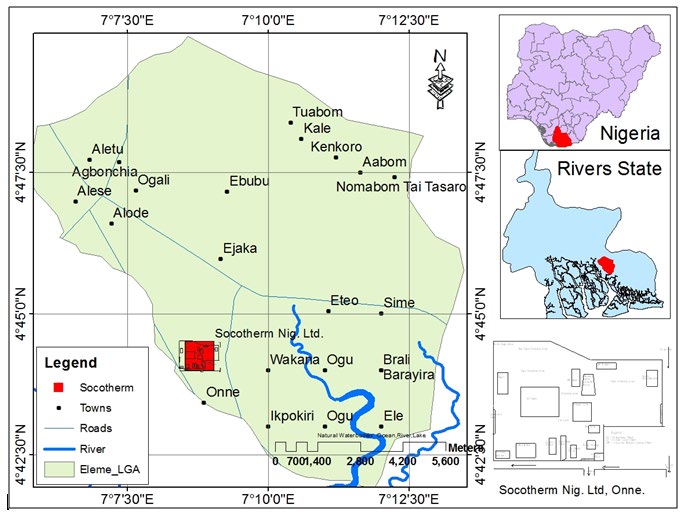
The outliers of raised alluvial ground or coastal plain terrace within the swamps are vegetated by tall forest tree species and oil palm. The freshwater zone is mainly the Upper and Lower Delta floodplains of the Niger, having fresh water forest trees which are the edaphic variants of the rainforest. The Abura tree, oil palm, raffia palm, shrubs, lianas, ferns and floating grasses and reeds are the typical vegetation. The study area is surrounded by a big river which leads to the ocean and this offers a major international sea route.
The soils of the sandy ridges are mostly sandy or sandy loams and supports crops like coconut, oil palm, raffia palm and cocoyam. The drier upland area of Rivers State covers about sixty one percent while riverine area, with a relief range of 2m to 5m, covers about thirty nine per cent of the State. The entire topography of the State is also characterized by a maze of effluents, rivers, lakes, creeks, lagoons and swamps crisscrossing the low lying plains in varying dimensions [11].
Rivers State has two major oil refineries, two major seaports, airports, and various industrial estates spread across the land. More than 60% of the country’s output of crude oil is produced in the state. Other natural resources found within its boundaries are silica sand, glass sand and clay [11].
Materials and Methods
Research Design
The research survey is a descriptive research.
Results
Data Collection
- A global positioning system (GPS)-NAVA 300 was used to obtain the Geographic coordinate data (altitude, latitude and longitude) of the equipment.
- A digital sound level Metre-Extech 407730 was used to determine the noise level in the selected locations of the equipment.
- A well-constructed questionnaire was used to elicit information on the effects of noise on the health of the workers.
Sampling Points
Data was collected in the morning (8:00am-9:00am), afternoon (12:00pm-1:00pm) and evening (4:00pm- 5:00pm) hours from the designated points within the company premises: namely Application Area Conveyor, Welding Spot, Aggregate Separator, Generator/Power House, Impingement Plant, and Brushing Area.
| Noise sources | Longitude | Latitude | Morning (dB(A)) | Afternoon (dB(A)) | Evening (dB(A)) |
|---|---|---|---|---|---|
| Application Area Conveyor | 4.739087 | 7.140942 | 95.1 | 99.2 | 94 |
| Welding Spot | 4.739373 | 7.145949 | 93.66 | 92.78 | 92.24 |
| Aggregate Separation | 4.737735 | 7.143417 | 92.22 | 91.36 | 90.48 |
| Generator | 4.734423 | 7.142484 | 90.78 | 89.94 | 88.72 |
| Impingement plant | 4.741409 | 7.143131 | 89.34 | 88.52 | 86.96 |
| Brushing Area | 4.734214 | 7.140752 | 87.9 | 87.1 | 85.2 |
Table 1: Noise Level Results of the Study Area.
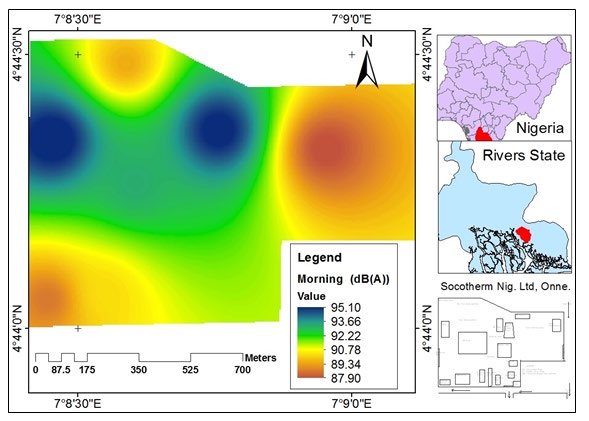
The sampling points from the company represented the major noise sources for the study. Noise level was measured in three period intervals namely Morning, afternoon and evening. These figures showed the results of Inverse Distance weighted (IDW) interpolation for the peak-work interval measurements of each of the three periods.
The noise measurement for the beginning of work period in the early hours of the morning was revealed in figure 2. The noise level was segmented into six categories at dB(A) covering the sampling points ranging from 87.90dB(A) to 95.10dB(A). From the IDW spatial interpolation results it was revealed that Application area Conveyor and welding spot have the highest noise levels in the morning.
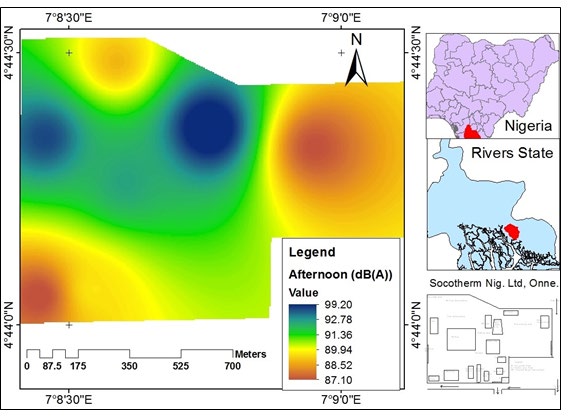
Figure 3 revealed noise measurement for the afternoon. The noise level was also segmented into six (6) categories at dB(A) covering the sampling points starting from 87.10dB(A) to 99.20dB(A). This figure was also an IDW spatial interpolation result of the afternoon noise measurements from the six different sampling points. it was revealed that in the afternoon, welding spot and Application Area Conveyor were the highest sources of noise.
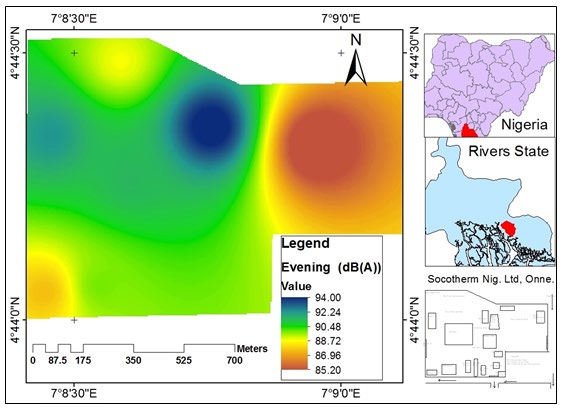
Figure 4 revealed that aggregate separator plant and welding spot recorded the highest levels of noise in the evening. These two spots were the busiest spots in the evening periods because materials to be used the next business day are separated and prepared in these two spots. For the evening measurement, the noise measurement can be categorized into three levels from the dominant color coverage in figure 3. The noise level were 94.00 dB(A), 90.49 and 85.20dB(A) covering the three dominant color codes in figure 3. This figure was also an IDW spatial interpolation result of the evening noise measurements from the six different sampling points.
Results from Questionnaire
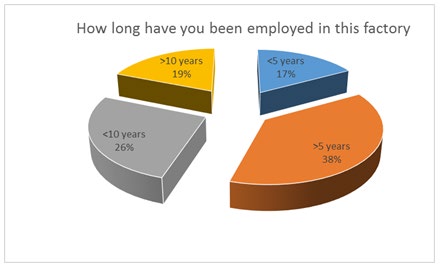
A total of 150 questionnaires were distributed in the company, but only108 were returned from the respondents. Figure 5 showed the period of service workers have put in for the company. 17% of the respondents have worked with the company for less than 5 years, 38% have worked for above 5 years while 26 have worked below 10 years and 19% above 10 years.
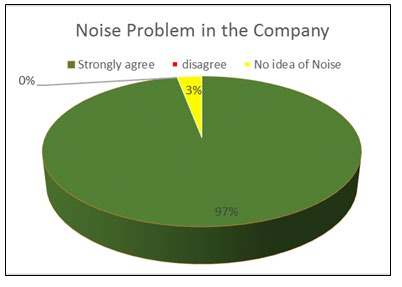
97% of the respondents strongly agree that the company has noise Pollution problem while 3% did not know that noise is pollution (Figure 6).
Duration at Work
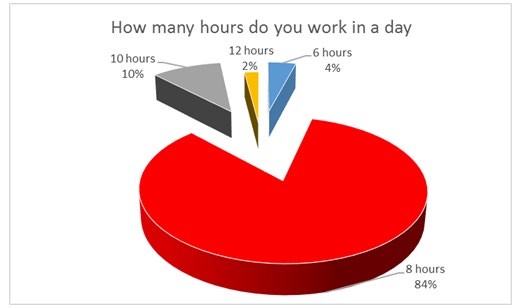
Among the 108 respondents 10% work for 10 hours, 2% work for 12 Hours, only 4 % work for 6 hours, while 84% work for 8 hours daily as either factory machine attendants or laborers (Figure 7 & 8).
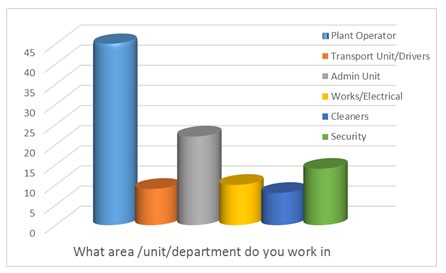
The noisy duration during its office hours showed that various units have different noise level. Greater percentages of the respondents were observed to be plant operators and attendants. While only 25% work in administrative units (Figure 9).
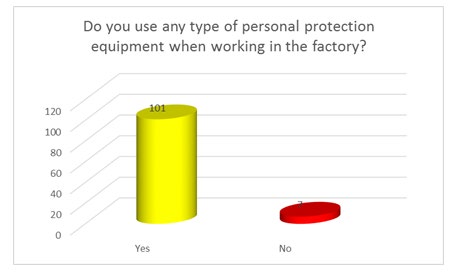
It was observed that 101 respondents use various personal protective equipment while only 7 indicated that they do not use any PPE. This could be that this category of stall is not directly exposed because they probably work in the offices as administrative staff (Figures 10-14).
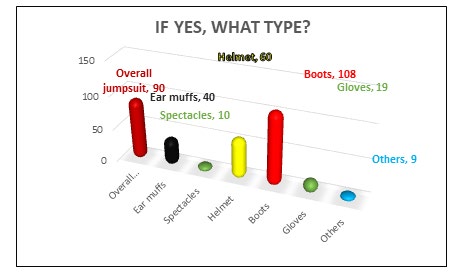
Figure 10 shows the various personal protective equipment used in the company.
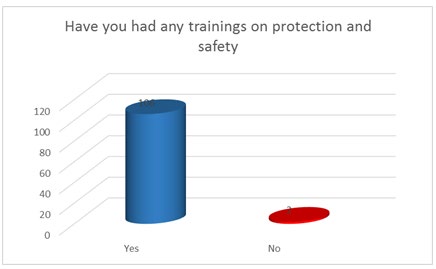
Of the 108 respondents, 106 accepted that the company has an awarenes campaign programmes on Protection and Safety of staff against occupational hazards within the work place while 2 0nly said they are not aware.
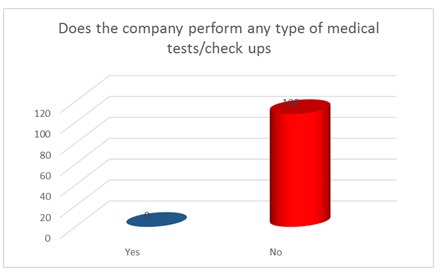
All the respondents claimed that the company has no health programmes like medical checkups for company worker.
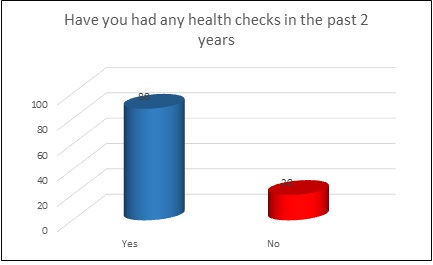
88 respondents agreed that they have had intensive health check-up within the past 2 years. Whereas 20 of the respondents said that they have not gone for medical check- ups within the past two years.
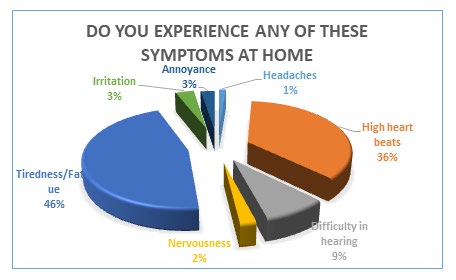
These symptoms include tiredness/fatigues, irritation, annoyance, headache, high heartbeat, difficulty in hearing, and nervousness as exposed in figure 14.
Discussion
Results revealed noise level in the morning period highest in the application area conveyor and welding spot with 95.10 and 93.66. In the afternoon period, welding spot and application area conveyor had the highest noise level of 99.20 and 92.78. In the evening period, it was observed that aggregate separator plant and welding spot produce the evening noise of 94.00 and 92.24. These two spots were the busiest spots in the evening periods because materials to be used the next business day are separated and prepared in these two spots and this accounted for the noise that was generated from these spots in the evening.
97% of the workers accepted to know that noise is a source of pollution while 3% only did not know. 84% agreed that there was no health programs like medical checkups attached to their monthly stipend. About 75% of the workers hence are exposed to noise. 106 0f 108 respondents accepted the company’s awareness program of occupational hazard. Different health challenges such as irritation, annoyance, headaches, increased heartbeat, nervousness, tiredness and fatigue were observed to have been experienced by the workers.
Higher number of the workers already have symptoms of noise-induced hearing loss as most of them could not hear at normal sound level during conversation and that confirms the report of Rilind [12] that observed that noise damages the brain, hearing power, results to poor sleep, psychological disorder, and increased risk of cardiovascular diseases.
Conclusion
The daily noise exposure of small and medium size factory workers in the study area exceeds the maximum Occupational Safety and Health Administration (OSHA) exposure limit of 90dBA. Exposure of factory workers further exceeded OSHA standards for occupational exposure to high noise levels due to long work hours. 84% reported working more than 8 hours per day and 25% more than 5 days per week. Old machines are responsible for most of the noise and more than 50% of workers are machine operators.
References
-
Anton JT (1979) Occupational Safety and Health Management. McGraw-Hill Book Co, New York.
-
Oluwagbemi BF (2003) Themes and Issues in Occupational Health and Safety. 1st (Edn.), Hure Prints Publishers Ibadan Nigeria, pp: 53-61.
-
FEPA (1991) Guidelines and Standards for Environmental pollution and control in Nigeria, pp: 69.
-
Leton TG (2004) Pollution Control Engineering. Celwill publisher Port Harcourt Nigeria.
-
Uchegbu SN (2002) Environmental Management and Protection 2nd (Edn.), Spotlite Publishers Enugu Nigeria, pp: 29-38.
-
Suter AH (1991) Noise and its Effects. Administrative Conference of the United States.
-
De Kluijver H, Stoter J (2000) Noise mapping and GIS: optimizing quality, accuracy and efficiency of noise studies. The 29th International Congress and Exhibition on noise control engineering, Nice, France.
-
Nwosu HU (2004) Fundamentals of Noise and Vibrations: Monograph University of Port Harcourt, Nigeria.
-
Klaeboe R, Engelien E, Steinnes M (2005) Context sensitive noise impact mapping. Applied Acoustics 67(7): 620-642.
-
Nwaogazie IL, Owate IO (1998) Noise pollution modeling of port Harcourt Refinery, part 2: Transient effects. NSE Technical Transactions 35(1).
-
Aisueheogun A (1995) The Port Harcourt region, landforms, characteristics of the environment. Journal of Geographic thought 1(1): 10-14.
-
Elezaj R (2019) Noise pollution effects.
- Pattern of Gonadal Hormones in Oral Testosterone-Supplimented Male Wistar Rats with Diabetes-Induced Hypogonadism
- Re-Evaluation of the Genotoxicity of Currently Used Food Dyes in Mouse Multiple Organs Via Continuous Administration by Drinking Using the Comet Assay
- Pharmacogenetics of Type 2 Diabetes Mellitus: Linking Genetic Variability to Drug Efficacy and its Cardiovascular Outcomes
- Exploratory Proteomic Profiling of SARS-CoV-2 Infected THP-1 Macrophages Reveals Alterations in Inflammatory Response and Cellular Metabolism
- Study of Genotoxicity of Hepatocarcinogens in Multiple Organs in Mice by Feeding and Drinking Using the Comet Assay
- Spirulina Polypeptides Inhibit the Growth of Human Lung Tumor (H460) Cells