
Evaluation of Groundwater Quality and its Suitability for Drinking Purposes in the Seiyun Area, Hadramout, Yemen
The present study evaluates the groundwater quality for drinking purposes and determines physicochemical characteristics of groundwater in the Seiyun in Hadramout. In order to investigate the water quality, sampling was done, the chemical parameters were analyzed, and water quality index was determined. The analyzed physicochemical parameters such as pH, electrical conductivity, total dissolved solids, calcium, magnesium, sodium, potassium, bicarbonate, carbonate, sulfate, chloride, nitrate, and fluoride are used to characterize the groundwater quality and its suitability for drinking uses Results showed the pH range of 7.5-7.78, TDS 624-450 mg/L, CaCO3 364-305 mg/L calcium 98-66.8 mg/L, magnesium 25- 43.7 mg/L, bicarbonate 415 -317 mg/L, chloride 124-190 mg/L, iron 0.03- 0.99 mg/L, Nitrate 3.4-9.3mg/L, sulphate 170-105 mg/L. Most of the physicochemical parameters of the samples were within acceptable limits for human consumption purposes recommended by the WHO standard.
Introduction
In recent years, stress on the natural resources is increasing due to rapid industrialization and population growth and their conservation is one of the major challenges form an kind. Groundwater is a most vital resource for millions of people for both drinking. Groundwater is essential for providing water supplies to rural and urban communities in many countries of the world. Nowadays, the contamination of groundwater is a major problem that has posed serious threats to human health and environmental values [1].
The quality of groundwater is as important as its quantity because it is the major factor in determining its suitability for drinking, domestic, irrigation and industrial purposes. The concentration of chemical constituents, which is greatly influenced by geological formations and anthropogenic activities, determine the groundwater quality. Anthropogenic activities have resulted in deterioration of water quality rendering serious threats to human beings. The quality of groundwater cannot be restored once it is contaminated [2].
The determinant of groundwater suitability for human use is achieved through physical and chemical properties, as well as any altering factors that may have occurred because of human activity and microbial activities in soils. World Health Organization (WHO) and many countries have published the guidelines for drinking water. The measurement of the water quality parameters is necessary to compare with declared water quality standards in order to protect public health [3]. The importance of water quality in human health has also recently attracted a great deal of interest. The importance of the groundwater in the area should not be underestimated because they are sources of water resource for drinking, not only for the people living in this area but also for those who live in the surrounding areas.
In the study area, the anthropogenic activities are deteriorating the water quality due to the disposal of domestic and industrial wastewater without treatment through the sewer systems and extensive use of fertilizers, pesticides in agriculture. These factors are representing the major role in causing the deterioration of groundwater quality through different chemical components, leading changes in the quality of the pumped water and suitability for human utilization. Therefore, assessing groundwater quality based on reliable assessment approach is very important for decision-making.
Materials and Methods
Study Area
The study area is located of Hadhramout Governorate in Yemen. It is located in the middle of the Hadhramaut Valley, about 360 km (220 mi) from Mukalla. Seiyun has an area of about (804) square kilometers, and the district is located in the central part of Hadramaut Governorate and Wadi Hadramout, on a longitude of 48.46 degrees east of Greenwich and latitude 15.57 degrees north of the equator. As for the terrain, the district consists of a relatively flat surface that forms a part of Wadi Hadhramaut surrounded by mountain ranges from the northern and southern sides leading to the northern and southern plateaus. These mountain ranges also penetrate several sub-valleys of Hadhramaut Valley. The climate is tropical with a high temperature in the summer (26-42°C) and a mild temperature in the winter (6 - 28 °C). Rain is rare and usually falls from mid-spring until autumn.
Sampling and Analysis
Groundwater samples were collected randomly from five wells period in 2019, following the sampling techniques as outlined by APHA [4]. The sample were collected only after the tube wells had pumped for at least 30 minutes to avoid stagnant or contaminated water sampling. After collection of water, the containers mouths were sealed tightly. The containers were kept airtight and labeled properly to avoid complication in identification.
These samples were stored at a temperature below 4°C prior to analysis in the laboratory. Procedures followed for analysis have been in accordance with the standard methods for examination of water and wastewater [4]. Calcium (Ca2+) and Magnesium (Mg2+) were determined titrimetrically using standard EDTA, while sodium (Na) and potassium (K+) were measured by flame photometry. Chloride was determined by standard AgNO3 titration. Sulfate, Nitrate Fluoride and heavy metals were determined by spectro photometer DR/3900. Bicarbonate (HCO3-) was determined by titration with HCl. Other texts such as conductivity (EC) and pH were directly measured in situ using portable measuring device (WTW pH 720H, ion lab series) Note that before each measurement, the pH meter was calibrated with reference buffer solution. Each analysis was carried out in triplicate and then the mean value was taken.
Results and Discussion
Suitability of Groundwater
Suitability of groundwater for drinking Groundwater quality assessment was carried to determine its suitability in terms of domestic purposes based on the WHO standard [5].
pH
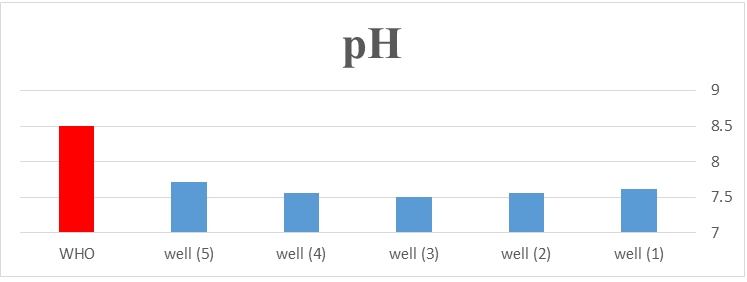
The pH is a measure of the hydrogen ion concentration in water. The pH value of water indicates whether the water is acidic or alkaline. Drinking water with a pH range of 6.5 to 8.5 is generally considered satisfactory [6]. The pH in the study area ranges from 7.5 to 7.7 with an average value of 7.6. This shows that the groundwater in the study area is slightly alkaline in nature and found within the maximum permissible limits of WHO standards.
Electrical Conductivity (EC)
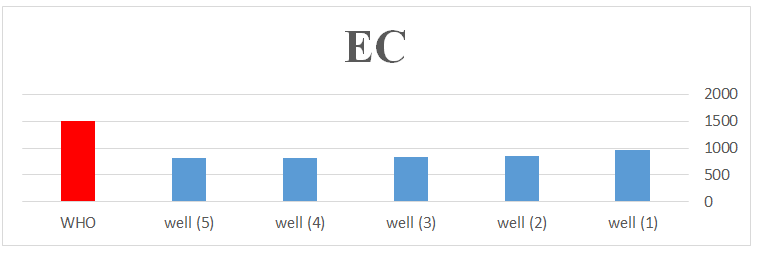
Electrical conductivity is a measure of water capacity to convey electric current. The most desirable limit of EC in drinking water is prescribed as 1.500 lmhos/cm. In the study area. The EC of the groundwater is varying from 810 to 960 μS/cm with an average value of 885 μS/cm. This shows that the groundwater in the study area is found within the maximum permissible limits of WHO standards.
Total Dissolved Solids (TDS)
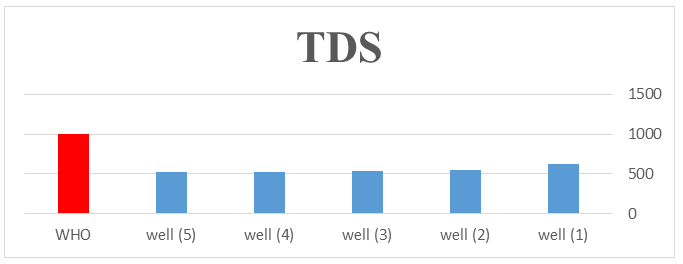
According to WHO specification TDS up to 500 mg/L is the highest desirable and up to 1.500 mg/L is maximum permissible. In the study area, the TDS has value varies between 527-624 mg/L. Groundwater samples in the study area is in a good level for consumption. High values of TDS in ground water are generally not harmful to human beings, but high concentration of these may affect persons who are suffering from kidney and heart diseases. Water containing high solid may cause laxative or constipation effects according to Sasikaran, et al. [7].
Calcium
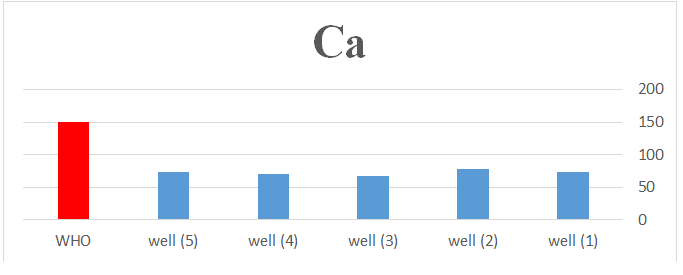
Calcium contributes to the hardness of water and it is the fifth most common element found in most natural waters. The sources of calcium in ground water especially in sedimentary rocks are calcite, aragonite, gypsum and anhydride. In the study area, the concentration of calcium in groundwater is low and ranged between 66.8 to 78.4 mg/L with the mean of 72.6 mg/L which is below the maximum allowable concentration of 200 mg/L.
Magnesium (Mg2+)
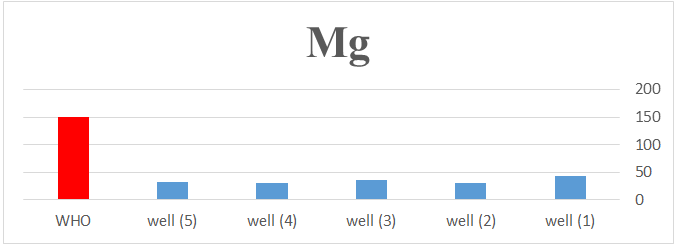
Magnesium is one of the most common elements in the earth’s crust. It is present in all natural waters. It is an important contributor to water hardness [8]. The sources of magnesium in natural water are dolomites and mafic minerals (amphibole) in rocks. The solubility of dolomite in water depends on the composition. In the study area, magnesium concentration ranged between 30.7 to 43.7 mg/L with the mean of 37.2 mg/L.
Sulfate (SO4)
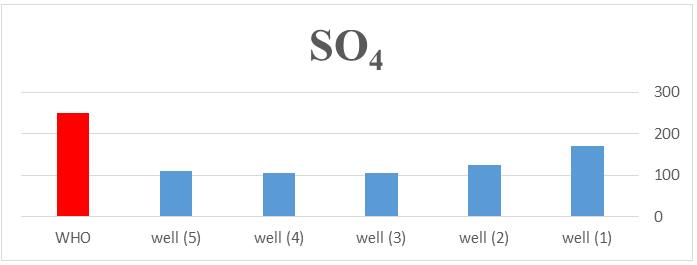
Sulphate occurs in water as the inorganic sulphate salts as well as dissolved gas. The concentration of sulphate (SO4 2- ) in the present study the values are low and ranged between 105-170 with the mean value of 137.5 mg/L and the values are within the maximum allowable limits of 250 mg/L according to WHO.
Chloride (Cl)
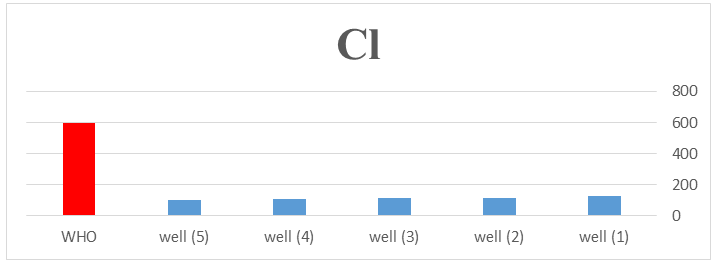
Chloride is present in all natural waters, usually in relatively small amounts .The origin of chloride in groundwater may be from diverse sources such as weathering, leaching of sedimentary rocks and soils, intrusion of saltwater, In the study area, the concentration of chloride is low and range between 104 to 124 mg/L, with a mean of 114 mg/L which is below the maximum allowable concentration of 250 mg/L.
Total hardness as CaCO3
Total hardness (TH) is caused primarily by the presence of cations such as calcium and magnesium and anions such as carbonate, bicarbonate, chloride and sulphate in water.
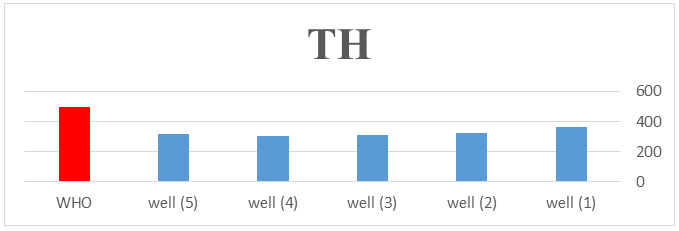
Water hardness has no known adverse effects; however, some evidence indicates its role in heart diseases [9]. In the study area, the total hardness varies between 317- 366 mg/l with a mean 341.5 mg/L, which is below the maximum allowable concentration of 500 mg/L.
Nitrate (NO3-)
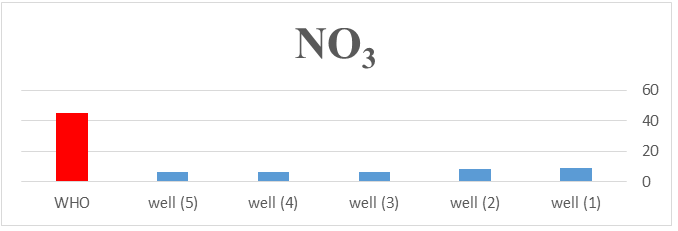
High-nitrate concentrations in groundwater are a world- wide problem. Nitrate is soluble, highly mobile and potentially leaches from the unsaturated zone to groundwater [10]. The concentration of nitrate in the study area is low and ranged between 6.5 to 9.3 mg/L with a mean of 7.9 mg/L, which is below the maximum allowable concentration of 45 mg/L according to WHO standard.
Iron
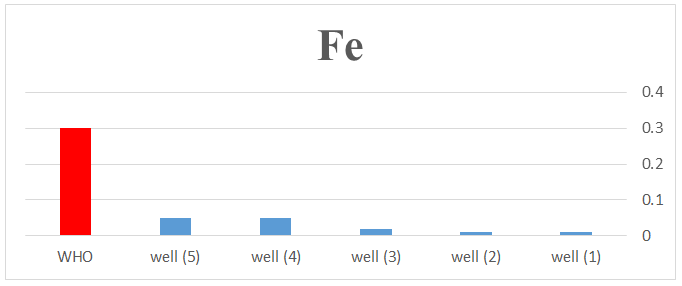
Element found in many of the rocks and soils of the earth‟s crust [11]. In the study area, the concentration of iron is between 0.01 - 0.05 mg/L with a mean of 0.0.3 mg/L, which is below the maximum allowable concentration of 0.3 mg/L according to WHO standard.
Conclusion
In this study, suitability of the groundwater, as major resource of drinking purposes. The study indicates that the wells samples in the district Seiyun area are generally soft. Most of the physicochemical parameters of the samples were within acceptable limits for human consumption purposes recommended by the WHO standard [5]. Since groundwater is a precious resource, therefore, there is a need to preserve and protect this valuable resource by following preventive measures to control the contamination.
References
-
Khalifa A, Dan L, Kai S, Eldaw E, Abualela S (2019) Evaluating the suitability of groundwater for drinking pur-poses in the North Chengdu Plain, China. E3S Web of Conferences 81: 8.
-
Thivya C, Chidambaram S, Thilagavathi R, Prasanna MV, Singaraja C, et al. (2015) Assessment of fluoride contaminations in groundwater of hard rock aquifers in Madurai district, Tamil Nadu (India).
-
Qishlaq A, Kordian S, Parsaie A (2017) Hydrochemical evaluation of river water quality-a case study. Applied Water Science 7: 2337-2342.
-
American Public Health Association (APHA) (1998) Standard Methods for the Examination of Water and Wastewater, 20th edition, American Public Health Association, Washington.
-
WHO (2004) Guidelines for drinking water quality, 3rd (Edn.), World Health Organization, Geneva.
-
Ramesh K, Soorya V (2012) Hydro chemical Analysis and Evaluation of Groundwater Quality in and around Hosur, Krishnagiri District, Tamil Nadu, India. International Journal of Research in Chemistry and Environment 2(3): 113-122.
-
Sasikaran S, Sritharan K, Balakumar S, Arasaratnam V (2012) Physical, chemical and microbial analysis of bottled drinking water. J Ceylon Medical 57(3): 111-116.
-
Obiefuna G, Sheriff A (2011) Assessment of Shallow Ground Water Quality of Pindiga Gombe Area, Yola Area, NE, Nigeria for Irrigation and Domestic Purposes. Research Journal of Environmental and Earth Sciences 3(2): 131-141.
-
Ibrahim AK, Gadam AU, Usman A, Umar AH (2015) Suitability assessment of groundwater for drinking and irrigation use. IOSR Journal of Agriculture and Veterinary Science 8(4): 25-32.
-
Liao L, Green C, Bekins B, Bohlke J (2012) Factors controlling nitrate fluxes in groundwater in agricultural areas. Water Resour Res 48(6).
-
Delgado C, Pacheco J, Cabrera A (2010) Quality of groundwater for irrigation in tropical karst environment: The case of Yucatan, Mexico. Agric Water Manag 97(10): 1423-1433.
- Pattern of Gonadal Hormones in Oral Testosterone-Supplimented Male Wistar Rats with Diabetes-Induced Hypogonadism
- Re-Evaluation of the Genotoxicity of Currently Used Food Dyes in Mouse Multiple Organs Via Continuous Administration by Drinking Using the Comet Assay
- Pharmacogenetics of Type 2 Diabetes Mellitus: Linking Genetic Variability to Drug Efficacy and its Cardiovascular Outcomes
- Exploratory Proteomic Profiling of SARS-CoV-2 Infected THP-1 Macrophages Reveals Alterations in Inflammatory Response and Cellular Metabolism
- Study of Genotoxicity of Hepatocarcinogens in Multiple Organs in Mice by Feeding and Drinking Using the Comet Assay
- Spirulina Polypeptides Inhibit the Growth of Human Lung Tumor (H460) Cells