
Systematic Review of Sulfur Oxides Levels in Industrial and Urban Settings in Iran
The Sulfur dioxide (SO2) is a prevalent pollutant in urban atmospheres. At a concentration level exceeding 9 ppm, it emits a potent and unpleasant odor and can prove fatal. The most harmful effects of air pollution are often due to a combination of sulfur oxides, particulate matter, and humidity. Given the importance of this pollutant in determining overall air quality, an investigation into its presence in Iranian cities can offer significant insights into the distribution patterns and influencing factors of its concentration levels. Such knowledge is crucial for improving our understanding of air quality and devising effective management strategies. This research was conducted through a systematic review of three databases: Magiran, SID, and Google Scholar. The review focused on articles reporting on the concentration of SO2 . A total of 123 articles relevant to the study were initially identified. After a thorough examination, duplicate and irrelevant articles were excluded, leaving 25 articles that fulfilled the inclusion criteria. The analysis shows that the average concentration of SO2 in industrial areas (226.1 ± 218.2 µg/m³) is significantly higher than that in urban areas (92.6 ± 125.4 µg/m³). Furthermore, the concentration of SO2 in outdoor environments (144.2 ± 178.9 µg/m³) exceeds that in indoor environments (74.9 ± 66.9 µg/m³). Notably, the concentration of SOx in central urban areas **surpasses** that in peripheral areas, with an average value of (190.1 ± 144.1 µg/m³). The study also found that these concentrations are considerably higher during the summer months, averaging (224 ± 334 µg/m³). The results demonstrate that the levels of sulfur oxides, particularly in industrial settings, are elevated during the warmer seasons in comparison to other periods.
Introduction
Currently, air pollution ranks as a predominant issue within urban environmental challenges [1]. Significant contributors to urban air pollutant emissions include mobile sources and industrial activities [2, 3]. The World Health Organization has identified air pollution as a contributing factor to the health complications of approximately 4.6 million individuals and the mortality of 800,000 people globally [4, 5]. This issue is recognized as a critical concern across most Asian nations. Notably, air pollution ranks among the top ten leading causes of increased mortality worldwide. Indeed, the mortality rate attributable to this factor has escalated from approximately 800,000 individuals in 2000 to 1.3 million by 2010 [6]. Sulfur dioxide (SO2) is identified as a principal atmospheric pollutant and a critical agent affecting respiratory health. Its emission rates have escalated in recent years, primarily due to the rapid economic expansion and the consequent surge in energy consumption [7]. Reports indicate that over one- fifth of the global population is subjected to elevated levels of SO2 and particulate matter [4].
SO2, a colorless gas, is recognized as one of the key pollutants monitored in air quality assessments. Predominantly, this pollutant is released into the atmosphere through the combustion of sulfur-containing fuels such as coal, oil, and diesel. Significant sources include power plants and urban traffic, making it a major contributor to air pollution in numerous large cities. Furthermore, SO2 can undergo oxidation processes, leading to the formation of a secondary pollutant, sulfur trioxide [2, 6].
SO2 is emitted into the atmosphere through both natural and anthropogenic sources. The primary natural sources are volcanic eruptions. However, over 80% of global SO2 emissions originate from the combustion of fossil fuels, with power plants accounting for 80% of this figure, while only 2% is attributable to vehicular sources. Among non-combustion sources, oil refineries, copper smelting factories, and cement production facilities are significant contributors to SO2 emissions. In the cement industry, the primary raw materials, typically lime and clay (marl), contain sulfur compounds due to their sedimentary origin. The decomposition of these materials and the oxidation of inherent sulfur result in the release of SO2 [8]. According to the World Atmospheric Research Database, Iran ranks as the world’s ninth-largest emitter of SO2, following China, the United States, India, Saudi Arabia, Russia, South Africa, Indonesia, and Kazakhstan. SO2 stands out as one of the most critical pollutants in the contemporary era, inflicting irreversible harm on the environment, climate, and human health. Presently, the escalation in industrial developments and the overconsumption of fossil fuels have led to increased concentrations of air pollutants, notably SO2. This rise in pollutants has subsequently resulted in significant health issues for the population [1]. SO2 exposure at 20 ppm is known to cause eye irritation, coughing, and inflammation, whereas concentrations between 400-500 ppm pose a risk of fatality. In the presence of air moisture, sulfuric acid is formed, exacerbating the impacts of SO2 on the respiratory and nervous systems [9]. Consequently, there is growing concern over the health effects of air pollutants, including SO2, in both developed and developing nations. Notably, SO2 imparts a detectable taste to the air at concentrations ranging from 0.9 to 4 ppm. Above 4 ppm, this gas emits a pungent and irritating odor and may lead to fatal outcomes. In combination with particulate matter and humidity, sulfur oxides contribute to the most severe health risks associated with air pollution, including narrowing of the airways, bronchial spasms, severe coughing, eye and respiratory tract irritation, reduced respiratory function, shortness of breath, diminished breathing depth, and exacerbation of cardiovascular and respiratory conditions.
Empirical studies have established a significant correlation between short-term exposure to sulfur dioxide and the increased incidence and mortality from respiratory and cardiovascular diseases. Furthermore, a notable association has been identified between the levels of fine particulate matter and SO2 concentrations, leading to heightened hospital admissions due to cardiovascular issues. Research conducted across 15 Italian cities demonstrated that an increase in SO2 levels is associated with an 11.1 percent increase in mortality from cardiovascular diseases. Additionally, when combined with hydroxide, this pollutant contributes to the acidification of precipitation, resulting in acid rain that detrimentally affects water and soil quality, leading to adverse environmental outcomes [1, 6, 7]. Due to its solubility in water and its capability to adsorb onto the surfaces of particles, sulfur dioxide exhibits synergistic effects when combined with suspended particulates and moisture, thereby exacerbating harmful health consequences associated with air pollution. This compound has been implicated in significant environmental incidents such as those observed in the Meuse Valley, Donora, and London, highlighting its potential for causing severe pollution episodes. Research indicates that sulfur dioxide can compromise the immune system by damaging lymphocytes, thereby weakening the body’s defense mechanisms, and may expedite oncogenesis and chromosomal alterations.
Given the detrimental impacts of sulfur dioxide and the sources of its production, it becomes imperative to monitor its concentration levels and conduct thorough investigations in this domain, particularly to assess the ambient levels of this pollutant in the urban atmospheres of Iran. Consequently, the current study is dedicated to evaluating the concentrations of SO2 in the air of Iranian cities and identifying the factors influencing these levels, with reference to existing literature.
Study Method
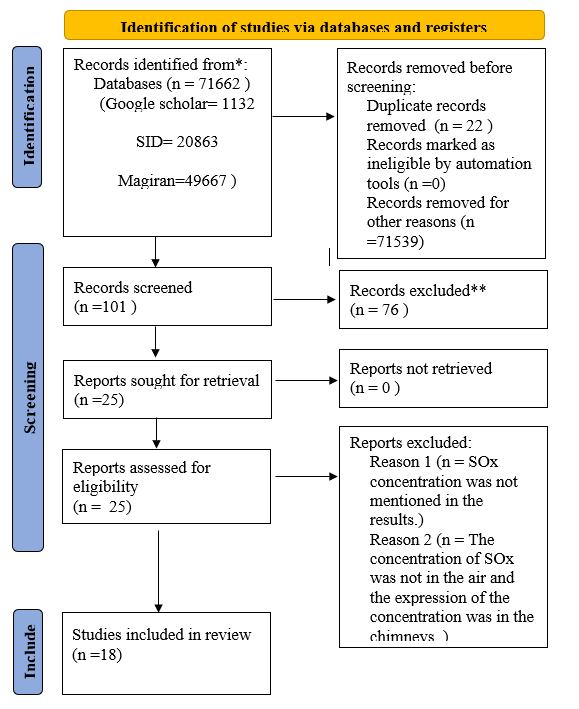
The present kinematic survey was carried out utilizing three databases: “Magiran,” “SID,” and “Google Scholar,” spanning from December 11 to December 26, 2022. The search terms employed across these platforms were “air pollution,” “air,” “sulfur oxides,” and “SOX.” The initial search yielded a total of 1132 articles from Google Scholar, 20863
from SID, and 49667 from Magiran. Upon reviewing these articles, 123 were deemed relevant to the research focus. Subsequently, using EndNote software, 22 duplicate articles were identified and removed, leaving 101 articles for further examination. A review of the abstracts led to the exclusion of 76 articles for reasons such as lack of information on atmospheric sulfur dioxide concentrations and the articles being descriptive or reporting unrelated sulfur dioxide concentrations, such as those from chimneys and fuels.
Consequently, 25 articles met the inclusion criteria for the study, characterized by reporting SOx concentrations in urban and industrial settings, various indoor and outdoor environments, different geographical locations, and across diverse seasons (Table 1). The methodology for reviewing the selected studies adhered to the 2020 PRISMA (Preferred Reporting Items for Systematic Reviews and Meta-Analyses) guidelines, and the corresponding flowchart is depicted in Figure 1.
| Sources | Search date | Total of results retrieved | records after deduplication within the database | records before deduplication from all sources | records after prescreening title & abstract | records with full- text | studies included in qualitative synthesis | studies included in quantitative synthesis (if applicable) |
|---|---|---|---|---|---|---|---|---|
| Google scholar, SID, Magiran | 11- 26 December 2022 | 71662 | 101 | 123 | 101 | 25 | 0 | 18 |
Table 1: Summary of searching for PRISMA reporting.
Results
SOx Concentration in Urban and Industrial Environments
The systematic review incorporated findings from 39 articles, with 13 focusing on industrial environments and 26 on urban settings. The analysis of SOx concentrations across different regions of Iran revealed distinct patterns in industrial and urban areas. the average concentration of SOx detected in industrial environments was significantly higher, recorded at 226.1 µg/m³ with a standard deviation of 218.2 µg/m³. This is contrasted with urban environments, where the average concentration was markedly lower at 92.6 µg/m³ with a standard deviation of 125.4 µg/m³. The peak concentration of SOx in industrial settings reached up to 896 µg/m³, whereas the minimum concentration reported was as low as 26 µg/m³. In urban settings, the highest recorded concentration of SOx was 653 µg/m³, with the lowest at 5.2 µg/m³.
These findings underscore a significant disparity between urban and industrial areas, with industrial zones exhibiting notably higher levels of SOx pollution. This difference can be primarily attributed to the emission sources prevalent in these environments, as industrial activities typically release higher quantities of sulfur oxides compared to urban sources. The observed data, represented in Figure 2, further substantiates the elevated levels of SOx concentrations in industrial regions due to their inherent pollution levels.
SOx Concentration in Indoor and Outdoor Environments
In the assessed body of literature, the findings of this study indicate that of the total articles reviewed, 35 are concerned with outdoor environments, while four focus on indoor environments. Upon examining the various concentrations of sulfur oxides in indoor and outdoor settings, it has been established that the average concentration in indoor environments is recorded at 74.9 µg/m³, alongside a standard deviation of 66.9 µg/m³ (74.9 ± 66.9 µg/m³). In contrast, outdoor environments exhibit a higher average concentration of 144.2 µg/m³ with a standard deviation of 178.9 µg/m³ (144.2 ± 178.9 µg/m³). The highest concentration of SOx found in outdoor settings reached 896 µg/m³, with the lowest recorded at 22.2 µg/m³. Similarly, in indoor settings, the highest concentration observed was 138 µg/m³, and the lowest was 5.2 µg/m³. Derived from the information presented in Figure 3, it is discernible that concentrations of SOx are significantly greater in outdoor environments compared to indoor environments. This discrepancy is largely attributed to the greater production of pollutants in outdoor areas, leading to more significant pollution levels than those found in indoor settings.
SOx Concentration in Geographical Areas
Within the scope of the articles reviewed, the study’s findings highlight distribution based on geographical areas: 16 articles focus on central regions, 13 on northern regions, and 10 on southern regions of the country. Investigating the varying concentrations of SOx across different geographical regions of Iran reveals distinctive patterns, the average SOx concentration in the central cities stands at 190.1 ± 144.1 µg/m³, in the northern cities at 52 ± 338 µg/m³, and in the southern cities at 163.1 ± 267.6 µg/m³. The highest recorded SOx concentration was 653 µg/m³ in central cities, 138 µg/ m³ in northern cities, and 896 µg/m³ in southern cities. Conversely, the lowest recorded concentrations were 26 µg/ m³ in central cities, 2.5 µg/m³ in northern cities, and 36 µg/ m³ in southern cities.
The results delineated in Figure 4 suggest that the central regions exhibit higher concentrations of SOx, which can be attributed to the prevalence of various industries in these areas that contribute to increased pollution levels.
Seasonal Variations in SOx Concentrations
The surveyed literature presents results from various studies, with seasonal differentiation: four articles are associated with spring, six with summer, four with autumn, five with winter, and twenty with unspecified seasonal categorization. Seasonal variations in SOx concentrations were observed, with average levels reported as follows: in spring, 177.8 ± 103.8 µg/m³; in summer, 224 ± 334 µg/ m³; in autumn, 69 ± 43.9 µg/m³; in winter, 81.8 ± 53 µg/ m³; and in instances lacking distinct seasonal demarcation, 130.3 ± 149.5 µg/m³. The peak concentrations recorded were 262 µg/m³ in spring, 896 µg/m³ in summer, 126 µg/ m³ in autumn, 158.9 µg/m³ in winter, and 653 µg/m³ in the unclassified seasonal category. Conversely, the minimal concentrations observed were 49 µg/m³ in spring, 5 µg/m³ in summer, 26 µg/m³ in autumn, 30.3 µg/m³ in winter, and 22.2 µg/m³ when seasons were undefined.
Further analysis of the data, particularly from Figure 5, elucidates that the summer season experiences heightened SOx concentrations. This increase can be attributed to atmospheric conditions such as relative stagnation, characterized by inadequate rainfall and insufficient wind flow, which consequently leads to a significant accumulation of pollutants.
According to the findings, SO2 concentrations are higher in external environments compared to internal ones. External emission of SO2 originates from both natural and anthropogenic sources. It is noted that over 80% of global SO2 emissions are derived from the combustion of fossil fuels, with power plants accounting for 85% of these emissions, whereas only 2% originate from vehicular sources. Additionally, significant non-combustion contributors include oil refineries, copper smelting plants, and cement factories. The research conducted by Raispour, focusing on the establishment of factories and industries in Tehran, particularly in its western and southwestern regions, highlights power plants and oil refining companies as primary contributors to the increased SO2 levels in the troposphere. Factors such as industrial activities, aging vehicle fleets, and the presence of cement factories and power plants that utilize diesel fuel or mazut, especially in southern Kerman province, are identified as causes for the relatively high year-round SO2 concentrations. Furthermore, the study reveals that SO2 concentrations peak during the colder months and seasons. This trend is attributed to more active emission sources during these times, including increased diesel fuel usage, higher traffic volumes, and a rise in the consumption of fossil fuels [1]. Alterations in the composition of air in external environments are attributed to both natural and anthropogenic factors. Natural processes include the emission of particulates from volcanic eruptions and desert tornadoes. In contrast, human-induced changes primarily arise from industrial activities, transportation, and urbanization. Key anthropogenic sources of air pollution include vehicular traffic, industrial emissions, and unregulated burning practices. Specifically, the elevated levels of pollutants in Sabzevar city are linked to an increased reliance on motor vehicles over time, the prevalent use of diesel cars with low fuel quality, and the absence of strict fuel regulation in vehicles. In the Asrar area of Sabzevar city, the particularly high concentration of sulfur dioxide (SO2) can be attributed to the dense vehicular traffic relative to other areas. Additionally, a lack of public awareness regarding health and environmental impacts contributes to air quality degradation. The issue is compounded by practices such as the use of smoke-emitting, unregulated motorcycles and the adulteration of gasoline with oil to decrease fuel consumption, often associated with youth activities. Furthermore, factors exacerbating pollution in external environments include heavy traffic, particularly during peak travel seasons like summer when the number of vehicles increases due to pilgrims traveling through Sabzevar to Mashhad. Adverse weather conditions, the onset of warmer seasons, and traditional heating methods employing low-efficiency fuels also contribute significantly to the heightened pollution levels [10]. Urban centers, due to their high population density and extensive economic and social activities, are significant contributors to resource consumption and waste production, making them central to discussions on pollution and environmental degradation. The urban expansion, coupled with unregulated industrial growth and improper siting, has been identified as a crucial factor in escalating environmental pollution [11]. In particular, investigations into air pollution at the Arvand Petrochemical Complex revealed major sources of gaseous pollutants, including process towers, heaters, tanks, waste incinerators, and emissions from chemical substances such as Hot oil and acetic acid originating from homogenization ponds and anaerobic reactors in the wastewater treatment units [12]. While vehicular emissions and traffic congestion are significant contributors to urban air pollution, it is essential to recognize the role of stationary sources, such as building engine rooms, in exacerbating environmental pollution. In Tabriz, for example, vehicular traffic significantly impacts air quality, affecting different regions of the city differently [3]. Arak, known for its industrial activities in Iran, showcases how industrial density, including refineries, petrochemical plants, aluminum, machinery manufacturing, and Pars Wagon factories, in addition to increased traffic, leads to a rise in air pollutants [13]. SO2 is recognized as a key pollutant in air quality monitoring, predominantly released into the atmosphere through the burning of fossil fuels, emissions from power plants, and urban vehicular traffic, thereby contributing significantly to air pollution in major urban centers. The research conducted by Khorsandi et al. highlights several factors contributing to the elevated emission levels of sulfur dioxide in Urmia city. These include the extensive use of various fuels, attributed largely to the region’s cold climate, a high vehicle per capita rate, the phenomenon of temperature inversion, and the influx of fine dust from neighboring countries in the northwest. These elements collectively exacerbate the concentration of sulfur dioxide, impacting the air quality and environmental health in Urmia city [6]. In Urmia city, the main factors contributing to air pollution include the infiltration of fine dust from the northwest, an elevated number of vehicles per capita, the occurrence of temperature inversion phenomena, and the prevalent use of fossil fuels for heating. These elements play a significant role in exacerbating the air quality issues in the region [14]. Furthermore, the study suggests a notable correlation between wind direction and pollution concentration in open environments. This dynamic facilitates the movement of contaminants from highly polluted areas to less polluted ones, thereby affecting broader regions. In contrast, this relationship between wind direction and pollution levels is found to be less significant in enclosed spaces. This distinction highlights the impact of physical and geographical conditions on the dispersion and concentration of pollutants in different settings [10].
SO2 Concentration in Urban and Industrial Environments
The findings indicate a higher concentration of SO2 in industrial regions compared to urban settings. A notable example is the city of Arak in Iran, recognized for its industrial activities. The dense presence of industries such as refineries, petrochemical plants, aluminum, machinery, and Pars wagon manufacturing, coupled with rising traffic, significantly contributes to the elevation of air pollutants within Arak [13]. Similarly, research conducted by Kouhzad Raispour in Tehran highlights the role of both natural factors and human activities in exacerbating SO2 levels. The establishment of factories and industries, particularly in the western and southwestern parts of Tehran, along with power plants and oil refineries, has been identified as major contributors to the increased SO2 concentration in the troposphere. Additionally, Kerman province, characterized by its industrial landscape, aging vehicle fleets, and the presence of cement factories and power plants utilizing diesel fuel or mazut, especially in the southern regions, experiences elevated SO2 concentrations throughout the year. This underscores the significant impact of industrial activities and vehicular emissions on air quality, particularly concerning SO2 levels in urban and industrial settings [1].
SO2 Concentration in Different Seasons
The study outcomes reveal that SO2 concentrations are notably higher during the summer months compared to other seasons. For instance, the research conducted by Ali Tulabi and others in the city of Bandar Abbas demonstrates that the measured levels of SO2 during the sampling period were generally above the maximum 8-hour concentration allowed by open-air standards, set at 0.02 ppm. An exception was noted in September when concentrations fell below the standard, attributed to operational changes at the refinery unit. Additionally, the extent of SO2 pollution dispersion was most significant in the initial month of the sampling, influenced by wind speed and direction.
Furthermore, in the Barez Industrial Complex of Kerman, findings indicate that SO2 was the primary pollutant in 60% of the samples collected from the latter half of the summer season to the end of November. This prevalence is attributed to the substantial traffic of heavy machinery, which typically uses fuel with a high sulfur content.
Contrary to common belief that air pollution issues are predominantly winter phenomena, aggravated by inversion conditions, the studies by Tulabi et al. illustrate that pollutant levels, particularly SO2, remain high on many summer days. This challenges the conventional understanding of seasonal air pollution dynamics and underscores the importance of monitoring and mitigating SO2 emissions throughout the year, especially in industrial areas and cities with significant vehicular traffic [14, 15].
SO2 Concentration in Different Geographical Locations
The data obtained indicate that the concentration of SO2 in central Iran surpasses that observed in other regions. The investigation of air pollution in urban environments is crucial, given its significant health and economic ramifications. The extent of air pollution within a city is influenced by a multitude of factors including geographical characteristics (such as elevation and topography), climatic conditions, population density, economic growth, and the rate of pollutant emissions per unit area combined with average wind speeds. Specifically, the city of Kashan, situated at the heart of Iran, experiences unique environmental conditions due to its geographical placement. The northern and eastern sections of the city border deserts, leading to increased air temperatures and aridity due to desert winds. The prevalent soil composition in these areas, predominantly sand and gravel, acts as a natural source for the suspension of particulate matter. Moreover, the rising population and the establishment of diverse factories and industries have emerged as anthropogenic factors contributing to the city’s air pollution. Consequently, it appears that the issue of air pollution in Kashan represents a significant environmental challenge [16, 17]. Therefore, in light of the significance of this issue and the presence of underlying factors contributing to air pollution, including insufficient rainfall, dry atmospheric conditions, elevated environmental temperatures, prolonged duration of the hot season, and the relatively high population density, addressing the issue of air pollution has become one of the foremost health and environmental priorities. Consequently, the city of Kashan has resolved to [5]. In the research undertaken by Moeini et al., emphasis is placed on the transformation of Arak into a significant industrial hub within Iran, recognized as a pivotal area for industrial development and a nexus for an array of manufacturing activities, including refineries, petrochemical plants, aluminum production, machinery construction, and the production of Pars wagons. Concomitantly, the augmentation of vehicular traffic has been identified as a contributory factor leading to the escalation of air pollutant levels in the city of Arak [18]. In Ilam, the gas refinery located 13 kilometers northwest of the city of Ilam and 81 kilometers west of Chavar city, constitutes one of the significant sources of environmental pollution.
In the provinces of Tehran, Isfahan, and Kashan, significant levels of SO2 are also present. The elevated quantities of tropospheric SO2 over Tehran can be ascribed to various geographical and anthropogenic factors. The city’s location in a semi-enclosed area on the southern slopes of the Alborz highlands leads to the Alborz mountains in the north and east acting as barriers that impede air circulation, thus fostering conditions conducive to the persistence and continuity of tropospheric SO2. In the Isfahan province, industrial entities such as Mubarakeh Steel, Isfahan Steel, Sepahan Oil Company, and the Islamabad power plant, alongside vehicular activities, exacerbate the concentration of SO2 in the region. Similarly, the cities of Sabzevar, Tabriz, and Urmia, located in the northern parts of the country, are also affected by increased levels of SO2 due to both local and regional sources of air pollution [1].
While the percentage of SO2 is lower in comparison to the central regions, for instance, in the city of Sabzevar, the increase in pollutant concentrations can be attributed to several factors. These include the heightened use of motor vehicles relative to the past, the inferior quality of diesel cars, inadequate regulation concerning the quantity of automotive fuel, Sabzevar’s location in a desert area, and the frequent occurrence of local winds throughout the year. Based on conducted research, given that manufacturing industries have been relocated to the industrial zones of Sabzevar city and the quantity of polluting industries under investigation is not significantly large, it can be deduced that the primary sources of pollution in Sabzevar city predominantly stem from vehicular emissions [10]. According to the research conducted by Morteza Esmailnejad and colleagues, the city of Tabriz is situated within the tectonic valley on the eastern part of the Tabriz Jalgah. It is encircled by the Aun Bin Ali mountains to the north and the Mahor hills of the Sahand highlands to the south, thus forming a valley. This geographical configuration plays a pivotal role in exacerbating pollution levels and contributing to the phenomenon of air inversion within the city’s atmosphere. Tabriz is constrained by topographical limitations and steep slopes from three directions: north, south, and east. While the west side appears to be more conducive for expansion, industrial development is restricted in this direction due to the presence of industrial factories and a high groundwater level. As one approaches the city center from the east, north, and south, the ground slope and, consequently, the gradient of streets and passages diminish. This gradient reduction leads to a concentration of industrial facilities in the western part of Tabriz, which poses a significant challenge to the city’s horizontal development. The allocation of industrial sites in Tabriz has overlooked critical factors essential for sustainable urban development. The positioning of industries in the western part of the city has resulted in pollution emanating from these industrial sites being carried towards the city center when west-east winds prevail, leading to irreversible impacts on urban health. The findings indicate that the pollution in the central and western zones of Tabriz is not only influenced by the city’s geographical location and topography, particularly the placement of the Zainal and Ainal mountains in the northwest, but also by the density of commercial, administrative, and industrial activities. Additionally, the low per capita availability of roads and green spaces exacerbates the pollution levels in these areas. The direction and speed of winds, varying across different seasons and between warm and cold months, further modulate the dispersion and impact of pollution in Tabriz [18]. In Urmia city, during conditions that do not meet air quality standards, suspended particulate matter, SO2, and carbon monoxide are identified as the primary contributors to air pollution. The incursion of fine dust into the northwest of the country, an elevated number of vehicles per capita, the inversion phenomenon, and the reliance on fossil fuels for heating purposes constitute the principal factors leading to the heightened levels of SO2 in Urmia’s atmosphere [14]. Khuzestan province, particularly the cities of Abadan, Ahvaz, and Mahshahr, situated in the southern part of Iran, stands as one of the nation’s most significant industrial hubs, primarily due to the presence of oil facilities and refineries (notably in Abadan), oil wells, and the combustion of sour sulfur gases via large flares. This province also houses industrial and power plants such as Ramin, Maron Petrochemical, and Khuzestan Steel in Ahvaz, along with the Bandar Imam Petrochemical Company in Mahshahr. Reports by Kohzad Raispour classify it as one of the most polluted areas globally due to these activities.
Following Khuzestan, Bushehr province exhibits a notable concentration of SO2, attributable to the oil and gas industries, with major emission sources including the Khark Petrochemical Company, South Pars Complex, and Assalouye Gas Complex. Similarly, Hormozgan province is identified as another polluted region due to activities like oil refining and operations at the Bandar Abbas thermal power plant. Additionally, a significant pollution hotspot is detected in the southern part of Kerman province, mainly due to the operations of the Kahnuj combined cycle power plant, which stands out as one of the predominant sources of SO2 emissions throughout all seasons [1].
Conclusion
Based on the findings, it is deduced that the concentration of SOx is substantially higher in industrial settings compared to urban environments. The presence of a relatively high contents of sulfur in the industrial fuels (diesel, crude oil and diesel fuel) is clearly effective on the concentration of SOx for the industrial areas. So, the regulations about the sulfur content of the fuels should be more preventive with rigid inspections. Like nitrogen oxides, sulfur dioxide also has a very high concentration around power plants, train and railway stations, airports and bus depots, which can be harmful for the residents of these areas. Additionally, outdoor environments exhibit higher SOx concentrations compared to indoors, indicating that outdoor spaces are more polluted. In outdoor environments, this result is mostly obtained due to the combustion process in industries, transportation, exhaust of the household combustion and agricultural waste incineration. Furthermore, the levels of SOx have been found to be significantly higher in the cities located in the southern part of the country as compared to other regions. Seasonally, the concentration of SOx peaks during the summer, surpassing the levels observed for remain.
Acknowledgments
The authors of this article would like to extend their sincere appreciation to Semnan University of Medical Sciences for their support, and to all individuals who assisted in the conduct of this research. Their cooperation was instrumental in the successful completion of this review study.
References
-
Raispour K (2021) Sulfur Dioxide (SO2) Monitoring Based on MetOp-A/GOME-2 Sensor Observations in the Troposphere of Iran. Journal of Environmental Studies 47(2): 125-146.
-
Esfahbodi A, Shafipoor M (2017) Evaluation and measurement of CO, SO2, NO2 and particles in parking area of Imam Reze Shrine. Journal of Environmental Science Studies 1(3): 19-24.
-
Esmailnejad M, Sani ME, Barzaman S (2015) Evaluation and Zoning of Urban air Pollution in Tabriz. Regional Planning 5(19): 173-186.
-
Rastegari M, Namini ME (2017) Investigation of Monthly and Annual Average Concentrations of Air Pollutants in Air Pollution Monitoring Stations in Tehran Province Department of Environment in Years 2012 and 2016. Journal of Environmental Science Studies 2(3): 485-491.
-
Dehghani R, Takhtfiroozeh S, Hosseindoost G, Mossayebi M, Arabfard M (2014) Investigation the air quality city of Kashan during 2012 based on the air quality index. Armaghan-e-danesh 19(4): 314-325.
-
Khorsandi H, Karimzade S, Aghaei M, Aghapour AA, Moghanjooghi SM, et all. (2016) Health Impact Assessment of Exposure to Particulate Matter less than 10 Micron and Sulfur Dioxide using AIRQ Model in Urmia, Iran. Studies in Medical Sciences 27(5): 438-448.
-
Nasr MM, Ansarizadeh M, Leili M (2016) The assessment of air pollutant concentrations and air quality index in Shiraz during 2011-2013. Journal of Environmental Health Enginering 3(3): 182-192.
-
Rahmani H, Hatefi O (2023) Investigation of environmental gases and suspended particles in the environment around Sepahan Cement factory. Journal of Environmental Science Studies 8(2): 6501-6509.
-
Tavakoli A (2020) Evaluation of indoor air pollution in traditional bazaars-Case study in Naqsh-e-Jahan square of Isfahan in 2018-2019. Journal of Research in Environmental Health 5(4): 273-282.
-
Allahabadi A, Ahmadi Asoor A (1970) Measuring the air pollutants in Sabzevar, Iran. Journal of Sabzevar University of Medical Sciences 18(2): 140-147.
-
Hosseini S, Khani NZ, Bakhsh BY (2017) Evaluation of the environmental sustainability of Ahwaz with an emphasis on air pollution (Using FPPSI method). Journal of Natural Environment 70(2): 309-317.
-
Malmasi S, Jozi SA, Monavari SM, Moghadam EJ, Manuchehri H (2015) Environmental Impacts Analysis of Petrochemical Industries Using Analytical Hierarchy Process (AHP). Journal of Sustainability Development and Environment 2(3): 21-33.
-
Moini L, Fani A, Bakhtyar M, Rafeie M (2011) Correlation between the concentration of air pollutants (CO, SO2 and NO2) and pulmonary function. Journal of Shahrekord University of Medical Sciences 13: 27-35.
-
Khorsandi H, Tapok AF, Cargar H, Moughanjogi MS (2013) Study of Urmia city air quality according to the air quality index (AQI). Studies in Medical Sciences 23(7): 767-775.
-
Zare M, Toolabi A, Zare MR, Sarkhosh M, Mahvi AH, et al. (2012) Outdoor investigation of air quality around Bandar Abbas - Iran oil refinery. International Journal of Environmental Health Engineering (IJEHE) 1(1): 46-50.
-
Malakootian, Momeni, Dolatshahi (2013) Survey of air pollutants of the air surrounding Barez Industrial Complex in Kerman. Tolooe Behdasht 12(2): 26-37.
-
Motalleby M, Mazaheri A, Mosayebi M, Takhtfiroozeh SM (2015) Assessing Health Impacts of Air Pollution in Kashan 2011. Arak Med Uni J 18(98): 77-87.
-
Rahimi R, Mansouri N, Alsheikh AA, Mirzahoseini A (2021) Evaluation of amount, emission factors and concentrations of SO2, NO2 and CO in ILAM Gas Refinery. Journal of Environmental Science and Technology 23(3): 71-85.
- Pattern of Gonadal Hormones in Oral Testosterone-Supplimented Male Wistar Rats with Diabetes-Induced Hypogonadism
- Re-Evaluation of the Genotoxicity of Currently Used Food Dyes in Mouse Multiple Organs Via Continuous Administration by Drinking Using the Comet Assay
- Pharmacogenetics of Type 2 Diabetes Mellitus: Linking Genetic Variability to Drug Efficacy and its Cardiovascular Outcomes
- Exploratory Proteomic Profiling of SARS-CoV-2 Infected THP-1 Macrophages Reveals Alterations in Inflammatory Response and Cellular Metabolism
- Study of Genotoxicity of Hepatocarcinogens in Multiple Organs in Mice by Feeding and Drinking Using the Comet Assay
- Spirulina Polypeptides Inhibit the Growth of Human Lung Tumor (H460) Cells