
Effect of Tomato (Lycopersicon Esculentum) Extract on Acetaminophen - Induced Acute Hepatotoxicity in Albino Wistar Rat
Introduction: It has been extensively reported that drug-overdose is the leading cause of liver injury in the world today. Diets rich in natural antioxidants have been observed to offer substantial remedy to drug-induced organ injuries. Objective: The aim of this study was to investigate the hepatoprotective effect of tomato extract against Acetaminophen-induced acute hepatotoxicity in rats. Method: Phytochemical analyses were performed. A total of 24 albino rats weighing (110±10g) were randomly allocated to four groups (A-D), with six rats per group. Group A was the normal control and received no treatment. Group B was the negative control and received a single dose of acetaminophen (750 mg/kg, i.p) only. Group C served as test group and received a single dose of acetaminophen (750 mg/kg, i.p.) before treatment with tomato extract (30 mg/kg, oral) for 14 consecutive days. Group D received simultaneous administration of tomato extract (30mg/kg, oral) and acetaminophen (750 mg/kg, i.p) for 14 days. Results: The single dose of Acetaminophen caused liver cell injuries with significant increase in the levels of the liver enzymes: AST (67.67±11.41U/L); ALT (46.33±10.59U/L) and ALP (223.70±23.31U/L) in rats in negative control when compared with normal (p
Introduction
Diet rich in natural antioxidant is highly recommended because they improve the health status and reduce the risk of oxidative stress-based diseases [1]. Tomato, a berry fruit from Solanum lycopersicum plant, contains natural antioxidants [2]. Tomato (Lycopersicon esculentum) originates from the central and south America. In 2013, world production of tomatoes was 163.4 million tones with China accounting for 31% of the total, followed by India, the United States and Turkey [3]. At present, it is grown also in Nigeria. Tomato grows 1-3m (3-10ft) in height with a weak stem that sprawls over the ground and vines over other plants. The leaves are10-25cm long, odd pinnate with 5-9 leaflets on petioles3. The leaflet is up to 8cm (3 in) long with a serrated margin. Tomato contains a significant amount of lycopene. Lycopene is a carotenoid pigment produce by vegetables and fruits. It is principally responsible for the deep-red colour of ripe tomatoes. The high number of conjugated dienes in lycopene makes them to scavenge rapidly, radicals induced in the liver which can lead to injuries. This damage to the liver cells is known as hepatic injury. Hepatotoxicity is a disease or damage to the liver cells due to accumulation of toxins. Toxic levels of drugs can lead to acute or chronic liver damage. Acute liver failure is the rapid development of hepatocellular dysfunction especially coagulopathy and change in mental status (encephalopathy) in a patient without known prior liver disease [4]. The main signs and symptoms of acute hepatotoxicity are: rapid onset of jaundice, weakness and eventually change in mental status that can begin as a mild confusion but progress to coma [4]. Acetaminophen is one of the drugs, if taking overdose, which can lead to liver failure. Acetaminophen also known as paracetamol is a non- steroidal anti-inflammatory drug. It is an aminophenol that acts centrally as an analgesic and antipyretic agent. It becomes toxic when taken in overdose or misused in at- risk population [5]. Acetaminophen is metabolized primarily in the liver. It is activated by Cytochrome P450 enzyme to reactive metabolite, N-acetyl-P- benzoquinoneimine (NAPQI). This metabolite, when in excess, depletes glutathione (GSH), the liver antioxidant and covalently binds to protein causing liver injury [5]. Some studies have shown that antioxidant-rich foods or food products have potential bioactive substances that exhibit protective properties [6, 7, 8, 9, 10]. The antioxidant in tomato may as well help to scavenge this free-radical, offering health benefit. There are few literatures on the protective effects of tomato extracts against drug-induced oxidative stress, and there is currently no study on the effect of tomato extract against hepatotoxicity induced by acetaminophen. The aims of this study were to evaluate the phytochemical constituents of tomato fruit and also evaluate the effect of tomato fruit extract against Acetaminophen-induced acute hepatotoxicity in albino Wister rat.
Materials and Methods
Collection of Tomato fruits
Fresh samples of tomato fruits (Lycopersicon esculentum) were purchased from Akwata-Ogbete main market in Enugu, Enugu state, Nigeria.
Processing of Tomato Fruits Extracts
Fresh samples of the tomato fruits were washed thoroughly in clean water. They were blended at maximum for five minutes using electric blender (Saisho, China). The extract was filtered and the filtrate was preserved in a refrigerator at adequate temperature (2- 8°C) until when needed.
Phytochemical Analysis
Preliminary phytochemical screening for the presence of glycosides, flavonoids, saponins, steroids, tannins, carbohydrates, proteins and terpenoids was carried out at Department of Pharmacognosy, Faculty of Pharmaceutical Science, and University of Nigeria Nsukka. Procedures outlined by Trease and Evans [11] were employed for the analyses.
Induction of Hepatotoxicity
Hepatotoxicity was induced in the rats by intra- peritoneal injection of acetaminophen (750 mg/kg) in a single dose.
Experimental Animals and Management
Twenty-four apparently healthy adult albinos Wister rats of about three (3) months old were used for the research. They were obtained from the animal house of the college of medicine, University of Nigeria Teaching Hospital (UNTH), Enugu. The rats were divided into four (4) groups. Groups: A, B, C, D of six (6) rats per group according to their body weights (110±10g) and each group was housed separately in clean steel gauzed cages. They were housed under standard condition of temperature (28±3ºC) and a 12 hours light / 12hours dark cycle at the animal house. They were allowed to acclimatize for a period of two (2) weeks. The rats were fed with standard pellets (Top feed® Nigeria) and clean water ad libitum. The cages were cleaned daily and food and water changed daily. All the animals were handled in this study according to Institutional guidelines describing the use of rats and in accordance with the American Physiological Society guiding principles for research involving animals and human beings [12].
Ethical Clearance
Ethical approval was obtained from the Institutional Ethics Committee at Department of Animal Science, University of Nigeria, Nsukka, and Enugu State, Nigeria.
Experimental Design
A total of 24 albino Wister rats were used. The rats were randomly allocated to four (4) groups (A−D) of six (6) animals per group in well ventilated cages. The experimental animals received the following treatments for two weeks period together with stipulated feed and water.
- Group A: (Normal Control): No treatment was administered to this group.
- Group B: (Negative Control): received a single dose of acetaminophen (750 mg/kg, i.p) alone
- Group C: received a single dose of acetaminophen (750 mg/kg, i.p.) before treatment with tomato extract (30 mg/kg, oral) for 14 consecutive days.
- Group D: received 14-days of simultaneous administration of tomato extract (30mg/kg, oral) and acetaminophen (750 mg/kg, i.p).
Sacrificing of Animal and Sample Collection
Blood samples for biochemical analysis were taken by cardiac puncture of the left ventricle of heart under chloroform anesthesia and subsequently liver was excised for histopathological studies.
Biochemical Analysis
Assessment of Liver Function
Serum was used for the assay of liver enzymes [aspartate aminotransferase (AST), alanine aminotransferase (ALT), alkaline phosphatase (ALP)], conjugated bilirubin and total bilirubin concentrations using Rx Monza Analyzer, and standard laboratory kits from Randox Laboratories Ltd.
Measurement of Bilirubin (Total and Direct)
Colorimetric method as described by Jendrassik and Grof [13].
Measurement of ALT and AST
Determination of ALT and AST were by colorimetric method as described by Reitman and Frankel [14].
Measurement of ALP
Determination of ALP was by colorimetric method as described by Kind and King [15].
Histopathological Analysis
The excised liver tissues were fixed in 10% formal saline for 24 hr and further processed using the conventional paraffin wax embedding technique for light microscopic examination. The paraffin-embedded liver tissues were sectioned at 5 microns using the rotary microtome (Leitz 1520 Rotary Microtome, Leica Biosystems, Nussloch Germany). The tissue sections were stained using the haematoxylin and eosin technique as described by Baker and Silverton [16]. The histological sections were examined using an Olympus TM light microscope.
Statistical Analysis
The statistical analysis was done using Graph pad prism6.0. The results were reported as mean±SEM (standard error of mean). Statistical significance p<0.05 (*), p<0.01 (), or p<0.001 (*) was determined by using the independent two-sample students t-test or ANOVA.
Results
Phytochemical Results
The result of the preliminary phytochemical analysis of tomato fruit is represented in Table 1.
| Constituent | Indication | ||||
|---|---|---|---|---|---|
| Carbohydrate | + | ||||
| Reducing Sugar | +++ | ||||
| Alkaloids | +++ | ||||
| Glycosides | − | ||||
| Saponins | − | ||||
| Tannins | − | ||||
| Flavonoids | ++ | ||||
| Resins | + | ||||
| Proteins | − | ||||
| Oils | − | ||||
| Acidic Compounds | − | ||||
| Terpenoids | − | ||||
| Steroids | − |
Table 1: Preliminary Phytochemical Analysis. Key: +++ = More intensely present ++ = Present + = Present (in trace amount) − = Abs
Biochemical results
Serum Total bilirubin, Conjugated bilirubin, AST, ALT and ALP levels in all groups are shown in Figures 2 and 3. The levels of Serum Total bilirubin, Conjugated bilirubin, AST, ALT and ALP were highly elevated significantly in the affected group following the administration of single dose of acetaminophen (750 mg/kg, i.p), except for group D which received the hepatotoxicant for 14 days . Post- administration or co-administration of tomato extract (30mg/kg) with injection of acetaminophen (750 mg/kg, i.p) significantly decreased the elevated Serum Total bilirubin (p<0.05), Conjugated bilirubin (p<0.05), AST (p<0.01), ALT (p<0.05) and ALP (p<0.01) when compared to the affected group. Note-worthy, the tomato fruit extract showed a strong anti-hepatotoxicity against acetaminophen.
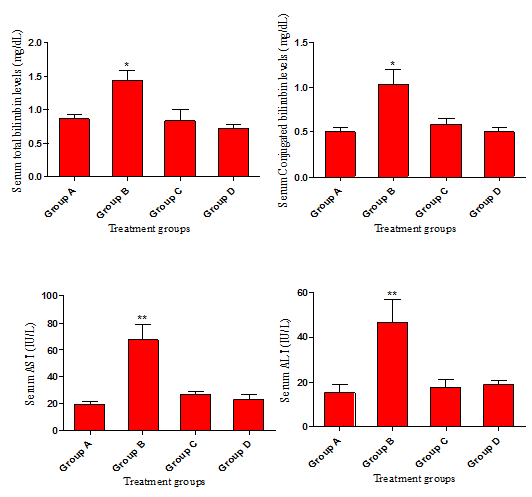
(*P˂0.05; **P<0.01) Figure 2: Comparison of liver biochemical concentrations in different experimental groups. The Histograms show serum total bilirubin and conjugated bilirubin, AST and ALT levels following experimental treatments. The preliminary data shows that tomato fruit extract significantly ameliorated the hepatotoxic effect of acetaminophen. The data are presented as mean±SEM of serum total bilirubin and conjugated bilirubin, AST and ALT levels for individual treatment. Statistical analyses were performed using the student’s t- test or ANOVA.
Figure 3: Comparison of ALP levels in different experimental groups. Histogram showing serum ALP levels following experimental treatments. The preliminary data shows that tomato fruit extract significantly reduced the elevated ALP levels induced by the hepatotoxicant, acetaminophen. The data are presented as mean±SEM of ALP levels for individual treatment. See Materials and Methods for experimental details. Statistical analyses were performed using the student’s t- test. (**P˂0.01).
Histopathological Result
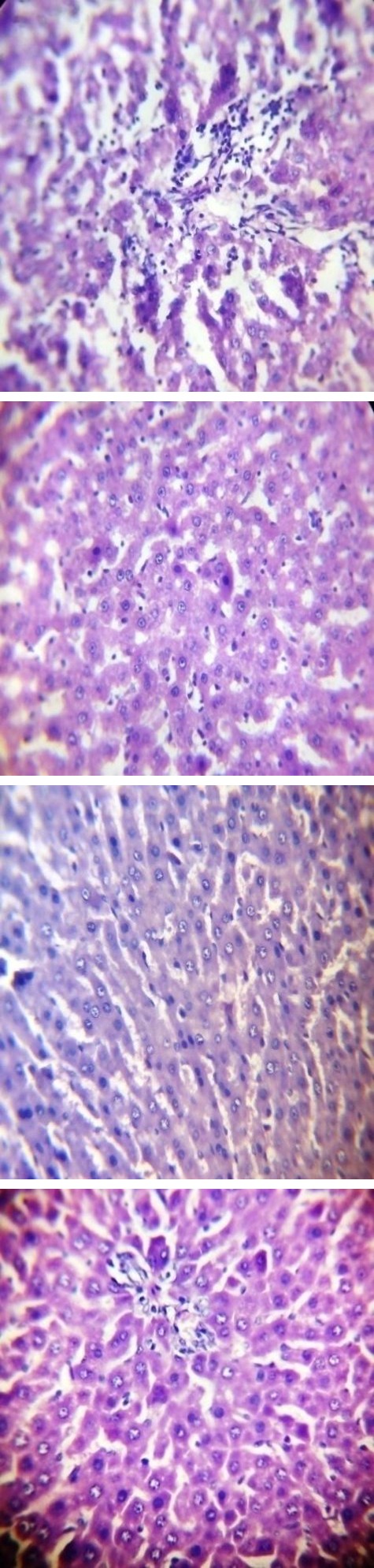
Microscopic examination of the liver isolated from the rat at sacrifice revealed no histopathological alteration in the control rats (Figure 4A). Presence of severe cell necrosis and severe hepatocellular parenchyma degeneration were observed in the liver of rats treated with intraperitoneal injection of acetaminophen (Figure 4B); however mild or no significant degenerations were observed in rats with post-administration and co- administration of tomato fruit extract separately (Figures 4C and 4D). The livers of rats in group C and D showed no significant histological alterations when compared with the control group.
(A)
(B)
(C)
(D) Figure 4(A-D): Histopathology and photomicrograph of liver from (A) normal control, (B) , acetaminophen treatment only, (C) post-treatment with tomato fruit extract and (D) co-treatment with tomato fruit extract [Stain: H and E; ×40]
Discussion
Liver is the major site for drug metabolism [9]. It metabolizes drug primarily by glucuronide and sulfate conjugation into inactive metabolites, which are easily excreted in urine. This metabolite can become very reactive and toxic when in higher amount than the glutathione can conjugate [17]. It is regrettably appalling the rate at which people consume drugs, especially over- the-counter drugs, without the knowledge of its toxic effect on the organ that metabolizes the drugs. Acetaminophen, also known as paracetamol, is one of the over-the-counter drugs. Under therapeutic dose, it is a good pain reliever. It is now preferred to aspirin, because of the Reye’s syndrome, therapeutic dose of aspirin causes in children. Thus, people consume paracetamol at free will whenever they notice slight headache or body pain. Actually, at therapeutic dose of acetaminophen, the liver glutathione (antioxidant) store is adequate. It conjugates the drug to ≈ 55% of inactive glucuronide metabolite and ≈ 30% inactive sulfate metabolite. Only ≈ 6% of the active metabolite, N- acetyl-P- benzoquinone imine (NAPQI) is produced. This reactive metabolite is rapidly conjugated and excreted through the urine before a significant injury or damage is done to the liver cells [17]. In an overdose, the glutathione available will not be enough to remove all the metabolites formed, excess NAPQI accumulates and causes a significant damage to liver cells. Rats in the negative control (Group B) are evidence to this. Acetaminophen (750mg/kg, i.p) administered to rats in this group resulted to abnormal increase in the liver enzymes markers; ALT, AST and ALP as shown in figures 2 and 3. This significant increase indicates damage to liver cells. The histological result (Figure 4B) concomitantly revealed severe liver cells damages. The active acetaminophen metabolite may have acted by depleting the glutathione (GSH), the liver antioxidant. This metabolite could also bind covalently to the proteins causing liver injury [5]. It is worthy of note that the physiological changes in animals and human are similar. Over the years, scientists have been researching on food products that possess protective effect against hepatotoxicity by various drugs. It was discovered that diet rich in natural antioxidants have potent effects against oxidative stress caused by hepatotoxic drugs [6, 9]. Phytochemical results revealed that tomato contains three major constituents: reducing sugar, alkaloids and flavonoid.
Flavonoids are antioxidants with the following mechanisms of action: scavenging the reactive oxygen species (ROS), suppressing ROS formation by inhibition of enzymes or by chelating trace elements involved in free radical generation. They also up regulate or protect the antioxidant defenses, which includes glutathione. It was proposed that one or more of these mechanism(s) could have contributed to the hepatoprotective effect of tomato as observed in this study [18]. Alkaloids are also possible antioxidants found in tomato but their mechanism of action has not fully been elucidated.
Conclusion
Oral administration of tomato extracts under acetaminophen challenge significantly protected the liver of albino rats from severe hepatic damage. The attenuating or protective action of tomato extract against hepatotoxicity by acetaminophen was evident in the extract’s ability to prevent further biochemical changes which are indicators of severe hepatotoxicity. Tomato fruits consumption may possibly be the safest treatment or management against any toxicity by drugs with similar mechanism of action as acetaminophen. Therefore, natural antioxidants in tomato possess the capacity of reducing the toxic effects of drug on liver hepatocytes.
Acknowledgement
The authors express deep sense of gratitude to Mr. Chris Ireoba, The head of department of the Laboratory Division at Eastern Nigeria Medical Centre, Enugu, and all the technical staff for their kind cooperation.
References
-
Wagner KH, Brath HA (2012) Global view on the development of non communicable diseases. Prev Med 54(Suppl): S38-S41.
-
Peralta IE, Knapp S, Spooner DM (2006) Nomenclature for wild and cultivation of tomatoes. Tomato Genetic Cooperative Report 56: 6-12.
-
Acquaah G (2002) Horticulture: Principles and Practices. New Jersey: Prentice Hall. ISBN 0130331252.
-
Sleisenger (2009) edited by Mark Feldman, Lawrence S, Lawrence J, Brandt; consulting editor, Marvin H. Sleisenger & Fordtran’s gastrointestinal and liver disease pathophysiology, diagnosis, management (PDF), 9th (Ed.), St Louis, Mo: MD Consult.
-
James LP, Mayeux PR, Hinson JA (2003) Acetaminophen – induced hepatotoxicity. Drug metab Dispos 31(12): 1499-1506.
-
Orji OC, Agu CE, Uchendu IK, Nsonwu AC, Offor JS (2016) Anti-diabetic and renal protective effect of the fruit juice of Citrus X Paradisi on alloxan induced diabetic male albino wistar rats. Der Pharmacia Lettre 8(19): 32-38.
-
Ikenna KU, Okechukwu SO, Chidozie EA, Oliver CO, Blessing EC, et al. (2016) Hypolipidaemic and renoprotective effects of glycine max (soy bean) against lipid profile and renal biochemical alterations in hypercholesterolemic rat. Int J Biomed Res 7(12): 822-828.
-
Kingsley UI, Steven OO, Agu CE, Orji OC, Chekwube BE, et al. (2017) Anti-hyperlipidemic effect of crude methanolic extracts of Glycine max (soy bean) on high cholesterol diet-fed albino rats. J Med Allied Sci 7(1): 34-40.
-
Ikenna KU, Chidozie EA, Oliver CO, Eluke BC, Ikechukwu JC, et al. (2017) Effect of Soy (Glycine max) Against Alcohol-Induced Biochemical Alteration in Liver of Male Albino Rat. Der Pharma Chemica 9(16): 115-119.
-
Uchendu IK, Orji OO, Agu CE (2017) Attenuation of glycerol-induced acute renal failure in albino rats by soy beans (Glycine max). International Journal of Chem Tech Research 10(12): 165-172.
-
Trease EG, Evans WC (1989) Pharmacognosy. 13th (Edn.), Philadelphia: Bailliere Tindall pp: 832.
-
American Physiological Society, World Medical Association (2002) Guiding Principles for research involving Animals and human beings. Am J Physiol Regul Integr Comp Physiol 283(2): R281-R283.
-
Malloy HT, Evelyn KA (1937) The determination of bilirub in with the photoelectric colorimetric method. Journal of Biological Chemistry 119: 481-490.
-
Reitman S, Frankel SA (1957) Colorimetric method for determination of serum glutamate oxaloacetate and glutamic pyruvate transaminase. Am Journal of Clinical Pathology 28(1): 56-58.
-
Kind PRH, King EJ (1954) Colorimetric method for determination of serum alkaline phosphatise. J Clin Path Pp: 322.
-
Baker FJ, Silverton RE, Pallister CJ (1998) Baker and Sylverton’s Introduction to Laboratory Technology. 7th Ed., Butterworth-Heinemann, Woburn, MA, USA pp: 448.
-
Tripathi KD (2008) Introduction, Routes of Drug Administration. Essential of Medical Pharmacology. JAYPEE Publisher pp: 4.
-
Halliwell B, Murcia MA, Chirico S, Aruoma OI (1995) Free radicals and antioxidants in food and in vivo: what they do and how they work. Crit Rev Food Sci Nutr 35(1-2): 7-20.
- Effects of 5-HTP and Melatonin on the Sleep Cycle of Medical Students
- Adsorption of Bisphenol A on NH4OH- Modified Rice Husk and Sugar Cane Bagasse Biochar
- Comparative Assessment of the Reinforcement Efficiency of Palm Fruit Fibre and Coconut Fibre in High Density Polyethylene (HDPE) Matrix Composite
- Importance of Bio Compounds Naturally Present in Food with Functionality in Animal Metabolism
- Sub-Acute Study on the Cardiotoxic Effects of Monosodium Glutamate Ingestion in Albino Rat
- Weight Management and Its Natural Solutions: A Review