
Overview of 3D Printing Technology
The pharmaceutical industry is advancing at an incredible rate. Novel drug formulations for targeted therapy have been developed all thanks to advances in modern sciences. Even so, the manufacturing sector of novel dosage forms is minimal, and the industry continues to rely on traditional drug delivery systems, particularly modified tablets. The use of 3D printing technologies in pharma companies has opened up new possibilities for printed products and device research and production. 3D Printing has slowly progressed from its original use as pre-surgical imaging templates and tooling molds to produce one-of-a-kind instruments, implants, tissue engineering scaffolds, testing platforms, and drug delivery systems. The most significant advantages of 3D printing technologies include the ability to produce small batches of drugs with custom dosages, forms, weights, and drug release profiles. The production of medicines in this manner could eventually contribute to the realization of the principle of personalized medicine. The biomedical industry and academia have also embraced 3D printing in recent years. It offers commercially available medical devices as well as a forum for cutting-edge studies in fields such as tissue and organ printing. This mini-review provides an overview of 3D printed technology in medicines
Introduction
Three-dimensional printing (3DP) is a growing industry that has simplified, made accessible, and inexpensive rapid prototyping and small-scale manufacturing, and is utilized in the aerospace, automobile, biomedical, dental, defense and industrial, commercial, and consumable sectors [1]. There are several possible applications for 3DP, including ophthalmology, which can significantly affect the way patients are being treated in the future for different conditions [2]. 3DP medical applications are increasingly expanding and the health care sector is expected to revolutionize. The implementation of 3DP in medicine will bring many advantages, for example, the development and personalization of medical devices, medicines, and appliances; economic efficiency; improved productivity; democratic architecture and production; and strengthened cooperation [3].
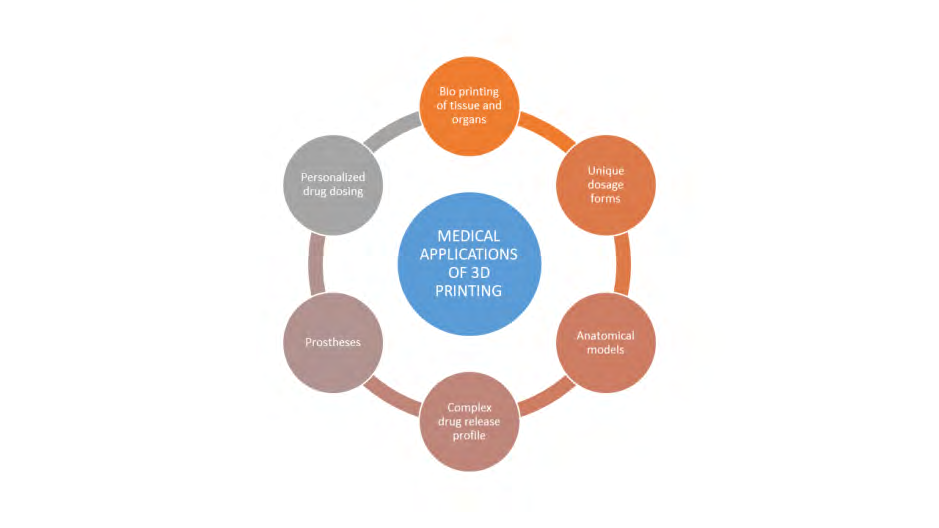
In a range of medical uses, including dentistry, anatomic models, medical instruments, tissue models and engineering skins, and medication formulations, 3DP technology is currently employed. To date, 3DP has been most commonly used for the dental market and the hearing aid industry. This may be because finished goods are small and need to be designed for patients, rendering these industries receptive to 3DP [4]. Figure 1 shows the different applications of the 3D printing technology.
3D Printing Procedure
First, an object’s simulated 3D modeling with applications of digital design, such as Onshape, Solidworks, Creo parametric, Autocad, Autodesk, etc.
The digital model is then modified to the electronic file format (.STL) that stands for stereolithography or standard tessellation language.
In terms of the surface of the 3D model (.STL) image, triangle facets provide detail.
The STL file has been transformed into G file, with the aid of specialized software slicer installed in a 3D printer which slices the design into a series of 2D horizontal cross-sections.
The printer head can now be shifted to the base of the 3D object in the x-y axis. The print head will now shift into the z-axis, sequentially deposit the layers of the content you like, thereby producing a full 3D object.
Maximum 3D printing technology numbers are file format compliant (STL). Few mistakes can arise when the 3D models are converted to a digital file. STL; tools such as Magics (Materialise) may be used to correct the mistakes during the conversion. STL has no detail about material type, color, texture, characteristics, and other characteristics [5].
Types of 3D Printing Technology
3DP technologies are the most widely used in medical applications. A short discussion continues on each of these technologies
Fused Deposition Modeling (FDM)
The method consists of selecting the Polymer you want that is melted and pushed into a cloud of moving heated dust. The polymer is layer by layer on a 3-axis (i.e. x-y-z) basis, which provides the exact structure of machine-assisted modeling models when solidified. This approach allows you to create several ways of dosing, such as implants, zero-order release tablets, etc [6].
Thermal Inkjet (TIJ) Printing
It heats the ink fluid using a micro-resistor to create a steam bubble that covers and forces the ink to drop out from the dust after expansion. Exempt drug preparation/solution is dispensed into 3D scaffolds and this technology can be used [7].
Selective Laser Sintering
The crushed material for printing new items is used in an SLS printer. A laser pulls the object outline into the powder and fuses it. Then a new powder layer is formed and the procedure is repeated one by one and builds each layer to create the product [3].
Challenge
Though 3D printing technology has shown promising results in the delivery of drugs, the technology is still under development. The issues include process optimization, improved efficiency for multi-use systems, selection of suitable excipients, post-treatment methods, etc., which need to be tackled to increase the performance of 3DP devices and expand the field of use of new drug delivery systems [8].
Conclusion
3DP in medicine can, in short, technique may be used to serve as a means to produce any kind of organ. In 3DP, the pharmaceutical industry may use a valuable and future medium that leads to customized medicines that address the needs of the patients. It provides many benefits, including increased cost efficiency and production speed. The usage of the customization of nutritional products, organs, and medicines 3DP is predicted to play an important role in this movement to personalized medicine. The manufacturing method has been revolutionized by 3DP. It increases the manufacture of new materials and decreases lead time and tooling costs. The impact of 3DP in medicine today, though, remains limited but it will become an incredibly advantageous technique.
Competing Interests
The author declared no competing of interest.
Funding
Not Applicable
References
-
Randolph SA (2018) 3D Printing, What are the hazards? Workplace Health & Safety 66(3): 164.
-
Schubert C, Langeveld MCV, Donoso LA (2014) Innovations in 3D printing: a 3D overview from optics to organs. Br J Ophthalmol 98(2): 159-161.
-
Ventola CL (2014) Medical Applications for 3D Printing: Current and Projected Uses. Pharmacy & Therapeutics 39(10): 704-711.
-
Liaw CY, Guvendiren M (2017) Current and emerging applications of 3D printing in medicine. Biofabrication 9(2): 024102.
-
Ali A, Ahmad U, Akhtar J (2020) 3D Printing in Pharmaceutical Sector: An Overview. Pharmaceutical Formulation Design-Recent Practices.
-
Hoy MB (2013) 3D Printing: Making Things at the Library. Medical Reference Services Quarterly 32(1): 94- 99.
-
Cui X, Boland T, Lima DDD, Lotz MK (2012) Thermal Inkjet Printing in Tissue Engineering and Regenerative Medicine. Recent Patents on Drug Delivery & Formulation 6(2): 149-155.
-
Maulvi FA, Shah MJ, Solanki BS, Patel AS, Soni TG, et al. (2017) Application of 3D Printing Technology in the Development of Novel Drug Delivery Systems. International Journal of Drug Development and Research 9: 44-49.
- Effects of 5-HTP and Melatonin on the Sleep Cycle of Medical Students
- Adsorption of Bisphenol A on NH4OH- Modified Rice Husk and Sugar Cane Bagasse Biochar
- Comparative Assessment of the Reinforcement Efficiency of Palm Fruit Fibre and Coconut Fibre in High Density Polyethylene (HDPE) Matrix Composite
- Importance of Bio Compounds Naturally Present in Food with Functionality in Animal Metabolism
- Sub-Acute Study on the Cardiotoxic Effects of Monosodium Glutamate Ingestion in Albino Rat
- Weight Management and Its Natural Solutions: A Review