
Guidelines on Fixed Dosage Combinations (FDCs): A Review
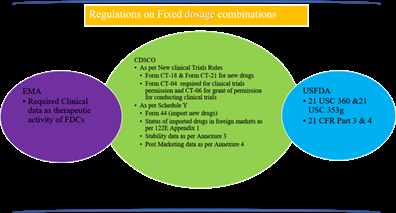
Combination products, also known as fixed dose drug combinations (FDCs), are a combination of two or more active pharmacological components. In the US, the Food and Drug Administration defines a "product" as "any combination of a drug and a tool or a biological product." Regulatory Bodies, such as CDSCO, have laid down various rules and regulations on FDCs and classify them into four different types based on their origin status and have laid down requirements for FDCs under schedule Y and New Clinical Trials Rules 2019 along with rules such as rule 80.
Introduction
Single-dose dosage forms that contain two or more active pharmacological components are known as combination products sometimes referred to as fixed dose drug combinations (FDCs). In the United States, the Food and Drug Administration defines a “product” as “any combination of a drug and a tool or a biological product.” Common wisdom holds that single compounds should be used to manufacture the majority of drugs. Regulatory Bodies plays vital role in improving patient’s health by enforcing stringent rules and regulation on new drug molecules but also on previously marketed drugs and fixed dosage combinations developed from previously marketed APIs or new drug molecules. In
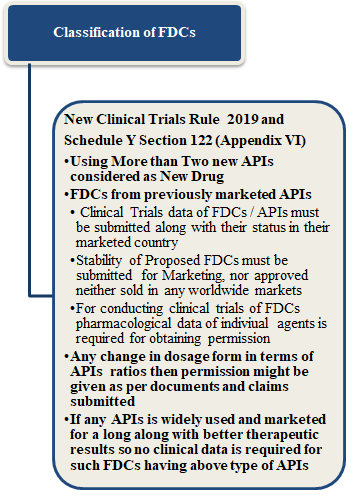
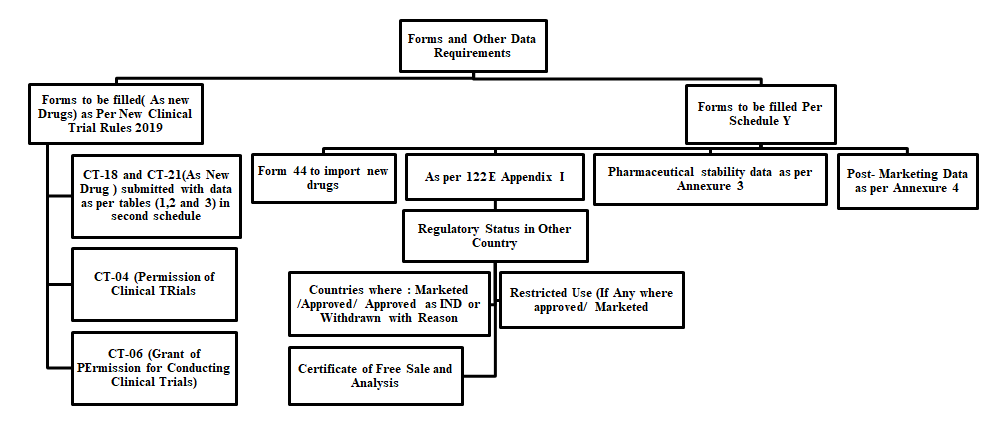
India CDSCO have laid down various rules and regulations on FDCs and classifying them into four different types on the basis of their origin status, whether the molecules used in FDCs formulation is previously marketed or not and their concentration in dosage forms (Figure 1), rules and regulations are amended processing of applications for Clinical Trials, review, approval, and follow-up until study completion, as well as evaluation of applications for final formulations approval, additional dosage form, modified dosage form, additional indication, additional strength, and additional method of administration for manufacture and marketing/import and marketing of FDCs. Such FDC developments are significant from the point of the general population’s health. Making “fixed dosage combination” medications has a pair of primary objectives: either to accordance with policy as well as to gain from the additional benefits of the two medications when taken together. When treating infectious disorders like HIV, malaria, and TB, when the administration of numerous antimicrobial drugs is customary, FDCs have shown to be very helpful. FDCs are helpful in treating chronic illnesses, particularly when many problems coexist. Mainly Schedule Y under rule 122 have covered forms and data requirement in appendix I item 9 while new clinical trials rule 2019 laid down fees (Table 1) and forms and other data requirement for manufacture/ sale/ import of FDCs in Figure 2 so far at least 1319 FDCs have been approved from 1961 to 2019 [1, 2, 3, 4].
| Form | Price (in Rupees) | |
|---|---|---|
| Rule 75 | Application for permission to import fixed dose combination having one or more of the ingredients as unapproved new molecules for marketing | 5,00,000 |
| Rule 75 | Application for permission to import fixed Dose combination having approved ingredients for marketing | 4,00,000 |
| Rule 75 | Application for permission to import fixed dose combination already approved for marketing | 2,00,000 |
| Rule 75 | Application for permission to import fixed dose combination for new claims, new indication or new dosage form or new route of administration or new strength for marketing | 3,00,000 |
| Rule 80 | Application for permission to manufacture fixed dose combination having one or more of the ingredients as unapproved new molecules for sale or distribution | 5,00,000 |
| Rule 80 | Application for permission to manufacture fixed dose combination having approved ingredients for sale or distribution | 3,00,000 |
| Rule 80 | Application for permission to manufacture fixed dose combination already approved for sale or distribution | 2,00,000 |
| Rule 80 | Application for permission to manufacture fixed dose combination for new claims, new indication or new dosage form or new route of administration or new strength for sale or distribution | 3,00,000 |
Table 1: Fees applicable on new clinical trial rules 2019 forms of FDCs.
Status of Fixed Dose Combinations in National List of Essential Medicines (NLEM) India and World Health Organisation (WHO) Essential Lists of Drugs
The National List of Essential Medicines of India (NLEM) 2015 contained 24 FDCs out of 376 entities, following thorough debate in national meetings, these FDCs were incorporated with scientific reasons [5]. The bulk of the FDCs on both lists are antimalarial, ant tubercular, and antiretroviral drugs, underlining the importance of FDC use in treatment adherence and the effectiveness of antiretroviral treatments Essentials list of drugs given by World Health Organisation (WHO) Essential drugs are those that address the population’s highest priority healthcare requirements and are created to be accessible in the shortest amount of time, in ample supply, and at a fair price. The list was created following a thorough analysis of medication effectiveness, safety, and comparative cost-effectiveness for each condition. Of the 414 drugs in the 19th WHO List of Essential Medicines, 27 are FDCs [6].
Materials and Methods
Guidelines and Regulations Regarding Safety and Efficacy Studies, required for Approval of FDCs
In India CDSCO have laid down various rules and regulations on FDCs and classifying them into four different types on the basis of their origin status, whether the molecules used in FDCs formulation is previously marketed or not and their concentration in dosage forms Figure 1, rules and regulations are amended processing of applications for Clinical Trials, review, approval, and follow-up until study completion, as well as evaluation of applications for final formulations approval, additional dosage form, modified dosage form, additional indication, additional strength, and additional method of administration for manufacture and marketing/import and marketing of FDCs. A marketing authorization will be granted for the FDC in line with Schedules Y, 122-D, 122-DA, and 122 E. According to Rule 122E of a D&C Regulations from 1945, this FDC has one or more active pharmaceutical ingredient(s) that are novel drugs that have not received Indian approval. Mainly Schedule Y under rule 122 have covered forms and data requirement in appendix I item 9 while new clinical trials rule 2019 laid down fees Table 1 and forms and other data requirement for manufacture/ sale/ import of FDCs in Figure 2 so far at least 1319 FDCs have been approved from 1961 to 2019 [1, 2, 3, 4]. FDCs are medications with documented safety and effectiveness in humans that combine active pharmacological components that have previously been approved or sold separately for a specific therapeutic claim. These medications are marketed internationally as FDCs.
FDCs are designated as new drugs, and CDSCO grants clearance after a thorough evaluation of evidence on rationale, safety, and efficacy. The State Licensing Authority (SLA) grants production and marketing authorisation based on this concept. In the past, SLAs awarded licences to produce and commercialise without seeking CDSCO’s approval. As a result, there is still controversy around the efficacy, safety, and logic of such FDCs. The fight against unreasonable FDCs
has stalled because to this “gap” between the CDSCO and SLAs. Combinations of NSAIDS/analgesics with antispasmodic agents also are available in Indian Markets.
Discussion and Conclusion
Fixed Dose Combinations are products that include more than two active pharmacological ingredients and are delivered as single dose forms. Several International Bodies- United States Food and Drug Administrations and European Medicines Agency along with National bodies like CDSCO (India) have laid down guidelines for Quality and Safe to Public health production of dosage combinations involving studies like pharmacodynamic and pharmacokinetics properties along with other toxicological studies evidenced by clinical data. Analgesics combinations with Antispasmodics play vital role in treatment of pains. Apart from its benefits such as synergistic impact with a single prescription, amnesia of so many medications, and prevention of drug resistance (chronic illnesses), it also has numerous problems such as pharmacodynamic and pharmacokinetic compatibility, drug- drug interactions, side effects, and inability to identify active moiety if adverse/side effects occur. In India DCGI a part of CDSCO have approved 1319 multiple dosage combination from 1961 to June 2019.
References
-
System of preliminary scrutiny by CDSCO at the time of receipt of application for approval of Fixed Dose Combinations (FDCs), pp: 1-23.
-
CDSCO (2013) Policy Guidelines for Approval of Fixed Dose Combinations (FDCs) In India, pp: 1-61.
-
CDSCO (2019) New Drugs and Clinical Trials Rule.
-
CDSCO (2018) List of Approved Fixed Dose Combinations.
-
(2015) National List of Essential Medicines.
-
WHO (2019) Model list of Essential Medicine. World Health organization.
- Effects of 5-HTP and Melatonin on the Sleep Cycle of Medical Students
- Adsorption of Bisphenol A on NH4OH- Modified Rice Husk and Sugar Cane Bagasse Biochar
- Comparative Assessment of the Reinforcement Efficiency of Palm Fruit Fibre and Coconut Fibre in High Density Polyethylene (HDPE) Matrix Composite
- Importance of Bio Compounds Naturally Present in Food with Functionality in Animal Metabolism
- Sub-Acute Study on the Cardiotoxic Effects of Monosodium Glutamate Ingestion in Albino Rat
- Weight Management and Its Natural Solutions: A Review