
Assessing the Effectiveness of Helfer Skin Tap Technique on Pain Reduction among Children Undergoing Intramuscular Vaccination in FLACC Numerical Pain Scale
Introduction: Intra muscular vaccination is complex technique used to deliver vaccines among children deep into the large muscles of the body. Pain at injection site is one of the most commonly-reported local reactions associated with administration of a vaccine. It is more painful when combination of more than two vaccines injected at a time among children. Pain management in invasive procedure is a challenge to the nurse. Hence, complementary therapy like Helfer skin tap technique has its own significance and provides a mechanical stimulation and distraction during intramuscular vaccination and thus helps to decrease pain as described by gate control theory which keeps the muscles relaxed while administering IM injection. Objective: A study to assess the effectiveness of Helfer skin taps technique on pain reduction among children undergoing intramuscular vaccination at district hospital Waidhan, Singrauli. Method: The study involved quasi experimental posttest only design with non-probability purposive sampling method. The data was collected from 60 Children’s undergoing intramuscular vaccination. Intervention: In Helfer skin tap technique Intramuscular vaccination is done by tapping to the injection site by using palmer aspect of the hand about three times and inserting the needle without the feeling of pain and removing the needle by tapping the area again three times. Tools: Standardized FLACC 0-10 numerical pain scale used to assess the pain reduction among children undergoing intramuscular vaccination. Results: The data collected was analyzed using descriptive and inferential statistics. The study shows using standard technique in control group 27 children had moderate pain (90%), 3 children had severe pain (10%) while in experimental group 17 had moderate pain (57%), 8 had severe pain (26%) and 5 had mild pain (17%). Analysis among experimental group by using paired‘t’ test found significant value 5.94 at p<0.05 level. The study shows that after the procedure observation intramuscular vaccination is less painful in experimental group as compare to control group among children. Interpretation & Conclusion: The study shows that Helfer skin tap technique was more effective on pain reduction undergoing intramuscular vaccination than the usual standard technique used among children.
Introduction
In healthcare sector nursing profession focuses on the care of individuals, families as well as communities, so that they can have better quality of life and can recover from unhealthy state to attain and maintain an optimal health. Nurses are responsible for developing a plan of care so as to work collaboratively with physicians, therapists and patient and their family along with other team members to treat and improve quality of life. There are various routes that are used to introduce drug or medication in patient’s body. The routes can be oral i.e. from mouth, intravenous i.e. by injecting in the veins or intramuscularly where it is injected in muscles. Injection can be given in spinal cord (intrathecal) or in the subcutaneous layer of skin. Some drugs administered through the rectum and vagina or by through eye, ear and nose. Few drugs are applied superficially on skin by cutaneous route or by transdermal patches for local and systemic response respectively [1, 2, 3]. In 2006 WHO said that “Intramuscular injection is an administration of medication parenterally through a skin puncture by a syringe and a needle deep into a large muscle of the body for prophylactic or curative purposes”.
Vaccination
Is the process of administration of a vaccine so that recipient develops immunity and gets protected from a disease. Vaccination is of major importance during childhood so that growing children gets protected from different diseases. Anterolateral thigh muscles are selected as site of administration of Intramuscular vaccine in infants and toddlers. Position of vastus lateralis muscle is between mid- to upper-thigh regions in the outer part of leg. For adults and children deltoid muscle is selected for intra- muscular injection. Deltoid is approximately 3 fingers down to acromion. Though intramuscular injection is most common route administration for vaccine still it is one of the complex technique as it is associated with pain at the site of injection which becomes the major source of distress for patients especially children. For children and adults pain is a common and ubiquitous form of sensation. It occurs due to tissue damage and everyone has their individual perception of pain [4, 5].
According to WHO, 12 billion injection are given in a year out of that around 5% is for the purpose vaccination of children. Helfer skin tap technique is used while intramuscular injection. Helfer skin tap technique is based on the concept that mechanical stimulation of muscle fibers of larger diameter decreases the impact or influence of small fibers that carry pain. Tapping the muscles not only helps the muscles to relax but also helps the nurse to synchronize the insertion of needle with tapping on the count of three and that eventually standardize the technique. Management of pain is an integral part of nursing. It is the responsibility of nurse to manage pain of patient effectively. During the time of intramuscular injection nurse can minimize pain by helping patient to have a proper position and by implementing of physical and psychological intervention [6, 7].
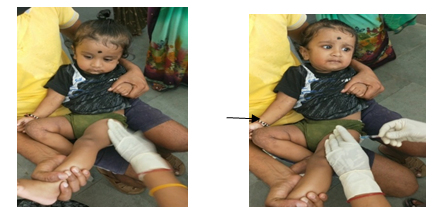
Helfer skin tap technique Intramuscular vaccination is done by tapping to the injection site by using palmer aspect of the hand about three times and inserting the needle without the feeling of pain and removing the needle by tapping the area again three times. It is a technique in which the researcher taps the Dorso gluteal muscle by counting 1-15 with the palmar aspect of fingers (non-dominant hand) in rhythmic manner before inserting the injection intra muscularly at 90 degree and remove the needle quickly again by tapping and counting 1-3. This study Helfer skin Tap technique refer to the taping skin several times with the palmer aspect of the fingers of the dominant hand for approximately five seconds to relax the muscle on injection site with three time tap during inserting and removing of injection [8]. The mechanism of Helfer skin tap technique is Gate Control Theory. In this technique, rhythmic tapping before and during injection over the skin at the site of injection keeps the muscle relaxed and stimulates large diameter fibers. As per the gate control theory described by Roger Metzack and Past Wall, this technique provides a mechanical stimulation as well as distraction during administration of IM injection, thereby helping in the reduction of pain. In this technique while doing tapping before intramuscular injection the nervous system will shut down the sensory gate and the pain sensation of the injection will not reach the brain. So the injection pain goes unnoticed [9].
Need of the Study
Sensation of pain is a common for children and adult. Everybody has their own perception of pain. During hospitalization Injections is of the most common painful medical procedure. Injections become the reason for iatrogenic pain. As there is a steady increase in numbers of recommended injections, there is also increase in concern about the adequacy of pain management. ‘Do not harm’ is the fundamental principle of responsibility of an healthcare professional and they are committed in preventing harm to their patients as it a major source of distress for patients and their families as well as health care providers.
The main purpose of study is to identify effectiveness of Helfer skin tap technique in pain reduction among children during intramuscular vaccination. Then, compare Helfer skin tap technique with traditional technique of pain reduction during Intramuscular vaccination. After comparison, finding of effective method to minimize pain during intramuscular vaccination among children and at last finding of an effective technique for nurses to manage pain in patients in their daily practice.
Objectives
- To assess the pain level of children during intramuscular vaccination with usual standard technique.
- To assess the pain level of children during intramuscular vaccination with Helfer skin tap technique.
- To compare the pain level of children during intramuscular vaccination with and without the use of Helfer skin tap technique.
- To find out the association between the level of pain perception with the selected socio- demographic variables of experimental group.
Hypothesis
H1: There is a significant difference in pain score of the children receiving intramuscular vaccination in experimental and control group. H01: There will be no significant differences in pain score of the children receiving intramuscular vaccination in experimental and control group. H2: There is a significant association between the levels of pain perception with the selected socio- demographic variables of experimental group. H02: There will be no significant association between the levels of pain perception with the selected socio- demographic variables of experimental group.
Research Methodology
Research methodology comprises of research approach, research design, setting of the study, population, criteria for selection of sample, sample size, sampling technique, description of tool, scoring procedure, pilot study, data collection procedure, plan for data analysis and protection of human rights (Figure 1).
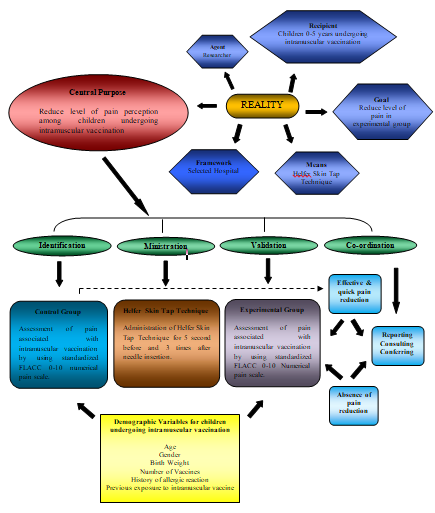
Research Approach
The research approach employed for this study was quantitative approach to evaluate the effectiveness of Helfer skin tap technique on pain associated with intramuscular vaccination among children.
Research Design
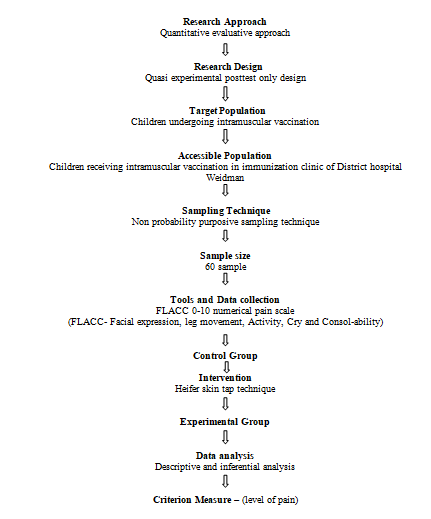
In present study, quasi experimental posttests only design was employed to assess the pain of children during Intramuscular vaccination. It is composed of two randomly assigned groups, i.e., experimental and control but neither of which is pretested before the implementation of treatment. Treatment is implemented on the experimental group only but posttest observation is carried out on both the groups to assess the effect of manipulation [10]. The diagrammatic representation of the research design given as follows (Figures 2 & 3).

Variables
A variable is defined as an attribute of a person or object that varies that is takes on different values. Variables are measurable characteristics of a concept and consist of logical group of attributes [11].
Dependent Variable
Dependent variable is hypothesized to depend on (or) been caused by another variable. In present study the dependent variable is the level of pain associated with intramuscular vaccination among children [12].
Independent Variable
Independent variable is that which is manipulated and it intends to cause a change in the dependent variables. In this study the independent variable is Helfer skin tap technique [13].
Setting of the Study
The study was conducted at district hospital Waidhan which is situated in Singrauli District in Madhya Pradesh (India). This hospital is Government hospital with the capacity of 200 beds with different departments like pediatric ward and SNCU, immunization clinic, medical surgical, gynecology, orthopedics, psychiatric and OT and a well- equipped laboratory. On daily basis outpatient and inpatient department register about 500 and 70 cases respectively.
Population
The target population is the aggregation of cases about which the researcher would like to make generalization. An accessible population is the section of the target population to which the researcher has reasonable access [14]. In this study the target population is children undergoing intramuscular vaccination. The accessible population is children undergoing intramuscular vaccination in district hospital Waidhan, Singrauli (M.P).
Sampling Technique
The sample of the study was selected by adopting Non
Scoring Procedure: Table 1
probability purposive sampling technique.
The total sample size was 60 and they were selected based on inclusion criteria.
Criteria for Sample Selection
The study includes
- The children age up to 5 yr.
- The children who are receiving intramuscular vaccine.
- The children (parents) who are willing to co-operate in the study.
- The children who are available at the time of study.
- Both male and female children are included in the study.
Development of the Tool
Treece and Treece (1986) emphasized that the instrument selected for research should as far as possible be the vehicle that could best obtain data for drawing conclusion pertinent to the study. The research tool was developed in English after an extensive review of literature and expert opinion. It was translated into Hindi by language expert. The standardized FLACC 0-10 numerical pain scale was used as the instrument to measure the pain [15].
Description of tool
Part A: It consist of demographic data of children receiving intramuscular vaccinate that includes age, gender, birth weight, history of allergic reaction due to intramuscular vaccine, number of vaccine, Previous exposure to intramuscular vaccine.
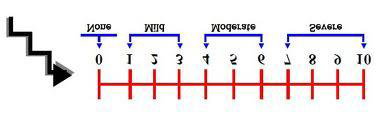
Part B: To maintain record and easy application of FLACC scale video recording of the procedure is done. It consisted of standardized FLACC 0-10 numerical pain scale. It is a standardized numerical scale used to assess the level of pain in children between the ages of 2 months and 7 years. It consists of 0 to 10 scores and four categories ‘0’ representing no pain, 1-3 represents mild pain, 4-6 represents moderate pain and 7-10 represents severe pain. The scale has five criteria (FLACC), which are each assigned a score of 0, 1 or 2 [16].
| Criteria | Score 0 | Score 1 | Score 2 |
|---|---|---|---|
| Face | No particular expression or smile | Occasional grimace or frown, withdrawn, disinterested | Frequent to constant quivering chin, clenched jaw |
| Legs | Normal position or relaxed | Uneasy, restless, tense | Kicking, or legs drawn up |
Table 1: Score to assess the level of pain among children undergoing intramuscular vaccination.
- Activity
- Lying quietly, normal position, moves easily squirming, shifting, back and forth, tense
- Arched, rigid or jercking
- Cry
- No cry (awake or asleep)
- Moans or whimpers, occasional complaint
- Crying steadily, screams or sobs, frequent complaints
- Consolability
- Content, relaxed
- Reassured by occasional touching, hugging or being talked to, distractible
- Difficult to console or comfort
Table 2: Score to assess the level of pain among children undergoing intramuscular vaccination.
The FLACC scores range from 0 to 10 and are interpreted as follows Figure 4 0 - Relaxed and comfortable, no pain 1-3 - Mild discomfort 4-6 - Moderate pain 7-10 - Severe discomfort/pain
Validity
In this study five experts in nursing and two experts in pediatric has evaluated the content validity of the instrument.
Reliability
An instrument can be considered reliable if it yields similar results on separate occasions. In this study standardized FLACC 0-10 numerical pain scale was used to assess level of pain associated with intramuscular vaccination, is a reliable tool.
Pilot Study
Pilot Study is a small-scale version or trial run of the major study. The purpose of the pilot study was to find out the feasibility of the study, clarity of Language of tool. The pilot study was conducted in Vindhya Hospital, NTPC Vindhyanagar, Singrauli (M.P).
Pilot study was conducted on 26-08-2020. After taking consent from the Chief Medical Officer and HOD of Pediatrics of hospital, the investigator selected 10 samples of children at Vindhya Hospital. The study was done to assess the effectiveness of Helfer skin tap technique on pain reduction undergoing intramuscular vaccination by taking first 5 children as a control group and next 5 as an experimental group after taking consent from their parents.
The purpose of the study was explained to each of the parent and a written consent was obtained from them. Data Analysis was done using descriptive and inferential statistics. After the pilot study the tools were found to be feasible, practicable and acceptable. No modification was made in the tools or in the study assigned. The researcher proceeded for the main study.
Data Collection
The data collection procedure was done for a stipulated period of 4 weeks in District Hospital Waidhan, Singrauli. Permission to conduct the study was obtained from the Civil Surgeon of the hospital. The samples were informed by the researcher about the nature and the purpose of the study. The informed written consent was obtained as per rule on the 1st day. By following purposive sampling technique the sample were selected as experimental and control group. 1st 30 samples assigned as experimental group and applied Helfer skin taps technique during the vaccination procedure. The procedure was observed and video recorded and pain assessment had been done by using the FLACC scale by the researcher. Next 30 samples were assigned as control group. For the control group, routine procedure was carried out & procedure was observed or video recorded and pain assessment had been done by using FLACC scale by the researcher.
Plan for Data Analysis
The demographic variables were analyzed by using descriptive measures (frequency and percentage).The pain was analyzed by using descriptive statistics (mean, standard deviation). The effect of Helfer skin taps technique on pain associated with intramuscular vaccination was analyzed by using paired test. Association between pain associated with intramuscular vaccination and the selected demographic variables were analyzed by using chi square test [17].
Protection on Human Rights
The study was conducted after the approval of ethical committee in District hospital Waidhan. The nature and The Variable of Age Table 2 purpose of the study was explained to the care personnel involved. The informed written consent was obtained from the study participants. The anonymity of the sample was maintained throughout the study.
Result and Discussion
Data on Demographic Variables of Children Under Going Intramuscular Vaccination
This section deals with the data pertaining to the sample characteristics of the subjects. It is presented and analyzed in terms of frequency and percentage distribution. It shows the distribution of sample characteristics with respect to subject’s age, gender, birth weight, history of allergic reaction due to intramuscular vaccination previously, number of vaccines and previous exposure to intramuscular vaccine regarding pain level in children undergoing intramuscular vaccination.
| N=60 | |||
|---|---|---|---|
| Demographic Variable | Category | Children’s | |
| Frequency | Percentage (%) | ||
| Age Group (In Years) | 0-1 (Infants) | 50 | 83 |
| 1-3 (Toddlers) | 9 | 15 | |
| 3-5 (Preschoolers) | 1 | 2 |
Table 3: Frequency and Percentage distribution of children by age.
In this table, regarding age study shows 50 (83%) are infants belonged to the age group of 0-1 year, 9 (15%) are toddlers belonged to the age group of 1-3 years and 1 (2%) is preschooler belonged to the age group of 3-5 years. Hence it was interpreted that most of the children selected in this study are infants (Table 2).
The Variable of Gender
In this table, regarding gender study shows 35 (58%) of children who undergoing intramuscular vaccination were males and 25 (42%) were females. Hence it was interpreted that male children are more than female children’s (Table 3).
| N=60 | |||
|---|---|---|---|
| Demographic Variable | Category | Children’s | |
| Frequency | Percentage (%) | ||
| Gender | Male | 35 | 58 |
| Female | 25 | 42 | |
| N=60 | |||
| Demographic variable | Category | Children’s | |
| Frequency | Percentage (%) | ||
| Birth Weight | 2-3 Kg | 30 | 50 |
| 3-4 Kg | 30 | 50 |
Table 4: Frequency and Percentage distribution of children’s by gender.
The Variable of Birth Weight Table 4
Regarding birth weight of children, study shows 30 (50%) of children are belonged in between 2-3 Kg and 30 (50%) are belonged in between 3-4 Kg. Hence it was
The Variable of Number of Vaccines Table 5
interpreted that the weight of half children are belonged in between 2-3 kilograms and half are belonged in between 3-4 kilograms after the birth (Table 4).
| N=60 | |||
|---|---|---|---|
| Demographic variable | Category | Children’s | |
| Frequency | Percentage (%) | ||
| Demographic variable | Single vaccine | 4 | 7 |
| Combination of two vaccine | 39 | 65 | |
| Combination of three | 17 | 28 | |
| Combination of more than three | 0 | 0 |
Table 5: Frequency and Percentage distribution of children by numbers of vaccine injected at a time during vaccination.
Majority of children 39 (65%) had intramuscular vaccination with the combination of two vaccines at a time, 17 (28%) had vaccination with combination of three vaccines at a time, 4 (7%) had vaccination with single vaccine and no children had vaccination with combination of more than three vaccines. Hence it was interpreted that most of children had intramuscular vaccination with combination of two vaccines (Table 5).
The Variable of previous exposure to Intramuscular Vaccine Table 6
| N=60 | |||
|---|---|---|---|
| Demographic variable | Category | Children’s | |
| Frequency | Percentage (%) | ||
| Previous exposure to Intramuscular vaccine | Yes | 35 | 58 |
| No | 25 | 42 |
Table 6: Frequency and Percentage distribution of children by previous exposure to intramuscular vaccine.
Regarding previous exposure to intramuscular vaccine to children, study shows 25 (42%) was not previously exposed to intramuscular vaccine and 35 (58%) was previously exposed to intramuscular vaccine before this vaccination.
Hence it was interpreted that most of the children was previously exposed to intramuscular vaccine before this study (Table 6).
Data on Level of Pain Associated with Intramuscular Vaccination among Children of Control Group Table 7 & Figure 5
| N=60 | |||
|---|---|---|---|
| S.No | Level of Pain | Frequency (f) | Percentage (%) |
| 1 | No pain | 0 | 0 |
| 2 | Mild pain | 0 | 0 |
| 3 | Moderate pain | 3 | 10 |
| 4 | Severe pain | 27 | 90 |
Table 7: Frequency and percentage distribution of control group for pain associated with intramuscular vaccination among children
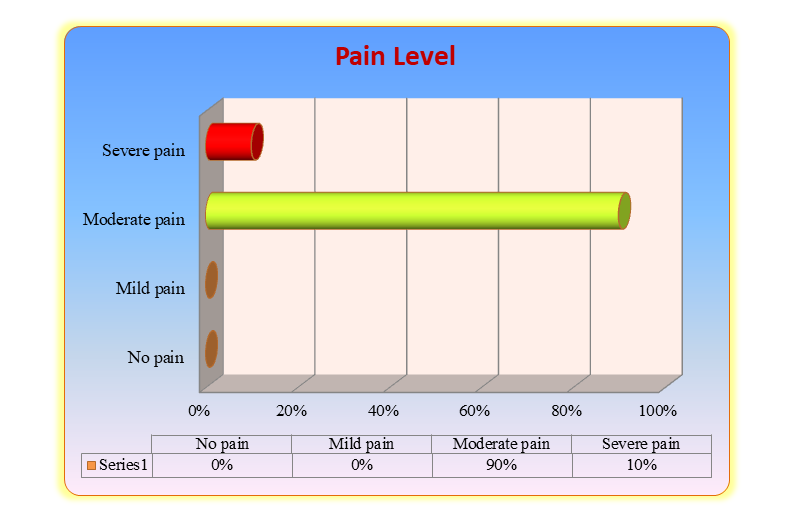
The above table and figure shows that among 30 children of control group, 90% had moderate pain and 10% had severe pain during intramuscular vaccination.
Data on Level of Pain Associated With Intramuscular Vaccination among Children of Experimental Group Table 8 & Figure 6
| N=30 | |||
|---|---|---|---|
| S.No | Level of Pain | Frequency (f) | Percentage (%) |
| 1 | No pain | 0 | 0 |
| 2 | Mild pain | 5 | 16.66 |
| 3 | Moderate pain | 17 | 56.66 |
| 4 | Severe pain | 8 | 26.66 |
Table 8: Frequency and percentage distribution of experimental group for pain associated with intramuscular vaccination among chi
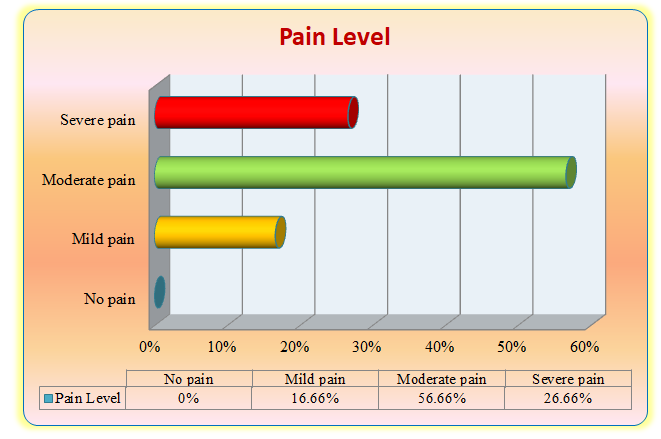
The above table and figure shows that among 30 children of experimental group, 57% had moderate pain, 26% had severe pain and 17% had mild pain during intramuscular vaccination.
Data on effectiveness of Helfer skin tap technique on pain associated with intramuscular vaccination among children
This section deals with the analysis and interpretation of the data in order to evaluate the effectiveness of the Helfer skin tap technique on pain associated with intramuscular vaccination among children comparing the control group and experimental group score (Table 9, Figures 7 & 8).
In the above table, study shows the experimental group mean score (5.36 ± 2.3) was apparently lower than the control group mean score (8.4 ± 1.49) which reveals that there was decrease in pain level by using Helfer skin tap technique associated with intramuscular vaccination among children of experimental group. The calculated mean difference was 3.04 and the obtained‘t’ value 5.94 (P<0.05) shows that there was a significant difference between control group and experimental group. Hence, this study found to be effective.
| S.No | Items | Point Score | |||||
|---|---|---|---|---|---|---|---|
| Control group | Experimental group | t value | p value | ||||
| Mean | S.D | Mean | S.D | ||||
| 1 | Face | 1.9 | 0.3 | 1.13 | 0.56 | 6.48 | p < 0.05 |
| 2 | Legs | 1.76 | 0.42 | 1.03 | 0.75 | 4.58 | p < 0.05 |
| 3 | Activity | 1.56 | 0.49 | 0.83 | 0.63 | 4.89 | p < 0.05 |
| 4 | Cry | 1.86 | 0.33 | 1.4 | 0.55 | 3.87 | p < 0.05 |
| 5 | Consolability | 1.3 | 0.52 | 0.96 | 0.4 | 2.7 | p < 0.05 |
| 6 | Total Pain | 8.4 | 1.49 | 5.36 | 2.3 | 5.94 | p < 0.05 |
| Mean difference – 3.04 | |||||||
| Significant at p < 0.05 level |
Table 9: Mean, Standard Deviation and ‘t’-value on control group & experimental group level of pain associated with intramuscular
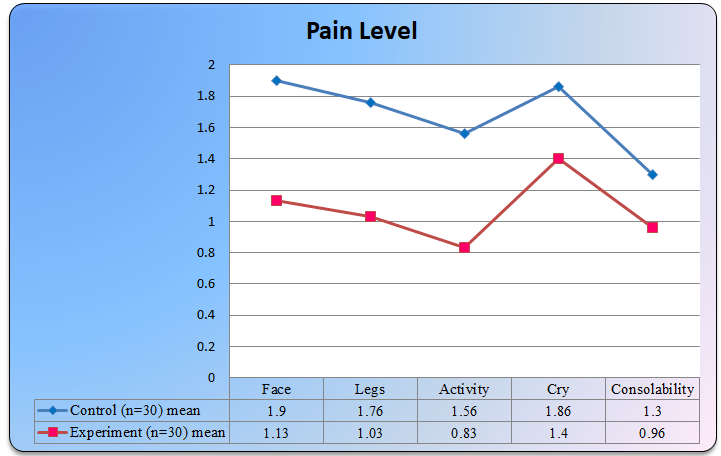
This figure shows, the experimental group line of mean score was lower than the control group line of mean score on the basis of different standardized FLACC criteria. The mean found to be in control group is facial expression (1.9 ± 0.3), legs movement (1.76 ± 0.42) , activity (1.56 ± 0.49), cry (1.86 ± 0.33) and Consolability (1.3 ± 0.52). On other hand average mean found to be in experimental group is facial expression (1.1 ± 0.56), legs movement (1.03 ± 0.75), activity (0.83 ± 0.63), cry (1.4 ± 0.55) and Consolability (0.96 ± 0.40) on the basis of scoring. This reveals that there was decrease in pain level by using Helfer skin tap technique associated with intramuscular vaccination among children in experimental group as compared to control group [18].
Data on association between pain perceptions with intramuscular vaccination among children with their selected demographic variables Table 10
| N=60 | ||||||||
|---|---|---|---|---|---|---|---|---|
| S.No | Demographic Variables | Level of Pain | χ2 Value | |||||
| Mild | Moderate | Severe | ||||||
| f | % | f | % | f | % | |||
| 1 | Age (In Years) (a) Infants 0-1 Years (b) Toddlers 1-3 Years (c) Preschoolers 3-5 Years | 4 0 1 | 6.6 0 1.6 | 19 1 0 | 31.6 1.6 0 | 27 8 0 | 45 13.3 0 | 15.0* df-4 p-.005 |
| 2 | Gender (a) Male (b) Female | 3 2 | 5 3.3 | 10 10 | 16.6 16.6 | 22 13 | 36.6 21.6 | 0.87** df-2 p-0.647 |
| 3 | Birth Weight (a) 2-3 Kg (b) 3-4 Kg | 3 2 | 5 3.3 | 10 10 | 16.6 16.6 | 17 18 | 28.3 30 | 0.22** df-2 p-0.892 |
| 4 | History of allergic reaction due to intramuscular vaccination previously (a) Yes (b) No If Yes, specify | 0 5 | 0 8.3 | 0 20 | 0 33.3 | 0 35 | 0 58.3 | 0** df-1 p-1 |
| 5 | Number of vaccines (a) Single vaccine (b) Combination of two vaccine (c) Combination of three vaccine (d) Combination of more than three | 1 4 0 0 | 1.6 6.6 0 0 | 3 11 6 0 | 5 18.3 10 0 | 0 24 11 0 | 0 40 18.3 0 | 7.84** df-6 p-0.248 |
| 6 | Previous exposure to intramuscular vaccine (a) Yes(b) No | 2 3 | 3.3 5 | 11 9 | 18.3 15 | 22 13 | 36.6 21.6 | 1.08** df-2 p-0.583 |
* Significant Not Significant Table 10**: Frequency, percentage and χ2 distribution on level of pain associated with intramuscular vaccination among children with their selected demographic variables.
Table 10 shows the substantive summary of chi square analysis which was used to bring out the relationship between the levels of pain associated with intramuscular vaccination among children with their selected demographic variables.
With regard to age, among infants 0-1 year 4 (7%) had mild pain, 19 (32%) had moderate pain and 27 (45%) had severe pain. Among toddlers 1-3 years, 1 (2%) had moderate pain and 8 (13%) had severe pain. Among preschoolers 3-5 years none of them had moderate and severe pain but 1 (2%) had mild pain. The obtained chi square value of 15.0 was significant at p < 0.05 level thus stated hypothesis is supported. So it is inferred that there is a significant association between the age and level of pain associated with intramuscular vaccination among children. With regard to gender, among males 3 (5%) had mild pain, 10 (17%) had moderate pain and 22 (37%) had severe pain. Among females 2 (3%) had mild pain, 10 (17%) had moderate pain and 13 (22%) had severe pain. The obtained chi square value of 0.87 was not significant at p < 0.05 level thus stated hypothesis is not supported. So it is inferred that there is no significant association between the gender and level of pain associated with intramuscular vaccination among children.
With regard to birth weight, among children birth weight between 2-3 kg 3 (5%) had mild pain, 10 (17%) had moderate pain and 17 (28%) had severe pain. Among children birth weight between 3-4 kg 2 (3%) had mild pain,
10 (17%) had moderate pain and 18 (30%) had severe pain. The obtained chi square value of 0.22 was not significant at p < 0.05 level thus stated hypothesis is not supported. So it is inferred that there is no significant association between the birth weight and level of pain associated with intramuscular vaccination among children.
With regard to history of allergic reaction due to intramuscular vaccination previously, none of them have allergic reaction due to intramuscular vaccination previously are present. Among children who are not having allergic reaction previously 5 (8%) had mild pain, 20 (33%) had moderate pain and 35 (58%) had severe pain. The obtained chi square value 0 was not significant and thus the stated research hypothesis is not supported. So it is inferred that there is no significant association between history of allergic reaction due to intramuscular vaccination previously and level of pain associated with intramuscular vaccination among children’s [19].
With regard to number of vaccines injected, among children injected with single vaccine 1(2%) had mild pain, 3(5%) had moderate pain and none of them had severe pain. Among children injected with combination of two vaccines 4(7%) had mild pain, 11(18%) had moderate pain and 24(40%) had severe pain. Among children injected with combination of three vaccines 6(10%) had moderate pain, 11(18%) had severe pain and none of them had mild pain. None of the any children injected with combination of more than three vaccines. The obtained chi square value of 7.84 was not significant at p < 0.05 level thus stated hypothesis is not supported. So it is inferred that there is no significant association between the number of vaccines injected and level of pain associated with intramuscular vaccination among children’s.
With regard to previous exposure to intramuscular vaccine, among children who are having previous exposure to intramuscular vaccination 2(3%) had mild pain, 11(18%) had moderate pain and 22 (37%) had severe pain. Among children who are not having previous exposure to intramuscular vaccination 3(5%) had mild pain, 9(15%) had moderate pain and 13(22%) had severe pain. The obtained chi square value 1.08 was not significant and thus the stated research hypothesis is not supported. So it is inferred that there is no significant association between previous exposure to intramuscular vaccine and level of pain associated with intramuscular vaccination among children.
At last, it was concluded that there is a significant association between levels of pain among children undergoing intramuscular vaccination with their selected demographic variable of age. There is no significant association between level of pain among children undergoing intramuscular vaccination with their selected demographic variables such as gender, birth weight, history of allergic reaction due to intramuscular vaccination previously, number of vaccines injected and previous exposure to intramuscular vaccine.
Discussion
The first objective was to assess the pain level of children during intramuscular vaccination with usual standard technique. The study shows using standard technique in control group 27 children had moderate pain (90%), 3 children had severe pain (10%) and none of them had mild pain. The study revealed that after the procedure observation shows that intramuscular vaccination is painful and high prevalence of pain associated with intramuscular vaccination procedure.
The second objective was to assess the pain level of children during intramuscular vaccination with Helfer skin tap technique. The study shows using Helfer skin tap technique in experimental group 17 had moderate pain (57%), 8 had severe pain (26%) and 5 had mild pain (17%). The study shows that after the procedure observation intramuscular vaccination is less painful in experimental group as compare to control group among children.
The third objective was to compare the pain level of children during intramuscular vaccination with and without the use of Helfer skin tap technique. In control group, facial expression mean was 1.90 (S.D- 0.3), legs movement mean was 1.76 (S.D-0.42), activity mean was 1.56 (S.D- 0.49), cry mean was 1.86 (S.D- 0.33) and Consolability mean was 1.30 (S.D- 0.52). In experimental group, facial expression mean was 1.13 (S.D- 0.56), legs movement mean was 1.03 (S.D- 0.75), activity mean was 0.83 (S.D- 0.63), cry mean was 1.40 (S.D- 0.55) and Consolability mean was 0.96 (S.D- 0.40). The mean difference was 3.04. The obtained t value 5.94 was significant at p < 0.05 level. Thus the stated hypothesis is accepted. The study revealed that the overall mean pain intensity by using Helfer skin tap technique was much lower than the pain level by the standard technique [20]. The study shows that Helfer skin tap technique is effective on pain reduction among children undergoing intramuscular vaccination and concluded that helfer skin tap technique is an effective method to reduce procedural pain.
The fourth and last objective was to find out the association between the levels of pain perception with the selected socio- demographic variables of the experimental group. The study revealed that there is only significant association between the levels of pain reduction among children undergoing intramuscular vaccination with their selected demographic variables such as age. There is no significant association between level of pain reduction among children undergoing intramuscular vaccination with their selected demographic variables such as gender, birth weight, history of allergic reaction due to intramuscular vaccination previously, number of vaccines injected and previous exposure to intramuscular vaccines. The study concluded that the age appears to be the only major factor that influences the pain of intramuscular vaccination and there were no correlation between genders, birth weight, history of allergic reaction due to intramuscular vaccination previously, number of vaccines injected at a time and previous exposure to intramuscular vaccine [21, 22, 23].
Hence, the study shows that Helfer skin tap technique was more effective on pain reduction undergoing intramuscular vaccination than the usual standard technique used among children.
Conclusion
The conclusion drawn from the study based on the assessment of the effectiveness of Helfer skin tap technique on pain reduction among children undergone intramuscular vaccination at selected district hospital Waidhan, Singrauli (M.P). After detail analysis of the study findings and experience of the investigator, this study leads to the following conclusion.
The experimental group mean score (5.36) (S.D - 2.3) was apparently lower than the control group mean score (8.4) (S.D - 1.49) which reveals that there was decrease in pain level by using Helfer skin tap technique associated with intramuscular vaccination among children of experimental group. The calculated mean difference was 3.04 and the obtained‘t’ value 5.94 (P<0.05) shows that there was a significant difference between control group and experimental group. Hence, this study found to be effective.
Acknowledgements
The authors are grateful to Dr. Vijaya K (MBBS, MD), Assistant Chief Medical Officer of Vindhya hospital, NTPC Vindhyanagar for conducting pilot study and Dr. M.K. Jain (MBBS, MD) Civil Surgeon of district hospital waidhan for giving permission to complete the research study. I would like also thanks to Mr. Joel Patrick, Principal, J.N.M Nursing College, Lakhimpur, (Bihar), Mrs. Sharanjeet Kaur, Associate Professor, SINR, Rewa (M.P) and Mrs. Anjana Patel, Nursing Tutor, Govt. College of Nursing, Rewa (M.P) for tool validation.
References
-
Taddio A, Ilersich AL, Moshe I, Kikuta A, Shah V, et al. (2009) Physical interventions and injection techniques for reducing injection pain during routine childhood immunizations: systematic review of randomized controlled trials and quasi-randomized controlled trials. Clin Ther 31(2): 48-76.
-
Therese M, Devi S (2014) Effectiveness of Helfer Skin Tap Technique and Routine Technique on Pain Reduction among Patients Receiving Intramuscular Injection at Government General Hospital, Puducherry. International Journal of Science and Research 3(10): 1446-1449.
-
Baxter JA (2007) Helfer skin tap technique and intramuscular injection. Indian Journal of Holistic Nursing 10(1): 67-70.
-
Carlos P (2010) Helfer skin tap - A Nursing Practice. Journal of Alternative and Complementary Medicine 6(1): 16-20.
-
Chaudhari H, Vageriya V (2018) Assess the Effectiveness of Helfer Skin Tap Technique on Pain during Vaccination among Infants. International Journal of Innovative Studies in Sociology and Humanities 3(12): 73-75.
-
Horton M (2002) Effects of Helfer skin tap technique on pain during intramuscular injection_._ Nightingale Nursing Times 10(2): 57-62_._
-
Jhamb L (2002) A survey on pain associated with intramuscular injection. Sri Ramachandra Journal of Medicine 3(2): 20-23.
-
Kalia AD (2008) The effect Helfer skin tap technique on Pain associated with intramuscular injection. Prism’s Nursing Practice 16(2): 104-108_._
-
Kim YH, Cho SH (2002) The Effect Rhythmic skin tap on pain during intramuscular injection among in patients. Nursing Times 6(1): 112-116.
-
Kumudavathy (2009) Prevalence of intramuscular injection. Health Action 11(1): 26-29.
-
Kusumadevi R (2011) Prevalence of pain associated with intramuscular injection in India. International Journal of Biological & Medical Research 6(3): 150-153.
-
Sivapriya SM, Kumari CL (2013) International Journal of Science and Research 4(43).
-
Abuelkheir M, Alsourani D, Al-Eyadhy A, Temsah MH, Meo SA, et al. (2014) EMLA(R) cream: a pain- relieving strategy for childhood vaccination. Journal of International Medical Research 42(2): 329-336.
-
Kaur M (2007) Effectiveness of Heifer skin tap technique on pain during intramuscular injection. Indian Journal of Holistic Nursing 34(6): 226-232.
-
Ram M (2011) Prevalence of intramuscular injection in India. The Journal of Indian Medicine 1(2): 11-14.
-
Garg N, Agarwal A (2018) Advances towards Painless Vaccination and Newer Modes of Vaccine Delivery. Indian Journal of Pediatrics 85: 132-138.
-
Neelam (2012) Sampling choosing participants. Pondicherry Journal of Nursing 3(1): 36-37.
-
Oh HS, Ahn SA (2006) The Effects of Heifer skin tap technique on pain during intramuscular injection among hospitalized women’s. Korean Journal of Rehabilitation Nursing 9(1): 25-33.
-
Park HS, Cho GY (2004) Effects of Heifer skin tap on intramuscular injection pain. Journal of Korean Academic Nursing 24(5): 439-450.
-
Negi P (2019) Effectiveness of Helfer skin tap technique on pain reduction during intramuscular injection among infants. International Journal of Advance Research and Development 4(3): 34-39.
-
Patel A (1999) Rhythmic skins tap technique. The Journal of Alternative and Complimentary Medicine 11(1): 1-6.
-
Ray S (2010) Incidence of intramuscular injections among hospitalized patients. Indian Journal of Medical Research 164: 102-107.
-
Shah V, Taddio A, Rieder MJ (2009) Effectiveness and tolerability of pharmacologic and combined interventions for reducing injection pain during routine childhood immunizations: systematic review and meta- analyses. Clin Ther 31(2): 104-151.
- Effects of 5-HTP and Melatonin on the Sleep Cycle of Medical Students
- Adsorption of Bisphenol A on NH4OH- Modified Rice Husk and Sugar Cane Bagasse Biochar
- Comparative Assessment of the Reinforcement Efficiency of Palm Fruit Fibre and Coconut Fibre in High Density Polyethylene (HDPE) Matrix Composite
- Importance of Bio Compounds Naturally Present in Food with Functionality in Animal Metabolism
- Sub-Acute Study on the Cardiotoxic Effects of Monosodium Glutamate Ingestion in Albino Rat
- Weight Management and Its Natural Solutions: A Review