
Physicochemical and In-Vitro Bioequivalence Analysis of Some Oral Solid-Dosage Metronidazole Formulations
Background: Metrodidazole is a 5-nitroimidazole antimicrobial agent, widely used in the treatment of infections caused by Trichomonas vaginalis, such as trichomoniasis, pseudomembranous colitis, and symptomatic amoebiasis resulting from anaerobic bacteria. Aim: The study aimed to qualitatively determine the quality and in-vitrobioequivalence of selected brands of metronidazole tablet dosage forms used in the management of infectious diseases. Method: The British Pharmacopeia (BP) Standard methods were followed to conduct weight uniformity, disintegration time, hardness, and friability tests. For the Thin Layer Chromatographic (TLC) Fingerprinting, 0.1g of the brands were weighed and dissolved ins 50 ml methanol (50%). The stock solution was prepared using 50% methanol and 50% dichloromethane and was transferred into the Chamber and allowed to stand for about 45 minutes; the plates were viewed under UV-VIS Spectrophotometer at 365 nm. Result: All the brands complied with the acceptable friability limit, and disintegrated within the appropriate time of not more than 15 minutes as specified in BP, for uncoated tablets. The tablets were found to have a dissolution profile of at least 70% of the active ingredient taken at 45 minutes from the dissolution medium as stated in BP. The analysis showed the consistency of concentration of the selected tablet brands with the label claims. Conclusion: The TLC procedure used in the analysis was accurate and precise, no interference was observed from the excipients. Thus, this method can be used in the routine quality control of metronidazole solid dosage form.
Discussion
There are several reasons why drug items of low quality are produced, such as using substandard raw materials and lack of equipment. Quality control is therefore necessary. Pharmacopeia testing compares these attributes to predefined standards for verification. In Owerri Metropolis, South-East Nigeria, several retail pharmacy establishments supplied several brands of metronidazole pills Table 1, which were then put through testing for weight variation, friability, hardness, and disintegration. We also performed thin-layer chromatographic fingerprinting on the different brands of metronidazole formulations. All of the sample brands satisfied the BP [35] weight variation requirement Table 2, which states that for tablets weighing 250 mg or more, the weight of no more than two tablets shall fluctuate by 5%. Both the amount of the pharmaceutical ingredient (API) in a product and good manufacturing practice (GMP) can be determined by weight fluctuation [26].
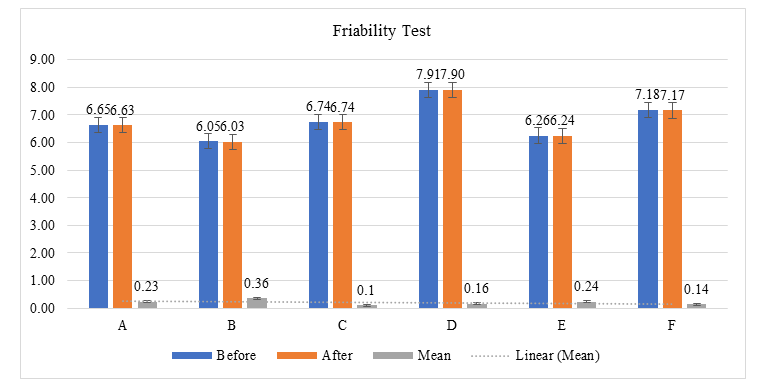
Even though it’s not official, hardness testing is a crucial in-process method to determine whether the tablets being made are solid enough to resist cracking, chipping, or crumbling, but not so hard as to cause them to dissolve more slowly [36]. 4 to 8 kgF is the acceptable range [37]. Every brand sample matched the allowable limit Table 3. The resistance of a tablet to abrasion is measured by its tablet friability [35]. 1% is the permitted upper level [35]. Friability values for each brand sample were within the acceptable range Figure 2. The use of a binder with low adhesive strength or not employing a binder at all, along with tableting with little compressing force, are indicated by the high friability values [38].
A disintegration test for the various brands of metronidazole tablets was conducted using a disintegration test apparatus. All the brands of metronidazole disintegrated within the acceptable limit of not more than 15 minutes as specified in El-Nahhas TM [35], for uncoated tablets Table 4. According to Riley, et al. [39], one of the most significant quality control procedures is in-vitro dissolution testing, which can provide crucial details regarding batch consistency and biological availability. However, a practical and affordable way to forecast absorption and bioavailability variations between capsule and tablet versions of the same medication is by in-vitro dissolution testing [40]. The achievement of a dissolving profile is advised as a tool for drug formulation development and optimization, as well as the construction of in-vitro/in-vivo correlations. All the brands examined using the BP method were found to have a dissolution profile of at least 70% of active ingredients taken at 45 minutes from the dissolution medium as stated in BP [35].
It was observed that all the brands of metronidazole tablets sampled had acceptable levels of bioequivalence and this can be used interchangeably following the physicochemical parameters analysis. This shows that there are no significant differences in the pharmaceutical, chemical, and bioequivalence amongst the samples evaluated. However, there was variation in the pharmaceutical parameters of the samples. Samples A, B, C, D, E, and F, none failed the hardness, weight variation disintegration, and dissolution test. Therefore, the findings from this study indicate that invitro dissolution profiles of different metronidazole tablet formulations could be used to predict the in vivo bioequivalence; suggesting a relationship between invitro dissolution and some pharmacokinetic parameters such as tmax, Cmax, and AUC, which are necessary in defining the rate and the extent of drug availability in the systemic circulation.
Thin layer chromatographic fingerprint of different bands of metronidazole was carried out using Silica gel as the stationary phase and Dichloromethane 50% and methanol 50% as the mobile phase (Figure 3).
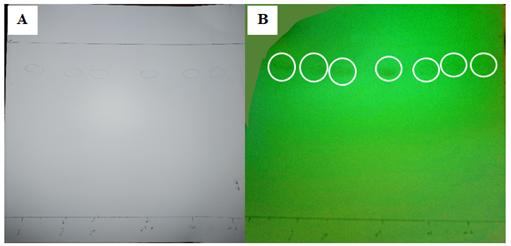
The lack of a significant difference between the Rf values at p-value < 0.05 indicated the relativeness (safety, efficacy, etc.) of the different brands included in the analysis. The recommended method is simple, delicate, precise, accurate, and economical. Since the analysis does not involve the use of organic solvents, the medicine does not need to be pre- treated, and there is no need for a laborious extraction process before the results can be determined, making it an environmentally benign technology. Furthermore, the suggested methodologies’ application to the examination of the pharmaceutical formulation demonstrates that excipients do not obstruct the determination. Hence, can be used in routine quality control.
| Sample code | A | B | C | D | E | F |
|---|---|---|---|---|---|---|
| Batch | 4355Z | A191239 | 001810H | RC20006 | ATE-160 | TE-2741 |
| NAFDAC | Apr-53 | Apr-66 | Apr-26 | Apr-66 | Apr-01 | Apr-21 |
| Strength | 400 mg | 400 mg | 200 mg | 400 mg | 400 mg | 500 mg |
Table 1: Six Different brands of Metronidazole used in the study.
| No. of Measurements | Sample Code | |||||
|---|---|---|---|---|---|---|
| A (%) | B (%) | C (%) | D (%) | E (%) | F (%) | |
| 1 | 0.1 | 3.7 | 5.7 | 1.6 | 0.14 | 2.5 |
| 2 | 0.3 | 2.2 | 4.7 | 0.2 | 4 | 0.1 |
| 3 | 1.1 | 0.2 | 0.9 | 1 | 12.2 | 2.4 |
| 4 | 0.7 | 2.1 | 3.4 | 1.5 | 3.5 | 1 |
| 5 | 0.3 | 0.2 | 7.7 | 4.5 | 1.8 | 1.8 |
| 6 | 0.4 | 3.4 | 1.7 | 3.1 | 0.7 | 0.5 |
| 7 | 3.7 | 1.1 | 2.2 | 0.7 | 0.1 | 0.9 |
| 8 | 1.6 | 1.6 | 7.8 | 0.1 | 1.4 | 0.2 |
| 9 | 0.1 | 2.5 | 0.6 | 0.2 | 0.8 | 0.4 |
| 10 | 0.7 | 1.7 | 0.2 | 0.1 | 1.2 | 1.4 |
| Mean ± SD | 0.9±1.1 | 1.9±1.2 | 3.5±2.9 | 1.3±1.5 | 2.6±3.6 | 1.1±0.9 |
Table 2: Weight Variation (%Deviation).
| No of measurements | Sample Code | |||||
|---|---|---|---|---|---|---|
| A | B | C | D | E | F | |
| 1 | 4.5 | 11 | 8.9 | 5.5 | 14.5 | 6.1 |
| 2 | 5 | 10.9 | 10 | 5.1 | 13.3 | 5.8 |
| 3 | 4.9 | 14 | 10.9 | 5 | 12.5 | 5.9 |
| 4 | 4.5 | 11 | 11 | 4.3 | 16 | 6.2 |
| 5 | 4 | 10.3 | 10 | 4.9 | 12.5 | 5.8 |
| 6 | 4.7 | 10.1 | 11.2 | 5.4 | 15 | 5 |
| 7 | 4.8 | 11 | 8.5 | 4 | 13 | 5.4 |
| 8 | 5 | 11.4 | 11 | 5 | 14.8 | 6.5 |
| 9 | 5.3 | 15 | 11 | 6 | 15 | 4.3 |
| 10 | 5 | 15 | 11 | 4.5 | 13.5 | 5 |
| Mean ± SD | 4.8±0.4 | 12.0±2.0 | 10.4±1.0 | 5.0±0.6 | 14.0±1.2 | 5.6±0.7 |
Table 3: Hardness Test (kgf).
| Number of Measurements | Sample Code | |||||
|---|---|---|---|---|---|---|
| A(min) | B (min) | C (min) | D (min) | E (min) | F (min) | |
| 1 | 0.57 | 0.47 | 2.39 | 6.5 | 2.12 | 10.45 |
| 2 | 1.02 | 1.01 | 2.58 | 7.09 | 2.3 | 8.08 |
| 3 | 1.07 | 1.04 | 3.02 | 7.34 | 2.55 | 11.52 |
| 4 | 1.1 | 1.07 | 3.11 | 7.54 | 3 | 12.06 |
| 5 | 1.2 | 1.13 | 3.19 | 8.3 | 3.2 | 13.1 |
| 6 | 1.28 | 1.22 | 3.26 | 8.47 | 3.3 | 15.07 |
| Mean ± SD | 1.04 ± 0.23 | 0.99 ± 0.24 | 2.93 ± 0.32 | 7.54 ± 0.68 | 2.75 ± 0.45 | 11.71 ± 2.17 |
Table 4: Disintegration Time.
Conclusion
Like any other test method currently in use, the methodology employed in this study is appropriate and helpful for routine quality control analysis and quantification of the metronidazole dosage form in pharmaceutical formulations. The TLC procedure used in the analysis was accurate, precise, and cost-effective, and no interference was observed from the excipients.Therefore, in situations when advanced pharmaceutical tools and methods are unavailable, this approach can be used for the regular quality control of metronidazole in tablets and other comparable pharmaceutical formulations.
References
-
Weir CB, Le JK (2023) Metronidazole. Treasure Island (FL), Stat Pearls, USA.
-
Bouchet D, Lorraine PAC, Michael SR, Michael F, Melvyn RD, et al. (1997) Multicenter comparison of clotrimazole vaginal tablets, oral metronidazole, and vaginal suppositories containing sulfanilamide, aminacrine hydrochloride, and allantoin in the treatment of symptomatic trichomoniasis. Sexually Transmitted Diseases 24(3): 156-160.
-
Joesoef MR, Schmid GP, Hillier SL (1999) Bacterial vaginosis: a review of treatment options and potential clinical indications for therapy. Clinical Infectious Diseases 28(1): S57-S65.
-
Samuelson J (1999) why metronidazole is active against both bacteria and parasites. Antimicrobial agents and chemotherapy 43(7): 1533-1541.
-
Rossi S (2013) Australian Medicines Handbook. In: Gary MH (Ed.), the Australian Medicines Handbook. Unit Trust, Adelaide, Australia.
-
Leitsch D (2015) Drug Resistance in the Microaerophilic Parasite Giardia lamblia. Current Tropical Medicine Reports 2(3): 128-135.
-
Haberfeld H (2020) Austria-Codex. Vienna: Osterreichischer Apothekerverlag, Anaerobex- Filmtabletten, Germany.
-
Brayfield A (2014) Metronidazole. The Complete Drug Reference, Pharmaceutical Press, Martindale.
-
Loft S, Dossing M, Poulsen HE, Sonne J, Olesen KL, et al. (1986) Influence of dose and route of administration on disposition of metronidazole and its major metabolites. Eur J Clin Pharmacol 30(4): 467-473.
-
Eisenstein BI, Schaechter M (2007) DNA and Chromosome Mechanics. In: Schaechter M, et al. (Eds.), Schaechter’s Mechanisms of Microbial Disease. Lippincott Williams & Wilkins, Philadelphia, USA, pp: 28.
-
Yeung PKF, Little R, Jiang Y, Buckley SI, Pollak PT, et al. (1998) A simple high-performance liquid chromatography assay for simultaneous determination of omeprazole and metronidazole in human plasma and gastric fluid. Journal of Pharmaceutical and Biomedical Analysis 17(8): 1393-1398.
-
Iqbal SM, Murthy JG, Banerjee PK, Vishwanathan KA (1999) Metronidazole ototoxicity--report of two cases. The Journal of Laryngology and Otology 113(4): 355- 357.
-
Bowman WC, Rand MJ (1980) Treatment of Trichomonas urogenitalis, Pharmacology. 2nd(Edn.), Blackwell Scientific Publications, Melbourne, Australia, pp: 16-36.
-
Ebel K, Koehler H, Gamer AO, Jackh R (2000) Imidazole and Derivatives. Ullmann’s Encyclopedia of Industrial Chemistry. Wiley-VCH, Weinheim, Germany.
-
National Center for Biotechnology Information (2022) PubChem Compound Summary for CID 4173, Metronidazole.
-
Edwards DI (1986) Reduction of nitroimidazoles in vitro and DNA damage. Biochem Pharmacol 35(1): 53-58.
-
Tocher JH, Edwards DI (1992) The interaction of reduced metronidazole with DNA bases and nucleosides. International Journal of Radiation Oncology Biology Physics 22(4): 661-663.
-
Muller M (1983) Mode of action of metronidazole on anaerobic bacteria and protozoa. Surgery 93(1): 165- 171.
-
Nagel JL, David M (2015) 28-Metronidazole. In: Bennett JE, et al. (Eds.), Bennett’s Principles and Practice of Infectious Diseases. 8th(Edn.), WB Saunders, Philadelphia, USA, pp: 350-357.
-
Fitzgerald KT (2013) Metronidazole. In: Peterson ME, et al. (Eds.), Small Animal Toxicology. 3rd(Edn.), WB Saunders, Philadelphia, USA, pp: 653-657.
-
Benowitz NL, Hukkanen J, Jacob P (2009) Nicotine chemistry, metabolism, kinetics, and biomarkers. Handbook of Experimental Pharmacol 192: 29-60.
-
Bano R, Gauhar S, Shyum-Naqvl SB, Mahmood IS (2011) Pharmaceutical Evaluation of Different Brands of Levofloxacin Tablets (250 mg) Available in the Local Market of Karachi (Pakistan). The International Journal of Current Pharmaceutical Research 3(1): 15-22.
-
Martindale (1999) Monograph on Metronidazole. In: Royal Pharmaceutical Society of Great Britain. The Complete Drug Reference, Great Britain, England, UK, pp: 585-588.
-
Murray MT, Tatjana B (1969) Analysis of Metronidazole. Journal of Pharmaceutical Sources 58(11): 1401-1403.
-
Remington’s Pharmaceutical Sciences (1975) The Science of Pharmaceutical dosage forms. 15th(Edn,). Mack Publishing Company.Easton, Pennsylvania, USA.
-
Ngwuluka NC, Lawai K, Olorunfemi PO, Ochekpe NA (2009) Post-market In-vitroBioequivalence Study of Six Brands of Ciprofloxacin Tablets/Caplets in Jos, Nigeria. The Scientific Research and Essay 4(4): 298-305.
-
Gupta MM, Khoorban A, Ali A, Ramlogan O, Talukdar D (2020) Comparative Quality Control Study of Different Brands of Diclofenac Sodium Tablet Available in Local and Government Pharmacies by In-Vitro Testing. Cureus 12(11): e11348.
-
Ogah CO, Falade OM, Erorini OC (2002) Quality of Chloroquine Phosphate and Paracetamol Tablets Preparations in Lagos, Nigeria. The West African Journal of Pharmacy 20(1): 58-63.
-
Lewis HW, Moody CJ (1989) Experimental Organic Chemistry: Principles and Practice. Wiley-Blackwell, USA, pp: 159-173.
-
Stratton CW, Weeks LS, Aldridge KE (1992) Inhibitory and bactericidal activity of selected beta-lactam agents alone and in combination with beta-lactamase inhibitors compared with that of cefoxitin and metronidazole against cefoxitin-susceptible and cefoxitin-resistant isolates of the Bacteroides fragilis group. Diagn Microbiol Infect Dis 15(4): 321-330.
-
Pankuch GA, Jacobs MR, Appelbaum PC (1993) Susceptibilities of 428 gram-positive and -negative anaerobic bacteria to compared with their susceptibilities to ciprofloxacin, clindamycin, metronidazole, piperacillin, piperacillin-tazobactam, and cefoxitin. Antimicrob. Agents Chemother 37(8): 1649-1654.
-
Löfmark S, Edlund C, Nord CE (2010) Metronidazole is still the drug of choice for the treatment of anaerobic infections. Clin Infect Dis 50 (1): S16-S23.
-
Samuel BJ, Benjamin EU, Diepreye E (2020) Quantification of efavirenz plasma levels and associated adverse reactions using simple reversed-phase HPLC technique. Arabian Journal of Medical Sciences 4(1): 9-12.
-
El-Nahhas TM (2012) New Analytical Method for the Determination of Metronidazole in Human Plasma: Application to Bioequivalence Study. Tropical Journal of Pharmaceutical Research 11(5): 799-805.
-
British Pharmacopeia (2002) Metronidazole analysis.
-
Mbah CC, Emosairue CO, Builders PF, Isimi CY, Kunle OO (2012) Effect of process parameters on the Properties of some Metronidazole Tablet and Capsule Formulations. The African Journal of Pharmacy and Pharmacology 6(24): 1719-1725.
-
Mohammed FA, Arunachalam A, Venkatarami RG, Pallavi V, Moulali SK, et al. (2012) Formulation and Evaluation of Carbamazepine Extended Release Tablets USP 200mg. The International Journal of Biology and Pharmacy Research 3910: 145-153.
-
Ibezim EC, Attama AA, Obitte NC, Onyishi VI, Brown SA (2008) In-vitro Prediction of in vivo Bioavailability and Bioequivalence of Metronidazole Tablets in Eastern Nigerian Drug Market. The Science Research and Essays 3(1): 552-558.
-
Riley T, Christopher D, Arp J, Casazza A, Colombani A, et al. (2012) Challenges with developing in vitro dissolution tests for orally inhaled products (OIPs). AAPS Pharm Sci Tech 13(3): 978-989.
-
Savjani KT, Gajjar AK, Savjani JK (2012) Drug solubility: importance and enhancement techniques. ISRN pharmaceutics 2012: 195727.
- Effects of 5-HTP and Melatonin on the Sleep Cycle of Medical Students
- Adsorption of Bisphenol A on NH4OH- Modified Rice Husk and Sugar Cane Bagasse Biochar
- Comparative Assessment of the Reinforcement Efficiency of Palm Fruit Fibre and Coconut Fibre in High Density Polyethylene (HDPE) Matrix Composite
- Importance of Bio Compounds Naturally Present in Food with Functionality in Animal Metabolism
- Sub-Acute Study on the Cardiotoxic Effects of Monosodium Glutamate Ingestion in Albino Rat
- Weight Management and Its Natural Solutions: A Review