
Modeling of the Ecological Niche of Anogeissus leiocarpa (DC.) Guill & Perr and Conservation Strategies in the Context of Climate and Global Change (Benin, West Africa)
The objective of this work is to study the ethno botanical importance of Anogeissus leiocarpa and the potential impacts of climate and global changes on the spatial distribution of the species in order to contribute to its conservation and sustainable use. One hundred and eighty-nine (189) peoples were surveyed in the ten phytodistricts of Benin. Occurrences of Anogeissus leiocarpa downloaded from the Global Biodiversity Information Facility (GBIF) website (www.gbif.org; https://doi.org/10.15468/ dl.qgwnvf) was supplemented with those collected in the field to model the spatial distribution and the ecological niche of the species. Environmental climatic data were downloaded from Worldclim and Africlim website at the resolution of 2.5 minutes; non-climatic environmental data as soil, population and distance to dwellings (Settlement) were respectively downloaded from ISRIC and SEDAC website at the same resolution. The results of five modeling algorithms were compared: Maxent, BRT, RF, GLM, and GAM. From the main results, Anogeissus leiocarpa is well known and variously used by the surveyed population. Three categories of use were named: wood use (64 %), medicinal use (35 %) and spiritual or medico-magical use (1 %). The most named parts of the plants are the trunk and the leaves. Seven (7) forms of usage were named: service wood, decoction, timber, fuelwood, power, toothpick and trituration. Maxent and BRT algorithms have shown the best performance to predict suitable areas of Anogeissus leiocarpa (compared to RF, GLM and GAM) and were therefore combined to define conservation strategies for the species. Globally, there is an extension of the new suitable areas of the species. The suitable areas of the species are seldom threatened by climate change in Africa and Benin. Also, the protected areas of Benin will remain effective for the conservation of the species in the present and in the future.
Introduction
Biodiversity is extremely useful and valuable at planetary scale through ecosystem services [1, 2, 3]. However, these ecosystems are disturbed by several anthropogenic factors such as overexploitation of natural resources, pollution, loss of habitats due to a large-scale conversion of lands into agriculture and the development of urban centers, the invasive alien species, climate change and epidemics [1, 3, 4].
Climate change today appears to be a driving threat to other threats to plant and animal populations [1, 5]. According to projections, 20 to 30 % of plant and animal species will face a greater risk of extinction if global warming exceeds 1.5 °C to 2.5 °C in Africa [6, 7]. Thus, major changes will affect the ecosystem structure and functioning, the interactions between species, their geographic distributions with negative consequences on the goods and services associated to these ecosystems [7, 8, 9].
In Benin, forest biodiversity is very important for households. Among the inventoried plant species [10], several are used by the population in various categories: food, traditional medicine, energy and grazing [11, 12, 13]. Despite the very limited forest resources [3, 14], Benin is also experiencing a loss of its biodiversity. On average, Benin loses fifty thousand hectares of forests per year FAO [3] because of the expansion of agriculture, overgrazing and the uncontrolled exploitation of resources [15, 16, 17].
Among the species affected by these actions, we have Anogeissus leiocarpa (DC.) Guill & Perr which is very vulnerable to anthropogenic pressures and is increasingly rare [11, 18]. Anogeissus leiocarpa belongs to Combretaceae family and is used for various purposes in Benin [11, 19, 20]. The species is exploited as fuelwood and charcoal because of its excellent calorific value [15, 21]. It’s hardwood is resistant to termites and insects Yaoitcha [11] and is of excellent quality for buildings (frames, pilings, rafters, etc.) and tools manufacture (fence posts, handles tools) [22, 23, 24]. Likewise, the different parts of the plant are used in the traditional pharmacopoeia as extraction products as well as food and foodstuffs for consumption [25, 26, 27].
In a changing environment, predicting variations in the distribution of species can be an important tool, especially in terms of management of the species [28, 29]. Ecological niche modeling is used in several works to understand the ecological requirements of species, to predict geographic distributions, to select conservation areas and predict the effects of environmental changes [29, 30, 31, 32, 33]. The studies carried out on the distribution of Anogeissus leiocarpa Adjahossou [34]; Gbètoho [35] through ecological niche modeling have been very useful for understanding the distribution areas of the species in Benin. These studies show that climatic variables really influence the distribution of the species in Benin. Taking into account all the uncertainties associated with the projections, it is interesting to refine those studies by integrating more occurrences data and by comparing the results of different modeling algorithms. This study will address the following research questions: (i) what is the current number of occurrence data available for Anogeissus leiocarpa in Benin? (ii) what are the forms and usages values of the species? (iii) what is the influence of climatic and non- climatic factors on the geographic distribution of Anogeissus leiocarpa in the present and in the future? The answers to these questions will be useful to get more information on Anogeissus leiocarpa in Benin and thus to help in decision- making on its conservation and sustainable management.
Study area
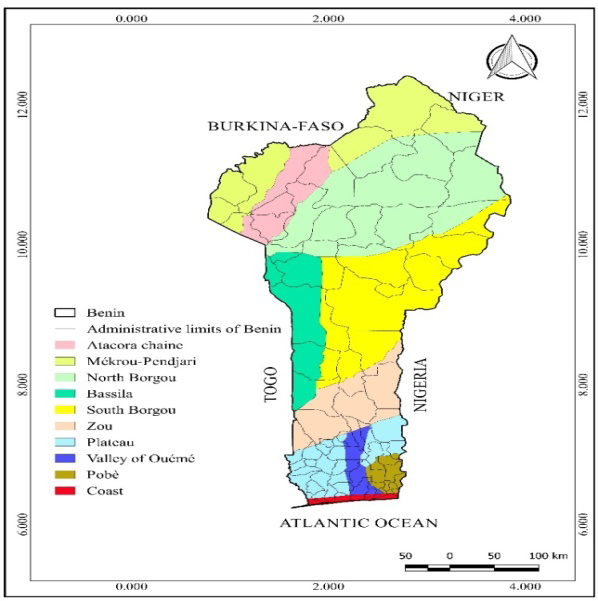
The study was carried out in Benin. More precisely, the climatic areas including the ten (10) phytodistricts of Benin Figure 1 were considered. Phytodistricts represent ecosystems or habitats for living organisms, some of which are endemic [36]. Benin is located between 6 º 30’ and 12 º 30’ N and 1 º and 3 º 40’ E [37]. Three major climatic zones have been identified in Benin: the Guinean-Congolese zone, the Guineo-Sudanian zone and the Sudanian zone [38]. The Guinea-Congolese zone is located in the southern part of Benin and extends from the coast to the latitude of the hill of Djidja. Annual rainfall ranges from 900 mm in the West to 1300 mm in the East. This climatic zone is subdivided into four phytodistricts: Coast, Pobè, Valley of Ouémé and Plateau. The Guineo-Sudanian zone extends from the municipality of Dassa to the latitude of the municipality of Bembérèkè. The annual rainfall varies from 1100 to 1200 mm. This zone is subdivided into three phytodistricts: Bassila, Zou, and South Borgou. The Sudanian zone is located beyond the 10° N latitude. The climate is typically Sudanese with only one rainy season. There is a decreasing rainfall gradient from the South (with 1150 mm per year) to the north (with 900 mm per year). This area is subdivided into three phytodistricts: North Borgou, chain of Atacora and Mékrou-Pendjari.
Material and Methods
Modeling algorithms
Five (5) modeling algorithms have been implemented in R 4.1.0 software R Core Team [39] to model the ecological niche of Anogeissus leiocarpa [40]: Maximum Entropy [41], Generalized Linear Model (GLM; McCullagh and Nelder [42]), Generalized Additive Model (GAM; Hastie and Tibshirani [43]), Boosted Regression Trees (BRT; Friedman [44]) and Breiman and Cutler's Random Forests (RF; [45, 46]).
Area Under Curve (AUC; Phillips [41]) is frequently employed as a single threshold-independent rating of model performance [47]. AUC was shown to be a prevalence independent [48, 49] and is thus an accurate measure of ordinal score model performance. The five (5) algorithms used in this study are the most efficient according to the AUC [50]. Here are the considered intervals and their interpretations [51].
- 0.5 – 0.7: very good discrimination;
- 0.7 – 0.9: reasonable discrimination;
- 0.9 – 1.0: very good discrimination.
Occurrence data collection on Anogeissus leiocarpa
Occurrences of Anogeissus leiocarpa were downloaded from GBIF website (https://doi.org/10.15468/dl.qgwnvf). Depending on the gaps in the data downloaded from the GBIF website, additional occurrences of the species were collected in six (6) municipalities of the phytodistricts of Benin: Ouaké, Matéri, Pèrèrè, Toucountouna, Lalo, and Zogbodomey.
Environmental data used
Two (2) types of variables were used: environmental climatic and non-climatic environmental variables. With regard to environmental climatic variables, current climatic (version 2.1) and future climatic data were respectively downloaded from Worldclim (www.wordclim.org) and Africlim website (https://www.york.ac.uk/environment/ research/kite/resources/) (by 2055 under 4.5 rcp and 8.5 rcp scenarios), both at the resolution of 2.5 minutes. Indeed, Africlim provides a set of high-resolution climatic projections for Africa and is therefore more adapted to the ecological realities of Africa [52]. Non-climate environmental variables such as Soil and Population were respectively downloaded from African Soil Profiles Database (https://www.isric.org) and SEDAC website (https://sedac.ciesin.columbia.edu/ data/set/grump-v1-settlement-points/data-download); Human settlement data was extracted from SEDAC website (https://sedac.ciesin.columbia.edu/data/set/grump-v1- settlement-points/data-download) and Proximity-analysis tool in ArcGIS was used to generate the distances related to dwellings.
Ethnobotanical data collection on Anogeissus leiocarpa
One municipality has been selected per phytodistrict for the collection of ethnobotanical data on Anogeissus leiocarpa. Per phytodistrict, the municipality chosen is the one where the greatest number of Anogeissus leiocarpa occurrences has been found following the projection on a map of the occurrence data downloaded from the GBIF website. The target groups surveyed were: carpenters, sawyers, and heads of households, foresters and traditional healers. The sample size (n) was calculated based on the formula of Dagnelie [53]:
$$ n = \frac {\bigcup_ {1} ^ {2} - \alpha_ {/ 2} p (1 - p)}{d ^ {2}} $$
With:
$$ \bigcup_ {1 - \alpha_ {l _ {2}} = 1. 9 6} $$
$$ \bigcup_ {1} ^ {2} - \alpha_ {i 2} $$
- n: total number of surveyed people in the study;
- : value of the normal random variable for a probability value of α = 0.05;
- P: proportion of the population using the species. Anogeissus leiocarpa is a woody species, very useful for farmers [11, 27, 54], the proportion of the population using the species was obtained by considering the report of agricultural population of the whole population [55],
- d: expected error margin of any parameter to be computed from the survey, which is fixed at 0.07 [56, 57].
Ethnobotanical data analysis
For ethnobotanical data analysis, the following indices were used: (1) Shannon Diversity Index (H) (Shannon [58]), (2) Pielou evenness (Eq) (Pielou [59]), (3) use diversity value (UD), (4) use equitability value (UE), (5) consensus value for plant parts (CPP) and (6) consensus value for the form of use (CMU) (Byg [60]; Monteiro [61]; Koura [62]). The structuring proposed by Monteiro [61] and Koura [62] assumed that young people are those under 40-year-old while those who are older than 40 years are considered as old people.
Modeling of the spatial distribution of the ecological niche of Anogeissus leiocarpa
Model calibration and validation Maxent, GLM, GAM, BRT and RF algorithms have been implemented in the Species Distribution Models (SDM)
[63]. The default setting calibration [63] was used. We randomly generated 10000 background points and chose the cross-validation method with 2 repetitions. Variance Inflation Factors (VIFs) of all the variables performed in R made it possible to select the least correlated variables and to eliminate multicollinearity that show more contribution power to the model. The packages dismo, rjava, gbm, random Forest, stats and mgcv were exploited. Area Under receiver operating characteristic Curve (AUC) and True Skill Statistic (TSS) Allouche [64]; Phillips [41] were used to evaluate the performances of the models.
Modeling of the spatial distribution and ecological niche of Anogeissus leiocarpa The occurrence data of Anogeissus leiocarpa downloaded from GBIF website and those collected in the field were cleaned up. Data cleaning consisted in eliminating the occurrences lacking geographic coordinates and those falling outside of Africa [29]. In R software (V4.1.2; R Core Team [39]), the spThin package [65] was used to remove duplicates so that there is only one occurrence per 5 km X 5 km grid. A mask covering all occurrences (cleaned up) was created. The environmental climatic and non-climatic environmental variables were calibrated to the created mask. The total number of replicates per model was 10. The outputs of the models (in present and in future) were imported into the software QGIS Desktop version 2.18.4 [66] and then processed in binary form [67] using the threshold of maximum training sensitivity and specificity. The same threshold, the one that maximizes the TSS and the predictive capacity of the models [68] was also used to determine the impact of climate change through the raster calculator tool in QGIS Desktop version 2.18.4 [66].
Results
Occurrence of Anogeissus leiocarpa
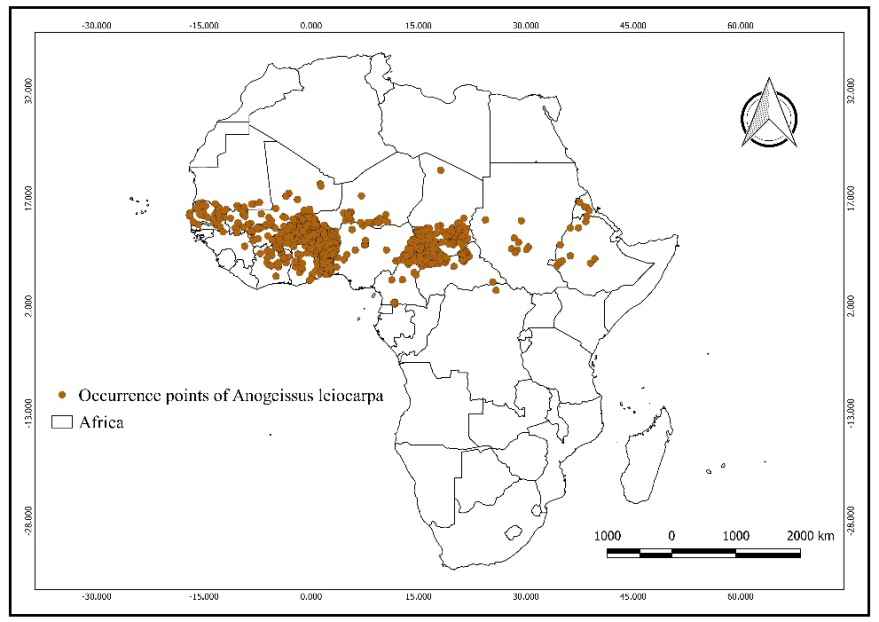
Eight thousand nine hundred and eighty-three (8983) occurrence data of Anogeissus leiocarpa were downloaded from GBIF website at the scale of Africa (https://doi. org/10.15468/dl.qgwnvf). In addition to these occurrences downloaded, one hundred and nineteen (119) occurrences of the species were recorded in six (6) municipalities of Benin’s phytodistricts. A total of 9102 occurrences of Anogeissus leiocarpa were therefore collected (Figure 2).
Ethnobotanical data on Anogeissus leiocarpa
Diversity and distribution of the knowledge of the interviewees The knowledge of the population surveyed is unevenly distributed. The probability value obtained for the Kruskal- Wallis nonparametric analysis showed a highly significant and significant difference between the Shannon diversity index (p-value = 5.737e-09) and Pielou evenness (p-value = 0.01054) values respectively at the 5 % threshold. Overall, men have more knowledge about Anogeissus leiocarpa (H = 3.20 and Eq = 0.87) than women (H = 0.93 and Eq = 0.40) (Table 2). The differences between age groups are not significant in either sexual category.
| Total number of people surveyed | 189 | |
|---|---|---|
| Number of specific uses cited | 28 | |
| Number of categories of uses cited | 3 | |
| H (Ecart- type) | Eq (Ecart- type) | |
| Total | 3.25 (0.26) a | 0.87 (0.05) a |
| Total for women | 0.93 (1.27) b | 0.40 (0.52) b |
| Total for women < 40 years | 0.23 (0.73) b | 0.10 (0.32) b |
| Total for women ≥ 40 years | 0.82 (1.08) b | 0.40 (0.52) b |
| Total for men | 3.20 (0.25) a | 0.87 (0.52) a |
| Total for men < 40 years | 2.94 (0.46) a | 0.88 (0.58) a |
| Total for men ≥ 40 years | 2.70 (0.52) a | 0.94 (0.04) a |
Table 1: Summary of quantitative measurements of knowledge about. NB: For each parameter, the means followed by different letters
Categories of uses, subcategories of uses and specific uses of Anogeissus leiocarpa Three categories of Anogeissus leiocarpa usages were identified: wood (64 %), medicinal (35 %) and medicinal- magical (1 %). The specific usages identified for the wood use category are: table manufacturing, beds, door and window frames, chairs and wardrobe with timber of the species, manufacturing of mortar, canoes, frames in the form of service wood, use of firewood and charcoal based on the species. The specific uses for the medicinal use category relate to the treatment of various diseases/symptoms and particular syndromes such as high fever, stomachache, extreme tiredness, wound on the body, diarrhea, vomiting, hip pain, stopping the over blood in a girl’s virginity, shitting blood, toothache, malaria, nursing newborns, sexual infections, sexual weakness, snakebite. The category of medico-magical use has only one specific use: spiritual clairvoyance.
Anogeissus leiocarpa plant parts use
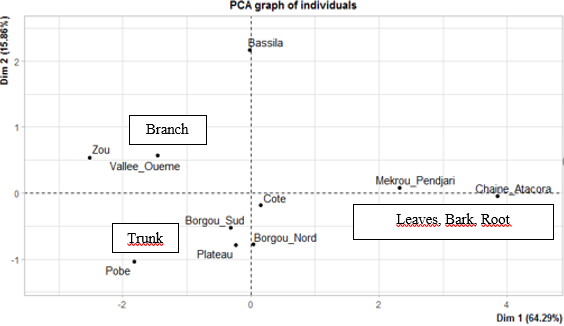
Five parts of Anogeissus leiocarpa are named by the surveyed population in the ten phytodistricts of Benin: trunk (35 %), leaves (20 %), branches (18 %), bark (16 %) and roots (11 %). The leaves, the barks and the roots of the species are the most used in the phytodistricts of the Mékrou-Pendjari, chain of Atacora, Coast and Northern Borgou whereas trunk and branch are less used in those phytodistricts (Figure 3). The trunk is the most used in the phytodistricts of South- Borgou, Plateau and Pobè. The toothpick is the most used in the phytodistricts of Zou, Bassila, and Valley of Ouémé.
Forms of uses
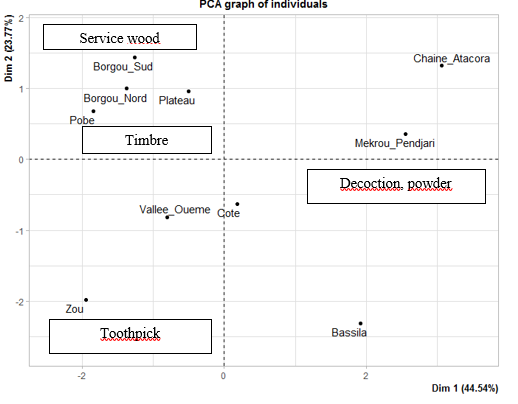
The forms of uses named by the surveyed people are: service wood (34 %), decoction (18 %), lumber (14 %), energy wood (13%), powder (11 %), toothpick (7 %) and trituration (2 %). According to figure 4, decoction and powder are more used in the phytodistricts of the Atacora chaine, Mékrou-Pendjari, Bassila and the Coast. Timber is widely used in the phytodistricts of Southern-Borgou, Northern-Borgou, Plateau, Pobè, Valley of Ouémé and Zou (Figure 4). Service wood is more used in the phytodistricts of Southern-Borgou, Northern-Borgou, Plateau and Pobè. The toothpick is widely used in the phytodistricts of Zou and Bassila (Figure 4). The results of calculated ethnobotanical parameters are available via the following link: https://docs.google.com/document/ d/1qnOvg63mqbCxsvmDUL6UlOSCJM_i8ZcD/ edit?usp=share_link&ouid=105952222716204680652&rtp of=true&sd=true
Spatial distribution models and ecological niche of Anogeissus leiocarpa
Models performance
A total of four (4) statistical tests (AUC, TSS, COR and deviance) were performed to assess the performance of the models (Table 3). The Area under Receiver Operating Characteristic Curve (AUC) provides an overall measure of performance independent of a threshold. It takes values from 0 to 1. The AUC values obtained for Maxent, BRT, GAM, GLM and RF algorithms are all above or equal to 0.9. There is therefore a good discrimination at the level of all the algorithms and a very good discrimination for RF (0.98) which has the highest AUC value with a standard deviation of 0.004.
The True Skill Statistic (TSS) assesses the predictive accuracy of a species distribution model. TSS values range from -1 to 1. The Models closer to 1 are better at discerning presence and absence points. The TSS test values obtained for all the algorithms are above 0.7. RF algorithm has the highest TSS value (0.88) with a standard deviation of 0.012.
The COR test measures the correlation between the prediction (presence, absence and pseudo absence) and the occurrence points. The COR test values obtained for all the five algorithms are above 0.7. The highest value was obtained for the RF algorithm (0.90) with a standard deviation of 0.009. Deviance of the variables measures the variability of the values importance at the model level. The highest values of the deviance are obtained for the BRT (0,77) algorithm with a standard deviation of 0.013, Maxent (0,75) with a standard deviation of 0.014 and GLM (0,72) with a standard deviation of 0.024. The lowest value is obtained for the RF algorithm (0.31) with a standard deviation of 0.021 which is therefore better than the other algorithms.
| Méthodes | AUC (Ecart-type) | TSS (Ecart-type) | COR (Ecart-type) | Déviance (Ecart-type) |
|---|---|---|---|---|
| Maxent | 0.94 (0.008) | 0.78 (0.017) | 0.81 (0.013) | 0.75 (0.014) |
| GLM | 0.90 (0.006) | 0.71 (0.022) | 0.75 (0.013) | 0.72 (0.024) |
| BRT | 0.95 (0.005) | 0.78 (0.017) | 0.82 (0.014) | 0.77 (0.013) |
| RF | 0.98 (0.004) | 0.88 (0.012) | 0.90 (0.009) | 0.31 (0.021) |
| GAM | 0.95 (0.006) | 0.79 (0.015) | 0.82 (0.013) | 0.54 (0.027) |
Table 2: Values of statistical tests performed for each model.
Variables contribution to the models
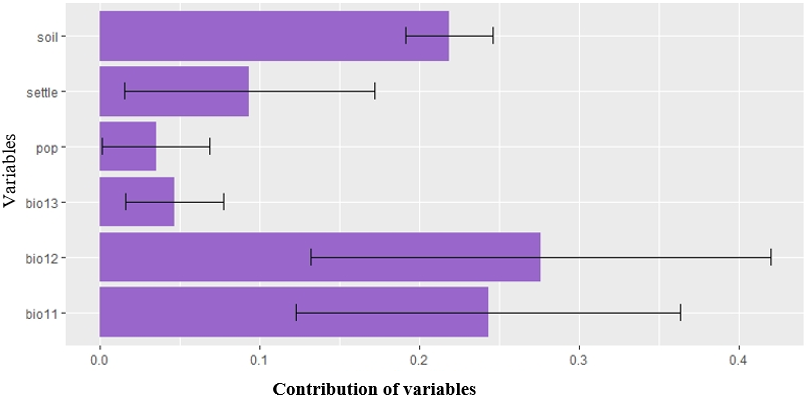
In total, six variables were retained as contributing to the potential distribution of Anogeissus leiocarpa: Mean temperature of coldest quarter (Bio11), Annual precipitation (Bio12), Precipitation of wettest month (Bio13), Population, Soil and distance to dwellings (Settlement). The figure 5 shows the relative variable importance for all the algorithms. Bio 12 has the highest importance for Anogeissus leiocarpa modelling process, followed by Bio11, Soil and distance to dwellings (Settlement) Figure 5. The relative variable importance for each algorithm is available via the following link: https://docs.google.com/document/ d/1GOdyMiga93fYxysuBy-c1_x5tPLYvvRn/edit?usp=drives dk&ouid=105952222716204680652&rtpof=true&sd=true
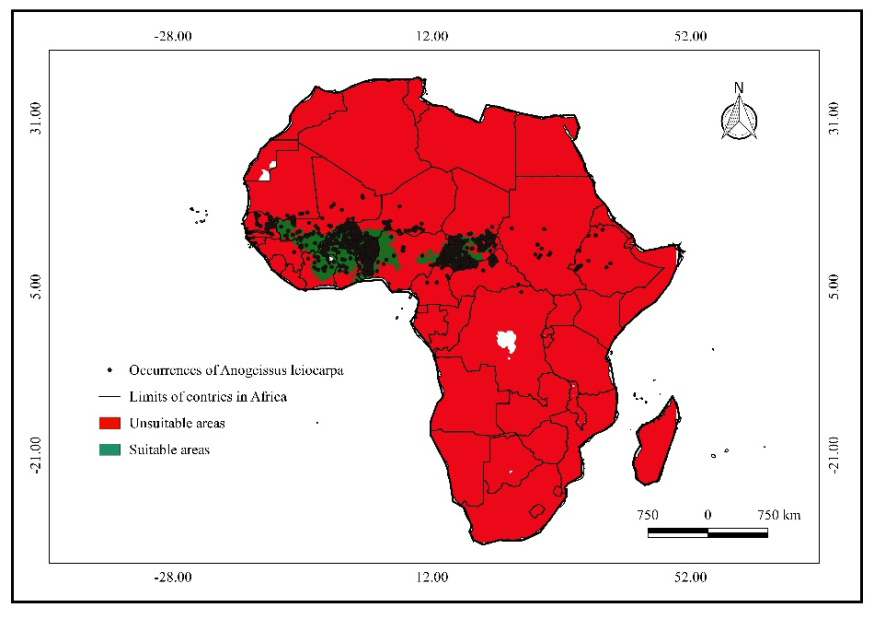
Spatial distribution of Anogeissus leiocarpa at the present At the scale of Africa (Figure 6a), suitable areas to Anogeissus leiocarpa (colored in green) cover some countries in West Africa, Southern Chad and Northern Cameroun. At the scale of Benin (Figure 5b), the suitable areas for the species cover the whole country except parts of the Atacora, Donga, Ouémé, Plateau, Littoral, and Atlantic departments.
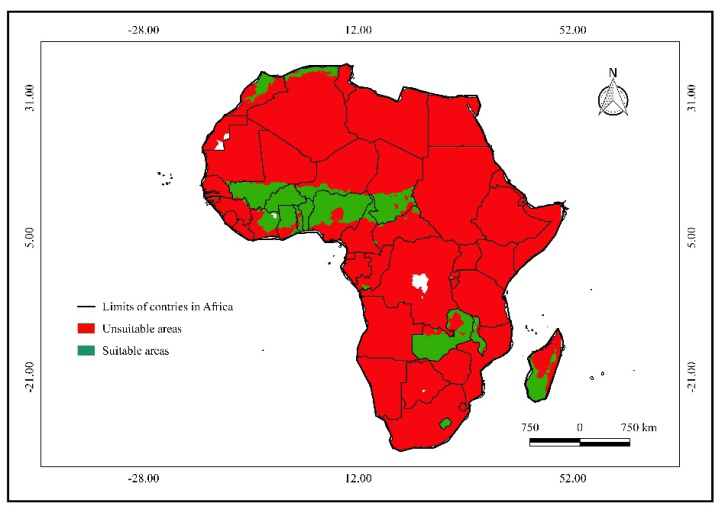
Projected spatial distribution of Anogeissus leiocarpa in the future under rcp 4.5 and 8.5 scenarios The results obtained under the rcp 4.5 and rcp 8.5 scenarios are quite similar. At the scale of Africa, under both scenarios (Figure 7a), the areas that will be suitable to Anogeissus leiocarpa (colored in green) cover most of the countries of West Africa, Southern Chad and Madagascar, Northern Morocco and Algeria, Zambia, Malawi and Lesotho. At the scale of Benin (Figure 7b), the areas that will be suitable to the species cover all the departments of the country except parts of Donga, Ouémé and Atlantic.
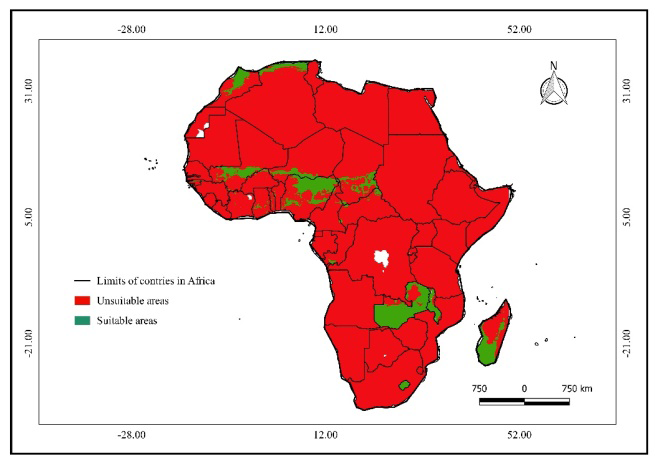
Impact of climate change on the spatial distribution of Anogeissus leiocarpa At the scale of Africa and Benin, under both scenarios (Figure 8a and 8b), compared to the present, there is an extension of the suitable areas of Anogeissus leiocarpa. The parts colored in green represent areas which were not suitable in the present but will became suitable in the future.
The maps obtained with BRT algorithm in the present and future (at the scale of Africa and Benin under rcp 4.5 and rcp 8.5 scenarios) are very close to those obtain with Maxent.
The suitable areas described by RF algorithm are very restricted. At the scale of Africa, in the present, the suitable areas of Anogeissus leiocarpa cover the countries described in the case of Maxent algorithm except Mali, Nigeria, Ivory Coast and Ghana. In the future, under both scenarios (4.5 and 8.5), the suitable areas of the species cover the countries described in the case of Maxent except Ivory Coast, Northern Morocco and Algeria. At the scale of Benin, in present, the suitable areas of Anogeissus leiocarpa cover all the departments of the country as described in the case of Maxent. In future, the suitable areas of the species cover all the departments of the country except a large part of Atacora, Alibori, Borgou, Donga, Collines, Zou, Ouémé, Plateau, Mono and Atlantic.
Compared to Maxent, GLM and GAM algorithms overestimate the suitable areas of the species. With regard to GLM, in the present, at the scale of Africa, the suitable areas of Anogeissus leiocarpa cover the countries described in the case of Maxent Algorithm. In addition to these countries, there are Kenya, Ethiopia, Central African Republic and Congo. In the future, under both scenarios (4.5 and 8.5), GLM predict all the countries of Africa as suitable for the species. At the scale of Benin, in present, the suitable areas of the species cover all the departments of Benin except Borgou, Donga and Alibori. In the future (under 4.5 and 8.5 scenarios), the suitable areas cover all the departments of the country except a part of Atacora, Donga, Borgou, Littoral and Ouémé. With GAM Algorithm, at the scale of Africa in present, the suitable areas of Anogeissus leiocarpa cover the countries described in the case of Maxent. To these countries are added Central African Republic, Malawi, Botswana, Zambia and Madagascar. By 2055, under 4.5 and 8.5 scenarios, the areas that will be suitable to the species cover all countries in Africa as GLM. At the scale of Benin, the suitable areas of the species cover all the departments of the country.
The maps obtained with the five algorithms (Maxent, BRT, RF, GAM and GLM) in present, future (under 4.5 and 8.5 scenarios) and the impact of climate change on the species can be found through the following link: https://drive. google.com/drive/folders/1sHU4uRGxIuD9hYtgToRCWSAli 0guVyvt?usp=sharing Conservation strategies for Anogeissus leiocarpa at present and in the future Algorithms evaluation shows different values for the statistical tests used (Table 3). At the level of the AUC (Independent threshold), TSS and COR tests, the highest value was obtained for RF algorithm (respectively 0.98; 0.88 and 0.90). RF algorithm is therefore the most efficient algorithm from AUC, TSS and COR tests. From the point of view of deviance, the highest value is found at the level of BRT (0.77).
Furthermore, at the level of Maxent and BRT, we observe a remarkable concordance between Anogeissus leiocarpa occurrence points and the projection of the spatial distribution of the species in Africa at the present. GLM, GAM and RF do not give at the present a very consistent prediction between the Anogeissus leiocarpa occurrence points and the projection of the spatial distribution of the species. There is an overestimation of the suitable areas of the species with GAM and GLM and a big restriction with RF. Moreover, GLM and GAM predict all the Africa as suitable to Anogeissus leiocarpa by 2055 (under 4.5 and 8.5 scenarios), which is unlikely. The combination of Maxent and BRT algorithms was therefore used as a decision and strategy model.
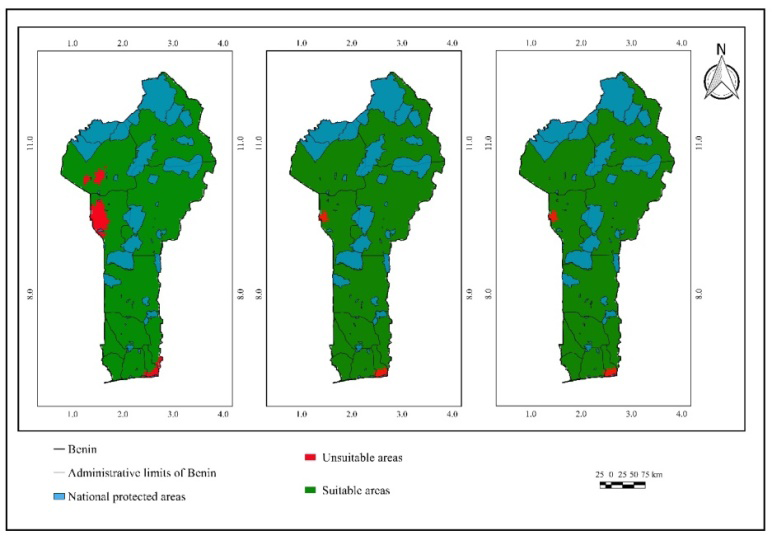
At the scale of Benin, the suitable areas of Anogeissus leiocarpa in the present cover almost all the protected areas (coloured in blue) of the country except the classified forest of Natitingou dam in the department of Atacora, the reforestation perimeter of Tanékas and the classified forest of Penessoulou in the department of Donga, the classified forests of Sèmè and Atlantic in the department of Ouémé (Figure 9). The protected areas of Benin are therefore effective for the conservation of the species in the present.
By 2055, under 4.5 and 8.5 scenarios, the suitable areas of the species also cover almost all the protected areas of Benin (coloured in blue) except the classified forests of Sèmè and Atlantic in the department of Ouémé (Figure 9). Protected areas of Benin are therefore mostly effective for Anogeissus leiocarpa conservation by 2055 under both scenarios.
In order to conserve Anogeissus leiocarpa, we recommend a more conservative and exploratory option taking in account the projection of the spatial distribution of the species in the present, by 2055 (under 4.5 and 8.5 scenarios) as well as the effectiveness of protected areas for the species conservation (Figure 9). Among the concrete actions to be carried out for Anogeissus leiocarpa conservation in Benin, we recommend making an inventory of the species in the areas planned as suitable to its presence, in order to know if the species is absent or under stocked. Then, the species will be introduced in the suitable areas where it has been previously identified as absent or under stocked. The forestry administration and the qualified structures should, through maintenance operations (weeding, liana cuttings, thinning, etc.), ensure the survival of Anogeissus leiocarpa throughout the successive stages of vegetation growth. Moreover, according to our results, the surveyed population use parts of the species such as the trunk and the roots in different municipalities of phytodistricts. The use of these parts (trunk and the roots) negatively impacts the natural regeneration of the species. To overcome this, we recommend regulatory measures be taken as well as a rigorous monitoring with regard to the species exploitation. In addition, it would be good to strengthen the capacities of population to cultivate the species in nurseries, to plant and to maintain the operations in the field. This will also allow population to be integrated into species conservation actions. Finally, awareness campaigns or workshops could be organized by the qualified structures (General Direction of Waters, Forests, and Hunts (DGEFC), Non-governmental organizations (NGOs) working in the field of biodiversity, etc.) in order to draw the attention of the populations to the issues of threats to biodiversity as well as the compatible behaviors with its preservation.
Discussion
Ethnobotanical importance of the species
This study reveals that Anogeissus leiocarpa is well known and used by the surveyed population. The use category wood is the most mentioned (64 %) followed by the medicinal use category (35 %).
The species is mainly used as service wood and timber in the use category wood. The wood of the species is very hard and quite resistant to termites and insects [11, 22]. The species is also used as fuelwood (charcoal and firewood) [15, 21]. These results are consistent with those of Sena [23], Yaoitcha [11] and Ogunjobi [24] describing Anogeissus leiocarpa as highly valued for its timber quality (as timber, service wood and fuelwood). According to these authors, the species is exploited for building, heavy carpentry and has an excellent calorific value.
The medicinal use of the species is also well known. The different parts of the species (leaves, roots, bark and branches) are used in various forms (decoction, powder, toothpick and trituration) to treat several illnesses/symptoms including high fever, sores, childhood diarrhea, extreme tiredness, toothache etc. Leaves and bark are the organs of Anogeissus leiocarpa the most used for the treatment of many diseases while decoction and powder are the best-known forms of use. These results are similar to those of Dembélé [22], Diatta [26] and Koné [27] who reported that leaves, bark and roots enter into the pharmacopoeia, especially against fever, extreme tiredness, childhood diarrhea, toothpick etc.
In addition, Koné [27] have shown decoction as the most used forms. This form of use would be better known because it would make it possible to collect the most active ingredients and would reduce the toxicity of some recipes [69]. Similarly, the interest in leaves and bark finds an explanation in the fact that they are the ideal site of the biosynthesis and the storage of the secondary metabolites responsible for the pharmaco- biological properties of the plant [70].
Variation in forms of use according to phytodistricts
There is a variation in the forms of use (decoction, powder, toothpick, trituration, service wood, timber and fuelwood) of Anogeissus leiocarpa depending on the phytodistricts. Decoction and powder are the most common forms of use in the phytodistricts of Chaîne of Atacora, Mékrou-Pendjari, Bassila and Coast. These results are consistent with those Salhi [69], Koné [27] and Kerfal and Allaoua [70] showing that decoction and powder are the most common forms of use to treat various diseases.
Service wood is the most maned forms of use in the phytodistricts of Southern-Borgou, Northern-Borgou, Plateau and Pobè. Timber is the most maned forms of use in the phytodistricts of Southern-Borgou, Northern-Borgou, Plateau, Pobè, Ouémé Valley and Zou. These results are consistent with those of Yaoitcha [11] and Ogunjobi [24] who showed that the species is heavily exploited for its wood.
According to Achigan [71], knowledge of the endogenous use of natural resources is essential for the development of conservation strategies. Unhappily, Anogeissus leiocarpa is heavily exploited for its wood, which is highly appreciated by the populations surveyed. These forms of use have a negative impact on the natural regeneration of the species. For this study, the forms of use of Anogeissus leiocarpa were taken into account according to the phytodistricts to highlight its link with the modeling aspect and thus propose effective conservation strategies.
The results of Anogeissus leiocarpa ecological niche modeling showed that the unsuitable area to the species in the present and in the future cover the municipalities of Ouaké (phytodistrict of Bassila), Adjohoun (phytodistrict of Pobè) and Sèmè-Podji (phytodistrict of Coast); this is in line with our results highlighting that the species is widely used in those municipalities. In the commune of Ouaké (phytodistrict of Bassila), the most used part of the species is the branch and the powder and the toothpick are the most used forms of use. The trunk is the most used part in the municipality of Adjohoun (phytodistrict of Pobè) and timber and service woods are the most named forms of use. Leaves, barks and roots are the most used parts in the municipality of Sèmè-Podji (phytodistrict of the Coast) and decoction and powder are the most used forms.
It can be deduced that the risk of the species disappearance in the future is high in these municipalities if the same rate of use of the species continues. These results are important for policymakers and natural resource managers and will guide them in decision-making. It should be noted that the target groups surveyed in these municipalities mentioned it is not easy to find the species naturally. During the species collection on the field, only 6 occurrences were recorded in Ouaké (phytodistrict of Bassila) municipality and no occurrence was found in Adjohoun. This confirms the results of the modeling which showed that these municipalities are unsuitable areas for the species.
Ecology of Anogeissus leiocarpa and environmental variables governing its spatial distribution
Anogeissus leiocarpa can live in variable and distinct environments such as dry savannas, dry forests and Sudano- Sahelian to Sudano-Guinean galleries along waterways at the edge of tropical rainforest [72]. The species has a wide ecological range and is very adapted to drought with temperatures between 24°C and 30°C [35]. Edaphic conditions in gallery forests and periodically flooded soils may allow Anogeissus leiocarpa to grow under severe drought conditions [35, 73]. An annual rainfall between 500 and 1,300 mm is found to be suitable for Anogeissus leiocarpa [35].
Direct parameters such as temperature and precipitation are important when the modeling of species distribution is made on a large area [35, 74]. Furthermore, non-climatic environmental variables improve the quality of species distribution and is used in many studies [67, 75].
Six variables were selected to predict the ecological niche of Anogeissus leiocarpa: Mean temperature of coldest quarter (Bio11), Annual precipitation (Bio12), Precipitation of wettest month (Bio13), Population, Soil and distance to dwellings (Settlement). The bio11, bio 12 and bio 13 variables were respectively selected as the main contributing variables to the models in the work of Gbèsso [28], Ganglo [29] and Gbètoho [35]. The non-climatic environmental variable as Population, Soil and Human settlement were also selected in the work of Issoufou [67] and Wouyou [75].
Performance of the algorithms used
The SDM module Naimi and Araújo [63] was used to model the ecological niche of Anogeissus leiocarpa. The statistical tests (AUC, TSS, COR and deviance) values carried out for the five algorithms (Maxent, BRT, GAM, GLM and RF) generally attest to the good quality of the models. At the present, the results of Maxent and BRT algorithms show a remarkable agreement between Anogeissus leiocarpa occurrence points and the projection of the spatial distribution of the species at the scale of Africa. GLM, GAM and RF do not give a very consistent prediction in the present between the Anogeissus leiocarpa occurrence points and the projection of the spatial distribution of the species. Moreover, the prediction of GLM and GAM algorithms is implausible and RF prediction is very restricted in future (by 2055 under 4.5 and 8.5 scenarios). Only BRT and Maxent were therefore combined to define the conservation strategies of Anogeissus leiocarpa.
Maxent and BRT respectively have almost the same values for the different statistical test made: AUC (0.94; 0.95); TSS (0.78; 0.78); COR (0.81; 0.82) and deviation (0.75; 0.77). BRT obtains the highest values for deviance test (0.77). Moreover, at the scale of Africa, Maxent has a better agreement between the Anogeissus leiocarpa occurrence points and the projection of the spatial distribution of the species in the present than BRT. The best algorithm in view of our results would be Maxent.
Studies of Gbèsso [28], Ganglo [29], Agbo [76], Kakpo [33], Ganglo [77] etc. carried out with Maxent algorithm showed the performance of the algorithm in terms of AUC and its ability to predict the suitable areas of species. The results obtained with Maxent for the present study agree well with those obtained by Adjahossou [34] and Gbètoho [35] showing almost the entire country as suitable to Anogeissus leiocarpa in the present. However, compared to the results of Gbètoho [35] (all the departments of the country are suitable to the species in the present except a small portion of the department of Atacora), our findings show that unsuitable areas to the species in the present cover part of Atacora, Donga, Ouémé, Plateau, Littoral, and Atlantic departments. This difference would be due to the number of Anogeissus leiocarpa occurrences used in the work of Gbètoho [35] (237 occurrences) against 1933 occurrences (after data cleaning) and the non-climatic variables added in the model in this study.
Moreover, our findings are very different from that presented by Adjahossou [34] for the same species in Benin. The differences may also be related to the low number of occurrences used (158), the resolution of the environmental data and the variables used (only soil variable) [35].
Impacts of climate change and species conservation strategies
Our results show that Maxent and BRT algorithms have a good predictive power and could be used to predict the spatial distribution of Anogeissus leiocarpa by 2055 under 4.5 and 8.5 scenarios. The combination of both algorithms (Maxent and BRT) was therefore used as a decision and recommendation strategies model in the present and by 2055 under 4.5 and 8.5 scenarios.
At the scale of Africa, by 2055, both scenarios (4.5 and 8.5) give similar results and suggest an overall extension of new suitable areas for the species. At the scale of Benin, in the present as by 2055 under 4.5 and 8.5 scenarios, suitable areas of Anogeissus leiocarpa cover almost all the departments of the country. Benin therefore remains suitable to the species under both scenarios. Our results are similar to those of Gbèssso [28], Hounkpevi [78] and Gbètoho [35] who found an increase in the suitable areas for their species in the future. According to these authors, the species is considered as suitable by the effects of climate change [75].
Talking about the impact of climate change, the suitable areas of Anogeissus leiocarpa are little threatened by climate change in Benin and in Africa. Also, the protected areas of Benin are effective for the species conservation in present and future [78]. The species therefore has a good chance of surviving in the face of climate change. The inventory of the species in the suitable protected areas will help to know the density of the species in these environments [29]. It will be then necessary to introduce the species into these suitable protected areas where it is absent or in low density.
Conclusion
Anogeissus leiocarpa is used as lumber, service wood and fuelwood and has many medicinal benefits. Maxent and BRT algorithms prediction is more realistic and has been used for the identification of conservation strategies for the species [67, 75]. This study revealed that suitable areas to Anogeissus leiocarpa are little threatened by the effects of climate change at the scale of Africa and Benin. Also, protected areas of Benin are mostly effective for the conservation of the species in the present and in the future by 2055. All this information will therefore be useful in guiding decision-making regarding the conservation and sustainable use of Anogeissus leiocarpa in Benin and Africa [29, 79].
Acknowledgement
We express our sincere and deep gratitude to the JRS Biodiversity Foundation for its financial support throughout our training in the Biodiversity Informatics Master program which is an innovative and current program to facilitate decision-making in the field of Biodiversity worldwide. Our thanks also go to Professor Cossi Jean GANGLO (Coordinator of Biodiversity Informatics Master program), Professor Augustin AOUDJI (Deputy coordinator of Biodiversity Informatics Master program) and Dr Kourouma KOURA for having supervised this work and supported throughout my training in the Biodiversity Informatics Master program at the Faculty of Agronomic Sciences of the University of Abomey-Calavi.
References
-
IPBES (2018) Intergovernmental Platform on Biodiversity and Ecosystem Services.
-
Rodriguez EJ, Echeverria C, Oyarzun LM (2018) Impact of land-use change on biodiversity and ecosystem services in the Chilean temperate forests. Landsc Ecol 33(3): 439-453.
-
FAO (2020) Global Forest Resources Assessment 2020. Main report, Italy, pp: 184.
-
Bommarco R, Vico G, Hallin S (2018) Exploiting ecosystem services in agriculture for increased food security. Glob Food Secur 17: 57-63.
-
Abotsi KE, Kokou K, Rouhan G, Deblauwe V (2020) Vulnerability of pteridophytes to climate change and implications for their conservation in Togo (West Africa). Plant Ecology and Evolution 153(1): 22-32.
-
Dupar M (2020) The IPCC’s Special Report on Climate Change and Land: What’s in it for Africa? Africa, pp: 1-40.
-
IPCC (2021) Summary for Policymakers. Climate Change 2021. The Physical Science Basis. Contribution of Working Group I to the Sixth Assessment Report of the Intergovernmental Panel on Climate Change. In: Masson DV (Eds.), UN Environment Programme.
-
Padonou AE, Teka O, Bachmann Y, Schmidt M, Lykke AM, et al. (2015) Using species distribution models to select species resistant to climate change for ecological restoration of bowé in West Africa. Afr J Ecol 53(1): 83- 92.
-
IPCC (2022) Climate change 2022: Impacts, Adaptation and vulnerability. Working Group II Contribution to the Sixth Assessment Report of the Intergovernmental Panel on Climate Change, pp: 37.
-
Akoegninou A, Adjakidje V, Essou JP, Sinsin B, Van der Burg WJ, et al. (2006) Flore analytique du Benin. Cotonou et Wageningen, pp: 1063.
-
Yaoitcha AS, Aboh AB, Zoffoun AG, Houinato M, Mensah GA, et al. (2016) Regeneration potential of charcoal production sites in Central Benin. International Journal of Biological and Chemical Sciences 10(4): 15.
-
Assogba GA, Fandohan AB, Salako VK, Assogbadjo AE (201) Uses of Bombax costatum (Malvaceae) in the landsbordering the Pendjari Biosphere Reserve, Republic of Benin. Tropical Woods & Forests 333: 17-29.
-
Koudokpon H, Dougnon TV, Bankole HS, Fah L, Hounmanou YMG (2018) Ethnobotanical survey about the plants used in the treatment of infections in southern Benin. Health sciences and diseases 18(2): 9.
-
SPANB (2011-2020) Biodiversity Strategy and Action Plan 2011-2020, pp: 116.
-
Bouko BS, Dossou PJ, Amadou B, Sinsin B (2016) Exploitation of biological resources and dynamics of the Mekrou classified forest in Benin. Eur Sci J ESJ 12(36): 228.
-
Hadonou YA, Houessou L, Lougbegnon T, Adebi Y, Sanni SG, et al. (2019) Diversity and forms of use of woody species in the Mono biosphere reserve (Benin). VertigO: the electronic journal in environmental sciences 19(2).
-
Ahononga FC, Gouwakinnou GN, Biaou SSH, Biaou S (2020) Vulnerability of the lands of the ecosystems of the Sudanian domain in Benin from 1995 to 2015. Woods & Forests of The Tropics 346: 35-50.
-
Houehanou TD, Glele Kakai RL, Assogbadjo AE, Kindomihou V, Houinato M, et al. (2013) Change in the woody floristic composition, diversity and structure from protected to unprotected savannahs in Pendjari Biosphere Reserve (Benin, West Africa). African Journal of Ecology 51: 358-365.
-
Dossou ME, Houessou GL, Lougbegnon OT, Tente AHB, Codjia JTC (2012) Ethnobotanical study of ligneous forest resources of the Agonve swamp forest and related lands in Benin. Tropicultura 30(1): 41-48.
-
Ganfon H, Houvohessou JP, Assanhou AG, Bankole HS, Gbenou J (2019) Antibacterial activity of ethanolic extract and fractions of Anogeissus leiocarpa (DC) Guill. And Perr. (Combretaceae). International Journal of Biological and Chemical Sciences 13(2): 643-651.
-
Madjimbe G, Goalbaye T, Belem MO, Ngarikla B (2018) Evaluation of ligneous resources and their exploitation as firewood and service wood in the Department of Barhkoh in southern Chad. International Journal of Biological and Chemical Sciences 12(6): 2856-2870.
-
Dembele IC (2012) Etude preliminaire du potentiel de multiplication par bouturage de Anogeissus leiocarpa (DC) Guill. Et Perr. Au Mali. Pp: 66.
-
Sena AST, Djakpa JBA (2016) Perception et importance de Anogeissus leiocarpus (DC.) Guill. et Perr. dans la commune de Boukoumbe au Benin. EPAC/CAP/UAC.
-
Ogunjobi KM, Ajibade MA, Gakenou OF, Gbande S (2019) Physical and mechanical properties of cement-bonded particle board produced from Anogeissus leiocarpus (DC.) Guill and Perr wood species. African Journal of Agriculture Technology and Environment 8(1): 192-199.
-
Mattana E, Sacande M, Bradamante G, Gomez BP, Sanogo S, et al. (2018) Understanding biological and ecological factors affecting seed germination of the multipurpose tree Anogeissus leiocarpa. Plant Biology 20(3): 602-609.
-
Diatta BD, Houël E, Gueye M, Niass O, Boetsch G, et al. (2019) Activités antimicrobiennes des plantes utilisées comme bâtonnets frotte-dents (cure-dents) par les Peul de la commune de Tessékéré (Ferlo Nord, Sénégal). International Journal of Biological and Chemical Sciences 13(3): 1444-1457.
-
Kone KHC, Coulibaly K, Konan KS (2019) Identification de quelques plantes utilisées en médecine ethnovétérinaire à Sinématiali (Nord de la Côte d’Ivoire). Journal of Applied Biosciences 135: 13766-13774.
-
Gbesso FHG, Tente BHA, Gouwakinnou NG, Sinsin BA (2013) Influence des changements climatiques sur la distribution géographique de Chrysophyllum albidum G. Don (Sapotaceae) au Bénin. International Journal of Biological and Chemical science 7(5) : 12.
-
Ganglo JC, Djotan GK, Gbètoho AJ, Kakpo SB, Aoudji, AKN, et al. (2017) Ecological niche modeling and strategies for the conservation of Dialium guineense Willd. (Black velvet) in West Africa. International Journal of Biodiversity and Conservation 9(12): 373-388.
-
Peterson AT, Nakazawa Y (2007) Environmental data sets matter in ecological niche modelling: an example with Solenopsis invicta and Solenopsis richteri. Global Ecology and Biogeography 17: 135-144.
-
Fandohan AB, Moutouama JK, Biaou SSH, Gouwakinnou GN, Adomou CA, et al. (2015) Le réseau d’aires protégées Bénin-Togo assure-t-il la conservation de Thunbergia atacorensis (Acanthaceae). CAMES Science de la vie de la terre et agronomie 3(2): 25.
-
Idohou R, Assogbadjo AE, Glèlè Kakaï R, Peterson AT (2016) Spatio-temporal dynamic of suitable areas for species conservation in West Africa: eight economically important wild palms under present and future climates. Agrofor Syst vol 91(3): 527-540.
-
Kakpo SB, Aoudji AKN, Gnanguenon‑Guesse D, Gbètoho AJ, Koura K, et al. (2019) Spatial distribution and impacts of climate change on Milicia excelsa in Benin, West Africa. J For Res 32: 143-150.
-
Adjahossou SGC, Gouwakinnou GN, Houéhanou DT, Sode AI, Yaoitcha AS, et al. (2016) Efficacité des aires protégées dans la conservation d’habitats favorables prioritaires de ligneux de valeur au Bénin. Bois et forêts des tropiques 328(2): 67-76.
-
Gbètoho AJ, Aoudji AKN, Roxburgh L, Ganglo JC (2017) Assessing the suitability of pioneer species for secondary forest restoration in Benin in the context of global climate change. Bois et forêts des tropiques 332(2): 43-55.
-
Adomou AC, Brice S, Maesen VD, Gerardus LJ (2006) Phytosociological and chorological approaches to phytogeography: a mesoscale study in Benin. Systematics and Geography of Plants 76(2): 155-178.
-
Neuenschwander P, Toko I (2011) Bénin, milieu naturel et données socio-économiques. In: Neuenschwander P, Goergen G, et al. (Eds.), Protection de la Nature en Afrique de l’Ouest: une liste rouge pour le Bénin, Benin, pp: 7-13.
-
White F (1983) The vegetation of Africa, a descriptive memoir to accompany the UNESCO/AETFAT/UNSO. UNESCO. Natural Resources Research, UNESCO, Paris, France, pp: 1-356.
-
R Core Team (2017) R: a language and environment for statistical computing. R Foundation for Statistical Computing, Vienna, Austria.
-
Drummond ST, Sudduth KA, Joshi A, Birrell SJ, Kitchen NR, et al. (2013) Statistical and neural methods for site- specific yield prediction. Trans ASAE 46: 1-10.
-
Phillips SJ, Anderson RP, Schapire RE (2006) Maximum entropy modeling of species geographic distributions. Ecol Model 190(3-4): 231-259.
-
McCullagh P, Nelder JA (1989) Generalized linear models 2nd (Edn.), Chapman and Hall, London, pp: 532.
-
Hastie TJ, Tibshirani RJ (1990) Generalized additive models 1st (Edn.), CRC press, USA, pp: 297-310.
-
Friedman JH (2001) Greedy function approximation: a gradient boosting machine. Annals of Statistics 29(5): 1189-1232.
-
Breiman L, Friedman J, Stone CJ, Olshen RA (1984) Classification and regression trees 1st (Edn.), CRC press, new york, USA, pp: 368.
-
Breiman L (2001) Random forests. Machine Learning 45: 5-32.
-
Thuiller W, Lavorel S, Araújo M (2005) Niche properties and geographical extent as predictors of species sensitivity to climate change. GlobalEcology and Biogeography 14: 347-357.
-
McPherson J, Jetz W, Rogers D (2004) The effects of species’ range sizes on the accuracy of distribution models: ecological phenomenon or statistical artifact. Journal of applied ecology 41: 811-823.
-
Somodi I, Lepesi N, Botta-Dukát Z (2017) Prevalence dependence in model goodness measures with special emphasis on true skill statistics. Ecology and evolution 7(3): 863-872.
-
Elith JH, Graham CP, Anderson R, Dudík M, Ferrier S, et al. (2006) Novel methods improve prediction of species distributions from occurrence data. Ecography 29(2): 129-151.
-
Swets JA (1988) Measuring the accuracy of diagnostic systems. Science 240(4857): 1285-1293.
-
Platts JPh, Peter A, Omeny PA, Marchant R (2015) Africlim: high resolution climate projections for ecological applications in Africa. Afr J Ecol 53(1): 103- 108.
-
Dagnelie P (1998) Statistique Théorique et Appliquée vol 2. De Boeck et Larcier, Belgique, Paris, France.
-
Gautier D, Hautdidier B, Ntoupka M, Onana J, Perrot N (2002) Fiches techniques des arbres utiles aux paysans du Nord Cameroun. Caractéristiques de l’arbre, ce qu’en font les paysans et ce qu’ils pourraient en faire. Hal, pp: 125.
-
INSAE (2013) Quatrième recensement général de la population et de l’habitat.
-
Aïkpon G, Koura K, Ganglo JC (2021) Spatial distribution, ecological niche model of pignut and control eradication strategies in the context of climate and global change for Benin, West Africa. International Journal of Biodiversity and Conservation 13(3): 86-97.
-
Traoré L, Hien M, Ouédraogo I (2021) Usages, disponibilité et stratégies endogènes de préservation de Canarium schweinfurthii Engl. (Burseraceae) dans la région des Cascades (Burkina Faso). Ethnobotany Research & Applications 21(1): 1-17.
-
Shannon CE, Weaver W (1949) The mathematical theory of communication. Illinois: University of Illinois Press.
-
Pielou FD (1975) Ecological diversity wiley Intescieco. New York.
-
Byg A, Baslev H (2001) Diversity and Use of Palms in Zahamena, Eastern Madagascar. Biodiversity and Conservation 10: 951-970.
-
Monteiro JM, Albuquerque UP, Lins Neto EMF, Araujo EL, Amorim ELC (2006) Patterns and Knowledge of Medicinal Species among Two Rural Communities in Brazil’s Semi-Arid Northeast-ern Region. Journal of Ethnopharmacology 105(1-2): 173-186.
-
Koura K, Ganglo JC, Assogbadjo AE, Agbangla C (2011) Ethnic differences in use values and use patterns of Parkia biglobosa in Northern Benin. Journal of Ethnobiology and Ethnomedicine 7: 42.
-
Naimi B, Araújo MB (2016) sdm: a reproducible and extensible R platform for species distribution modelling. Ecography 39(4): 368-374.
-
Allouche O, Tsoar A, Kadmon R (2006) Assessing the accuracy of species distribution models: prevalence, kappa and the true skill statistic (TSS). Journal of applied ecology 43(6): 1223-1232.
-
Aiello‐Lammens ME, Boria RA, Radosavljevic A, Vilela B, Anderson RP (2015) spThin: an R package for spatial thinning of species occurrence records for use in ecological niche models. Ecography 38(5): 541-545.
-
Sutton T, Dassau O (2015) “QGIS.”
-
Issoufou AA, Soumana I, Matchi II, Oumar Zon AO, Mahamane A (2022) Forecasting the distribution of Anogeissus leïocarpa (DC.) Guill. & Perr. by using an ensemble modelling in Niger, West Africa. Discover Sustainability 3: 9.
-
Barbet‐Massin M, Jiguet F, Albert CH, Thuiller W (2012) Selecting pseudo‐absences for species distribution models: how, where and how many? Methods in ecology and evolution 3(2): 327-338.
-
Salhi S, Fadli M, Zidane L, Douira A (2010) Etudes floristique et ethnobotanique des plantes médicinales de la ville de Kénitra (Maroc). Lazaroa 31: 133-146.
-
Kerfal I, Allaoua F (2020) Plantes médicinales utilisées dans le traitement des maladies bucco-dentaires dans la région de M’Sila (Algérie). Doctoral dissertation, Universite Mohamed Boudiaf-M’sila.
-
Achigan-Dako EG, N’Danikou S, Assogba-Komlan F, Ambrose-Oji B, Ahanchede A, et al. (2011) Diversity, Geographical, and Consumption Patterns of Traditional Vegetables in Sociolinguistic Communities in Benin: Implications for Domestication and Utilization. Economic Botany 65(2): 129-145.
-
Andary C, Doumbia B, Sauvan N, Olivier M, Garcia M (2005) Anogeissus leiocarpa. (DC.) Guill. & Perr. In: Jansen, P.C.M. & Cardon, D. (Editeurs), Dyes and tannins/ Colorants et tanins. PROTA, Wageningen.
-
Couteron P, Kokou K (1997) Woody vegetation spatial patterns in semi-arid savannah of Burkina-Faso, West Africa. Plant Ecology 132: 211-227.
-
Vayreda J, Gracia M, Martinez-Vilalta J, Retana J (2013) Patterns and drivers of regeneration of tree species in forests of peninsular Spain. Journal of Biogeography 40(7): 1252-1265.
-
Wouyou HG, Lokonon BE, Idohou R, Zossou-Akete AG, Assogbadjo AE, et al. (2022) Predicting the potential impacts of climate change on the endangered Caesalpinia bonduc (L.) Roxb in Benin (West Africa). Heliyon 8(3): 1-9.
-
Agbo RI, Idohou R, Missihoun VAA, Dagba RA, Assogbadjo AE, et al. (2018) Spatio-temporal dynamics of suitable habitats for Detarium microcarpum Guill. & Perr. (Caesalpiniaceae), a priority food tree species in Benin (West Africa). Modeling Earth Systems and Environment 5: 595-604.
-
Ganglo JC (2023) Ecological niche model transferability of the white star apple (Chrysophyllum albidum G. Don) in the context of climate and global changes. Scientific reports, 13 (1): 2430.
-
Hounkpèvi A, Tosso F, Gbèmavo DSJC, Kouassi EK, Koné D, et al. (2016) Climate and potential habitat suitability for cultivation and in situ conservation of the black plum (Vitex doniana Sweet) in Benin, West Africa. International Journal of Agronomy and Agricultural Research 8(4): 67-80.
-
Jax H, Furman E, Saarikoski H, Barton DN, Delbaere B, et al. (2018). Handling a messy world: lessons learned when trying to make the ecosystem services concept operational. Ecosys Serv 29: 415-427.
- Lessons to Learn: Trees are More than the Lungs of the World
- Community Forestry Enterprises as a Model for Sustainable Forest Development: The Case Of The "Baja Tarahumara" in Chihuahua, Mexico
- Ecological and Socio-Economic Impacts of Chromolaena odorata and Mesosphaerum suaveolens, Two Invasive Alien Species in Central and Southern Benin, West Africa
- Epigenetic Sustainability: Modeling the Human Factor as a Natural Resource through Science 4.0 and the NR3C1 Biological Pilot
- Growth-at-Risk: A Framework for Assessing Economic Vulnerability
- The Rural Territory as a Socioecological System for the Management of Public Policy for Sustainable Rural Development