
Ecological Niche and Strategies of Conservation of Sitatunga (Tragelaphus Spekii, Sclater) in the Context of Climate and Global Change in Benin “West Africa”
Mammals that live in inland wetlands are globally threatened. Tragelaphus spekii is a species belonging to this category of mammals and is on the IUCN red list. It is therefore necessary to conduct studies for its conservation. This study was conducted in Benin, mainly in the South of the country. It aimed to assess the distribution of Tragelaphus spekii, to know the threats to its habitats and to model its ecological niche in order to propose strategies for its conservation. The methodological approach used consisted in conducting surveys on neigh boring populations to its habitats, searching for signs of presence and modeling its ecological niche using Maxent algorithm. The results of this study showed that T. spekii is mainly found in the wetlands of southern Benin, particularly in swamps and rainforests. The main threats to its habitats, frequently cited by respondents, are hunting, transhumance and agriculture. A projection of the ecological niche was made over West Africa. The results showed that a West African coastal strip from Nigeria to Sierra Leone is favorable to the species. In Benin, only the south of the country is currently favorable to the species.
Introduction
Human actions and climate change are threats that destroy and degrade the habitats of wetland-dependent species. These threats to habitats and biodiversity in general have significant social, economic, and biological consequences [1]. More than 23% of inland wetland mammals are threatened worldwide, and 3% of them are classified as critically endangered [2]. Tragelaphus spekii is a mammal species that inhabits hydro-morphic forests, swamps, and marshes, and is found in clearings, forest galleries, and savannahs in the presence of permanent pools [3]. This species is one of the largest remaining bovine antelopes in Benin. It is listed among a significant number of mammals on the International Union for Conservation of Nature (IUCN) red list and on the Benin red list where it is classified as an endangered species [4]. It is therefore necessary to conduct studies to save this endangered species, especially in Benin. It is then necessary to know the threats to the species’ habitat, its potential range and the environmental factors that condition its distribution.
Modeling the ecological niche of species is an important predictive tool in conservation ecology [5].
In Benin, research has been conducted to conserve T. Spekii. One study used micrographic analysis of T. spekii droppings to learn about its diet [6]. It was thus noted that 74 plant species grouped in several forage categories are consumed by T. Spekii in dry and rainy seasons. According to the same authors, two types of vegetation make up the biotope of T. Spekii: the swampy grassland and the swampy forest. In 2012, the current and past distribution of T. spekii was assessed as well as the driving forces contributing to the species’ habitat regression [7] etc. However, little work has been done to model the ecological niche of T. spekii. In order to assess the effects of climate change and human actions on T. spekii, this study was conducted to determine threats to the species’ habitats on the one hand and by modeling its niche with the Maximun Entropy (MaXent) to better understand favorable areas and factors controlling the species distribution.
Material and Methods
Equipment
The material used takes into account the species studied, the study area, the surveys, the occurrence data and the environmental data.
Description of the species
Tragelaphus spekii (Philip Lutley Sclater, 1864), commonly known as Moorbuck or Sitatunga, is an antelope belonging to the bovid family and the genus Tragelaphus. Five subspecies are recognized: Tragelaphus spekii gratus, Tragelaphus spekii larkenii, Tragelaphus spekii selousi, Tragelaphus spekii spekii, and Tragelaphus spekii sylvestris. It measures between 115 and 170 cm long, for a weight ranging from 40 to 120 kg. The size of the tail varies from 30 to 35 cm long. Sexual dimorphism is present in this species, the males being larger and heavier than the females. Only the adult male has horns. The coat color varies between populations, but is generally reddish tan in females and juveniles. Both sexes have six white stripes on the body, a white crescent on the chest and throat, and white spots on the face. The long, splayed hooves allow the animal to stand and walk in mud and floating patches of vegetation without sinking. The coat is also adapted to a semi-aquatic life, it is semi-hard, very long and regular [3].
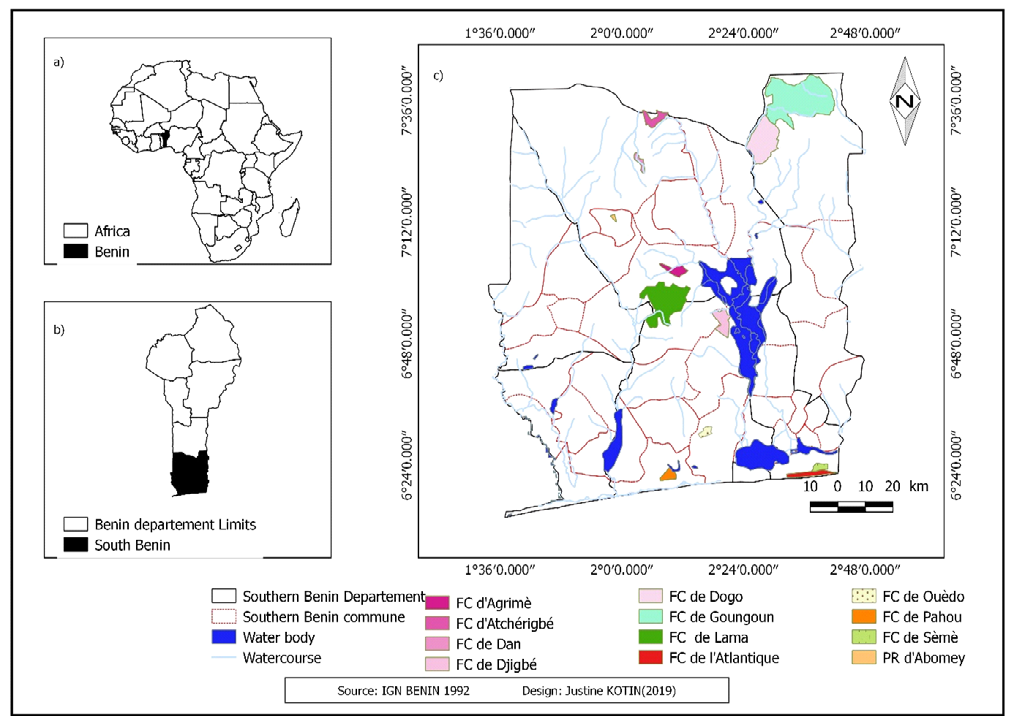
Study environment The present study was conducted in southern Benin, located between 1° 40’ and 2° 40’ east longitude and between 6° 20’ and 7° 00’ north latitude (Figure 1). Southern Benin is an environment that is influenced by a sub- equatorial climate with high humidity, and characterized by a long and short rainy season alternated by dry seasons. The temperature of the study environment varies between 28°C and 30°C, annual rainfall varies between 800-1200mm [8]. The soil types generally encountered in southern Benin are ferrallitic and hydromorphic soils [9]. The natural vegetation is distributed in the dry land and wetland formation. One encounters: mangroves, swamp savannahs, gallery forests, swamp forests, periodically flooded forests, herbaceous vegetation of brackish environments, and lagoons in temporary communication with the ocean [10]. Southern Benin is crossed by several rivers, namely the Mono, Couffo and Ouémé, and also has several bodies of water including Nokoué lake, Ahémé Lake and the Porto-Novo Lagoon (Figure 1).
Methodology
Investigation T. spekii is recognized as a wetland dependent species. Therefore, surveys were conducted among the sampled riparian populations in the swampy areas of southern Benin. Prior to the survey, the communes where there are still swamps were explored in order to identify and select the villages or localities that are close to the swamps and are almost at the natural stage, i.e. where there is less human action. Twenty- two (22) communes in four departments (see annex) were visited. The sampling technique used for the selection of respondents was the «snowball» method. The respondents to the questionnaires were hunters and farmers, 84% of the respondents were men, and most (53%) of the respondents were aged 45 years and over. The choice of these targets is justified by the fact that they are more frequently in contact with wildlife and therefore the results could be reassuring in terms of the quality of the answers provided as they can be based on their experiences. The snowball technique is used for the selection of respondents because a priori we do not have an exhaustive list of hunters and farmers. This technique allowed us to build on the recommendations of initial respondents to generate additional participants [11]. In total, 100 people were interviewed. The data collected mainly concerned the confirmation by local people of the presence of T. spekii in the marshes within the localities and the factors for the decline of the species’ habitat.
Collection of species occurrence data Three main sources were taken into account to obtain the occurrence data of T. spekii 1- Downloading data from the Global Biodiversity Information (GBIF) website (www.gbif.org )
2- Data from the literature
3- Collection of data in the field The literature guided us to survey the swampy areas of southern Benin. This survey allowed us to confirm or not the presence of T. spekii in the swamps. During this survey, we recorded several geographical coordinates indicating the presence of the species in these swamps, using a global positioning system (GPS). These data were complemented by occurrence data downloaded from the GBIF website (www. gbif.org; https://doi.org/10.15468/dl.fco9vc ) and data from the scientific literature.
Modeling of the ecology niche of T. spekii Environmental data used in the model On a large scale, climate is thought to be the main factor in the ecological niche of a species [12]. Thus, current and future bioclimatic variables at the spatial resolution of 2.5 arc minutes were downloaded from the Africlim website (www. africlim.org ) and were in TIF format. This dataset consists of 21 summary bioclimatic variables related to temperature and humidity. These data cover the period 1970-2000 [13]. The scenarios used are the Representative Concentration Pathways (RCP) 4.5 (optimistic scenario) and 8.5 (pessimistic scenario) (Meinshausen et al., 2011) at horizon 2055. Other biophysical variables such as: wetlands (https://databasin. org/datasets/ ; …consulted le 07/10/2019), landcover (https://databasin.org/datasets/ ; … le 07/10/2019), soil (https://webarchive.iiasa.ac.at/Research/LUC/ ...consulted le 07/10/2019), NDVI (www.usgs.gov ,consulted le 14/10/2019), elevation (https://globalmaps.github.io , consulted le 14/10/2019) were downloaded.
Data processing and analysis Survey data The data from the surveys were analysed and then entered into an Excel spreadsheet. We had to derive graphs from this spreadsheet to find out the threats to the species habitat.
Cleaning of occurrence data All GPS coordinates were entered into an Excel 2010 office file. At the GBIF data level, all data prior to 1970, duplicates, data without geographical coordinates, etc. were removed from the dataset. The dataset contains a total of 539 occurrence data. Then the Excel file was converted to csv format, which is the format compatible with MaxEnt software we used in ecological niche modeling.
Processing the bioclimatic variables After downloading the different bioclimatic variables, we calibrated the variables according to a mask defined according to the points of occurrence of the species in our study environment. The calibrated variables were brought to the same resolution (2.5mn) by an appropriate processing in QGIS 2.14 software. Then, we converted these different layers to ASCII format by assigning the value -9999 to grids without «No data value».
Model calibration Among many algorithms used for modelling we used MaxEnt [5]. (Version 3.4.0), to model the ecological niche of the T. spekii. Indeed, MaxEnt is known to have a better predictive ability than other algorithms [15]. It predicts a higher proportion of species occurrence, and is more useful for exploration purposes to discover new species ranges [15]. It has the ability to use presence data by generating the pseudo-absences itself. Before running the model, we checked the logistic format for the output of the results. We applied the parameter using 10,000 pseudo-absence points, a maximum of 1,000 iterations and a convergence threshold of 0.00001. Models were run using the Bootstrap as a replication method. 75% of the data was used to run the model and 25% to test the model. The remaining options were set as default. The final variables selected were used to run the model with 10 replications in the present at the Benin scale and in the future at the Benin and West Africa scale. Several approaches are cited in the literature to evaluate the performance of a model for predicting the presence or absence of a species in ecology. In the present study, we selected models using an independent threshold test. For this purpose, we considered the receiver operating characteristic (ROC) curve and its associated area under the curve (AUC) [5]; for additional model validation, we also used the online partial ROC test (http: //shiny.conabio.gob. mx: 3838 / nichetoolb2 ; Peterson et al. 2008). In addition, we used a threshold-dependent True Skill Statistic (TSS) test [16] to evaluate the decision thresholds, we chose to classify the MaxEnt outputs. • Processing and analysis of MaxEnt outputs The MaxEnt results were imported into QGIS 2.14 (http://www. qgis.org ) to map the extent of suitable habitats and their spatio-temporal dynamics under climate change.
Results
Threats to T. spekii.
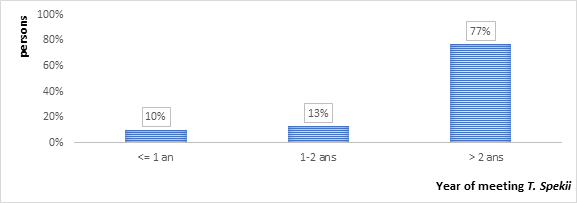
From figure 2, 77% of the respondents claim to have encountered the species more than two years ago, 13% encountered it at least two years ago and 10% encountered it at least one year ago.
Among the threats cited by our respondents, transhumance comes first, followed by hunting, agriculture, forest fires and urbanisation (Figure 3).
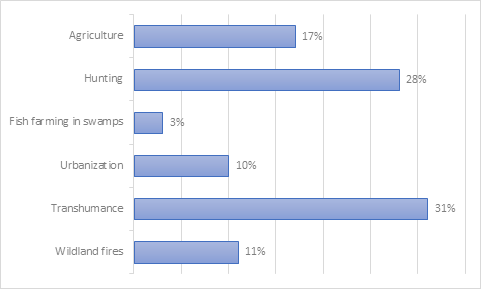
31% of respondents cited transhumance, 28% hunting, 17% agriculture, 11% forest fires, 10% urbanisation and 3% swamp fish farming as threats to T. spekii habitat.
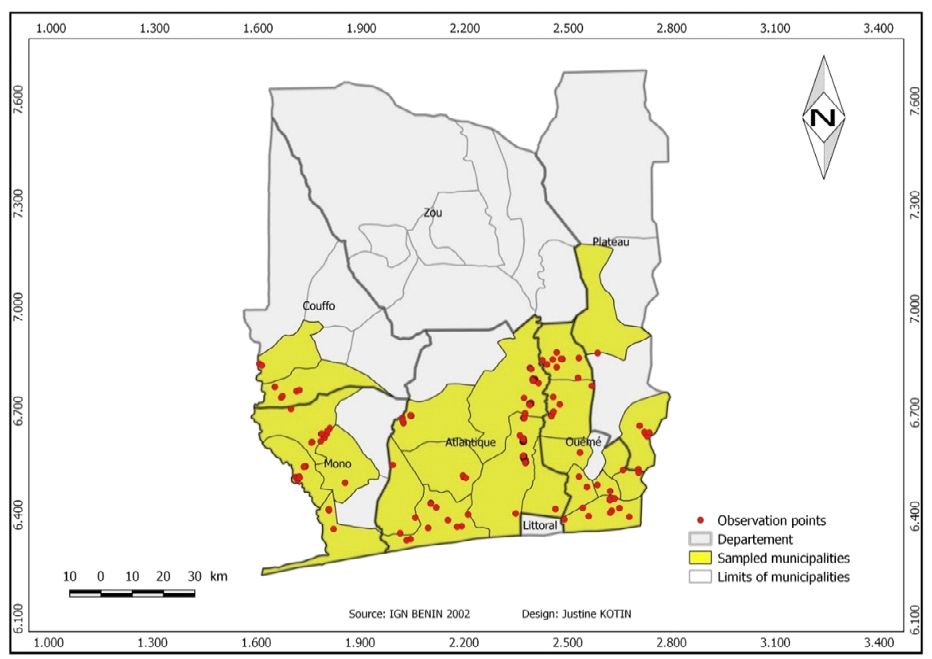
Geographical distribution of T. spekii in Southern Benin T. spekii is distributed in the South of the country mainly in the departments of Atlantique, Mono, Couffo, Ouémé and, the southern Plateau (Figure 4). In these departments, evidence of the presence of the water bush was mainly found in swamps and in forests near rivers that are periodically flooded. These areas are found at the bottom of the slopes of each locality. The soils in these areas are silty-clay, soft to the touch and heavy. The dominant plant species in these swamps is Cyclosorus interruptus (will) H. It occurs in dense mats.
Modeling the ecological niche of T. spekii
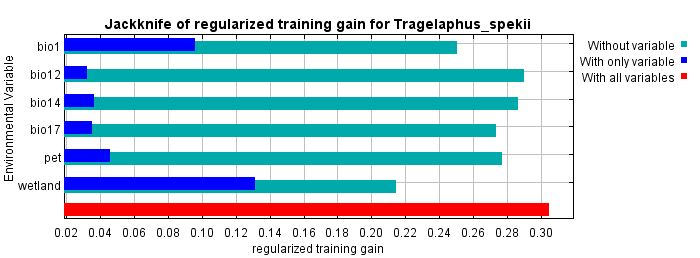
Variables retained in the model Based on the ecology of the species, the possible correlations between the variables in the model and the jackknife test, 06 variables determine the spatial distribution of the species (Table 1). The variable «wetland» is the most important contributor (28.6%) and confirmed the ecology of the species; the variable mean annual temperature (bio1) has the highest weight (21.7%) when replaced in the model. The jackknife tests show that the omission of the mean annual temperature (bio1) resulted in a remarkable loss of information (Figure 5).
| Variable | Variable definition | Percentage contribution (%) | Importance of permutation (%) |
|---|---|---|---|
| Wetland | Wetland | 28,6 | 16,4 |
| bio1 | Mean annual temperature | 27,9 | 21,7 |
| Pet | Potential evapotranspiration | 17,3 | 15,8 |
| bio17 | Rainfall of wettest quarter | 14,3 | 19,7 |
| bio14 | Rainfall of driest month | 6,9 | 10,5 |
| bio12 | Mean annual rainfall | 5 | 15,8 |
Table 1: Contribution of variables to the ecological niche model of T. spekii.
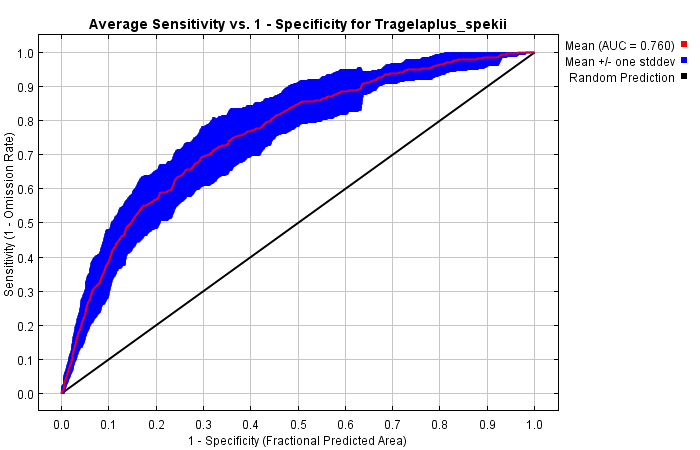
Model validation The average AUC for the 10 replicates of the model is 0.760 with a standard error of 0.039 (Figure 6). This shows that the model is better than a random model and that the AUC is not very scattered around the mean value. The results of the partial ROC test showed that after 500 simulations, the mean value of the AUC ratio at a jump rate of 0.05 is 1.99 and that of the AUC is 0.99. Furthermore, the test showed that the difference between the AUC of the model prediction and the AUC of the random model is highly significant and therefore the model performs better than a random model. The True Skill Statistic (TSS) values at the threshold values of 0.201 (minimum presence, conservative option) and 0.474 (maximum sensitivity and specificity, least conservative and most likely presence option) are 0.091 and 0.399 respectively and also showed that the model is better than a random model.
Spatial distribution of T. spekii in the present and in the future
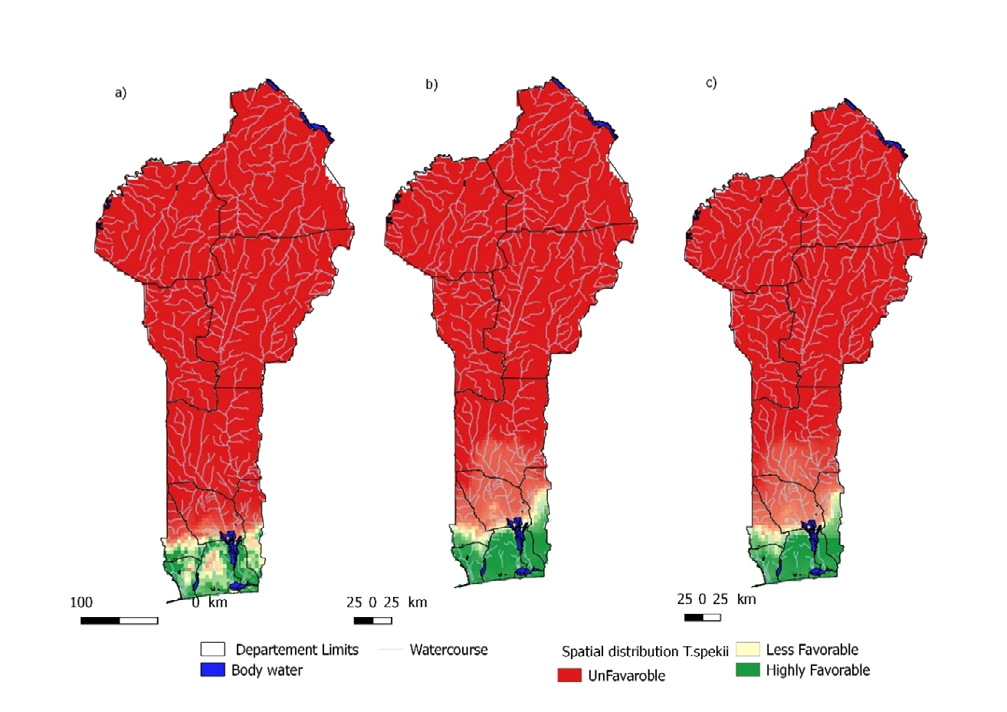
The modeling results indicated that only the southern part of Benin is currently favourable for the species (Figure 7). The areas favourable to the species cover more precisely the Atlantic departments (communes of : Abomey-Calavi, Ouidah, Zè, Allada, Toffo, Kpomassè, Soava, and Tori- Bossito); Littoral (Cotonou); Mono (communes of: Lokossa, Athiémé, Grand-Popo, Comé, Bopa, and Houéyogbé), Couffo (communes of: Lalo, Dogbota, Toviklin, and Djakotomè), Ouémé (communes of: Bonou, Adjohoun, Dangbo, Akpro- missereté, Adjarra, Porto-Novo and Aguégué), Plateau (communes of: Pobè, Adja-Ouerè, Sakété and Ifangni) and Zou (communes of: Zogbodomè and Ouinhi). These favourable areas are influenced by a sub-equatorial climate that is compatible with the ecology of T. spekii. A large part of the commune of Allada in the Atlantic department is unfavorable to the species. The center and north of the country are not favourable for the spatial distribution of the species. It should also be noted that the main rivers of Benin cross these areas that are favourable to the species: the Ouémé and Mono rivers, the Ahémé, Toho and So lakes. Projections for the future showed that, compared to the present, the favourable areas have expanded to the centre- south of the country. The communes of Aplahoué and Klouékanmè in the department of Couffo; the communes of Agbagnizoun, Abomey, Ouinhi, Djidja, Covè, Zandjannado, Bohicon and Za-Kpota in the department of Zou; the communes of Savè, Savalou, Glazoué and Dassa-zoumé in the department of Collines; and the commune of Kétou in the department of Plateau will become favourable areas for the species by 2055. Under the rcp 8.5 scenario, the favourable areas in the above-mentioned communes will be more stretched than under the rcp 4.5 scenario (Figure 7).
Projection of T. spekii over West Africa at present and in the future
The results indicated that only the southern part of West Africa is favourable for the species.
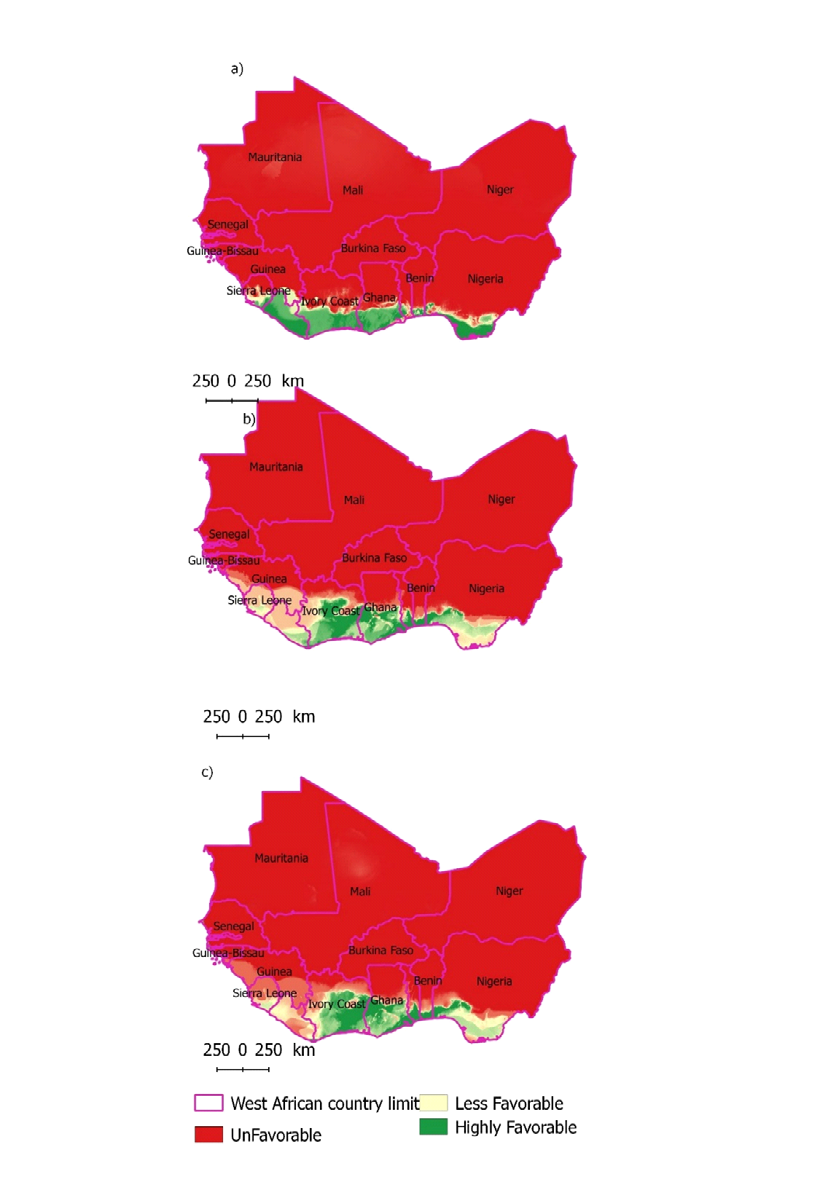
This is a coastal strip of about 50 to 100 km wide that stretches from southern Nigeria to eastern Benin and ends at Sierra Leonne (Figure 8a). In the future with the Rcp4.5 and 8.5 scenarios this coastal strip will widen to Guinea and a small part of southern Guinea-Bissau is favourable (figure 8 b and c). In the Rcp4.5 scenario, the favourable areas of the present will widen more than the favourable areas of the Rcp8.5 scenario (figure 8 b and c).
Discussion
Factors involved in the decline of T. spekii in its habitats
Our results showed that the destruction of the species’ habitats (wetlands) due to hunting, agriculture, transhumance, bush fires, urbanisation, etc. contributes significantly to its decline. These results confirmed those obtained by other authors. Indeed, Ndawula [18] reported that T. spekii is a well endangered antelope in the Rushebeya- Kanyabaha wetland in Uganda due to the decline of its habitat. In Benin, Kidjo [7] found that the habitat of the T. spekii is now greatly reduced from 24.75% of the Beninese territory to 6.07%. According to a study by Djego-Djossou and Sinsin [19] , the reduction in density of many mammals is linked to the fragmentation of their habitats. The same observation was made in Morocco by Cuzin [20] ,who explained that the regression of large mammals is generally due to a set of interacting factors, the most important of which are hunting and environmental degradation. Our results also showed that human pressure is a great risk for T. spekii. This corroborates the results of Kidjo [7]. Who found that anthropogenic pressure is the primary risk to which T. spekii is subjected.
The seasonal movement of pastoralists with their livestock, generally recognised under the terminology of ‘transhumance’, is one of the human activities that undeniably contributes to the disappearance of T. spekii. Indeed, during transhumance, cattle destroy the species’ habitat by grazing and trampling the grasses that could serve as food and protection. Indeed, according to a study by Tweheyo et al [21], 33% of the diet of T. spekii consists of grasses. Transhumance is therefore a stress factor for T. spekii.
Ecology of T. spekii and main environmental factors governing its ecological niche
The results of the fieldwork revealed that T. spekii is found in the sub-equatorial zone of southern Benin in swamps and forests located near rivers and which are therefore periodically flooded. These results are consistent with those reported by other authors. Indeed, according to Kidjo et [7], T. spekii is most often found in the Guinean zone in gallery forests, swamps and swampy galleries. This species is adapted to wetlands since, depending on its morphology, it can swim in swamps [22]. Thus, as far as the ecology of T. spekii is concerned, our results are consistent with reality. Indeed, the variables wetland, mean annual temperature (bio1) are the ones that most contributed to the projection model of the species’ spatial distribution. There are several reasons for the high contribution of the wetland variable. Indeed, humidity allows plants to develop. And it seems normal that the species is much more present in wetlands because of the presence of specific plants that constitute its food. According to Tweheyo [21] T. spekii feeds mainly on leaves (60%), and in wetland edge habitats. Thus, the plants in the diet of T. spekii may suffer from a lack of moisture [23]. Temperature is a determining factor in the spatial distribution of animal and plant species. It is therefore not surprising that temperature turns out to be the second most contributing variable in the model. This is because plant growth and development is a function of ambient temperature and each environment is characterized by a minimum, maximum and optimum temperature [24]. Potential evapotranspiration, precipitation in the driest quarter, precipitation in the driest month and annual precipitation contributed significantly to the model as well and are part of the species ecology.
Impact of climate and global changes on the distribution of T. spekii in Benin
According to the results of our work, there are favorable areas for T. spekii in West Africa in general and in Benin in particular. By horizon 2055, according to the RCP 4.5 and RCP 8.5 scenarios, Benin will experience an increase in favorable areas and priority areas for the conservation of the species. This means that climate change will not have a negative effect on the favorable areas for T. Spekii. Various results are reported in the literature on different animal species. For example, the results of Dossou et al. [25]. Showed that there are fewer areas of high suitability for the common hippopotamus in southwest Benin due to human activities. Matawa et al. [26] showed that fields near elephant preferred areas have a negative impact on elephants. In the same vein, results from Freeman et al. [27]. Showed that the predicted impacts of climate change on the geographical distribution of the white-breasted guinea fowl will be minimal, suggesting stability throughout the species’ range in the present and future. We infer from this work that climate change is not always the only factor affecting the spatial distribution of species. We acknowledge here the limitations of our results due to the fact that other variables such as anthropogenic pressures, habitat degradation, urbanization etc. are not directly introduced into the model and may be limiting factors to the favorable areas of the species predicted in this work.
Conservation strategies for the species in the context of climate and global change
Our results showed that climate change will not have a negative effect on the favorable areas of the species (Figures 7 and 8). Conservation strategies for the species should therefore take into account human actions rather than climate change. We therefore recommend
- An inventory of the species in its favorable areas (Figures 7b and 8b), in order to identify where it is actually present;
- That the forest administration and its depending services introduce the species in favorable areas where the species is absent or in low density;
- That an artificial park be created in the species’ favorable areas to compensate for the perpetual degradation of wetlands, favorable habitats to the species;
- That no-governmental organizations (ONG) fighting for the conservation of biodiversity in general and interested in wetlands in particular, in collaboration with the forest administration, organize workshops to raise awareness on the threats to Tragelaphus spekii and advise the population on appropriate behavior compatible with the conservation of the species;
- Involve the population in income-generating activities in order to encourage them to contribute to the sustainable management of the species habitats.
Conclusion
The variables governing the spatial distribution of the species are consistent with its ecology. At present and in the future (horizon 2055), climate change will have a positive effect on the spatial distribution of the species. Taking into account the effects of climate change, we recommended strategies for the conservation and sustainable management of the species. Modelling of ecological niches of other species of the same family as T. spekii is needed to raise awareness of the risks of species extinction in wetlands.
Acknowledgment
The authors are grateful to the JRS Biodiversity Foundation for its financial support to the Master and Ph. D program in Biodiversity Informatics in Benin and also thank Professor Peterson Town of the University of Kansas (USA) for his dedicated role as advisor to the Biodiversity Informatics program.
References
-
Amar R (2010) Impact de l’anthropisation sur la biodiversité et le fonctionnement des écosystèmes marins : exemple de la Manche-mer du nord. [VertigO] La revue électronique en sciences de l’environnement, Hors-série: 8.
-
Collen B, Whitton F, Dyer EE, Baillie JEM, Cumberlige N (2014) Global patterns of freshwater species diversity,threat and endmism. Global Ecology and Biogeography 23: 40-51.
-
Magliocca F, Quérouil S, et Gautier-Hion A (2002) Grouping patterns, reproduction and dispersal in a population of sitatungas (Tragelaphus spekei gratus). NRC Research Press 80(2): 245-250.
-
Neuenschwander P, Sinsin B, Goergen G (2011) Protection de la Nature en Afrique de l’Ouest: Une Liste Rouge pour le Bénin. Nature Conservation in West Africa: Red List for Benin. International Institute of Tropical Agriculture, Ibadan, Nigeria, pp: 365.
-
Phillips SJ, Anderson RP, Schapire RE (2006) Maximum entropy modeling of species geographic distributions. Ecol Model 190(3-4): 231-259.
-
Kidjo FC, Djossa BA, Houngbedji MG, Lougbegnon OT, Codjia TC, et al. (2011) Ecologie alimentaire du Guib d’eau (Tragelaphus speckei, Sclater, 1864) dans les sites Ramsar du Sud-Bénin. Int J Biol Chem Sci 5(2): 603-617.
-
Kidjo FC, Lougbegnon OT, Codjia TC (2012) Analyse des facteurs de distribution actuelle et passée du Guib d’eau (Tragelaphus spekiiSclater, 1864) au Bénin. Revue de Géographie du Laboratoire Leïdi 10 **:** 200-212.
-
Météo Bénin (2013) Guide voyage Capaustral climat Cestanet inc, pp: 1.
-
Blalogoé CP (2014) Stratégies de lutte contre les inondations dans le grand Cotonou: diagnostic et alternative pour une gestion durable. Thèse de Doctorat Unique, Abomey-Calavi, Université d’Abomey-Calavi, pp: 242.
-
Adjakidjè V, Sokpon N (2001) Inventaire et caractérisation de la flore et de la végétation des complexes Est et Ouest des zones humides du Sud-Bénin. PAZH/Bénin, pp: 65.
-
Johnston lG, Sabin K (2010) Echantillonage determine selon les repondants pour les population difficiles a joindre. Methodological Innovations Online 5(2): 38-48.
-
Parviainen M, Luoto M, Ryttari T, Heikkinen Rk (2008) Modeling the occurrence of threatened plant species in taiga landscanes: methodological and ecological perspectives. J Biogeoger 35(10): 1888-1905.
-
Hijmans RJ, Cameron ES, Parra LJ, Jones GP, Jarvis A (2005) Very high resolution interpolated climate surfaces for global land ereas. International journal of climatology: A Journal of the Royal Meteorological Society 25(15): 1965-1978.
-
Meinshausen M, Smith SJ, Calvin K, Daniel JS, Kainuma MLT, et al. (2011) The RCP greenhouse gas concentrations and their extensions from 1765 to 2300. Climatic Change 109: 213.
-
Pearson GR, Raxworthy JC, Nakamura M, Peterson AT (2007) Predicting species distributions from small numbers of occurrence records: a test case using cryptic geckos in Madagascar. J Biogeogr 34(1): 102-117.
-
Allouche O, Tsoar A, Kadmon R (2006) Assessing the accuracy of species distribution models: prevalence, kappa and the true skill statistic (TSS). Journal of Applied Ecology 43(6): 1223-1232.
-
Tweheyo M, Amanya KB, Turyahabwe N (2010) Feeding patterns of sitatunga (Tragelaphus Speki) in the Rushebeya-Kanyabaha wetland, south western Uganda. African Journal of Ecology 48(2): 1045-1052.
-
Ndawula J, Tweheyo M, Tumusiime MD, Eilu G (2011) Understanding sitatunga (Tragelaphus spekii) habitats through diet analysis in Rushebeya-Kanyabaha wetland, Uganda. African Journal of Ecology 49: 481-489.
-
Djego-Djossou S, Sinsin B (2009) Distribution et statut de conservation du colobe de Geoffroy (Colobus vellerosus) au Bénin. Int J Biol Chem Sci 3(6): 1386-1397.
-
Cuzin F (1996) Répartition actuelle et Statut des grands mammifères sauvages du Maroc (Primates, Carnivores, Artiodactyles). Mammalia 60(1): 101-124.
-
Tweheyo M, Amanya KB, Turyahabwe N (2010) Feeding patterns of sitatunga (Tragelaphus Spekii) in the Rushebeya-Kanyabaha wetland, south western Uganda. African Journal of Ecology 48(2): 1045-1052.
-
Hainard R (1962) Le Chevreuil Capreolus capreolus Linné 1758. Mammifères sauvages d’Europe, E. D. Niestlé, (Edn.) Neuchâtel 99: 57-68.
-
Haferkamp MR (1987) Environmental factors affecting plant productivity. In: White RS, Short RE (Eds) Achieving efficient use of rangeland resources. Montana Agricultural Experiment Station: 132.
-
Hatfield JL, Prueger JH (2015) Temperature extremes: Effect on plant growth and development. Weather and Climate Extremes 10: 4-10.
-
Dossou ME, Houessou GL, Lougbegnon OL, Jean T. Claude Codjia CTJ (2018) Common hippoptamus (Hipopotamus amphibius) habitat suitability modeling in Southwestern Benin. Annales de l’Université de Parakou Naturelles et Agronomie 8(1): 57-64.
-
Matawa F, Murwira A, Schmidt SK (2012) Explaining elephant (Loxodonta africana) and buffalo (Syncerus caffer) spatial distribution in the Zambezi Valley using maximum entropy modelling. Ecological Modelling 242: 189-197.
-
Freeman B, Jiménez‑García D, Barca B, Grainger M (2019) Using remotely sensed and climate data to predict the current and potential future geographic distribution of a bird at multiple scales: the case of Agelastes meleagrides, a western African forest endemic. Avian Research 10(1): 2-9.
- Lessons to Learn: Trees are More than the Lungs of the World
- Community Forestry Enterprises as a Model for Sustainable Forest Development: The Case Of The "Baja Tarahumara" in Chihuahua, Mexico
- Ecological and Socio-Economic Impacts of Chromolaena odorata and Mesosphaerum suaveolens, Two Invasive Alien Species in Central and Southern Benin, West Africa
- Epigenetic Sustainability: Modeling the Human Factor as a Natural Resource through Science 4.0 and the NR3C1 Biological Pilot
- Growth-at-Risk: A Framework for Assessing Economic Vulnerability
- The Rural Territory as a Socioecological System for the Management of Public Policy for Sustainable Rural Development