
The Environmental Consequence of Automobile and Motor-bike Traffic Noise Intensity on the Activity of African Grey Parrots (Psithacus erittacus) in Limbe Botanic Garden, Southwest Region, Cameroon
Highway traffic noise pollution is unavoidably generated by human activity, and has caused serious health problems to the human society. However, it’s also a challenge to many wildlife species, though, continous exposure to the noise stimuli has seemingly given them adaptation. Understanding the ability of wildlife species to cope with noise pollution is complex, thus, requires research. Therefore, the objective of this study was to explore automobile and motor bike traffic noise intensity on African grey parrots’ activity in Limbe Botanic Garden. The research data was collected for a period of three months from 8:00 am - 5:00 pm each day. Traffic noise pollution is difficult to avoid in urban settings because of huge human population and its activity, however, its interference with other sounds is common, and wildlife population living in cities, such as birds are affected. The study revealed a positive significance X2 = 25.796 df=2 P=0.000 and X2 =39.489 df=6 P=0.000 on photo- period and meteorological conditions respectively. Moreover, meteorological changes in the study area recorded significance on sun 75%, cloud 15%, wind 6%, and rain 4% respectively. Furthermore, noise intensity of automobile and motor bike traffic around the botanic garden area showed a significance X2 = 5.657 df=8 P<0.05, and r = 0.209 P=0.000 on behavior and parrots' food availability respectively. The highest parrots’ activity recorded during this study was on contact calls 54%, and the least was roosting 3%. Though a comprehensive inventory is not carried out on the parrot population in Cameroon, there are signs, these birds are already facing population reduction; principally because of the pet-trade driven by the craving human love for the colourful plumage morphology and the talented sound-mimicking behavior of the parrots. There is a necessity for further study to be carried out on the birds’ population census in the country. The study found that traffic noise intensity at all levels have a negative influence on the aggregation activity of grey parrots, reason why they avoid the vegetation along the streets of the garden. Finally, oil palm fruit-feeding was a dominant activity recorded in this study, hence, we recommend more oil palm trees be planted in the garden far from major roads to enrich the feeding environment of the grey parrots.
Introduction
Interest in the ecological effects of roads and the traffic they carry has increased over the past two decades [1, 2, 3, 4]. These effects include the loss and fragmentation of habitat, injury and death of wildlife attempting to cross roads, pollution of air, water, and soil, and constraints on acoustic communication in areas affected by traffic noise. Many animals including insects, frogs, birds, and mammals communicate via acoustic signals. Birds use calls and songs to attract and bond with mates, defend territories from rivals, maintain contact with social groups, beg for food, and warn of danger from approaching predators [5, 6]. Acoustic interference, also known as masking, occurs when background noise reduces the distance over which a signal can be heard (the active space; Marten and Marler [7]). Birds use a variety of strategies to maximize the active space of their signals in naturally noisy habitats [8]. However, those that live near roads must also compete with traffic noise, much of which occurs in the low-frequency bands below 2000 Hz [9, 10]. Because energy in the spectral region of an acoustic signal contributes more to masking than does energy remote from the signal [11], low-frequency signals are expected to suffer greater acoustic interference from traffic noise than are high-frequency signals. Most research to date on the impact of traffic noise on wildlife has focused on birds in the northern hemisphere [12, 13]. A range of behavioral responses to urban noise has been observed, including singing at a higher frequency (pitch), thereby reducing acoustic interference from the low-frequency noise [14, 15, 16, 17]; and changing diurnal singing patterns to avoid peak traffic periods [18]. Traffic noise may also affect bird populations and communities [19]. Reijnen, et al. [20, 21] suggested that the lower population densities of birds in habitats close to roads in Netherland were caused by traffic noise, although these results may be confounded with other differences among the noisy roadside sites and the quieter control sites away from roads. Traffic noise was also proposed as the primary cause of reduced breeding success in Willow Warblers (Phylloscopus trochilus) with territories close to busy roads; the males had difficulty attracting and maintaining a mate [22]. Rheindt [23] hypothesized that birds with low-frequency calls or songs would be less abundant at sites with high levels of traffic noise because they would experience greater acoustic interference from low-frequency noise. In an unreplicated study, Rheindt [23] found some evidence that species with lower frequency signals were less abundant in noisy sites than they were in quiet sites.
Traffic volume and the number of vehicles traveling on an adjacent road could also affect birds in roadside habitats. The probability of a fatal collision with a vehicle is likely to increase with traffic volume [24], as will visual disturbance by passing cars and trucks. The impact of visual disturbance from passing vehicles on habitat suitability for birds is poorly understood [25], but could include avoidance of roadside areas for foraging and/or nesting, or reduced breeding success. Because both the level of traffic noise and the frequency of visual disturbance from passing vehicles increase with traffic volume, their effects are difficult to separate. However, Reijnen, et al. [20] controlled for the visibility of cars in their analysis of bird densities in woodland habitats adjacent to and distant from roads, and concluded that traffic noise had a greater effect on bird densities than did visual disturbance.
During the agricultural expansion of Australia, vast areas of native forest and woodland were cleared for pasture and crops. In many rural landscapes, much of the remnant vegetation is confined to narrow strips on public road reserves, forming a network of native habitat [26]. Road reserves cover 567,000 ha (2.5%) of the state of Victoria [27]. They provide important habitat for many species of plants and animals, including the threatened Grey-crowned Babbler (Pomatostomus temporalis), Squirrel Glider (Petaurus norfolcensis), and Brush-tailed Phascogale (Phascogale tapaotafa) [28, 29, 30]. A recent study of bird communities of roadside remnants on the Mornington Peninsula, Victoria recorded 39 native species across eight transects [31]. Similarly, roadsides provide valuable habitat for plants, insects, birds, and mammals in the USA, UK, and Europe [32, 33, 34, 35, 36]. The use of roadside habitats by animals that communicate using acoustic signals, such as birds, presents an interesting trade-off between the presence of suitable habitat and the potentially detrimental effects of traffic noise and passing vehicles on survival rates, maintenance of territories, attraction of mates, and breeding success [10, 37].
The conservation of parrots in the tropical rainforest habitat is an ecological achievement benefiting humans in many aspects. Beauty of the grey parrots endemic in the gulf of guinea has been the major setback to their population loss in the region. Cameroon is rich in rianforest vegetation in the southern ecological zone of the country. This is enhancing the population of rainforest-wildlife-dependent species, such as the african grey parrots. Though a comprehensive inventory is not carried out yet on the parrot population in Cameroon, there are signs, these birds are already facing population reduction, a situation believed to have been caused by pet-trade business driven by a craving human love for the colourful plumage morphology and the talented sound-mimicking behavior of grey parrots. Noise intensity from automobile and motor bike traffic was examined on the activity of parrots.
Materials and Methods
Description of the study area
Limbe Botanic Garden (LBG) is the first botanic garden in Cameroon and the oldest in Africa. It was created in 1892, during the German colonial era, in Victoria (former name of Limbe), between the ocean and Mount Cameroon at 4°0’49.46″N and 9°12’3.13″E (fig. 1). Initially intended for agricultural purposes, it has become one of the main curiosities of the South West Cameroon Region. The Garden has also served as a training center for Cameroonians in the fields of agriculture, horticulture and forestry. It is also an international center for biodiversity research [38].
Today, the garden, which originally covered 250 hectares, has only 48 hectares, the rest (202 hectares) is the rainforest. The garden has about 1,500 taxa (1,000 herbaceous and 500 woody plants). There are rare or endangered plants: 150 endemics, 100 from the south-west, including Calamus sp, Prunus africana, Gnetum spp. Some plants are the object of particular attention, notably the African palms, the endemic plants of Mount Cameroon, the Musa spp. Others are cultivated for conservation purposes: Irvingia gabonensis, Garcinia kola, Afrostyrax kamerunensis, Cola spp, Prunus africana, Gnetum spp, Pterocarpus soyauxii, Diospyros, Rauvolfia vomitoria, Nauclea diderrichii, Terminalia spp, Enantia chlorantha, Eremomastax speciosa, Bryophyllum spp and Physostigma venenosum. The botanical garden also houses a herbarium, which in 2001 had about 21,000 specimens and more recently 30,000. Its acronym in the Index Herbariorum is SCA [38].
![Figure 1: Limbe Botanic Garden [38].](/fulltextimages/10670/fig_1.png)
Method of Data Collection
Data collection was done for a period of three months, each day from 8:00 am – 5:00 pm. However, the research data collection methods were tested to have a feasibility confirmation on the various that were to be used during the process. A letter of authorization was written by the Department of Forestry and Wildlife to the authorities of Limbe Botanic Garden for research approval before the data collection was launched. The Garden has a longstanding reputation on the conservation of many endangered species of plants, and also has rainforest where this study carried out. The rainforest vegetation area has many species of wild bird, including the African grey parrots, believed to be homed by the zoological garden. The highway traffic noise intensity was tested on meteorological conditions, photo- period, behavior, and food availability.
Data Analysis
The research data was analyzed by using SPSS version 25, with the help of statistical models, such as chi-square and spearman correlation. Analysis started with exploratory statistics, and later the variable were subjected to a further test of inferential statistics. Traffic noise intensity variable was tested against meteorological conditions, photo-period, behavior, and food-type. Hence, the result of analyzed data was displayed on bar-charts, pie-charts, and graphs.
Results
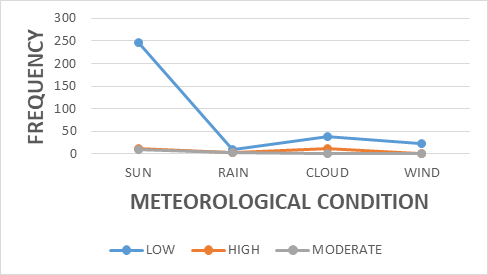
Traffic noise pollution is difficult to avoid in urban settings because of huge human population and its activity, however, its interference with other sounds is common, and wildlife population living in cities, such as birds are affected. This study revealed a positive significance X2 = 25.796 df=2 P=0.000 and X2 =39.489 df=6 P=0.000 on photo-period (Figure 2) and meteorological conditions (Figure 3) respectively. Wildlife and other animals depend on vocalization, a means of mine-expression on many events and activities. Social organization in humans is enhanced by the talking ability; hence an individual’s capacity to communicate well earns him/her an edge over others. The human education is a great communication tool enhanced by good communication ability. Animals that do not communicate by writing solely depend on contact calls, songs, roars, screams, whistles, and many other related vocalizations depending on the animal species. Human activity in Limbe city is the major source of noise pollution interfering with African grey parrots’ vocal communication. Feeding location, mating partner attraction, predatory defense, movement to new areas in groups, all depend on communication. Unfortunately, the automobile traffic of Limbe city would not allow effective communication of the grey parrots to have an expected social organization that would deliver their needs. This study recorded relatively low noise intensity in many locations of the study area, the vegetation nearer the automobile highway where some of the parrots supposed to have been feeding were with less or no birds. Clearly indicating the negative cost of noise pollution on some behavioral activities, such as feeding. In the case of humans, this kind of disturbance would be reported to the city administrative authorities for an immediate remedy, but not same with wildlife.
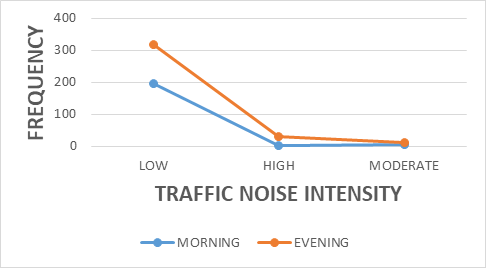
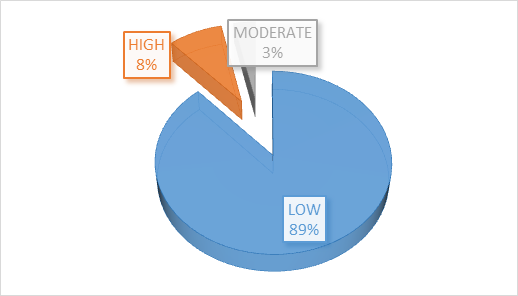
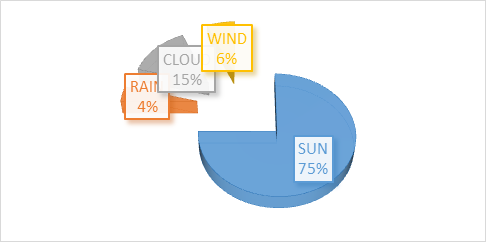
Automobile and motor bike noise pollution is associated to Limbe city traffic activity, just like any other city in the country. Noise intensity witnessed during the study was low 89%, high 8%, and moderate 3% respectively (Figure 4). Though, noise intensity was recorded low in the garden, it was relatively high at the vegetation close to the roads, an area expected to have a huge activity of parrots. Activity preference and priority were given to noiseless areas far away from the road-traffic. Meteorological changes in the study area recorded significance on sun 75%, cloud 15%, wind 6%, and rain 4% respectively (Figure 5). Atmospheric conditions are very important in determining the daily activities of wildlife; feeding, grooming, resting, playing, movement, roosting etc. In the study area, a bright sunny atmosphere with low traffic noise intensity recorded the highest activities of parrots, especially feeding and foraging.
Several studies have shown that a highway traffic volume with noise intensity is a deterrent to many wildlife activities. Even with the rich vegetation on the roadside habitats of the garden, the presence of parrots was not significant. The study also discovered that even during very low traffic volume, parrots and other birds species were hardly observed feeding on these road stretch habitats because of noise. The acoustic interference on parrots’ social communication activity caused by the traffic noise pollution might be the major reason for abandoning healthy feeding areas in the garden. Prolong exposure to traffic noise intensity can cause hearing disorder, increase in blood pressure, headache, and other similar discomforts in humans, however, in birds it’s not clear whether same health disorder occurs. But avoidance of these noisy areas might go beyond their contact call disturbance or acoustic interference, their fear to sight automobile and motor bikes at proximity distance may also be a reason.
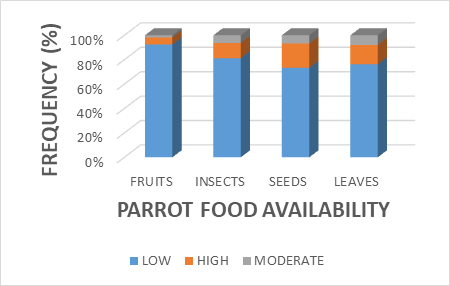
The noise intensity of automobile and motor bike traffic around the botanic garden area showed a significance X2 = 5.657 df=8 P<0.05, and r = 0.209 P=0.000 on birds’ behavior (Figure 6) and their food availability (Figure 7) respectively. Social organization in parrot groups needs vocalization communication, especially during movement migration for healthy safe feeding areas. Group feeding and foraging during their routine daily activities also depend on effective visual and contact call communication. Hence, any slight obstruction to this system of activity program might obstruct and compromise the survival strategy of the entire bird community.
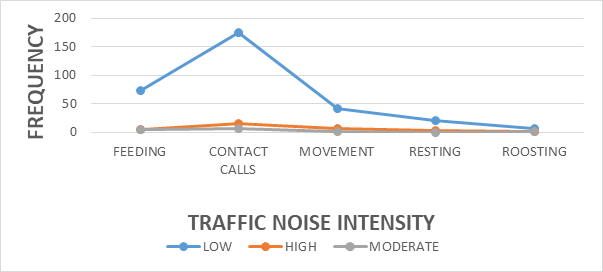
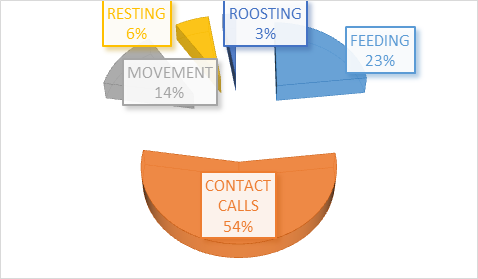
The highest parrot activity recorded in during the study was contact calls 54%, and the least was roosting 3% (fig.8). Bird communication in general, enhances contact calls, mating, feeding, and other social organizational requirements. Vocalization in birds is the pivot of other behaviors; hence, any negative interference caused by highway traffic system could destabilize their population, as well as reducing their survival in that habitat.
Discussion
Roadsides provide important habitat for birds in many countries around the world. They currently support a variety of threatened species [28, 37, 39]. Such species may be more vulnerable to the combined effects of traffic noise and passing vehicles than the common and widespread Grey Shrike-thrush and Grey Fantail. If roadside habitats are otherwise suitable for threatened species, this could be an argument for protecting them from noise and/or passing vehicles. But how do we do this? Installing sound barriers in urban habitats, as suggested by Slabbekoorn and Ripmeester [4], would create barriers to movement for a variety of terrestrial animals, contributing to landscape fragmentation and the isolation of populations [1, 3]. Sound barriers are also expensive to construct and install, and contain substantial amounts of embodied energy. Alternatives to sound barriers include more careful consideration of the impact of traffic noise on animals that communicate acoustically when new roads are being planned, reducing traffic noise by changing road surfaces or decreasing the speed of vehicles, re-routing existing roads around important habitats for threatened species, or even closing roads during certain times of the year [4]. Closing key roads during the breeding season could help to protect populations of threatened bird species from traffic noise and collision with vehicles at the time of year when they are most vulnerable. However, the effectiveness of such a strategy has yet to be examined for birds.
Traffic noise could affect bird populations in a number of ways. Acoustic interference from noise could hamper the detection of song by conspecifics, making it more difficult for birds to establish and maintain territories, attract mates, and/or maintain pair bonds [22, 40, 41]. This, in turn, may reduce breeding success in noisy roadside habitats. When begging for food, nestlings may need to call louder to elicit the desired response from their parents, thereby increasing the energetic cost of obtaining food and potentially decreasing fitness. High levels of traffic noise may also interfere with the detection of alarm calls such as those signaling the presence of predators, which could lead to higher rates of predation. There is evidence from studies in the northern hemisphere that traffic noise reduces the density of bird populations [20, 21, 42], but more research is needed to establish the generality of these patterns. These studies have inferred effects of traffic noise on bird populations from increases in the occurrence and/or density of birds with increasing distance from roads [20, 21, 42]. However, such changes could be partially a result of other differences between roadside and road-distant habitats.
There are a number of possible explanations for the observed results. First, traffic noise could be the real factor limiting populations of the Grey Shrike-thrush and Grey Fantail in roadside habitats, and the observed decline in the probability of detection with increasing traffic volume might be spurious, i.e., an observation attributable to the high correlation between traffic volume and traffic noise. Alternatively, both traffic noise and traffic volume might reduce habitat suitability and affect the persistence of populations of the Grey Shrike-thrush and Grey Fantail in roadside habitats. The probability of a fatal collision between a bird and a passing vehicle is likely to increase with traffic volume [24, 43], thereby reducing survival rates of adults and/or juveniles in roadside habitats. If this reduction were sufficiently large and not offset by immigration, it could lead to local extinction. Mumme, et al. [37] investigated the population-level response of Florida Scrub Jays (Aphelocoma coerulescens) to an adjacent two-lane highway with a traffic volume of 500 vehicles/d. They concluded that roadside habitats were acting as a population sink in which deaths of breeding birds from road-kill outweighed the number of fledglings that survived to adulthood. A mathematical model developed by Jaeger, et al. [44] also supported traffic volume as an important determinant of the persistence of wildlife populations in habitats near roads. Passing vehicles reflect sunlight by day and flash headlights at night [25]; their movement may disturb birds, lower rates of occupancy, and/or reduce breeding success at busy sites with high traffic volumes. However, it is difficult to separate the biological effect of visual disturbance from passing cars and the effect of disturbance by traffic noise, and only one other study has attempted to do so. Reijnen, et al. [20] assessed the effect of each variable while controlling for the other. They found that traffic noise reduced the density of more species of birds in woodlands than did the visibility of passing cars. Disturbance by pedestrians is known to interrupt activities such as foraging, nest building, and chick feeding in woodland and heathland birds, leading to reduced breeding success [45, 46], whereas disturbance by vehicles can reduce the breeding success of ground-nesting birds in open coastal habitats [47]. However, the way in which birds of roadside habitats respond to disturbance by vehicles is uncertain.
Detailed studies of song frequency within individuals over time would address the question whether the observed frequency shift is a short-term, plastic response to noise or a more consistent phenomenon such as a dialectical change in noisy areas. Songbirds learn their songs from parents and neighbors, and some species can incorporate new songs into their repertoire throughout their lives [48]. Low-frequency components of songs will be more difficult to detect in noisy roadside habitats, and may not be learned by other neighboring birds [14, 49]. This could lead to the relatively rapid development of dialects with improved detectability in noise among populations occupying noisy roadside habitats [16]. A dialectical change may be more likely to occur at sites with constant, high levels of traffic noise such as those adjacent to freeways or in the center of cities.
At sites at which the Grey Shrike-thrush occurred, the species sang at a higher acoustic frequency with increasing traffic noise. The predicted increase of approximately 200 Hz in the dominant frequency of its song between the quietest and noisiest sites would be clearly detectable by conspecific birds. This frequency shift would serve to increase the active space of an individual’s song in traffic-noisy conditions, but is unlikely to fully compensate for the acoustic interference experienced. Thus, birds singing at a higher frequency in traffic noise would still achieve a smaller active space than birds singing at the baseline frequency in quiet conditions. Furthermore, the frequency shift observed for the Grey Shrike-thrush could reduce a bird’s attractiveness to potential mates, as hypothesized for Great Tits Parus major [4]. However, preferences for low-frequency song, as a potential indicator of larger body size or overall condition, have not been investigated in the Grey Shrike-thrush. The impact of a frequency shift in traffic noise on the ability to attract a mate, maintain a pair bond, and successfully fledge young in roadside habitats is an important avenue for further research. In contrast to the frequency shift observed in the Grey Shrike- thrush, there was little evidence that the frequency of Grey Fantail song changed with increasing levels of traffic noise. This supports the hypothesis that birds with low-frequency signals will show a larger frequency shift in traffic noise than birds with higher frequency signals, because the former will experience greater acoustic interference from the low- frequency noise [10, 11]. All bird species previously observed singing at a higher frequency in urban noise have songs in the frequency range below 3500 Hz [14, 15, 16, 17]. In contrast, Grey Fantail song predominantly occupies the frequency band between 4000 and 7500 Hz, with the dominant frequency of the lowest tonal note around 4300–4400 Hz. Although acoustical energy in the spectral band of a signal makes the greatest contribution to masking, high-frequency signals can still suffer acoustic interference from low- frequency noise [11], a phenomenon known as the upward spread of masking. Traffic noise masked the contact calls of the budgerigar, canary, and Zebra Finch, each with a dominant frequency around 3000 Hz during a controlled laboratory experiment [50]. Masking noise with the spectral distribution of t raffic noise substantially reduced the distance over which the calls could be detected by conspecific birds. Signals higher than 4000 Hz may not experience important levels of acoustic interference from traffic noise; however, data on additional species are required to evaluate this further.
Conclusion
Wildlife population decline in the tropical rainforest is mainly caused by habitat loss and poaching, a situation aggravated by the increase in human population, poor family planning strategy, unemployment, and corruption. The migratory behavior of birds to embark on continental flight movement in avoiding environmental challenges, such as extreme cold winter condition and pollution has contributed to stabilize their population. Additionally, birds’ ability to nest on tall tree cavity and landscape cliff protects them against predators, leading to population enhancement. However, the African grey parrot has a morphological plumage beauty, equipped with an outstanding talent of mimicking sounds of humans and other objects in the environment, they have been pressured for pet-trade business, a key reason for conservation interest. Poaching and habitat loss has contributed to the population reduction of the grey parrots, however, the international pet-trade is seemingly the major cause of parrot population loss. The study carried out in Limbe Botanic Garden on traffic noise interference with contact call communication has shown significance. Even low traffic noise intensity was negatively influencing the activity of parrots, reason which they avoided the vegetation along the motorways around the garden. Furthermore, oil palm fruit-feeding was a dominant activity recorded in same study; hence, this study recommends more palms trees be planted in the garden far from major roads to enrich the feeding environment of the grey parrots.
References
-
Forman RTT, Alexander LE (1998) Roads and their major ecological effects. Annual Review of Ecology and Systematics 29: 207-231.
-
Trombulak SC, Frissell CA (2000) Review of ecological effects of roads on terrestrial and aquatic communities. Conservation Biology 14(1): 18-30.
-
Forman RTT, Sperling D, Bissonette J, Clevenger A, Cutshall C, et al. (2003) Road ecology: science and solutions. Island Press, Washington D.C., USA.
-
Slabbekoorn H, Ripmeester EAP (2008) Birdsong and anthropogenic noise: implications and applications for conservation. Molecular Ecology 17: 72-83.
-
Collins S (2004) Vocal fighting and flirting: the functions of birdsong. P. Marler and H. Slabbekoorn, editors. Nature’s music: the science of birdsong. Academic Press/ Elsevier, San Diego, California, USA, pp: 39-79.
-
Marler P (2004) Bird calls: a cornucopia for communication. P. Marler and H. Slabbekoorn, editors. Nature’s music: the science of birdsong. Academic Press/ Elsevier, San Diego, California, USA, pp: 132-177.
-
Marten K, Marler P (1977) Sound transmission and its significance for animal vocalization I. Temperate habitats. Behavioral Ecology and Sociobiology 2: 271- 290.
-
Brumm H, Slabbekoorn H (2005) Acoustic communication in noise. Advances in the Study of Behaviour 35: 151-209.
-
Patricelli GL, Blickley JL (2006) Avian communication in urban noise: causes and consequences of vocal adjustment. The Auk 123(3): 639-649.
-
Warren PS, Katti M, Ermann M, Brazel A (2006) Urban bioacoustics: it’s not just noise. Animal Behaviour 71(3): 491-502.
-
Egan JP, Hake HW (1950) On the masking pattern of a simple auditory stimulus. Journal of the Acoustical Society of America 22(5): 622-630.
-
Sun JWC, Narins PM (2005) Anthropogenic sounds differentially affect amphibian call rate. Biological Conservation 121(3): 419-427.
-
Bee MA, Swanson EM (2007) Auditory masking of anuran advertisement calls by road traffic noise. Animal Behaviour 74(6): 1765-1776.
-
Slabbekoorn H, Peet M (2003) Birds sing at a higher pitch in urban noise. Nature 424: 267.
-
Fernández-Juricic E, Poston R, De Collibus K, Morgan T, Bastain B, et al. (2005) Microhabitat selection and singing behaviour patterns of male House Finches (Carpodacus mexicanus) in urban parks in a heavily urbanized landscape in the western U.S. Urban Habitats 3(1): 49-69.
-
Slabbekoorn H, den Boer-Visser A (2006) Cities change the songs of birds. Current Biology 16(23): 2326-2331.
-
Wood WE, Yezerinac SM (2006) Song Sparrow (Melospiza melodia) song varies with urban noise. The Auk 123(3): 650-659.
-
Fuller RA, Warren PH, Gaston KJ (2007) Daytime noise predicts nocturnal singing in urban robins. Biology Letters 3(4): 368-370.
-
Katti M, Warren PS (2004) Tits, noise, and urban bioacoustics. Trends in Ecology and Evolution 19(3): 109-110.
-
Reijnen R, Foppen R, ter Braak C, Thissen J (1995) The effects of car traffic on breeding bird populations in woodland. III. Reduction of density in relation to the proximity of main roads. Journal of Applied Ecology 32(1): 187-202.
-
Reijnen R, Foppen R, Meeuwsen H (1996) The effects of traffic on the density of breeding birds in Dutch agricultural grasslands. Biological Conservation 75(3): 255-260.
-
Reijnen R, Foppen R (1994) The effects of car traffic on breeding bird populations in woodland. I. Evidence of reduced habitat quality for Willow Warblers (Phylloscopus trochilus) breeding close to a highway. Journal of Applied Ecology 31: 85-94.
-
Rheindt FE (2003) The impact of roads on birds: does song frequency play a role in determining susceptibility to noise pollution? Journal of Ornithology 144: 295-306.
-
Clevenger AP, Chruszcz B, Gunson KE (2003) Spatial patterns and factors influencing small vertebrate fauna road-kill aggregations. Biological Conservation 109(1): 15-26.
-
Goosem M (2007) Fragmentation impacts caused by roads through rainforests. Current Science 93(11): 1587-1595.
-
Bennett AF (1991) Roads, roadsides and wildlife conservation: a review.
-
Land Conservation Council (1988) Statewide review. Land Conservation Council, Melbourne, Australia.
-
Adam P, Robinson D (1996) Negative effects of fuel- reduction burning on the habitat of the Grey-crowned Babbler Pomastomus temporalis. Victorian Naturalist 113: 4-9.
-
van der Ree R (2002) The population ecology of the Squirrel Glider (Petaurus norfolcensis) within a network of remnant linear habitats. Wildlife Research 29(4): 329- 340.
-
van der Ree R, Bennett AF, Soderquist TR (2006) Nest- tree selection by the threatened Brush-tailed Phascogale (Phascogale tapoatafa) (Marsupialia: Dasyuridae) in a highly fragmented agricultural landscape. Wildlife Research 33(2): 113-119.
-
Antos MJ, White JG (2004) Birds of remnant vegetation on the Mornington Peninsula, Victoria, Australia: the role of interiors, edges and roadsides. Pacific Conservation Biology 9(4): 294-301.
-
Way JM (1977) Roadside verges and conservation in Britain: a review. Biological Conservation 12(1): 65-74.
-
Munguira ML, Thomas JA (1992) Use of road verges by butterfly and burnet populations, and the effect of roads on adult dispersal and mortality. Journal of Applied Ecology 29(2): 316-329.
-
Bellamy PE, Shore RF, Ardeshir D, Treweek JR, Sparks TH (2000) Road verges as habitat for small mammals in Britain. Mammal Review 30(2): 131-139.
-
Saarinen K, Valtonen A, Jantunen J, Saarnio S (2005) Butterflies and diurnal moths along road verges: Does road type affect diversity and abundance? Biological Conservation 123(3): 403-412.
-
Shochat E, Wolfe DH, Patten MA, Reinking DL, Sherrod SK (2005) Tallgrass prairie management and bird nest success along roadsides. Biological Conservation 121(3): 399-407.
-
Mumme RL, Schoech SJ, Woolfenden GE, Fitzpatrick JW (2000) Life and death in the fast lane: demographic consequences of road mortality in the Florida Scrub-jay. Conservation Biology 14(2): 501-512.
-
Tchinmegni FI, Djeukam PSV (2023) Potential of biological invasion for carbon sequestration in a protected area: the case of the Limbe Botanic Garden (LBG) forest, Cameroon.
-
Williford DL, Woodin MC, Skoruppa MK, Hickman GC (2007) Characteristics of roost sites used by Burrowing Owls (Athene cunicularia) wintering in southern Texas. Southwestern Naturalist 52(1): 60-66.
-
Habib L, Bayne EM, Boutin S (2007) Chronic industrial noise affects pairing success and age structure of ovenbirds Seiurus aurocapilla. Journal of Applied Ecology 44(1): 176-184.
-
Swaddle JP, Page LC (2007) High levels of environmental noise erode pair preferences in Zebra Finches: implications for noise pollution. Animal Behaviour 74(3): 363-368.
-
Forman RTT, Reineking B, Hersperger AM (2002) Road traffic and nearby grassland bird patterns in a suburbanizing landscape. Environmental Management 29(6): 782-800.
-
Oxley DJ, Fenton MB, Carmody GR (1974) The effects of roads on small mammals. Journal of Applied Ecology 11(1): 51-59.
-
Jaeger JAG, Brennan J, Fahrig L, Bert D, Bouchard J, et al. (2005) Predicting when animal populations are at risk from roads: an interactive model of road avoidance behavior. Ecological Modelling 185(2-4): 329-348.
-
Fernández-Juricic E (2000) Local and regional effects of pedestrians on forest birds in a fragmented landscape. The Condor 102(2): 247-255.
-
Murison G, Bullock JM, Underhill-Day J, Langston R, Brown AF, et al. (2007) Habitat type determines the effects of disturbance on the breeding productivity of the Dartford Warbler Sylvia undata. Ibis 149 (S1): 16-26.
-
McGowan CP, Simons TR (2006) Effects of human recreation on the incubation behavior of American Oystercatchers. The Wilson Journal of Ornithology 118(4): 485-493.
-
Hultsch H, Todt D (2004) Learning to sing. Pages 80-107 in P. Marler and H. Slabbekoorn, editors. Nature’s music: the science of birdsong. Academic Press/Elsevier, San Diego, California, USA.
-
Brumm H (2006) City birds have changed their tune. Current Biology 16: R1003-R1004.
-
Lohr B, Wright TF, Dooling RJ (2003) Detection and discrimination of natural calls in masking noise by birds: estimating the active space of a signal. Animal Behaviour 65(4): 763-777.
- Lessons to Learn: Trees are More than the Lungs of the World
- Community Forestry Enterprises as a Model for Sustainable Forest Development: The Case Of The "Baja Tarahumara" in Chihuahua, Mexico
- Ecological and Socio-Economic Impacts of Chromolaena odorata and Mesosphaerum suaveolens, Two Invasive Alien Species in Central and Southern Benin, West Africa
- Epigenetic Sustainability: Modeling the Human Factor as a Natural Resource through Science 4.0 and the NR3C1 Biological Pilot
- Growth-at-Risk: A Framework for Assessing Economic Vulnerability
- The Rural Territory as a Socioecological System for the Management of Public Policy for Sustainable Rural Development