
Structural Characteristics of Niaouli Forests, Biodiversity, and Ethnobotanical Importance of the Valuable Species
In Benin, forest resources are limited and are in the grip of alarming degradation. In southern Benin, the Niaouli forests (6°40’ to 6°45’ North Lat. and 2°05’ to 2°10’ East Long.) require special attention given their state of degradation leading to loss of biodiversity. In order to contribute to the sustainable management of the forests, our investigations focused on the characterization of the structure, floristic diversity, and forms of use of the valuable species. The data was collected by systematic sampling with rectangular meshes of 100 m × 200 m in square plots of one (01) ha each. In total, seven (07) plots were installed for the determination of dendrometric and biodiversity parameters. The regeneration of the species was counted in quadrats of 100 m² installed on a diagonal of each plot. Ethnobotanical surveys were carried out within local populations, on a sample of 188 people made of heads of peasant households or their representatives, carpenters, traditional healers, and loggers in order to identify valuable species and appraise their ethnobotanical importance. Four valuable species were identified. They were Albizia zygia, Antiaris toxicaria, Ceiba pentandra, and Newbouldia laevis. The diversity parameters showed that the forests of Niaouli are characterized by a low floristic diversity in comparison with the forest ecosystems of southern Benin. The main valuable species of the Niaouli forests were experiencing a regeneration problem likely to hinder their sustainability and sustainable use. Albizia zygia, Antiaris toxicaria, and Ceiba pentandra are used more in the form of wood respectively by 85 %, 50 %, and 75 % of respondents. Newbouldia laevis is used more in the form of an infusion by 33 %, fodder by 21 %, and wood by 21 % of respondents. Respondents cited 58 diseases treated with species from the Niaouli forests. Considering the results obtained, regular reforestation and the introduction of new adapted species must be carried out to increase the biodiversity and ecosystem services of the forests.
Introduction
Forests ecosystems are extremely rich in plant and animal species that are sometimes little or badly known [1, 2]. This species richness which characterizes especially some countries represents a fundamental basis for their development. On a global scale, forests currently cover an area of 4.06 billion ha corresponding to 31 % of the surface of the emerged land [3]. They play an essential role, thanks to the many ecosystem services they provide such as the production of wood and non-timber forest products (NTFPs), conservation of biodiversity, carbon storage, mitigation of the effects of climate change, water and soil protection, cultural and religious services [4, 5, 6, 7, 8].
In Benin, forests resources are limited. According to FAO [3], the forests of Benin cover an area of 3,135,000 ha. Those skinny forest resources are in the grip of alarming degradation [7, 9, 10, 11] and subject to strong anthropogenic pressures, then disappearing at the rate of 50,000 ha/an [3]. The Southern Benin, characterized by a subequatorial climate regime, was quite conducive to the extension of dense semi- deciduous forests Akoègninou [12] which have however suffered from severe degradation, leaving only vegetation consisting of fields and thickets in which the original massifs are reduced to fragments of forest [7]. Thereby, it must be remembered that these bits of forest are undergoing more and more ecological alteration because of the impact of biotic and abiotic factors. Among these forest relics in Benin, Niaouli forests require a particular attention taking into account the forest exploitation they suffer from humans leading therefore to a loss of biodiversity especially that of valuable species. The expression valuable species comes from the fact that some species provide forest products and then they are more used than other species which are considered as secondary species [13].
Some previous research works have been carried out in different forest ecosystems in Benin and beyond. We can cite the description of the structure and ecology of commercial timber species reported by Agbangla [13] on Niaouli forests; description of the structure of Anogeissus leiocarpa stands in relation to anthropogenic pressure in Wari-Maro Forest Reserve in the center of Benin [6]; the structural and ecological characteristics of plant-communities in Itchèdè forest reserve in the plateau department in south Benin [9]; the description of the structure and ecology of Diospyros mespiliformis and Dialium guineense forest in the Massi reserve (Lama forest) in south Benin [7]; the phyto ecological assessment of plant communities in the swampy forest of Agonvè and related ecosystems in south Benin [14]; the typology, structural characteristics, and dynamics of fragile Isoberlinia spp. woodlands to inform their management in Togo [14]; the structural and ecological characteristics of Antiaris toxicaria and Ceiba pentandra communities in south Benin forests reported by Yêhouénou Tessi [15]; the ecology and structure of Parkia biglobosa parks highlighted in Donga department in North West Benin by Koura [16]; the characterization of the structure and ecology of tree communities in the forest of Pobè in Southeast Benin [17], etc. From the studies reported above, we can deduce that most of the previous research works didn’t focus on Niaouli forests. In order to fill the knowledge gaps on those forests, our study investigated on their structural and ecological characteristics, biodiversity, and valuable species. The research questions that guided our investigation were as follows: (1) what are the characteristics of the structure and biodiversity of the Niaouli forests? (2) What are the main valuable species of the forests studied, their forms of use by local population and the related threats? Answering those questions will surely contribute to inform decision-making on the sustainable management of Niaouli forests.
Material and Methods
Study area
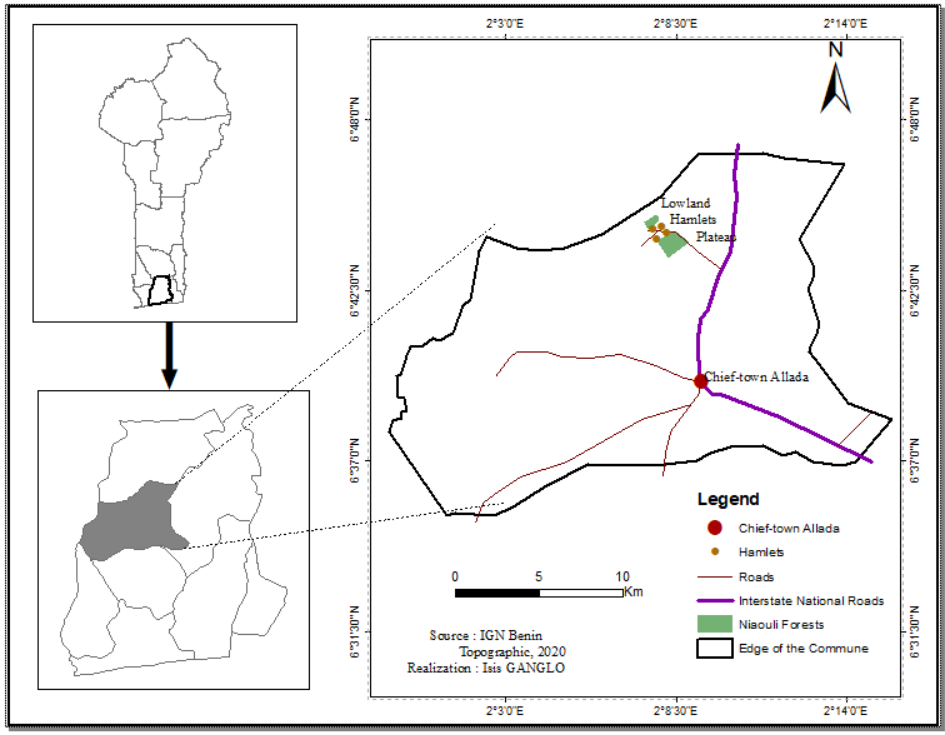
The total area of Niaouli forests is 120 ha [13]. They are located in the department of Atlantic, Allada municipality, and the district of Attogon (Figure 1), between latitudes 6°40’ and 6°45’ North, and longitudes 2°05’ and 2°10’ East. With respect to the topography of the study area, one of the forests is located on plateau while the second one is in lowland. The lowland forest is crossed by a tributary of the Couffo River, which represents the main source of water supply for the local population [13]. Along this river, it can be noticed the presence of certain hygrophilous species such as Pentaclethra macrophylla Benth, Cola gigantea A. Chev. var glabrescens Brenan & Keay, Pycnanthus angolensis Warb, Entandrophragma angolense (Welw.) C. DC. In the forest of plateau, grows a dense but degraded semi-deciduous forest whose central floristic core is composed of species such as Antiaris toxicaria, Celtis mildbraedii Engl_., _Ceiba pentandra, Triplochiton scleroxylon K. Schum, Sterculia tragacantha Lindl, Lecaniodiscus cupanioides Planch and many others. Phytogeographically speaking, this region belongs to the Guinea-Congolese regional transition area [18]. The average annual rainfall over the period from 1950 to 2009 is 1,144 mm. The rainfall regime is bimodal, with two rainy seasons of which the main one covers March to July and the second one lasts from September to October. The average daily temperature is about 28°C. The plateau area is characterized by a ferrallitic soil as opposed to the lowland where, hydromorphic soil is dominant [13]. Niaouli forests had also served as shelter for some war fugitives, which justifies the presence of Dracaena arborea Link species used at time to materialize tombs or sacred places. Thus, it can be inferred that it is a secondary degraded forest by human activities.
Methods
Data collection Forests inventory A device of sample was installed and allow to collect data. The data was collected by systematic sampling with rectangular meshes of 100 m × 200 m in square plots of one (01) ha each. To avoid the border effect, each plot of 1 ha was installed at a minimum distance of 50 m from the border. In total, seven (07) plots of 1 ha were installed. The main data collected in each plot were: diameter at breast height (1.30 m) and the height of trees which are individuals of plant species with more than 10 cm of diameter at breast height [19]. They were respectively measured with π ribbons and Suunto clinometer. The Global Positioning System (GPS) was used to record the coordinates of each plot. To value the potential of regeneration in Niaouli forests especially for the valuable species, a count was made in diagonal quadrats of 100 m2 (10 m * 10 m) installed in the 1 ha plots. Three regeneration classes were considered [15]:
- Seedling classes with circumference of C < 31.4 mm;
- Juvenile classes with circumference of 31.4 mm ≤ C < 157 mm;
- Young pole classes 157 mm ≤ C < 314 mm.
Identification of valuable species of Niaouli forests The valuable species of a forest refers to a species that has an importance to the population taking into account the ecosystem services it provides and is thus submitted to some pressures due to its exploitation, leading to its possible disappearance from the environment. Thus, an ethnobotanical survey was carried out on surrounding populations living in nearby villages like Tanmè, Zoungoudo, Tokpa, Niaouli 1 and Lozounkpa. This allowed identifying the valuable species of Niaouli forests exploited by the populations. The most cited species and inventoried in the forests were considered as valuable species of Niaouli forests. The following formula was used Rea [20] and allowed to investigate 188 people:
( ) ( ) ( )
2
2 2 * 1 * t p p N n t p p N y
− = − + − p
* 1 1 * p n is the size of the sample; n = 188; N is the size of the target population. N = 4506 [21]; P is the proportion of response expected from the population or real proportion. P = 0.5 [20]; tp is the quantile of the normal distribution; y is the margin of sample error. y = 7% [20].
Data analysis
Description of the floristic diversity of Niaouli forests The following diversity parameters were calculated for each plot and the average was computed by forest. There are: The species richness [22]; Shannon Index [23, 24]:
N N H N N =
s i i = − ′ ∑
2 1 * log i Ni: number of individuals of the species i; N: total number of individuals; log2: basic logarithm 2. Equitability of Pielou [25]
' log H EQ S =
2
S: Total number of species H’: Shannon Index
Structural characteristic of Niaouli forests Dendrometric parameters The dendrometric parameters are mainly: The basal area [19]
π =∑
2 id
4 G s With di is the diameter at breast height level and s is the area of the plot in ha.
The density of population [19]
The density of each plot was calculated with the following formula:
ni Ni s = Where ni is the total number of trees per 1 ha plots and s the area.
The density of the forests was calculated as the mean value of the plot densities inventoried in each of them The density of regeneration [13, 17]
n Nr s = r q
With nr, the number of stems of the species considered in the quadrat and sq the area of the quadrat of regeneration.
The number of regenerations by forest was calculated as the mean value of the number of regenerations in the quadrats inventoried in each of them The quadratic mean diameter [19]
= = ∑ n
2 i di Dg n
1 With n the number of trees with dbh ≥ 10 cm inside the plot and di is the diameter in cm of tree i.
The quadratic diameter of the forests was calculated as the mean value of the quadratic diameter of the plots inventoried in each of them The height means of Lorey (HL) [26]
= = ∑ ∑ n gihi H gi
1 i L n =
1 i With gi and hi the basal area and the total height of the tree i in each plot.
The height of the forests was calculated as the mean value of the height of the plots inventoried in each of them The contribution to the basal area
100 p G Cs G =
With Gp the basal area of the trees of the species i and G the total basal area of the whole trees per plot.
The contribution to the basal area of a species per forest was calculated as the mean value of its contribution to the basal area per plots inventoried in each of the forest.
Diameter structure of the forests
All individuals inventoried were arranged by diameter classes of 5 cm of amplitude and then, tree densities by class of diameter were computed [18]. This allowed having histograms describing the diameter structure of the forest and their valuable species respectively.
Tests of mean comparison
Niaouli forests and their components were compared with respect to the structural and biodiversity parameters calculated, using an analysis of variance (ANOVA) and the nonparametric Kruskal-Wallis’s test with the Ri386_3.5.1 [27] software.
Forms of use of valuable species of Niaouli forests
The variables collected on the basis of ethnobotanical surveys were encoded in the Excel software to facilitate the calculation of citation frequencies. The formula considered is as follows [28]:
( ) *100 in Fci N =
With ni the citation number of a variable i of a given parameter and N, the total number of citations of that parameter.
The parameters considered were the sex, age, ethnic group, educational level, marital status, categories of uses, organs used, forms of use, frequency of use, perceived abundance, harvesting method, selling market, species conservation strategy. Frequency histograms were performed to allow the interpretation of the results. The species, with high citation frequencies were considered as valuable species of Niaouli forests.
Index Value Importance (IVI) of the valuable species
The Index Value Importance (IVI) of the species is often used in tropical forest to describe the ecological importance of the species [29, 30, 31]. It varies form 0 (lack of dominance) to 300 (mono-dominance) [32, 33].
IVI = Relative frequency + Relative density + Relative dominance for the species [2, 32].
Where:
100 Frequencyof thespeciesi Relative frequency Sumof the frequenciesof all species = ×
100 Total number of individualsof a species Relativedensity Total number of theindividualsof all community species = ×
100 Basal areaof a species Relativedominance Totalbasal area = ×
Results
Structural characteristics of Niaouli forests
Dendrometric parameters
The dendrometric parameters of Niaouli forests are presented in Table 1. The variance analysis of these parameters (N, Dg, HL, G) showed that there was no significant difference at 5 % of probability threshold between the two types of forest although the lowland forest has slightly higher dendrometric parameter values than the forest of plateau.
| Forests | Density (N/ha) | Dg (cm) | H (m) L | G (m2/ha) |
|---|---|---|---|---|
| Forest of plateau | 317 ± 58.48 a | 26.8 ± 3.06 a | 10.1 ± 1.78 a | 16.53 ± 2.65 a |
| Lowland forest | 333 ± 104.36 a | 28.0 ± 2.66 a | 11.1 ± 2.10 a | 20.11 ± 5.94 a |
| P value | 0.793 | 0.656 | 0.509 | 0.221 |
Table 1: Dendrometric parameters of Niaouli forests.
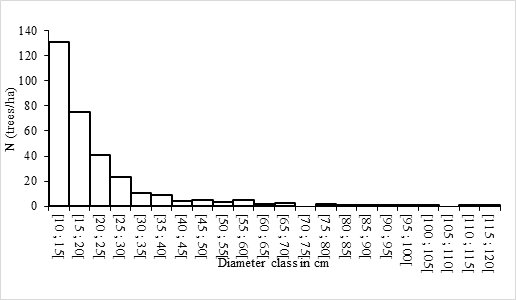
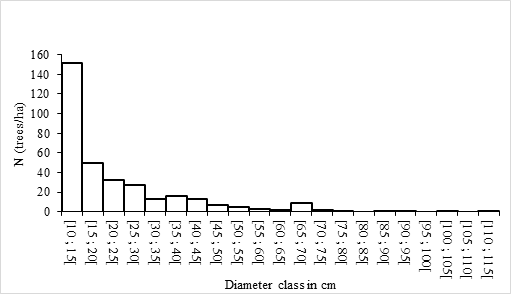
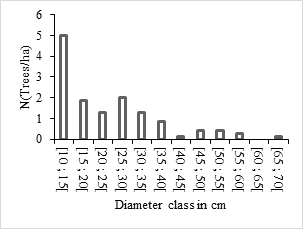
Diameter structure of the whole forests: The Figures 2 and 3 respectively show the diameter structures of the forest of plateau and the lowland forest. According to these figures, the diameter structures of the Niaouli forests showed an exponential negative pace where individuals of small diameters predominate. This diameter structure is characteristic of undisturbed natural forests. The diameter structure of the global forests rarely shows silvicultural problems of individual species. In order to appraise such problems to suggest management solutions, we present on Figures 4-7 the diameter structure of the valuable species identified in the forests.
Plant diversity of Niaouli forests
The plant biodiversity parameters of Niaouli forests are summarized in the Table 2. The analysis of variance of the species richness, Shannon index, and the equitability of Pielou of the Niaouli forests showed a significant difference at 5 % of probability threshold for the species richness and the Shannon index between the two types of forests. The lowland forest showed the highest species richness and Shannon index values compared to the forest of plateau. We deduced that; the lowland forest has higher species richness with better balance of species abundance distribution than the forest of plateau. The occurrence data we derived from the forest inventory were published on GBIF site at the following link (https://doi.org/10.15468/kvg37e)
| Forests | Species richness (S) | Shannon index (H’) | Equitability of Pielou (E) |
|---|---|---|---|
| Forest of plateau | 12.4 ± 1.37 a | 2.74 ± 0.25 a | 0.54 ± 0.04 a |
| Lowland forest | 18.5 ± 4.37 b | 3.50 ± 0.45 b | 0.60 ± 0.08 a |
| P value | 0.01305 | 0.0054 | 0.158 |
Table 2: Plant diversity parameters of the Niaouli forests.
N.B. For each parameter, the averages with the same letters are not significantly different at the 5% of probability threshold. Table 2: Plant diversity parameters of the Niaouli forests.
Regeneration in Niaouli forests Table 3 presents the evolution of the regeneration number across the developmental stages of the forests. It was noticed that in the forest of plateau, there was a decreasing trend of the density of regeneration following the evolutionary stages of the forest. Indeed, the seedlings were present in high number (12), the juveniles in number slightly low, and the young pole in lower number. Therefore, it is deduced that throughout the evolutionary stages of the forest, individuals of regeneration choke and die gradually. In the lowland forest however, there is a relatively stable situation across the developmental stages of the forest.
| Regeneration classes/ Forests | Number of seedlings (dbh ˂ 10 mm) | Number of juveniles (10 mm ≤ dbh ˂ 50 mm) | Number of young poles (50 mm ≤ dbh ˂ 100 mm) |
|---|---|---|---|
| Forest of plateau | 11.6 ± 10.2 a | 4.2 ± 1.7 a | 2.1 ± 1 a |
| Lowland forest | 2.4 ± 0.6 a | 2.9 ± 0.6 a | 3.1 ± 2.1 a |
| P value | 0.647 | 0.784 | 0.539 |
Table 3: Evolution of the regeneration number across the developmental stages of the forests.
Identification and diameter structure of the valuable species of the forests
Identification of the valuable species of the forests In total 79 plant species were used by the respondents. Among them, 44 were inventoried in the forests and therefore
35 were used by the respondents but were not inventoried in the forests. Twenty-four (24) other species were inventoried in the forests but the respondents did not mention them.
We present in Table 4, the frequency of the most cited species by respondents. We therefore deduced that, those four (04) species, are the valuable species of Niaouli forests.
According to the Index Value Importance (IVI), Antiaris toxicaria has the highest value of IVI (Table 4) compared to the other three species, followed by Albizia zygia; Ceiba pentandra, and Newbouldia laevis. All these species have an IVI value greater than 0 indicating their presence and dominance in the area.
| Valuable species of Niaouli forests used by the respondents | Citation frequency (%) | Index Value Importance |
|---|---|---|
| Antiaris toxicaria | 1.99 | 17.32 |
| Albizia zygia | 3.99 | 11.03 |
| Ceiba pentandra | 1.99 | 10.25 |
| Newbouldia laevis | 2.08 | 3.09 |
Table 4: Citation frequencies and Index Value Importance of the valuable species of Niaouli forests.
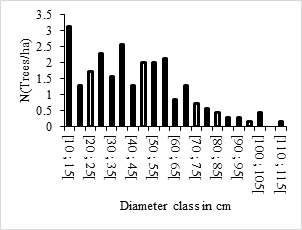
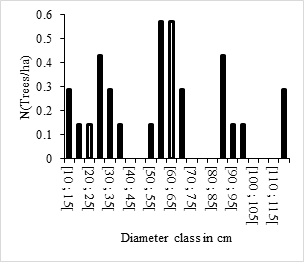
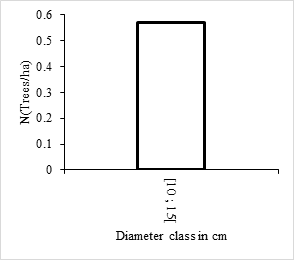
Diameter structure of the valuable species and lesson learnt: The diameter structures of the valuable species of Niaouli forests are presented on Figures 4-7. Analysis of the diameter structures of Albizia zygia and Antiaris toxicaria revealed the predominance of individuals of first diameter class [10, 15]. It is then roughly an “inverted J” diameter distribution, which characterizes uneven aged and undisturbed stands; their sustainability is almost guaranteed by sufficient regeneration; we can infer that they are in appropriate site conditions. The diameter structure of Ceiba pentandra was rather irregular across diameter classes and let us infer irregular or sporadic fructification and regeneration with time; this diameter structure does not offer sufficient guarantee for the sustainability of the species in the forests; ecological conditions might not be so favorable for its long-term survival. Concerning Newbouldia laevis, it is represented by only one diameter class [10, 15] and quite low density per ha; the species is therefore at risk of extinction and need pressing silvicultural care to increase its density through forest’s enrichment and cultural follow-up operations like weeding, liana cutting, thinning of dominant species where canopy is closed etc.
Use categories of plant species
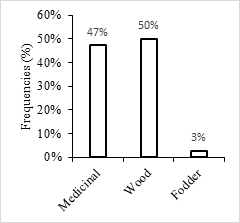
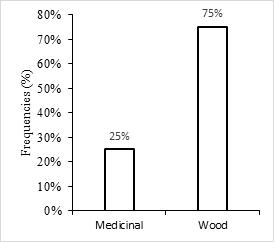
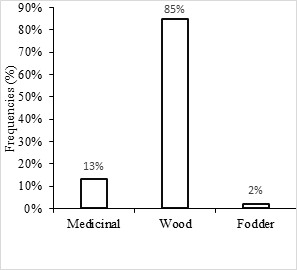
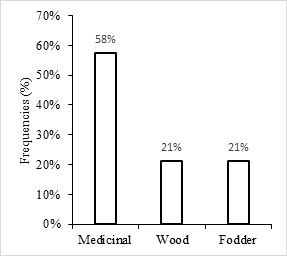
The use category of a species refers to the specific objective of usage. It can be either medicinal or food. In this way, the identified valuable species are all used medically and also serve as wood (Figures 8-11). Apart from Newbouldia laevis the use as wood is the form of valorization for all species in comparison to other categories of uses. Newbouldia laevis is more used as fodder, compared to Albizia zygia and Antiaris toxicaria. Ceiba pentandra is the only one of the species which is not used as fodder by the respondents. For the use of wood, Albizia zygia comes first with 85 % of the citation frequency, followed by Ceiba pentandra (75 %). Albizia zygia, Antiaris toxicaria, and Ceiba pentandra are mainly used by carpenters to make tables, benches, chairs, beds etc. Newbouldia laevis is mainly used as energy wood.
Use of valuable species in medicine
The identified valuable species of the Niaouli forests are used to treat mainly anemia, high blood pressure, wounds on the body, leprosy, diarrhea, bleeding in pregnant women, eczema, hemorrhoid, rheumatism, excessive thinness observed, ringworm, madness, envy, malaria (Table 5) and some of them have healing power (Albizia zygia). All these diseases are treated with the leaves of the plants, bark, and the roots through decoction and crushing. The treatment of the bleeding is done mainly through crushing either the leaves of Newbouldia laevis or the leaves of Ceiba pentandra. By crushing, the sap of these leaves is extracted and consumed.
| Treated diseases | Citation frequencies (%) | Valuable species | |||
|---|---|---|---|---|---|
| Albizia zygia | Antiaris toxicaria | Ceiba pentandra | Newbouldia laevis | ||
| Malaria | 30.55 | + | - | - | + |
| Bleeding in pregnant women | 5.33 | - | - | + | + |
| Anemia | 5.04 | - | - | - | + |
| Hemorrhoid | 4.90 | - | - | - | + |
| Wounds on the body | 2.02 | + | + | + | - |
| Leprosy | 2.02 | - | + | + | - |
| Eczema | 1.44 | - | + | - | - |
| Diarrhea | 1.15 | + | - | + | - |
| High blood pressure | 1.01 | - | - | + | + |
| Ringworm | 0.14 | + | - | - | - |
| Excessive thinness observed | 0.14 | - | - | + | - |
| Rheumatism | 0.14 | - | + | - | - |
Table 5: Use of valuable species in medicine.
BN: (+) stands for use and (-) stands for non-use of the species. Table 5: Use of valuable species in medicine.
Organs used and Harvesting Methods
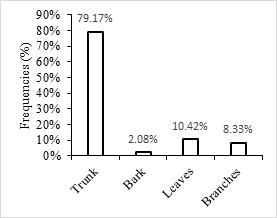
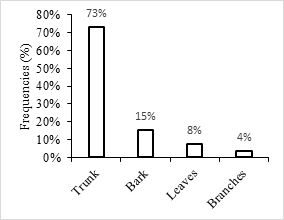
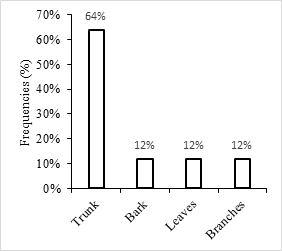
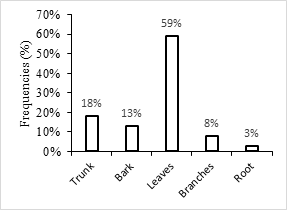
The trunk is the most used organ for all valuable species apart from Newbouldia laevis for which the leaves are most used compared to the other valuable species (Figures 12- 15). This species is also the only one for which the roots are exploited. The organs used are related to the medicinal services the species provides. The trunk of Albizia zygia has the highest frequency citation with respect to the importance of the wood use category followed by Antiaris toxicaria and Ceiba pentandra. For Ceiba pentandra not only the trunk is used but the branches are also exploited for wood energy.
As for the harvesting methods, the harvesting of the valuable species was essentially done by totally or partially cutting the organ to be used. One hundred percent of the respondents confirmed that for Antiaris toxicaria, Ceiba pentandra, and Newbouldia laevis. It is only for Albizia zygia that 2 % of the respondents mentioned as harvesting method, the removal of the whole plant, while 98 % use organ cutting method. However, it was noted that no matter the valuable species is, the majority of respondents found out that the harvesting methods they used were not destructive.
| Species | Destructive method of harvesting (% of respondents) | Non-destructive method of harvesting (% of respondents) |
|---|---|---|
| Albizia zygia | 17 | 83 |
| Antiaris toxicaria | 9 | 91 |
| Ceiba pentandra | 31 | 69 |
| Newbouldia laevis | - | 100 |
Table 6: Opinion of respondents with respect to harvesting methods of the organ of species.
We can note from the Table 6 above that most of the methods used in harvesting the organs of the species were not destructive.
Use forms of the species
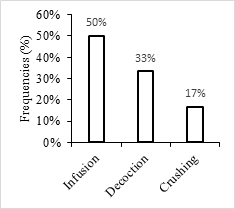
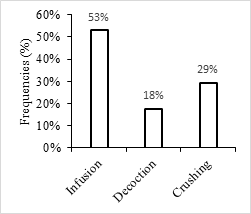
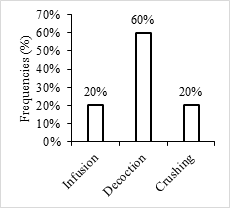
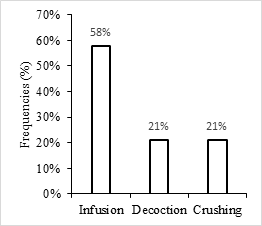
The use form of a species refers to the particular transformation that an organ of the species undergoes before being used. For instance, we have use forms like infusion, decoction, crushing, etc. In this regard, Albizia zygia, Antiaris toxicaria, and Newbouldia laevis are more used in the form of infusion, according respectively to 50 %, 53 % and 58 % of the respondents (Figures 16-19). Ceiba pentandra is the only one that is more used in the form of decoction according to 60 % of the respondents (Figure 18).
Discussion
Structural Characteristics, Plant Diversity, and Considerations on the Measures of Conservation of Niaouli Forests
The highest values of dendrometric parameters were obtained in the low land forest. This can be explained by the more favorable ecological conditions of the area, especially the humidity induced by the presence of the stream. There is then a microclimate which allows more continuous development of species and justifies the presence of species subservient to wetlands. According to Agbangla [34], the densities in Niaouli forests varied from 51 to 71 trees/ha with a basal area of 8.1 to 10.0 m2/ha. Those results are low in comparison with those of our study where the forest’ densities varied from 317 to 333 trees/ha with a basal area of 16.53 ± 2.65 to 20.11 ± 5.94 m²/ha. The forests’ densities of our study are higher than those obtained by Hounkpèvi [7] in the forest of Diospyros mespiliformis and Dialium guineense in Massi forest in Center Benin but lower than those reported by Froumsia [35] in Kalfou Forest Reserve of Cameroon despite the low rainfall noted and by De Lima [36] in a Brazilian tropical dry forest domain. The density (N/ha), the quadratic mean diameter Dg (cm) and the basal area G (m2/ha) obtained in the forest of plateau (respectively N = 317 trees/ha; Dg = 26.8 cm; G = 16.53 m2/ha) are also lower than those reported in the same type of forest (Itchèdè forest, South-East Benin) by Awokou [9]; indeed, the rainfall in South-East Benin is higher than what is recorded in the South Center Benin where Niaouli forests are located. Comparing to the work of Houéto [37] in Belléfoungou forest reserve located in the central west of Benin, the forest of plateau has higher dendrometric parameters. This can be explained by the rainfall patterns (bimodal in Niaouli forest versus unimodal in Belléfoungou forest in South-East Benin); furthermore, Niaouli forest grows on ferrallitic soils whereas Belléfoungou forest grows on ferruginous soils which are less favorable for deep roots soil exploration by plants. As for the plant diversity, the species richness (S) in Niaouli forests varied from 12.4 ± 1.37 to 18.5 ± 4.37 and the highest value was obtained in the low land forest. The Shannon index of the forest of plateau is (H’) = 2.74 ± 0.25; this value is lower than the one found by da Silveira [38] in the Amazon basin (Brazil); indeed, although the Amazon Forest studied is degraded, Amazon forests in general remain the most diversified with respect to species richness and abundance of animals and plants. The lowland forest had a relatively high plant diversity with a mean value of Shannon index (H’) = 3.50 ± 0.45 and a mean value of Equitability of Pielou (E) = 0.60 ± 0.08 implying that the site conditions were favorable for a more balanced abundance distribution than the forest of plateau. Those values are however lower than those found by Kingbo [17] in Pobè forest. The difference can be explained by the fact that, the Niaouli forests are more degraded than Pobè forest due to more care ensured to Pobè forest by its managers. A sustainable management of these forests would involve silvicultural operations aimed at reducing the density of high height trees where the canopy is closed in order to open it and facilitate the incidence of solar rays in the undergrowth to favor regeneration of species. The wood produced by these trees can be sold as a source of income for the Research Center. Also, we recommend proceeding to a regular reforestation and introduction of new species taking into account their ecology to increase the biodiversity and ecosystem services of the forests. For a sustainable management of the forests, we recommend to involve the local population in the management tasks so that they can derive some financial income and become more prone to forest protection.
Use categories, organs used, methods of harvesting, and threats to the biodiversity of the forests
The valuable species identified in Niaouli forests are Albizia zygia, Antiaris toxicaria, Ceiba pentandra, and Newbouldia laevis. Considering the valuable species list of Agbangla [33] two new species are added by our study. These are Albizia zygia and Newbouldia laevis. The forms of use of valuable species involved several organs in particular the trunk, bark, leaves, branches, and the roots. Their harvest is done by removal of the whole plant or by cutting the organ concerned. The harvesting method can therefore be destructive. It has been noted that the use of wood is the most widespread among the surrounding population. However, all species are used in medical domain and treat several diseases. Our results therefore support those reported in different studies elsewhere. Indeed, as Weniger [39] identified in Cameroon, Albizia zygia is used to treat malaria; in India, Elumalai [40] justified that Ceiba pentandra bark decoction has been used as a diuretic, aphrodisiac, and to treat headache, as well as type II diabetes; in Ivory Coast, Malan [39] identified Albizia zygia to treat rheumatism by applying the crushed leaves on the body, Antiaris toxicaria in the healing of hydrocephalus by bathing with bark decoction, Ceiba pentandra in the healing of diarrhea by making a decoction with the leaves or the bark and Newbouldia laevis in the healing of dysmenorrhea by making a decoction with the leaves and the bark; Adomou [41] identified healing anemia and hemorrhoid through the use of the barks, leaves and the roots of Newbouldia laevis in Southern Benin. As Adingni [42] justified through their work in the South East of Benin, the exploitation of the bark and the root in medical domain and the trunk for obtaining the wood, poses a threat to the survival and evolution of species, especially, Albizia zygia and Antiaris toxicaria. The diameter structures of the valuable species showed regeneration problem of Ceiba pentandra and even risk of extinction of Newbouldia laevis. It is important to take care in order to enrich these forests in valuable species so as to assure the survival and sustainability of the species. In Cameroon, Mapongmetsem [43] had identified Ceiba pentandra and Albizia zygia as the main local species useful for the conservation and the valorization of biodiversity in the agro-forests of the area. In Bia Tano Forest Reserve, Southern Ghana, Hammond [44, 45, 46], found that, Antiaris toxicaria has an important problem of regeneration when the area where it is located is disturbed, but in the absence of disturbance this species can easily regenerate. It would then be good to ensure the protection of these valuable species in Niaouli forests in order to guarantee their biodiversity.
Conclusion
This study was carried out in Niaouli forests, located in Southern Benin. The study enabled us to identity the valuable species of the forests and to characterize their structure. The dendrometric parameters were not significantly different at 5 % of probability threshold between the two forests. However, apart from the equitability of Pielou, the biodiversity parameters are significantly different at 5 % of probability level between the two forests. The results of this study led to conclude that some of the valuable species of Niaouli forests had a regeneration problem which does not guarantee their sustainability; Niaouli forests are characterized by a low floristic diversity in comparison to other forest ecosystems of Southern Benin and the use of wood of the valuable species is the most widespread among the local population. Considering the results obtained, it would be preferable to refer to silvicultural thinning aiming at decreasing the density of mature trees through opening the canopy where it is closed so that the regeneration of valuable species can be favored. The study of the structure, ecology, and the valuable species of the Niaouli forests should continue to yield results on other traits of the forests like their quantitative and qualitative dynamics to inform management decisions.
Acknowledgments
The authors tell their profound gratitude to the Global Biodiversity Information Facility (GBIF, www.gbif.org) and the European Union for their kind financial support to the research activities in the framework of the project BID- AF2020-083-USE.
Conflicts of Interest
The authors declare no conflict of interest.
References
-
Mukerji AK (1995) Special thesis on the importance of non-timber forest products and sustainable development strategies. Non- Timber Forest products 15: 225-237.
-
Tiokeng B, Mapongmetsem P, Nguetsop VF, Tacham WN (2015) Floristic biodiversity and natural regeneration on the Lebialem highlands (West Cameroon). International Journal of Biological and Chemical Sciences 9(1): 56-68.
-
FAO (2020) Global Forest Resources Assessment 2020: Main report. Rome.
-
Guariguata MR, Ostertag R (2001) Neotropical secondary forest succession: changes in structural and functional characteristics. Forest ecology and management 148(1- 3): 185-206.
-
Millennium Ecosystem Assessment (2005) Ecosystems and Human Well-being: Synthesis. Island Press, Washington DC.
-
Assogbadjo AE, Kakaï RLG, Sinsin B, Pelz D (2009) Structure of Anogeissus leiocarpa Guill., Perr. natural stands in relation to anthropogenic pressure within Wari‐Maro Forest Reserve in Benin. African Journal of Ecology 48(3): 644-653.
-
Hounkpèvi A, Yévidé ASI, Ganglo CJ, Devineau JL, Azontonde HA, et al. (2011) Structure and ecology of _Diospyros mespiliformis_ Hochst forest. ex A. DC. and _Dialium guineense_ Willd. in the reserve of Massi (Lama Forest), Benin. Bois et forêts des tropiques 308: 33-45.
-
Scholes R, Montanarella L, Brainich A, Barger N, Ten Brink B, et al. (2018) Summary for policymakers of the assessment report on land degradation and restoration of the Intergovernmental Science-Policy Platform on Biodiversity and Ecosystem Services. IPBES secretariat, Bonn, Germany, pp: 44.
-
Awokou KS, Ganglo CJ, Azontondé HA, Adjakidje V, De Foucault B (2009) Structural and ecological characteristics of plant-communities in Itchèdè forest reserve (Plateau Department, South Benin). Sciences & Nature 6(2): 102.
-
Yêvidé AS, Ganglo JC, Aoudji AK, Toyi MS, De Cannière C, et al. (2011) Structural and ecological characteristics of undergrowth plant-communities of private Teck plantations in the Atlantic Department (South-Benin, West Africa) Acta botanica gallica 158(2): 263-283.
-
Mama A, Bamba I, Sinsin B, Bogaert J, De Cannière C (2014) Deforestation, savanization and agricultural development of savanna-forest landscapes in the Sudano-Guinean zone of Benin. Bois et Forêts des Tropiques 324(4): 11.
-
Akoègninou A, Van der Burg WJ, Van der Maesen LJG (2006) _Analytical Flora of Benin_ (No. 06.2).; Backhuys Publishers.
-
Dossou ME, Lougbégnon OT, Houessou GL, Teka SO, Tente AH (2012) Phytoecological assessment of plant communities in the swampy forest of Agonvè and related ecosystems, Benin. Journal of Applied Biosciences 53: 3821-3830.
-
Yêhouénou-Tessi DR, Akouèhou GS, Ganglo JC (2012) Structural, ecological and ethnobotanical characteristics of populations of _Antiaris toxicaria_ (Pers) Lesch and _Ceiba pentadra_ (L.) Gaertn in the relict forests of South Benin. International Journal of Biological and Chemical Sciences 6(6): 5056-5067.
-
Koura K, Dissou EF, Ganglo JC (2013) Ecological and structural characterization of _Parkia biglobosa_ (Jacq.) R. Br. Ex G. Don parks of the Donga department in North- West Benin. International Journal of Biological and Chemical Sciences 7(2): 726-738.
-
Kingbo A, Agbo ARA, Ganglo JC (2021) Structural and Ecological Characteristics of Tree Communities in the Forest of Pobe in Southeast Benin. Agriculture Forestry and Fisheries 10(3): 102-111.
-
Rondeux J (1999) Measurement of forest stands. Gembloux agronomic presses: Gembloux, pp: 522.
-
White F (1986) The vegetation of Africa: memory accompanying the map of the vegetation of Africa Unesco/AETFAT/UNSO, 20, IRD Editions.
-
Rea LM, Parker RA (1997) Designing and conducting survey research: A comprehensive guide. San Francisco, CA: Josey-Bass Publishers.
-
INSAE (2016) _Book of villages and city districts of the_ _Atlantic department._ RGPH-4, 2013. Benin Republic.
-
Menhinick EF (1964) A comparison of some species diversity indices applied to samples of field insects. Ecology 45(4): 859-861.
-
Shannon CE (1948) A Mathematical Theory of Communication. Bell System Technical Journal 27: 379- 423, 623-656.
-
Margalef R (1968) Perspective in Ecological Theory. University of Chicago Press, Chicago, pp: 111.
-
Pielou EC (1968) An introduction to mathematical Ecology. Wiley Inter science. John Willey and Sons, New York.
-
Philip MS (2002) Measuring trees and forests. Second Edition. Wallingford, Royaume-Uni, CAB International, pp: 311.
-
R Core Team (2019) R: A language and environment for statistical computing. R Foundation for Statistical Computing, Vienna, Austria.
-
Bada Amouzoun AAM, Badou RB, Ahamide DYI, Adomou CA (2019) Ethnobotanical knowledge and conservation of _Uvariodendron angustifolium_ (Engl. & Diels) R. E. Fries (Annonaceae) in Ewe-Adakplame Forest islet in south- east Benin, West Africa. Rev Ivoir Sci Technol 34: 328- 348.
-
Yao CA, N’guessan EK (2005) Botanical biodiversity in Southern Tai National Park, Ivory Coast. Africa science. International Journal of Science and Technology 1(2).
-
Agbodjogbe GJ (2011) Analysis of the structure of the forest galleries of the Total Tamou Wildlife Reserve in the Republic of Niger. Master thesis in plant and tropical biodiversity, University of Paris_,_ pp: 50.
-
Gonmadjè CF, Doumenge C, McKey D, Tchouto GP, Sunderland TC, et al. (2011) Tree diversity and conservation value of Ngovayang’s lowland forests, Cameroon. Biodiversity and Conservation 20(12): 2627- 2648.
-
Curtis JT, McIntosh RP (1951) An upland forest continuum in the prairie‐forest border region of Wisconsin. Ecology 32(3): 476-496.
-
Kent M (2011) Vegetation description and data analysis: a practical approach_._ John Wiley & Sons.
-
Agbangla MM, Aoudji AKN, Gbetoho AJ, Sanon K, Ayina O, et al. (2015) Structural an Ecological Characteristics of cCommercial Timber species’ population: a Basis for Silviculture in Niaouli Forest Stands (Southern Benin). Tropicultura 33(3): 238-252.
-
Froumsia M, Zapfack L, Mapongmetsem PM, Nkongmeneck BA (2012) Woody species composition, structure and diversity of vegetation of Kalfou Forest Reserve, Cameroon. Journal of Ecology and the Natural Environment 4(13): 333-343.
-
De Lima RB, Bufalino L, Júnior FTA, Da Silva JAA, Ferreaira RLC (2017) Diameter distribution in a Brazilian tropical dry forest domain: predictions for the stand and species. Annals of the Brazilian Academy of Sciences 89(2): 1189-1203.
-
Houéto G, Fandohan B, Ouédraogo A, Ago EE, Salako VK, et al. (2012) Floristic and dendrometric analysis of woodlands in the Sudano-Guinean zone: a case study of Belléfoungou forest reserve in Benin. Acta Botanica Gallica 159(4): 387-394.
-
da Silveira AB, Chaves e Carvalho SPC, Nicoletti MF, Silva CA, Drescher R, et al. (2022) Impact of plot size on tropical forest structure and diversity estimation. Terrestrial ecology 70(1): 437-449.
-
Weniger B, Lagnika L, Ndjakou Lenta B, Vonthron C (2008) Ethnopharmacology and the search for antimalarial molecules in biodiversity in Ivory Coast, Benin and Cameroon. Ethnopharmacologia 41: 62-70.
-
Elumalai A, Mathangi N, Didala A, Kasarla R, Venkatesh Y (2012) A Review on Ceiba pentandra and its medicinal features. Asian Journal of Pharmacy and Technology 2(3): 83-86.
-
Malan DF, Neuba DFR, Kouakou KL (2015) Medicinal plants and traditional healing practices in ehotile people, around the aby lagoon (eastern littoral of Côte d’Ivoire). Journal of Ethnobiology and Ethnomedicine 11: 21.
-
Adomou CA, Dassou GH, Yedomonhan H, Favi GA, Ouachinou JMAS, et al. (2018) Analysis of traditional knowledge and determinants related to the use of Newbouldia laevis (P.Beauv.) Seemann ex Bureau (Bignoniaceae) in Southern-Benin. Afrique Science 14(1): 194-205.
-
Adingni C, Vodounon HST, Yedo MFA, Kodja JD, Boko M (2021) Environmental dynamics and anthropogenic pressure on woody agroforestry systems in the Lower Oueme Valley (Southeastern Benin). International Journal of Progressive Sciences and Technologies 29(2): 45-57.
-
Mapongmetsem PM, Etchiké D, Ngassoum MB (2016) Conservation and valorization of the biodiversity in agroforests in the suburban area of the city of Bafia (Central region of Cameroon). Scientific and Technical Journal Forest and environment of the Congo Basin 6: 60-69.
-
Hammond ME, Pokorny R, Okae-Anti D, Gyedu A, Obeng IO (2021) The composition and diversity of natural regeneration of tree species in gaps under different intensities of forest disturbance. J For Res 32(5): 1843- 1853.
-
Curtis JT (1959) The Vegetation of Wisconsin: An Ordination of Plant Communities; University of Wisconsin Press: Madison, WI, USA.
-
Dourma M, Wala K, Guelly KA, Bellefontaine R, Deleporte P, et al. (2012) Typology, structural characteristics and dynamics of fragile _Isoberlinia_ spp. Woodlands to support their management in Togo. Bois et Forêts des Tropiques (313): 19-33.
- Lessons to Learn: Trees are More than the Lungs of the World
- Community Forestry Enterprises as a Model for Sustainable Forest Development: The Case Of The "Baja Tarahumara" in Chihuahua, Mexico
- Ecological and Socio-Economic Impacts of Chromolaena odorata and Mesosphaerum suaveolens, Two Invasive Alien Species in Central and Southern Benin, West Africa
- Epigenetic Sustainability: Modeling the Human Factor as a Natural Resource through Science 4.0 and the NR3C1 Biological Pilot
- Growth-at-Risk: A Framework for Assessing Economic Vulnerability
- The Rural Territory as a Socioecological System for the Management of Public Policy for Sustainable Rural Development