
Applying the Rumsfeld Matrix: Unknown Unknown Climate Risks in an AMOC Collapse Scenario
This paper investigates scientific research using Rumsfeld’s typology to grasp uncertainties in an era of ‘catastrophic climate change and the risk landscape of a ‘2°C-3°C world’. The study highlights the importance of 'unknown unknowns' and the emergence of 'Black Swan' climate events, such as frequent 500-year droughts and discusses how adaptive strategies can be crafted today, building on the “unknown knowns” of the past, such as the Great American Dust Bowl. It emphasizes the need for a structured approach to uncertainty in water resource management, relevant for understanding climate change’s significant impact on water cycles, evident in phenomena like cloudbursts and prolonged droughts. Additionally, research into abrupt climate change, such as the potential mid-century collapse of the Atlantic Meridional Overturning Circulation (AMOC) is analyzed using the Rumsfeld matrix to understand research gaps and generate insights for further study.
Introduction
Humanity is approaching unknown territory. In the year of 2023, meteorological records were shattered as approximately one-third of all days reached temperatures at least 1.5°C above pre-industrial levels, making 2023 the warmest calendar year on record [1]. Data from the European Union’s climate service, Copernicus, confirmed that the global warming trend is accelerating. The acceleration comes not from a lack of climate commitments, but due to the unmet pace of change needed to address escalating climate impacts.
Nevertheless, the long-term trend of the global economy is set; as of November 2022, some 140 countries had announced or were considering net zero targets, covering close to 90% of global emissions [2]. Despite this progress, current emissions have yet to decline at the speed we need.
With the Paris Agreement’s thresholds being breached multiple times in 2023, it may be time to revive the Rumsfeld Matrix’s ‘unknown unknowns’, to better understand and prepare for the unforeseen climate extremes arriving at our doorstep. Because although researchers strive to better understand climate change and its physical and socio- economic impacts, there are still unknowns.
Leveraging Donald Rumsfeld’s statement on ‘known knowns’ and ‘unknown unknowns’ provides a framework for understanding this complexity. Adapted from the post- 9/11 world that was 2002, this classification of risks is highly relevant given today’s climate risks, and the climate system's known tipping points that require enhanced modelling to ensure better prediction.
Moreover, the paper contributes to the growing field of ‘catastrophic climate change’ research, a research field that analyzes impacts and strategies for a 2°C-3°C world [3].
Research Questions and Methodology
Adopting an interdisciplinary approach, this paper addresses the posed questions through a research methodology that includes an assessment of recent literature, journal article reports, and policy documents. The paper explores the use of the Rumsfeld Matrix to understand climate risks, but also applies the matrix to new climate science to conceptualize what we do not yet know. This methodology will provide a coherent narrative, offering insights for policymakers, industry stakeholders, institutional investors, and academics [4, 5].
Q1: How can the Rumsfeld Decision-Uncertainty Matrix be effectively utilized to navigate the complex web of known and unknown risks associated with extreme climate change?
Q2: How may the Rumsfeld Matrix guide the development of adaptive strategies for risk management?
The Rumsfeld Matrix and Understanding Risks
The Rumsfeld Matrix is a tool that had its origin in intelligence studies and risk management. It offers a nuanced lens to examine and navigate risks. The philosopher Slavoj Zizek [6] argued that while Rumsfeld identified the threats in the Iraq conflict as the “unknown unknowns,” signifying the dangers emanating from Saddam Hussein’s possible use of Weapons of Mass Destruction in 2002, the subsequent Abu Ghraib scandal highlighted that the actual peril lay in the “unknown knowns”. These refer to the unacknowledged assumptions, neglected presuppositions, and practices that, despite being disowned, subtly influence our public values [6].
Flash forward to 2023; the uncertainty surrounding the sensitivity of the climate system and important tipping points are amplified. The complexity brings the importance of each quadrant of the Rumsfeld Matrix in (Figure 1) into focus.
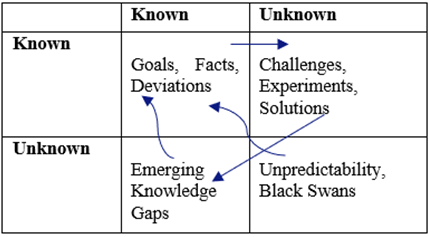
The Rumsfeld Matrix’s Four Quadrants Explained:
- Known Knowns: This quadrant holds data that are both recognized and comprehended. This is assumptions, facts we know, and goals we want to pursue; that forms our knowledge base and serves as an anchor for informed decision-making.
- Known Unknowns: This quadrant covers the risks we know exist, but lack complete understanding of, often referred to as gaps. These gaps require further research or bringing in expert advice.
- Unknown Knowns: Elements within this domain are matters unconsciously embedded in our consciousness or in organizational practices, but often disregarded or undetected, sometimes seen as tacit knowledge, or as practices held by indigenous people. Discovering such latent features can improve our decision-making.
- Unknown Unknowns: These represent unpredictable and unrecognized elements, posing the most profound uncertainty and tail risk events for financial markets.
Their unforeseeable nature can unexpectedly disrupt well-laid private and public sector planning. Scientific discovery lies here; these are the things we are not aware of, and do not understand.
The arrows in the Rumsfeld Matrix signify explorative pathways: from established knowledge (known knowns) we probe into challenges and seek solutions (known unknowns), while uncovering implicit, forgotten and overlooked insights (unknown knowns) and eventually confronting unforeseen challenges. These pathways of questioning guide our exploration of complexities and uncertainties. One of the most difficult types of risks to predict is the Black Swan events to which the paper turns next.
Highlighting Tail Risks: The Black Swans
A prime example of the quadrant unknown-unknowns is the sort of event, which is very unpredictable and very impactful. We often invoke such tail risk events to describe unforeseen shocks like the Great Financial Crisis of 2008-09 and, more recently, the COVID-19 pandemic. Nassim Nicholas Taleb, in his pivotal 2007 book “The Black Swan: The Impact of the Highly Improbable,” defines a Black Swan as a rare event with extreme consequences, which, upon reflection, appears predictable [7].
Taleb’s metaphor, rooted in the surprising discovery of black swans in Australia when it was believed all swans were white, sheds light on social system vulnerabilities when they are unprepared for unexpected risks. Interestingly, Taleb also highlighted that the financial world relies on risk models that heavily rely on known probabilities, time series and predictability.
Today, black swan climate events are becoming more likely. We often refer to extreme weather events such as coastal flooding, long-term droughts or cloudbursts as 100- year or 500-year events. Previously, such events were rare outliers. But they now occur much more often. The reason is simple; as we reach higher temperature levels of 2-3°C, the effects of climate change are intensifying, particularly the effects associated with a change in the hydrological cycle.
Yet, our understanding of the climate system is incomplete, fostering uncertainty about the exact response of the climate system. There are absolute unknowns, such as feedback loops with methane locked in the tundra. Policy-makers and planners comprehend some aspects, like the inevitable warming with increased CO2 levels. Yet, precise climate sensitivity values remain elusive; recent Intergovernmental Panel on Climate Change (IPCC) reports and research has highlighted that the climate is more sensitive than expected.
Currently, CO2 emissions, persisting in the atmosphere for periods ranging from 300 to 1,000 years, result in sustained atmospheric changes. Global warming necessitates the full use of natural carbon sinks, and rapid roll-out of decarbonization technologies. Melissa Lazenby from Sussex University has highlighted the uncertainty aspects in particular, “it is a sign that we are reaching levels that we have not seen before” [8]. Presently, 2023 was the warmest year in recorded human history, with predictions suggesting that 2024 may be even warmer due to a Super El Nino.
Therefore, more effort could be needed to analyze outlier climate events, - the outlier climate events where societal stability is challenged. Particularly, water cycle changes and unexpected prolonged droughts have major implications. It is within such Climattic Black Swans that we find new unknown-unknowns, - the unpredictable second-order effects that occour when our natural systems and human systems such as agriculture and food supply interact.
However, the true challenge in climate change mitigation may well reside in the realm of “unknown knowns”. These might include subconscious societal beliefs, the delay and time lag we expect for catastrophic climate change to occur when that time lag is no longer valid, the implicit assumptions about how we can prosper and endure through a much warmer climate, when climate sensitive sectors such as agriculture and water supply are already seeing major physical impacts, and the difficulty of changing our consumption patterns that may be overlooked or ignored.
Utilizing the Rumsfeld Matrix: Enhancing Organizational Environmental Scanning
The Rumsfeld Matrix is not limited to analyzing macro events; it can be effectively applied at an organizational level. The Matrix helps organizations assess worst-case scenario risks that could gravely jeopardize their operations. For instance climate exposed industries might face threats from extreme weather, like prolonged droughts which can have dire consequences for olive oil companies in Spain.
Yet, a critical aspect of risk management in government agencies and corporations revolves around the organization’s ability to prioritize methods for risk identification. The vulnerability of an organization to external risks is often not derived from its decisions regarding risk response, but rather from its inability to recognize and comprehend the risks present. Many would think of how the CIA and U.S. intelligence community failed to accurately spot the 9/11 attacks, despite having scattered intelligence reports [10].
The Commission’s 9/11 report was succinctly summarized as “a failure of imagination,” highlighting the role of unforeseen risks or “unknown-unknowns.” However, this author contends that many organizations may overlook important climate risks, often preoccupied with day-to-day operations or silo thinking.
Often, a scan of the external environment focuses on the factors we can identify and understand (the known- knowns). But uncertainty underpins the very nature of risk, exemplified by the gaps in knowledge and awareness. Here, risk analysis must be stretched to look at the unknown- unknowns, using the Rumsfeld Matrix for further analysis, when an environmental scan has been discussed.
Risks within the realm of the unknown wield a perilous and elusive impact, analogous to hidden icebergs beneath the surface. Consequently, anticipation of these risks is imperative for all organizations, irrespective of their structure or operational sector [9].
The Water Cycle and Climate Change Risks
Climate change is first felt through a change in the water cycle. Diving into the realm of water-related risks, climate change presents a myriad of uncertainties. Understanding the uncertainty linked with climate change impacts on water resources requires a structured approach to water stewardship. Firstly, many regions are already seeing major changes in precipitation patterns. Here, a changing water cycle spells a new set of risks for agriculture, forestry, and other commodity-dependent sectors. Using the Rumsfeld matrix can guide planning and action to boost resilience at an organizational level against sudden, intense rainfall events and, unexpectedly prolonged droughts.
Experts have already used the Rumsfeld framework on the risks surrounding the water cycle. The framework incorporates vital elements like climate models and precise hydrological models. Uncertainty in this scenario emanates from a range of sources, such as the validity of the observed data, our understanding of water cycle processes, the reliability of modeling techniques, and the accuracy of future projections, all of which contribute to the layers of uncertainties [10].
In the face of extreme climate change, these strategies collectively function as an anchor for steering through the risks and uncertainties tied to the realm of water resources. Our water resources, now more than ever, are under the expanding pressure of a climate that is changing, sometimes in ways that are subtle, other times in ways that are sudden and catastrophic [10]. With so much that remains unknown about how climate change influences the water cycle, governments and dependent sectors must consider sponsoring research and investments in irrigation, desalination, and water efficiency to prepare for longer droughts, flooding and sea-level rise in a 2°C-3°C world.
Application of the Rumsfeld Matrix to the Collapse of the AMOC: The Unknown Unknowns Are Becoming Real and Important
What about the ‘unknown unknowns’ associated with extreme climate change? The Organization for Economic Co- operation and Development (OECD) published a policy report in 2022 on the climate tipping points, with the AMOC placed in the middle of a web of connected tipping points. New research has also been presented on planetary boundaries, and the need to monitor tipping points and their interactions [11]. One of the tipping points that concern scientists the most is the Altantic Meridional Overturning Circulation (AMOC).
The IPCC have previously ruled out a collapse of the AMOC in the 21st century. But in July of 2023, two scientists rocked the climate world with a new scientific article on the Atlantic Meridional Overturning Circulation (AMOC). What is alarming is the possibility a shutdown could occur by 2057, much earlier than previous IPCC predictions [12].
Scientists have evidence that the AMOC has indeed collapsed before. Roughly 12,000 years ago, there was an abrupt decrease in temperatures around Greenland by about -7.7 degrees Celsius or 18 degrees Fahrenheit, and this temperature drop came about over two decades, as the AMOC went from an "on" state to an "off" state. Abrupt climate change is no longer a distant threat; it could arrive our doorstep, sooner than expected, and an AMOC collapse is full of unanticipated effects.
Recall that the North Atlantic saw a colder period persisting for 1,600 years, a climate shift that came about literally in two decades, due to the collapse of the AMOC. We recall the dramatization of the Hollywood movie “The Day After Tomorrow”. Movie director Ronald Emmerich may have exaggerated greatly, but the movie got the non-linearity and regional cooling just right.
Given that two researchers from the University of Copenhagen, Peter and Susanne Ditlevsen recently moved forward the timeline for a suspected collapse of the AMOC from IPCC’s “end of the century” to 2057, paleoclimatic research is suddenly immensely important for policy-makers and planners.
Countries such as the United Kingdom, Norway, Denmark, and Northern France, which benefit from the warm winters influenced by the Atlantic Meridional Overturning Circulation (AMOC), ought to inform themselves and their citizens about past regional climate shifts, including the sudden arrival of the Younger Dryas approximately 12,000 years ago.
This revelation by the Ditlevsens is not unprecedented; previous studies have hinted at the AMOC approaching a tipping point. Despite the news stories, the collapse by 2025 is unlikely. The Ditlevsens’ modeling hinges on a “business-as-usual” scenario, assuming a continuation of current greenhouse gas emission trends. So if we cut back greenhouse gas emissions significantly and engaged in deep decarbonization across societies we could prevent the collapse.
A potential AMOC collapse is a risk multiplier, illustrating the Matrix’s application. Integral to climate, the AMOC affects heat distribution, impacting regions like Western Europe and Scandinavia. With the weakest state in 1,600 years, diligent research, projections, and investments are vital to address potential abrupt regional climate shifts affecting agriculture, water cycles, and coastal temperatures [13].
The Ditlevsens formulated their estimates using data spanning the past 150 years, leading to some inherent uncertainty. This uncertainty predominantly arises from the short duration of a key segment of the dataset, commonly referred to as the “fingerprint” of the AMOC. This fingerprint has only been directly monitored for 20 years and may not
1. Known Knowns (Things we are certain about and understand) 2. Known Unknowns (Things we know we don’t understand) General: The AMOC is an integral component of the global climate system, essential for redistributing heat through warm currents to the coasts of the British Isles, Norway, Denmark, Northern France, etc.
Specific to AMOC: Research highlights the AMOC has slowed down to the weakest level in 1,000 years. This has exposed regions such as Western Europe, Scandinavia, and Denmark to a so-called abrupt climatic shift, but the implications and exact timing is unknown [15].
3. Unknown Knowns (Things we do not realize we understand, often embedded in institutional knowledge) General: Subtle observations and data over time may provide overlooked AMOC associations with local climate variations and changes.
Specific to AMOC: Scientists might offer clues about AMOC behavior in distinct scenarios. Past climate events such as Dansgaard-Oeschger events during the last ice age and the Great American Dust Bowl may provide clues as to how local populations today may endure and strengthen resilience in face of regional drying or rapid cooling.
fully represent the balance between global warming effects and natural fluctuations.
The Dansgaard-Oeschger Events 11,500 years ago – An Unknown-Known Relevant Today? The core message of the Ditlevsen study is clear and urgent: the AMOC’s collapse may be imminent, even in the near future. Winter temperatures in Europe could drop by as much as 10 degrees Celcius or 50 degrees Fahrenheit. Such abrupt changes could cause significant temperature fluctuations, with the AMOC already showing weakening signs since 2004 [14].
An unknown-known can in fact give some guidance; the so-called Dansgaard-Oeschger events represent a series of rapid and intense climate fluctuations during the last ice age. Climate records for the last ice age (which ended 11,500 years ago) show enormous climate fluctuations in the North Atlantic region - the so-called Dansgaard Oeschger events. Each event was marked by a quick phase of warming, succeeded by a more gradual period of cooling. Indicators of these abrupt cooling events are mainly found in the North Atlantic region, particularly within the ice cores of Greenland, and researchers link the events to fluctuations in the AMOC.
General: While the AMOC’s broad mechanics are understood, detailed behavior and long-term effects on specific regions and local climates are yet to be completely grasped.
Specific to AMOC: Uncertainties exist around the exact timing and triggers of a potential AMOC shift, and the breadth of impacts across real estate, agriculture, and the water cycle. A drying trend over Europe is driven by the weakening trend of AMOC, via changes in the large-scale atmospheric circulation [16]. The long-term drying trend is also linked to a relatively high frequency of atmospheric blocking conditions.
4. Unknown Unknowns (Things we do not even realize we are unaware of) General: Black Swan events from an AMOC collapse might reshape global weather dynamics unpredictably, particularly how the AMOC influences other tipping points [17].
Specific to AMOC: Climate effects could lead to secondary collapses or unforeseen societal chain reactions such as the Arab Spring uprising, due to climate impacts on food security due to price spikes and climate induced migration. Extreme temperature risks could challenge predictive models in the financial sector.
(Table 1) showcases the Applied Rumsfeld Matrix, providing a structured analysis of the potential risks associated with a potential AMOC collapse. The following can be derived: With AMOC at its weakest in a millennium, abrupt climate change carry with it a new risk landscape, it may bring new unpredictability and new unknowns, as it may lead to a range of major physical impacts, yielding uncertain global implications.
Predicting the exact impacts of a collapse of the AMOC is difficult, given their complex and evolving aspects, but with significant progress being made on understanding the AMOC, the research gaps highlighted below in the matrix may soon be closed.
Standard deviations provide a measure of volatility in a dataset. However, the systemic risks introduced by major changes in the climatic tipping points can disrupt established patterns. The AMOC’s broad mechanics are understood; however, its intricate behaviors and long-term regional impacts remain uncertain, with notable implications for agriculture and real estate. While some AMOC behavior is understood, unexpected “Black Swan” events necessitate adaptive, forward-looking investment and resilience strategies to navigate unforeseen, consequential disruptions.
Estimating the true severity of the risk is challenging. A proactive stance might be essential; Europe should prepare for changes in its regional climate stability. As signs of a regional climate shift become apparent, waiting for undeniable evidence could be perilous. Particularly concerning is the potential for irreversible changes, like a total breakdown of the AMOC, which might require centuries to recover, which was the case 12,000 years ago.
An Unknown Known: The Great American Dust Bowl
Can lessons learned in our recent past help us adapt to new physical climate risks?
A drying trend over Europe, influenced by a weakening AMOC, could continue and worsen environmental and agricultural conditions in Southern Europe, demanding urgent action. The drying trend is believed to be driven by the weakening trend of AMOC, via changes in the large-scale atmospheric circulation [16]. Understanding the situation, and making use of past experience is what the Rumsfeld Matrix's unknown knowns can help ensure.
The Dust Bowl was an environmental disaster during the 1930s in America that significantly degraded the Plains’ landscapes, severely diminishing agricultural land values and incomes in highly eroded regions compared to their less affected counterparts.
The Dust Bowl’s economic adjustment mainly manifested as substantial population declines in eroded counties. This population decline continued from the 1930’s into the 1950s [17]. Farmland recovery was minimal, highlighting the need for proactive measures in similar contemporary scenarios.
The American Midwest’s recovery from the Dust Bowl was marked by adaptation strategies, many of which hold relevance today. Tree barriers or shelterbelts were crucial in mitigating soil erosion; they reduced dust storm ferocity during the Dust Bowl.
Today, Spain experiences a probable climate shift, with winter and summer heatwaves, a desertification trend and drier conditions for longer. The apparent changes to the water cycle from climate change is hitting Spain very hard. Spanish policymakers can learn from the Midwest’s predicament the during Dust Bowl as well as its recovery. They must assess whether the drying conditions may worsen, creating deteriorating conditions for agriculture, necessitating agricultural resilience against climate change, also to avoid population declines and economic deterioration in drying regions. Such land-use practices and agricultural techniques can guide current climate resilience efforts against prolonged heatwaves.
Predicting the Cascading Unknown-Unknowns
Climate-induced risks, besides their direct impact, set off cascading and knock-on effects across the economy and society. Again, prolonged droughts, such as in Spain and diminishing agricultural yields, could trigger unemployment in agriculture-dependent regions, leading to food shortages and price spikes, which would be a type of cascading impact such as social dislocation and migration [18].
Our understanding is limited regarding how extreme climate impacts might create cascading effects across sectors. Cascading happens due to the interconnections within natural and socio-economic systems, which can amplify stressors and potentially overwhelm the adaptive capacity of individuals, governments, and the private sector, leading to individual and sector-wide losses.
In West Africa, a failure of the monsoon - one of the OECD report's tipping points - could lead to prolonged droughts and economic instability that induce migrations as populations seek better opportunities. This may cause competition for resources and lead to social and political instability in the Sahel Region impacted by these migrations, as observed during events like the Arab Spring (from 2010- 2012.).
The exact unfolding and interplay of these societal knock- on effects of a climate tipping point represent ‘unknown- unknowns’. Knock-on effects are not only multifaceted, but also highly uncertain, making it crucial to use scenario-based approaches and stress testing. These methods prepare stakeholders for a range of future scenarios, accounting for both gradual shifts and abrupt, extreme changes induced by our shifting climate.
This unpredictable terrain of cascading consequences necessitates a risk assessment paradigm that can navigate through the unknown and unforeseeable impacts of climate change. And this is where we need to update our models, as multiple layers of risk can lead to very large financial losses. The sting of climate change is simply greatest in the tail.
Connecting Unknown Unknown Climate Risks to Financial Risk
In the last section, the paper draws parallels to risks that exceed standard deviations. Recall that risks that led up to the ‘Black Swan event’ of 2008-09, namely the Great Financial Crisis, were convoluted and compounded risks materializing across sectors, which begs the question of whether correlated risks now appear with climate risk serving as a severe risk multiplier. Particularly if we are approaching the flipping of important tipping points, which could trigger significant changes or events.
An AMOC collapse contains multiple unknowns that should be explored. It could bring turmoil to the regional climate but also to certain sectors of the European economy, and these impacts should not be underestimated. The spring and summer temperatures will likely decline, leading to shorter growth seasons, impacting farmers and property owners. With property markets, agriculture and tourism likely affected, there could be severe systemic risks of an AMOC collapse spilling over to the financial system, - therefore, stakeholders should plan ahead, and studies of the impacts could draw from fields such as finance, commodities market analysis, hydrology, climate science and insurance, emphasizing the non-linearity of an AMOC collapse as a severe regional tipping point.
Focused financial modeling on commodity volatility, alongside predictive hydro-climatic simulations, is crucial for mitigating abrupt regional climate shifts and possible, broad economic impacts.
The unpredictable nature of climate change influences the landscape of financial risk. Financial models are often built on time series. Here, the matrix can help us consider the concept of ‘Black Swan’ events, illuminating the necessity for revamped risk models based on extrapolated time series, or extreme scenarios, in response to climate-induced challenges such as major alterations in temperature and precipitation patterns.
Moreover, statistical uncertainty which is pivotal for sectors like finance is highlighted by the Rumsfeld Matrix's fourth quadrant. For instance, unknown-unknown climate events such as the timing and impacts of an AMOC collapse could lead to significant financial volatility. The collapse of the AMOC could dramatically alter Northern Europe’s regional climate with impacts across sectors, which should be further assessed.
A sudden collapse of the AMOC would likely imply much more severe disruption of the European economy, with harsher winters, changes in rainfall, and more extreme weather.
We need more research to grasp the cascading impacts on markets and compounded risks across various sectors. Commodities will likely feel the first blow from extreme climate change, due to prolonged droughts and regional temperature fluctuations.
Extreme weather can affect agriculture, water resources, infrastructure, and health, with consequences more severe and unpredictable than anticipated. Traditional risk estimation models may not capture the complexities and non-linearities of catastrophic climate change.
Already, Europe witnessed a 500-year drought event in the summer of 2022, with impacts on agriculture, wastewater treatment, transport, etc. Around two-thirds of the continent experienced alert or warning conditions. The drought caused a decrease in inland shipping and affected electricity generation, as well as diminished yields for specific agricultural crops, challenging the assumptions underpinning standard deviation calculations, and revealing the limits of relying on historical data [19].
All in all, extreme climate change might induce cascading effects and feedback loops, for example, the release of large amounts of methane from thawing permafrost, further exacerbating global warming [20, 21, 22, 23, 24, 25]. These interconnected dynamics increase the difficulty in predicting the precise magnitude and timing of climate risks, necessitating the adoption of scenario-based approaches and stress testing to explore and prepare for a range of possible future scenarios, including both gradual changes, the flipping of tipping points, and more extreme outcomes [26, 27, 28, 29, 30].
Conclusion
Implications and Suggestions for Further Research
In this study, the Rumsfeld Matrix has been used to analyze risks linked to extreme climate change. While many unknowns remain, it is vital to address and understand these uncertainties. We have some grasp on the climate system, such as the anticipated warming with rising CO2, but exact climate sensitivity figures are still uncertain. The Rumsfeld Matrix helps categorize uncertainty, especially when projecting future climate scenarios. Advanced modeling and lessons from past climate changes are essential for navigating these uncertainties, but we must realize that although insightful, these models have limitations.
Given this, it is advised that we consider revising our risk frameworks to account for catastrophic climate events. In essence, our financial models must now incorporate significant outlier risks and the potential knock-on effects, like the potential collapse of the AMOC.
In short, we must integrate new “fat tail risks” into financial models. An interdisciplinary research agenda to tackle unknown-unknown climate risks related to AMOC collapse integrates climate science and finance. This agenda should prioritize scenario building, developing robust predictive models, enhancing our understanding of climate- economy feedback loops, and fostering adaptive policies to mitigate unforeseen environmental and socio-economic consequences. Collaboration across sectors and disciplines is vital to prepare for and respond to such severe systemic and cascading climate risks as expected from a collapse of the AMOC.
The Rumsfeld Matrix helps identify knowledge blind spots. We face unpredictable climate challenges. From there, new knowledge can be generated and new research agendas can be formed.
References
-
CCCS: Copernicus Climate Change Service (2023) “Global Climate Highlights 2023.” Copernicus, European Centre for Medium-Range Weather Forecasts, climate. copernicus.eu/global-climate-highlights.
-
CAT (2022) Climate Action Tracker, Net Zero Target Evaluations.
-
Kemp L, Xu C, Depledge J, Lenton TM (2022) ”Climate Endgame: Exploring catastrophic climate change scenarios.” Earth, atmospheric, and planetary sciences 119 (34): e2108146119.
-
Bowen GA (2009) Document Analysis as A Qualitative Research Method. Qualitative Research Journal 9(2): 27- 40.
-
Tranfield D, Denyer D, Smart P (2003) Towards a Methodology for Developing Evidence-Informed Management Knowledge by Means of Systematic Review. British Journal of Management 14(3): 207-222.
-
Zizek S (2005) The Guardian. The Empty Wheelbarrow.
-
Taleb NN (2007) The Black Swan: The Impact of The Highly Improbable. Random House.
-
BBC (ND) Science & Environment.
-
Bhadra B (2021) Risk Management Analysis in the light of Rumsfeld Matrix– A study on some selected companies in India. KINDLER–The Journal of AIMK 21: 1-2.
-
National Commission on Terrorist Attacks upon the United States. The 9/11 Commission Report: Final Report of the National Commission on Terrorist Attacks Upon the United States. 2004, govinfo.library.unt. edu/911/report/911Report.pdf.
-
Kundzewicz ZW, Krisanova V, Benestad RE, Hov O, Piniewski M, et al. (2018) Uncertainty In Climate Change Impacts On Water Resources. Environmental Science & Policy 79: 1-8.
-
Ionita V, Nagavciuc V, Scholz P, Dima M (2022) Long- Term Drought Intensification Over Europe Driven By The Weakening Trend Of The Atlantic Meridional Ov-- erturning Circulation. Journal Of Hydrology: Regional Studies 42: 101176.
-
Ditlevsen P, Ditlevsen S (2023) Warning of a forthcoming collapse of the atlantic meridional overturning circulation, Nature Communications, pp: 4254.
-
Praetorius SK (2018) North Atlantic Circulation Slows Down. pp: 180-181.
-
Boers N (2021) Observation-Based Early-Warning Signals for a collapse of the atlantic meridional overturning circulation. Nature climate change 11: 680- 688.
-
OECD (2022) Climate Tipping Points: Insights for Effective Policy Action. OECD Publishing, pp: 90.
-
Richard H (2012) The Enduring Impact of the American Dust Bowl: Short- and Long-Run Adjustments to Environmental Catastrophe. American Economic Review 102(4): 1477-1507.
-
Lawrence J, Blackett P, Cradock-Henry NA (2020) Cascading Climate Change Impacts and Implications. Climate Risk Management 29(2020): 100234.
-
Copernicus Eu (2022) OBSERVER: 2022: A Year of Extreme.
-
Barwise M (2014) What Is Risk? It now 56(2): 28-29.
-
Biggs S (2010) Between Zero and One: On the unknown knowns. Edinburgh College of Art.
-
Boring RL (2010) Bridging Resilience Engineering and Human Reliability Analysis. In: 10th International Conference on Probabilistic Safety Assessment and Management. Idaho National Laboratory.
-
Mortensen CH (2023) Abrupt Climate Change and A Potential Collapse of Ocean Currents.
-
Lenton TM, Rockstrom J, Gaffney O, Stefan R, Richardson K, et al. (2019) Climate tipping points — too risky to bet against. Nature 575(7784): 592-595.
-
Marshall A, Ojiako U, Wang V, Lin F, Chipulu M (2019) Forecasting Unknown-Unknowns By Boosting The Risk Radar Within The Risk Intelligent Organisation. International Journal of Forecasting 35(2): 644-658.
-
NASA (2011) National Aeronautics and space Administration. Gov.
-
Pescaroli G, Alexander D (2018) Understanding Compound, Interconnected, Interacting, And Cascading Risks: A Holistic Framework. Risk Anal 38(11): 2245- 2257.
-
AMNH (2022) American Museum of Natural History.
-
Svoray T (1998) Final Thoughts. A Geoinformatics Approach to Water Erosion: Soil Loss and Beyond, Springer International Publishing, pp: 335-343.
-
World Economic Forum (2020) Nature Risk Rising: Why the crisis Engulfing Nature Matters for Business and the Economy. World Economic Fourm.
- Lessons to Learn: Trees are More than the Lungs of the World
- Community Forestry Enterprises as a Model for Sustainable Forest Development: The Case Of The "Baja Tarahumara" in Chihuahua, Mexico
- Ecological and Socio-Economic Impacts of Chromolaena odorata and Mesosphaerum suaveolens, Two Invasive Alien Species in Central and Southern Benin, West Africa
- Epigenetic Sustainability: Modeling the Human Factor as a Natural Resource through Science 4.0 and the NR3C1 Biological Pilot
- Growth-at-Risk: A Framework for Assessing Economic Vulnerability
- The Rural Territory as a Socioecological System for the Management of Public Policy for Sustainable Rural Development