
Marketing in a Fast-Changing World: Non-Timber Forest Products in Pampanga, Philippines
The economic significance of timber products is well-established in temperate forests and developed regions which surpass the potential of non-timber forest products (NTFPs). NTFPs encompass biological resources other than timber which help rural families earn money and support local economies. However, unlike timber, NTFP marketing remains unstable limiting their development as tools for economic advancement and forest conservation. Addressing this gap is critical as the forest sector adjusts to fast-changing markets, where flexibility and strategic marketing are critical for competitiveness. In the Philippines, NTFPs such as rattan and abaca play vital roles in major industries, providing raw materials for furniture, fabrics, and specialty products, especially in regions like Pampanga. Recognizing and investing in the marketing systems of NTFPs could unlock their potential as catalysts for sustainable economic growth and forest conservation, while addressing the growing consumer demand for diverse forest-derived products.
Abbreviations
NTFPs: Non-Timber Forest Products; NWFPs: Non-Wood Forest Products; DENR: Department of Environment and Natural Resources.
Introduction
The economic impact of timber products is reasonably well recognized, quantified, and recorded, particularly in temperate forests and the industrialized world. As a result, policymakers often believe forests have little economic value unless they are used for timber. However, non-timber forest products (NTFPs), which include all natural resources other than timber, have been an important source of income for rural communities worldwide. This means NTFPs could play a big role in boosting economic growth in areas with man- made or natural resources [1].
Knowledge about NTFP marketing is limited and scattere [2], while timber marketing and trade are well-covered in forestry studies. Therefore, to develop NTFPs as a source of economic growth and support forest conservation, their marketing needs further study [3].
The corporate environment is evolving swiftly as the world does. To flourish in this “new” economy, the industry’s adaptability is critical to retaining competitiveness [4]. The external environment has changed rapidly for the forest business and as a result of changing business environment constraints, marketing in the forest sector has also progressed over time.
Marketing plays a vital role in maintaining flexibility and adaptability, enhancing the industry’s ability to respond to change. In free-market economies, marketing serves as a way to meet societal needs by linking an enterprise’s production with the specific demands of consumers [5].
Sanga [6] emphasized that marketing is far more important than many people realize. It goes beyond advertising and personal selling, the two most recognizable aspects of marketing. Over time, marketing has evolved and will continue to adapt to changes in the business environment.
Goldberg [7] highlighted in a New York Times article that “The market for forest products other than trees has mushroomed by nearly 20% annually over the last several years.” This growth in non-timber forest products (NTFPs) underscores the importance of understanding their marketing systems. Globally, trade in NTFPs is dominated by products such as ginseng roots, natural honey, walnuts, gum turpentine, rosin, rattan, and gum arabic, with rubber products leading in import value at US$4.2 billion.
In the Philippines, industries rely heavily on rattan and abaca, which are traditional materials used in furniture and fabric production. These resources are also utilized in creating specialty products.
Concept of Market and Marketing
Market
The word “market” originates from the Latin word marcatus, meaning merchandise, trade, or a place where business is conducted. According to Flammer [8], the term “market” has been widely interpreted to refer to: (a) a physical place or building where goods are bought and sold, such as a supermarket; and (b) the group of potential buyers and sellers of a product, such as the wheat market or cotton market.
A market is essentially a meeting place or location where people come together to buy and sell. It is also defined as a space where goods and services are exchanged. Regardless of its physical or conceptual form, a market revolves around the promotion, sale, and trading of goods, products, and services.
Han, et al. [9] stated that for a market to exist, specific conditions must be met. These conditions are both necessary and sufficient, forming the fundamental components of a market.
They may also be termed as the components of a market:
- The existence of a good or commodity for transactions (physical existence is, however, not necessary)
- The existence of buyers and sellers;
- Business relationship or intercourse between buyers and sellers; and
- Demarcation of area such as place, region, country or the whole world.
The existence of perfect competition or a uniform price is not necessary.
Marketing
Hansen, et al. [10] explained that for marketing to occur, the drive for supply (production) must align with the drive for demand (consumption). Similarly, Miles, et al. [11] describe marketing as a business process that matches products with markets and facilitates the transfer of ownership. Peattie, et al. [12] defines marketing as a comprehensive system of business activities aimed at planning, pricing, promoting, and distributing goods and services to meet the needs of current and potential customers.
Porter, et al. [13] view marketing as a human activity focused on satisfying needs and desires through the exchange process while pursuing market objectives. Sheth, et al. [14] further define it as a social process where individuals and groups meet their needs and desires by producing and exchanging goods and services with others.
While “marketing” has various definitions, the common theme is that it encompasses more than just selling. It involves the entire process that bridges the production of surplus goods or services and their consumption or use, with a strong emphasis on being consumer-oriented. Wang, et al. [15] highlighted that marketing extends beyond a single corporate function. Kotler and Armstrong emphasize that it is a philosophy guiding the entire organization, aiming to create profits by building value-laden relationships with customers. Thus, marketing integrates multiple aspects, including finance, production, research, development, merchandising, advertising, promotion, distribution, and sales.
The Evolution of Marketing
The marketing philosophy and culture of a company significantly shape how marketing is carried out and the role it plays within the organization. An outdated or inappropriate marketing philosophy often leads to ineffective marketing strategies and poor business performance.
When marketing is viewed solely as a selling function, the organization tends to be production-oriented. In contrast, treating marketing as an integrative or relationship-building function requires an advanced market orientation. Over
time, marketing philosophies have evolved to align with societal changes. During the early stages of modern industry and mass production, demand for products was typically high, reducing the need to invest in creating demand. As a result, marketing was primarily production-oriented during this period.
However, recent shifts in the marketplace have compelled companies to adopt more sophisticated marketing strategies, transitioning from production orientation to market orientation (Figure 1). This evolution has introduced a focus on social responsibility alongside economic goals. In the context of the emerging bioeconomy, interest in alternatives to fossil fuel-based products has increased. The forest industry, in particular, must adapt to this growing customer interest by aligning its production and marketing strategies with an “environmental” orientation.
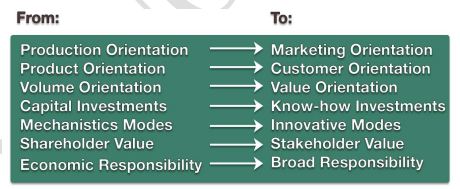
Source: open.oregonstate.education Figure 1: The development of marketing philosophies.
Market Orientation
“Customer orientation” and “market orientation” are closely related but distinct concepts. Customer orientation focuses on understanding and meeting the needs of customers, while market orientation takes a broader approach, positioning marketing as an integrative function that aligns all organizational activities toward building strong customer satisfaction and delivering value.
A company that is both customer- and market-oriented recognizes that profits are driven by understanding customer needs and purchasing behavior. This results in strong relationships with end users, regular marketing research, and product development rooted in customer feedback. Marketing operations are designed to respond to client needs, prioritizing customers and markets in every level of decision-making. From investments and production to raw material procurement, markets and marketing strategies guide business planning. The foundation of customer relationships lies in delivering superior value. Companies must provide this value to attract customers, helping them succeed and, in turn, creating value for their own clients.
In recent years, environmental concerns have become more prominent in the forest industry market. Consumers, environmental groups, and governments have voiced strong and enduring opinions on the matter. These sentiments are driving the integration of social and environmental responsibility into marketing philosophies, reflecting a broader commitment to sustainable practices.
Environmental Orientation
A big part of the growing focus on environmental issues is the idea of sustainable development. In the 1990s, people began to expect that businesses should be responsible in three ways: financially, socially, and environmentally. From a traditional economic view, a business’s main duty is to make profits for its owners while following the law. On the other hand, there’s a broader view that companies have a responsibility to many more groups. Internal stakeholders are groups like the company’s employees, while external stakeholders include suppliers and the communities where the company operates. Institutional stakeholders are mostly the owners of the company’s stock.
It can be very challenging for large companies that work in different countries or regions to meet the different expectations of their stakeholders. These needs vary based on factors like culture, economic development, and education. Companies need to adjust to meet the needs of stakeholders in each place, while still keeping high standards in all their operations.
People often get involved and demand more from companies when their actions negatively affect communities or the environment. For example, poor factory conditions and human rights issues in the clothing industry have led to protests about the roles of buyers, manufacturers, and sellers. In the forestry industry, the focus has been mainly on environmental concerns. These concerns and how they’ve changed over time can be summarized as follows:
- 1970s – emissions to water and air
- Mid 1980s – recycling
- Late 1980s – chlorine bleaching
- Early 1990s – forestry and forest management
- Mid 1990s – forest certification
- 21st century – global climate change and the role of forests.
In response to increased public scrutiny, forest industry companies have made major changes in their operations. Some visible signs of this shift include the introduction of environmental management systems, lower emissions, higher recycling rates, adoption of forest certification, auditing practices, and the publication of social responsibility and environmental reports. This period in the industry can be seen as the era of “responsible forest industry-responsible marketing.” At this stage, companies engage in what is known as environmental marketing. However, it’s important to note that the industry has often been reactive rather than proactive in addressing these issues. As a result, the idea of “responsible forest industry — responsible marketing” is still a valuable goal for the sector.
Environmental concerns, along with the purchasing habits of large retailers and other clients, have influenced the marketing strategies of forest industry companies. But it’s important not to overestimate how much customers value these factors. Research shows that both consumers and clients prioritize quality and price over features like “environmental friendliness.” Therefore, any focus on environmental aspects of a product should be in addition to meeting the basic demands of customers.
This overview explains the general evolution of marketing strategies within the industry but doesn’t imply that all companies have changed in the same way. The marketing approaches in the forest industry vary greatly, from a focus on production to a focus on environmental concerns. For instance, recent studies of European forest industry companies highlight a clear difference between “proactive green marketers” and others.
Environmental Marketing in the Forest Industry
“Environmental,” “green,” or “ecological” marketing refers to ethical marketing practices that focus on environmental issues. It involves acknowledging a company’s responsibility to the environment and adapting to new conditions. This concept has gained significant attention in academic discussions, where it is often seen as an extension of traditional marketing. It aims to minimize environmental harm while still meeting consumer needs and wants.
According to Peattie [12], environmental marketing involves social responsibility, the pursuit of sustainability, and a holistic approach that views everything as interconnected. Some even argue that businesses should use environmental marketing to steer consumer demand toward more environmentally friendly products and services.
Environmental marketing is about understanding customer needs and meeting them, while also minimizing environmental impact and making a profit. It is an important tool for promoting long-term development by creating a connection between companies and stakeholders, particularly customers. Marketing helps companies analyze customer needs and turn them into business opportunities.
Companies that cater to environmentally conscious customers can turn these values into economic benefits. Forward-thinking businesses will try to guide customers toward more sustainable choices. This involves integrating environmental factors into every aspect of marketing, especially strategy.
Environmental marketing can also promote responsible and sustainable forestry practices. For the forest industry, it serves as a way to meet company goals and gain a competitive edge. True environmental marketing comes from a genuine company philosophy of responsibility toward society and the environment. If the commitment to environmental issues is not authentic, a company risks being accused of “greenwashing,” which is considered worse than doing nothing at all.
NWFPs in the Market
The following non-wood forest products (NWFPs) are produced in the Philippines and documented in the Department of Environment and Natural Resources (DENR) Annual Forestry Statistics: almaciga resin (copal), anahaw leaves, bamboo, buri midribs, elemi, hinggiw, honey, nipa shingles, diliman and other vines, salago bark, split and unsplit rattan, and tanbark. Export volumes and values have been recorded for products such as almaciga resin, elemi gum, bamboo, rattan poles, salago fiber, and buri raffia. Additionally, exports include baskets and basketware made from bamboo, rattan, raffia, and other natural fibers, as well as placemats made from abaca, buri, and pandan, and furniture made from bamboo, rattan, and buri. Imported NWFPs include gum, bamboo, and split and unsplit rattan.
Considerations for NWFP Commercialization
The factors that should be considered before non-wood forest products could be commercialized fall into three main groups, namely ecological, social and economic factors.
Ecological Factors Affecting NWFP Marketing
When considering a non-wood forest product (NWFP) for commercialization, the most important factors are typically ecological. These factors ensure that the product maintains a positive relationship with its natural environment. While it is possible to cultivate almost any plant anywhere with the right resources, NWFPs are usually low-maintenance or even require no maintenance. This makes them accessible to many subsistence farmers or forest dwellers, unlike other natural resources that may not be as easily obtained.
One critical ecological factor is the availability of the product in the forest, both currently and in the near future. It is essential to assess whether there is enough of the NWFP to meet market demand without the need for cultivation.
If cultivation is necessary for commercialization, it is important to determine if there is sufficient land available for cultivation without interfering with land needed for other purposes. Case studies from India, China, Australia, and the Philippines highlight the role of NWFPs in various forest types [6]. These studies show that different forest types offer varying potential for NWFPs, from conifer or eucalyptus monocultures with limited non-timber value to community- managed timber plantations with significant NWFP potential. However, social equity challenges and commercialization risks were common across all regions.
A list of NWFPs used by people in the Province of Pampanga, Philippines (Table 1), shows some potential for NWFP enterprises. These species are well-known and used by local forest communities. Among these, a few, like rattan and certain types of bamboo, are already established as commercial products. Most NWFPs collected in Pampanga are used for subsistence purposes, meaning they are not bought or sold, while some fall between subsistence and commercial goods.
| Local Name | Plant part/use | |
|---|---|---|
| Bambusa | Bamboo | Poles/handicrafts & construction Shoots/food source & medicinal |
| Calamus rotang | Rattan | Stems/handicraft |
| Corypha taliera | Buri | Leaves/handicrafts & low-cost construction Fruits/food source |
| Nypa frutican | Nipa | Leaves/handicrafts & low-cost construction |
| (F. globulosa (Retz) Kunth) | Tikog | Stems/handicrafts & for decorative purposes |
| Thysanolaena latifolia | Tiger grass | Panicles/used for making broom |
| Donax cannaeformis | Bamban | Stems/handicrafts |
| Senna alata | Akapulko | Leaves/used in curing a wide range of skin diseases |
| Quisqualis indica | Niog-niogan | Leaves/medicinal value |
| Entada rheedii | Gogo | Stems/hair & scalp cleansing agent |
| Cananga odorata | Ilang-Ilang | Flowers/essential oils |
| Pogostemon cablin | Patchouli | Leaves/essential oils |
| Vetiveria zizanioides | Vetiver Grass | Roots/essential oils |
| Antidesma bunius | Bignay | Fruits/food source Leaves, stems/medicinal |
Table 1: Non-wood forest products used by the people of Pampanga, Philippines.
Social Factors in Marketing NWFPs
In the past, when transforming subsistence NWFPs into commercial products, two main approaches were commonly used. One approach focused on large-scale commercialization based on the market potential of the product itself, such as whether a plant, animal, or resource could be sold and how to access that market. The other approach viewed the development of NWFPs as a smaller part of a larger initiative, such as providing income for individuals (especially women, landless agricultural workers, indigenous people, and other target groups) in areas where timber harvesting was restricted. While both approaches and others have their value, they often limit the potential of NWFPs as a source of income for a broader range of people, particularly in poverty- stricken areas. NWFPs are rarely seen as the main product to improve the economic situation of every household in forest communities. Nevertheless, these models exist and serve as examples of ‘best practices.’ Salafsky, et al. [17] highlighted key social factors that are necessary for a successful NWFP enterprise. These include secure resource tenure, incentives for conservation, availability of infrastructure for transporting the products, absence of alternative land-use pressures, and political support for the producers. These factors were crucial to the success of NWFP enterprises in regions like Peten, Guatemala, and Kalimantan, Indonesia, which were part of the study.
A more recent study of indigenous forestry firms in the United States identified social factors that influence the economic success of forest products [18]. The study found that self-rule is essential, as it creates clear connections between decisions and their consequences. It also emphasized the importance of non-politicized conflict resolution processes, governance structures, and long-term community development planning for the success of a forest business.
The study contradicted the idea that economic success is primarily determined by resource availability, location, or education level. Instead, it showed that effective decision- making by key stakeholders is more important than other socioeconomic factors like formal education.
While it may be difficult to fully institutionalize these social factors, there are government programs in the Philippines aimed at ensuring that such aspects are considered in forest management.
Economic Factors Affecting Prospects for Commercialization
Since NWFPs are typically low-value products, they tend to be less attractive to larger forestry entrepreneurs. Additionally, they usually require low market entry costs, which makes them more accessible to a broader group of poor forest product entrepreneurs. The CIFOR studies categorize the factors that make NWFPs ideal for poverty alleviation into three key areas: demand, supply, and market characteristics [18].
• The demand for marketable non-wood forest products NWFPs are products with growing demand and low market entry costs, which allows for the continuous entry of new entrepreneurs. The small and inconsistent volumes of these products, along with flexible quality standards for raw materials, make it easy for small producers to enter and exit the market, unlike larger producers who often face significant capital investment risks.
A favorable demand situation for small producers of NWFPs can only occur if certain conditions are already in place. These conditions include unrestricted bidding processes and a large number of buyers for raw materials, which could lead to higher prices and more equitable terms for producers. However, these conditions can only be established if there is an existing demand for the NWFP; without this, small producers will struggle to create demand at a fair market price.
Comparisons of domestic markets for rattan in Laos, Vietnam, and Cambodia show the importance of existing demand [19]. The potential for rattan markets in these countries depends on their level of development. Vietnam has exhausted its wild rattan stocks but is working on plantations. Cambodia has similar issues with diminishing wild stocks but lacks well-established plantations. Laos, on the other hand, has significant wild stocks and has started plantation development, alongside a steady demand for edible rattan shoots, which gives it the greatest potential for maintaining a sustainable rattan market.
Additionally, market intermediaries often support small- scale collectors of NWFPs by providing a mix of funding, technical support, and marketing for the raw materials. However, if competition among these intermediaries is limited, small producers may become too reliant on a single intermediary, which could work against their interests.
• Supply considerations for non-wood forest products Scherr, et al. [18] suggest that the supply factors making NWFPs ideal for generating income for poor entrepreneurs are based on the assumption that these products are relatively abundant. However, they highlight clear benefits for small producers. Most NWFPs are produced using low- cost, locally known technologies, allowing them to be easily adjusted in response to market demands and production costs.
If NWFP marketing is linked to national or international government or non-governmental organization initiatives related to environmental conservation, there is potential for NWFPs to supplement income from other sources, such as agriculture or industry, rather than replace them.
This is especially important in countries like the Philippines, where a lack of agricultural land or capital for industry prevents many forest community members from entering the market. Support for NWFP marketing encourages these communities to recognize the species used for NWFPs as valuable income sources and as part of efforts to preserve their forests. The non-timber benefits of forests, including NWFPs, are well-documented [20], but marketing support has mainly focused on wood products [21].
In many forest communities, NWFPs are undervalued due to the low prices offered for them compared to cultivated produce or manufactured goods. For example, NATRIPAL (United Tribes of Palawan), a non-governmental organization that supports indigenous communities in Palawan Province, has faced challenges in encouraging local communities to invest in value-added NWFPs. This is due to past disappointing experiences, where the prices offered by infrequent tourists were very low, and transportation costs to even local markets were prohibitively high [22].
Review of NTFP Marketing Studies
Most countries lack scientific data on Non-Timber Forest Products (NTFPs) or their markets [23]. Due to their geographic fragmentation and lower economic returns compared to timber products, NTFP marketing has been largely overlooked in research and management [24]. However, some studies have compared the economic value of managing forests for NTFPs versus timber and agricultural production.
Because marketing chains are essential to marketing systems, several studies have been conducted to map out NTFP marketing chains. Edwards [25] studied NTFPs marketed from Nepal to India’s traditional medicine and essential oil industries. The study identified various participants in the chain, including local collectors, village traders, road-head traders, large traders, Indian wholesale agents, and industrial units. The research found that trade contributes US$8.6 million annually to Nepal’s national economy, which is six times the value of Nepal’s official timber exports to India. The trade also supports several hundred thousand workers, with many depending on it for over half of their household income.
Everett [26] examined NTFP marketing in the Pacific Northwest, revealing inefficiencies in the marketing system. The system is controlled by urban-based, capital-intensive industrial firms that buy NTFPs from local communities. Issues such as waste, over-harvesting, conflicts between ethnic groups and institutions, and the government’s inability to manage NTFP resources effectively hinder efficient marketing.
Various efforts have been made to improve NTFP marketing by addressing these inefficiencies and inequities [26]. Non-governmental organizations and state Forest Departments, for instance, are working to increase returns for NTFP collectors through cooperative organizations [27].
Developing Markets for NTFPs
While traditional methods of selling Non-Wood Forest Products (NWFPs) in the domestic market continue to be practiced, expanding and finding new markets for NWFPs is crucial. Encouraging farmers to rely on NWFP-based livelihoods is futile if there is no market for their products. Pendleton highlighted five key market-related factors necessary for a successful NWFP activity:
- The availability of an economically viable volume of products in the harvesting area.
- The presence of markets (current or potential) for the products or their derivatives.
- Accessibility for harvesting and the ready availability of NWFPs.
- Assurance of a long-term supply of these resources.
- The sustainability of NWFP harvesting operations.
Strategic Marketing Planning
As mentioned earlier, the evolution of society and industry requires businesses to adopt more advanced marketing strategies. A production-oriented approach requires minimal marketing efforts, while focusing on customer needs and meeting those needs demands greater investment in customer planning and delivery. Therefore, thorough planning of marketing strategies is crucial. In this section, we will explore strategic marketing planning in the forest industry, along with a model-based approach that can help guide more sophisticated marketing efforts. Strategic marketing involves a holistic and integrated approach to marketing planning.
Making the Future of Marketing
In today’s business environment, effective marketing practices are crucial for a company’s success, as they enable firms to adapt their business models. Achieving success through marketing depends on the following:
- Ability to do the right thing: The forest industry must strike a balance between company profits, customer needs, community interests, and both local and global environmental concerns.
- Doing things the right way: Companies need to understand the marketing environment, provide value- oriented information to customers about products and services, and ensure transparency in business processes, such as the supply chain.
- Ability to identify and use the best available tools and technologies: Successful strategic marketing implementation requires a company culture that supports market orientation. Management tools like total quality management help create a customer-focused culture. Additionally, strategic planning, scenario planning, and other “foresight” tools are essential for analyzing future market opportunities.
NTFPs Marketing Interventions
• Business development approach - Adding value locally on NWFPs Rather than focusing on developing a single product, it is better to emphasize creating business strategies that can be applied at the grassroots level to promote economic development with a variety of products. Efforts should concentrate on repackaging and redesigning existing products and knowledge into more business-oriented approaches, rather than inventing entirely new products [28]. For instance, members of Soroptimist International of PSAU in Magalang, Pampanga, significantly boosted their income by turning fresh bamboo shoots into kimchi. This example shows how value addition and improved marketing strategies can enhance producers’ revenue.
Local NWFP producers often sell their products without processing them. However, processed products can provide extra income, increase value, extend shelf life, and help manage seasonal surpluses. Increased technological innovation in local production and processing can benefit producers. Adopting appropriate technology is an effective way for producers to save time, improve product quality, or add value. The technology should be simple to use and reliable.
Choosing Right Marketing Strategies for NWFPs
The seasonality of prices highlights the importance of market strategies to add value to NWFPs. It may be more beneficial to base production scale decisions on local and national demand, as well as the potential for secondary processing or use in making other consumer products like soaps, cosmetics, and pharmaceuticals. For example, marula can be used in fruit, jams, jellies, cosmetics, wines, and creams, while gum Arabic has a wide range of potential applications. This approach helps reduce the risk of not being able to sell a single product by diversifying the types of end users for each NWFP.
Moreover, products can be marketed in local, regional, national, or international markets, or in any combination of these. Producers can also target end users who may have different markets or uses for the product. Communities can differentiate their products to command better prices, such as by labeling them as organic, green, natural, or socially responsible [29]. However, this requires third-party certification, which comes at a cost.
Information Resource Base and Market Conditions
Local producers of NWFPs often face a competitive disadvantage due to a lack of knowledge, especially compared to traders. If there were more transparency in the marketing chain, local producers could access important information, such as monthly price updates from key points in the chain, including FOB prices for NWFPs leaving the country. A solid understanding of all players in the commercial chain—such as producers, buyers, sellers, importers, exporters, brokers, and freight forwarders—would empower local producers to negotiate more effectively with traders.
The mass media, including newspapers, radio, television, and other local communication channels, can be crucial in expanding information flows regarding NWFP markets. Non-governmental organizations (NGOs) can also play a significant role in improving access to market information for local producers.
Conclusion
The evolution of forest products marketing reflects the growing demand for new types of products and services, as well as a shift toward system solutions over individual products. In the future, marketing strategies will need to adapt to meet the more diverse needs of customers through larger, global companies. In Pampanga, Philippines, the relationships among raw material collectors, low-quality producers, and market players mirror patterns seen worldwide. Collectors and local traders, who are often the poorest participants in the marketing chain, continue to face significant socioeconomic challenges, a trend that aligns with Browder’s [30] observations.
Looking ahead, rather than simply predicting what the future will look like, we must consider the type of future we want for the forest sector. The forest industry, including forestry, forest industries, and marketing, will play a pivotal role in shaping the world’s future. While long-term predictions are inherently uncertain, we can reasonably forecast several key trends: local markets will expand globally, customer needs will become more diverse and be met by larger, global companies, the information environment will be fast-changing, transparent, and global, and stakeholders will increasingly demand social and environmental responsibility from businesses [31, 32, 33, 34, 35].
In this evolving landscape, the forest sector can thrive by embracing three guiding principles: doing the right thing by aligning operations with societal values, doing things the right way through responsible business philosophies and practices, and using the best available tools and technologies to innovate and improve efficiency. By following these principles, the forest sector can not only adapt to change but also prosper in an increasingly complex and fast-paced global environment.
“The authors declare no conflict of interest”
References
-
Greene SM, Hammett AL, Kant S (2000) Non-timber forest products marketing systems and market players in southwest Virginia. Journal of Sustainable Forestry 11(3): 19-39.
-
Newman DH, Hammett AL (1994) Non-Timber Forest Products Market Development as a Means of Tropical Forest Protection. Chapter 17 in Forest Resources and Wood-Based Biomass Energy as Rural Development Assets. Winrock International. Oxford and IBH Publishing, New Delhi, India, pp: 297-306.
-
Jefferson F (1994) Introduction: Society and Non-Timber Forest Products in Asia. Society and Natural Resources 8: 189-192.
-
Eric H, Heikki J (2005) Marketing of Forest Products in a Changing World. New Zealand Journal of Forestry Science 35: 190-204.
-
Dixon-Fowler HR, Slater DJ, Johnson JL, Ellstrand AE, Romi AM (2013) Beyond “does it pay to be greenTZS” A meta-analysis of moderators of the CEP–CFP relationship. Journal of business ethics 112(2): 353-366.
-
Samwel S (2021) Chapter six marketing of forest products and services.
-
Carey G (1996) From Necessity, New Forest Industry Rises. The New York Times: National Report. March pp: 12.
-
Flammer C (2015) Does corporate social responsibility lead to superior financial performanceTZS A regression discontinuity approach. Management Science 61(11): 2549-2568.
-
Han X, Hansen E (2015) Marketing sophistication in private sawmilling companies in the United States. Canadian Journal of Forest Research 46(2): 181-189.
-
Hansen E, Fletcher R, McAlexander J (1998) Sustainable Forestry, Swedish Style for Europe’s Greening Market. Journal of Forestry 96(3): 38-43.
-
Miles MP, Covin JG (2000 Environmental Marketing: A Source of Reputational, Competitive, and Financial Advantage. Journal of Business Ethics 23: 299-311.
-
Peattie K (1995) Environmental Marketing Management, Meeting the Green Challenge. Pitman Publishing. London, UK, pp: 309.
-
Porter ME, van der Linde C (1995) Green and Competitive: Ending the Stalemate. Harvard Business Review. September-October pp: 120-134.
-
Sheth J, Parvatiyar A (1995) Ecological Imperatives and the Role of Marketing. In: Polonsky M, MintuWimsatt A (Eds.), Environmental Marketing: Strategies, Practice, Theory and Research. The Haworth Press.
-
Wang L, Heikki J (2007) New Business Models and Marketing Designs for the Nordic Sawmilling Industry. Reports 41. University of Helsinki. Department of Forest Economics.
-
Harrison SR, Herbohn JL (2001) The Importance of Non-Timber Products in Tropical Small-Scale Forestry. In: Sustainable Farm Forestry in the Tropics: Social and Economic Analysis and Policy Edward Elgar, Cheltenham.
-
Salafsky N, Dugelby BL, Terbough JW (1993) Can extractive reserves save the rain forest? An ecological and socioeconomic comparison of non-timber forest product extraction systems in Peten, Guatemala and Kalimantan, Indonesia. Conservation Biology 7(1): 39-52.
-
Scherr SJ, White A, D Kaimowitz (2004) A New Agenda for Forest Conservation and Poverty Reduction: Making Markets Work for Low-Income Producers. Washington, DC: Forest Trends, Centre for International Forest Research (CIFOR). World Conservation Union (IUCN).
-
Evans TD (2002) The status of the rattan sectors in Lao People’s Democratic Republic, Viet Nam and Cambodia – with an emphasis on cane supply. In: Rattan: Current Research Issues and Prospects for Conservation and Sustainable Development. Food and Agriculture Organisation of the United Nations (FAO), Rome, Italy.
-
Herbohn JL, Harrison SR, Lamb D, Keenan R (2000) Small-scale forestry systems for timber and non-timber benefits including biodiversity. In Sustainable Small- scale Forestry: Socio-Economic Analysis and Policy. Edward Elgar, Cheltenham.
-
Harrison SR (2000) Socio-economic and policy issues in farm forestry. In: Sustainable Small-scale Forestry: Socio-Economic Analysis and Policy. Edward Elgar, Cheltenham.
-
Alsa L, Banua D (2004) Sales of Rattan and Honey. NATRIPAL. Puerto Princesa City, Palawan, the Philippines.
-
Hagen V, James B, Weigan F, McLain R, Fight R, et al. (1996) Conservation and Development of Non-Timber Forest Products in the Pacific Northwest: An Annotated Bibliography. Gen. Tech. Rep. PNWGTR-375. Portland, OR: U.S. Department of Agriculture, Forest Service, Pacific Northwest Research Station pp: 246.
-
Catherine M (1993) Minnesota Special Forest Products. Minnesota Department of Natural Resources, Forestry Division.
-
Edwards DM (1996) The Trade in Non-Timber Forest Products From Nepal. Mountain Research and Development. United Nations University and The International Mountain Society 16(4): 383-394.
-
Everett (1996) studied NTFP marketing in the Pacific Northwest that gives some insight of the inefficiency of the marketing system. System is controlled by urban- based and capital-intensive industrial units which buy NTFPs from communities. Obstacles to effective marketing include waste and over harvest of products, conflicts and communication barriers between ethnic groups and institutions, and the government’s inability to adequately manage NTFP resources.
-
Shashi K (1997) Integration of Biodiversity Conservation and Economic Development of Local Communities. Journal of Sustainable Forestry 4(1/2): 33-61.
-
Commercial Products from the Wild Consrtum (CP-wild) (2004) Commercial products from the wild. Sustainable utilisation nd domestication of products from indigenous forests and woodland ecosystems. Innovation Fund Round 1. Project 31114. Final Report 1.
-
Clay JW (1995) An overview of harvesting, forest processing and transportation of non-wood forest products. Report of the International expert Consultation on NWFPs. 17–27 January. Yogyakarta, Indonesia. NWFP 3. ISBN 92-5-103701-9. FAO, Rome, Italy pp: 235-250.
-
John B (1992) Social and Economic Constraints on the Development of Market-Oriented Extractive Reserves in Amazon Rain Forests. Non-Timber Forest Products from Tropical Forests. Nepstad, Daniel C. and Stephen Schwartzman. The New York Botanical Gardens, New York, USA.
-
Anderson R, Hansen E (2004) Determining consumer preferences for ecolabeled forest products: An experimental approach. Journal of Forestry 102(4): 28- 32.
-
Eastin I (1996) The role of marketing in promoting a sustainable trade in forest products in tropical regions. Paper presented at the Workshop on “Forest Products Marketing,” UPLBCF, College, Laguna in September.
-
Han X, Hansen E (2016) Marketing organization and implementation in private US sawmilling companies. BioProducts Business pp: 1-13.
-
Kärnä J, Hansen E, Juslin H (2003) Social responsibility in environmental marketing planning. European Journal of Marketing 37(5/6): 848-871.
-
Shook SR, Eastin I (2001) A characterization of the U.S. residential deck material market. Forest Products Journal 51(4): 28-36.
- Community Forestry Enterprises as a Model for Sustainable Forest Development: The Case Of The "Baja Tarahumara" in Chihuahua, Mexico
- Ecological and Socio-Economic Impacts of Chromolaena odorata and Mesosphaerum suaveolens, Two Invasive Alien Species in Central and Southern Benin, West Africa
- Epigenetic Sustainability: Modeling the Human Factor as a Natural Resource through Science 4.0 and the NR3C1 Biological Pilot
- Growth-at-Risk: A Framework for Assessing Economic Vulnerability
- The Rural Territory as a Socioecological System for the Management of Public Policy for Sustainable Rural Development
- Transition Risks in a Small Open Economy: An EDSGE Model with Blue Firms, Financial Frictions and Macroprudential Policy