
Is Uvula Important? Absence of Uvula: An Accidental or an Incidental Finding
Introduction: Absence of the uvula is very rare in the general population, which is mostly acquired secondary to surgery or is rarely congenitally absent since birth. Uvula is a small band of connective tissue, gland and small muscle fibers and is documented to be useful in speech, lubrication and central support of the palatopharyngeal arch during swallowing. Cultural practice of uvulectomy is very common in African countries as a treatment or prophylactic measure for chronic cough or frequent respiratory infection. Congenital absence of uvula is a rare condition and is also accompanied by other genetic abnormalities such as cleft lip or cleft palate. Case Report: This case report is based on an accidental finding in a 20-year-old African-American male who was acting as a standardized patient in a clinical course at a medical college. Conclusion: This is one of the rare cases of absence of uvula without any other congenital or genetic abnormality to be reported in medical literature.
Introduction
Many organs of the body can be seen, some organs can be felt but very few organs are only present to be heard.
One such organ is uvula, which is extremely essential in various functions in the oral cavity [1]. The other structures in oral cavity are cheeks, tongue, palate, gums, teeth & lips. The uvula is a dangling, fleshy, small teardrop shaped projection that hangs from the posterior free margin of the soft palate, it is hidden from the view but can be seen when the mouth is wide open and gives a heart shape contour to posterior throat [2]. Two muscular folds extend downwards from soft palate, on either side of uvula [3]. For years scientists have debated about the functions and importance of uvula, some are speculative, and others are based on definitive scientific basis. It has an important role with soft palate when you swallow, they move upwards helping to keep foods and liquid from entering the nasal cavity while eating or drinking. It is also reported that uvula helps soft palate from being forced into nasopharynx, and resists pressure difference between the mouth and oral part of pharynx as in coughing or sneezing. Few scientists also think the uvula has an influence on tone of voice and others it’s immunological function. Its influence on speech is because of its ability to produce large quantities of salivary secretions which lubricates the throat while speech. It is innervated by vagus nerve (cranial nerve X) and glossopharyngeal nerve (cranial nerve IX) which play an important role during gag reflex [3].
Case Report
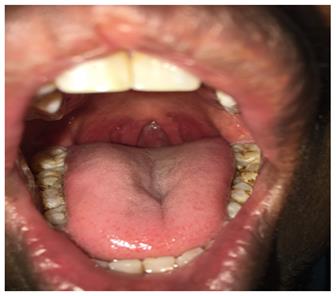
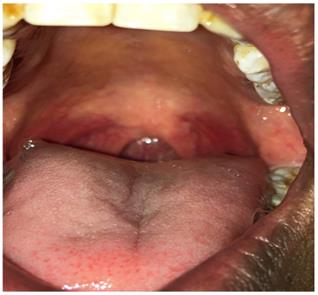
A 20-year-old apparently healthy American male was acting as a standardized patient for a clinical course at this Caribbean Medical School. He did not have any significant medical or surgical illnesses or complaints. During intraoral examination it was noticed that though the palate and palatopharyngeal arch were developed normally, the uvula was absent (Figure 1,2). Upon further questioning the patient denied any history of intraoral surgery or chemical cauterization procedures. He was born and raised in America and does not recollect any travel history to African, Middle Eastern subcontinent. He had no difficulty with speech and the tone and quality of his words sounded completely normal. He was asked to recite a few velar consonants (k, g and ŋ) and he had no difficulty in reciting them and they sounded normal. He had no complaints of difficulty or trouble during swallowing or any regurgitation of saliva or fluids during coughing or sneezing. He does have a history of frequent snoring which his partner has observed several times, though he does not complain of difficulty breathing or shortness of breath while exercise, physical activity or resting. The patient does not give history of any alcohol consumption or smoking or leisure drugs. No history or deviated nasal septum or sinusitis. The rest of the history was insignificant.
Physical Examination Findings Vitals: Pulse Rate: 84/ min regular, symmetrical Blood Pressure: 122/76 mm of Hg Respiratory rate: 18/ min Temperature: 98.6 F BMI: 25.8 (Normal range 18.5 – 24.9) Systemic Examination Oral examination: No Cleft lip or cleft palate, Palatopharyngeal arch are normal, no signs of inflammation or injury. Uvula is absent, no signs of any surgery or trauma. Gag reflex was positive signifying no damage to vagus and glossopharyngeal nerves Velar consonants were normal to sound, tone and quality of speech
Discussion
Uvula is considered as vestigial or rudimentary organ by many scientists and hence is under represented in the literature or study being done on uvula. Embryologically it is formed during the 7-12th week of intrauterine life by fusion of palatine shelves. The common abnormality associated with uvula are few cases of bifid or trifid uvula or absence of uvula with cleft palate or some other genetic abnormality [4]. The congenital absence of uvula without any other visible or clinical abnormality is very rare in the general population and is yet to be studied in detail. Jorgenson et al. reported just one case of congenital absence of uvula from 2258 oral examinations in neonates. Absent uvula can be associated with certain genetic conditions like Alpert syndrome, anhidrotic ectodermal dysplasia and cerebrocostomandibular syndrome [5]. These genetic conditions may be associated with difficulty in airway management during surgeries. Acquired cases are mostly following surgical procedures. These procedures can be secondary to surgery such as uvulopalatopharyngoplasty for obstructive sleep apnea or as a cultural practice which are well documented in Sub- Saharan continent or the Middle East as a prophylactic treatment for chronic cough or frequent repeated respiratory tract infection in children [6]. This subject denied any participation in any such surgical or chemical cauterization procedures. Many physicians in the past have used quick lime for chemical cauterization of uvula by immersing it in the solution [7].
Conclusion
Congenital absence of the uvula is a rare observation in the general population and the cause must be explored as it may be associated with various genetic abnormalities like cleft lip or cleft palate, which will present very early in life or conditions like Alpert syndrome or hyperimmunoglobulin E syndrome which may cause difficulty in breathing or airway management during surgeries. This case is unique as the subject has no surgical history nor has a history of traveling to any countries where it is a routine religious practice for centuries. It can be concluded that cases such as congenital absence of uvula can be important from embryological perspective and from evolutionary point. We recommend that thorough clinical examination be done on subjects with congenital absent uvula to rule out other associated clinical condition as a prophylactic measure. We also recommend that further research be carried out in population where uvulectomies have been a common practice to check for an evolutionary role.
References
-
Back G, Nadig S, Uppal S (2004) Why do we have uvula? literature review and new theory. Clin Otolaryngol Allied Sci 29(6): 689-693.
-
Ijaduola G (1981) Uvulectomy in Nigeria. J Laryngology and Otology 95(11): 1127-1133.
-
Achalli S, Bhat S, Shetty R, Babu SG, Suvarna R (2012) Deformities of uvula in oral cavity- A case series. Iran Red Crescent Medical J 14(10): 676-679.
-
Samsoon G, Young J (1987) Difficult tracheal intubation: A retrospective study. Anesthesia 42(5): 487-490.
-
Jorgenson R, Shapiro S, Salinas C (1982) Intraoral findings and anomalies in neonates. Pediatrics 69(5): 577-582.
-
Chipeta J, Banda J, Mbinga M, Wa S (2009) Absent uvula and thrombocytopenia in an African infant with Jobs syndrome: Case report and review of literature. J Infect Dis Immun 1(4): 1-5.
-
Manni J (1984) Uvulectomy a traditional surgical procedure in Tanzania. Ann Trop Med Parasitol 78(1): 49-53.
- Pattern of Breast Lesions in Ovu Inland, Delta State, South Southern Nigeria
- Morphometric Analysis of the Human Femur: Exploring Platymetric and Robusticity Indices Among the Nigerian Population
- Anatomical Variation of Arteria Lusoria: Clinical Implications for Dysphagia Lusoria and Surgical Risk
- Morphometric Study of the Vertebral Body and Pedicle of Typical Cervical Vertebrae Using Radiological Image
- Epigenetic Mechanisms Driving Human Evolutionary Changes
- Neuroprotective Effects of Ginkgo Biloba Extract on Bilateral Common Carotid Artery Ischaemic Stroke Induced in Wistar Rat