
Viability Test and Developing Inoculation Protocols for Tef Leaf Rust (Uromyces Eragrostidis) Urediniospores
Tef plants are prone to be attacked by tef leaf rust (Uromyces eragrostidis) disease under Ethiopian conditions. Tef urediniospores are considered the most economically important in maintaining disease from season to season and used as inoculums source for supporting natural infection of the disease. The longevity of freshly collected urediniospores of the tef leaf rust disease that is caused by Uromyces eragrostidis collected from different late maturing tef genotypes were studied under different temperature. Inoculation of the seedling was done with three different protocols. The first inoculation was done mixing urediniospores with tween20 and distilled water. The second inoculation was done mixing urediniospores with isoparaffin oil with distilled water and the third seedling received inoculation mixing urediniospores with distilled water. The urediniospores were placed in different refrigerators adjusted at different temperature reading from 5°C to 25°C. The collected urediniospores were kept at temperatures between 5°C and 25°C at 5°C increments. Therefore, the aims of this study are to determine the longevity of tef rust urediniospores under different temperatures and develop appropriate inoculation protocol for tef rust disease. The results revealed that 5 and 10°C were relatively the most favorable for long-term preservation for tef leaf rust urediniospores and the inoculation protocol for the seedling of tef genotypes were done using urediniospores mixed with distilled water and isoparaffin oil was best according to this study at green house.
Introduction
Tef plants are prone to be attacked by tef leaf rust (Uromyces eragrostidis) disease under Ethiopian conditions. Tef urediniospores are considered the most economically important in maintaining disease from season to season and used as inoculums source for supporting natural infection of the disease. Collecting urediniospores for the tef rust, is the first step in tef breeding program for developing rust tolerance genotypes. Tef leaf rust urediniospores should be collected from different tef genotypes. Urediniospores collections are usually kept from season to another for using the urediniospores as inoculums sources during artificial inoculation. In this respect, two main methods are usually followed. The first is a short-term preservation which include at room temperature and long term preservation [1, 2].
Generally, the longevity of rust urediniospores is affected by many factors. Temperature is considered as the main factor which affects urediniospores longevity [2, 3, 4, 5, 6, 7].
Nazim, et al. reported that spores kept on dry leaves of the susceptible wheat genotypes survived longer than spores kept in glass tubes [8, 9].
However, no data were available to describe the effect of different temperatures on the longevity of tef leaf rust urediniospores and inoculation protocols for tef leaf rust urediniospores. Therefore, the aims of this study were to determine the longevity of tef leaf rust urediniospores under different temperatures and develop appropriate inoculation protocol for tef leaf rust disease.
Materials and Methods
Tef rust urediniospores were collected from different late set of tef genotypes. The urediniospores were collected by battery charged collector. The collected urediniospores were dried for three days at room temperature by placing on the aluminum foil to remove moist from the urediniospores.
The collected urediniospores were divided into five petridish based on the required temperatures. The urediniospores viability or longevity of spores was studied under different temperatures ranging from 5°C to 25°C with 5°C intervals.
Four refrigerators were used for the required temperature adjustments and one sample was placed at room temperature. For each adjustment the urediniospores were observed under microscope until they lost their viability. At each temperature increments the viability of tef rust was observed weekly under microscope. Before placing the urediniospores under microscope each urediniospores was placed at different temperatures. Five petridish were prepared by adding distilled water and sponge was also placed in each Petridish. From each urediniospores placed at different temperatures, minute of spores were taken and placed on the slide. The slides containing the urediniospores were inverted on the upper side of the sponge. After 24 hours each slides containing the urediniospores were observed under microscope. Then the slide was marked on both sides by marker. The germinated spore between the marked slides was counted.
The percentage of the germinated urediniospores was calculated based on observation under microscope from lower to higher magnifications. Finally, the non viable urediniospores observed under microscope were confirmed by inoculating on host genotypes. If the spores appeared pale in color or deformed it was an indication of damaged and not be viable. The pale colored of urediniospores were also inoculated to tef seedling in the green house, but did not infect the tef genotypes. For developing inoculation protocols at seedling level tef genotypes were inoculated: first mixing urediniospores with tween 20 and distilled water. The second inoculation was done mixing urediniospores with isoparrafin oil and the third inoculation was done mixing urediniospores with distilled water.
Results and Discussion
Viability of Tef Leaf Rust Urediniospores
The results obtained indicates that, the viability of the urediniospores when measured as percentage of germination, after drying of the urediniospores for three days was 100% for urediniospores collected from the late maturing group of tef genotypes. Five degree centigrade (5°C): Figure 1 shows that urediniospores stored at five degree centigrade retained 100% viability for 16 weeks and sharply declined up to 17 weeks. Thereafter, it slightly decreased up to twenty six weeks. After thirty three weeks no viable spores were recorded at this temperature both under microscope and after inoculation of susceptible tef genotypes at green house. Ten degree centigrade (10°C): Figure 1 shows that urediniospores stored at ten degree centigrade retained 100% viability for 13 weeks. Thereafter, it slightly decreased up to twenty seven weeks. After twenty seven weeks no viable spores were recorded at this temperature both under microscope and after inoculation of susceptible tef genotypes at green house. After this period of storage, the viability sharply decreased to zero after 28 weeks. Ten degree centigrade (15°C): On the other hand, the spores remained viable (100%) at 15°C for five weeks and the viability slightly decreased up to the 12th weeks. After
12 weeks spore viability was clearly decreased and lost after 19 weeks (Figure 1). Ten degree centigrade (20°C) and 25°C: At 20°C, the stored urediniospores retained 100% viability for three weeks and this then declined slightly up to the 7th week. Therefore, viability has sharply decreased and was
5°C
10°C
completely lost after 9 weeks. While at 25°C, the percentage of germination was 93.7% in the first week and their viability slightly declined up to the 3rd week. After three weeks, the viability sharply decreased until it was completely lost after 5 weeks (Figure 1).
Recommendation
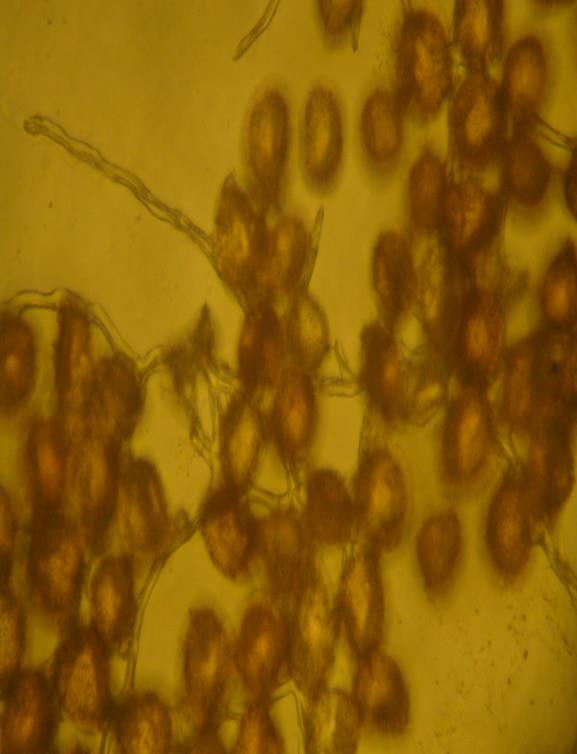
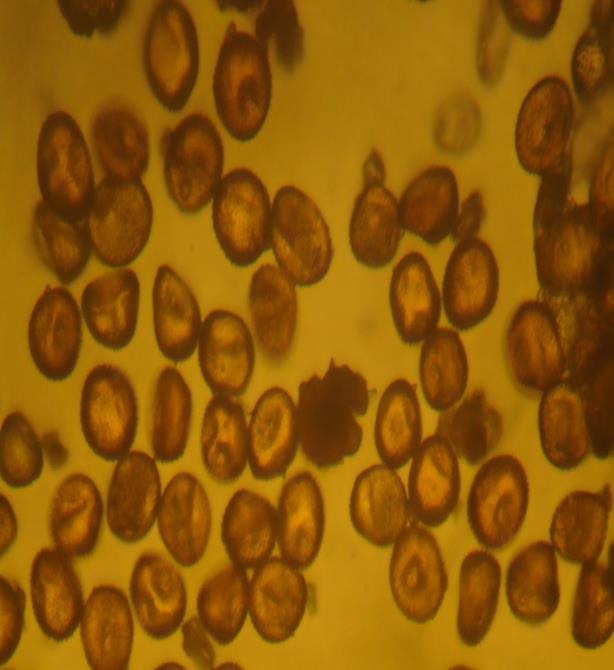
Generally, the results revealed that 5 and 10°C were relatively the most favorable for long-term preservation for tef leaf rust urediniospores and the inoculation protocol for the seedling of tef genotypes were done using urediniospores mixed with distilled water and isoparaffin oil was best according to this study at green house (Figures 2 & 3).
Acknowledgement
I would like to thank pathology lab technician Mr. Eresi Megersa and field technician Mr. Nugusu Hussen for helping me in lab and collecting urediniospores from infected fields.
References
-
Leathers CR (1961) Comparative survival of rehydrated and nonhydrated wheat stem rust urediospores on dry leaf surfaces. Phytopathology 51: 415-416.
-
Eversmeyer MG, Burleigh JR (1968) Effect of temperature on the longevity of Puccinia recondita Rob. f.sp. tritici urediniospores on dry wheat foliage. Plant Dis Reptr 52: 186-188.
-
Hung CH, Chien CC (1961) The effect of temperature on the germination of urediospores of wheat rusts. Spec Publ Coll Agric Taiwan Univ 10: 111-114.
-
Osman-Ghani N, Manners JG (1983) Effect of temperature on germination and viability of urediniospores of four races of Puccinia striiformis from Barley. Trans Brit Mycol Soc 81(2): 241-245.
-
Dennis JI (1987) Effect of high temperatures on survival and development of Puccinia striiformis on wheat. Trans Brit Mycol Society 88(1): 91-96.
-
Eversmeyer MG, Kramer CL (1994) Survival of Puccinia recondita and P. graminis urediniospores as affected by exposure to weather conditions at one meter. Phytopathology 84: 332-335.
-
Eversmeyer MG, Kramer CL (1995) Survival of Puccinia recondita and P. graminis urediniospores exposed to temperature from subfreezing to 35oC. Phytopathology 85: 161-164.
-
Nazim M, Aly MM, Imbaby IA, El-Malak A, Nagwa I (2003) Viability of rust urediniospores stored at different temperatures and produced on different wheat genotypes. Journal of Environmental Science 7: 911-934.
-
Burleigh JR, Schulze AA, Eversmeyer MG (1969) Some aspects of the summer and winter ecology of wheat rust fungi. Plant Piso pp: 648-651.
- Enhancement of Vegetative Growth and Fruit Yield in Cucumber (Cucumis sativus L.) via Spiritual Blessing (Biofield) Energy Intervention
- Production of Açaí (Euterpe oleracea Mart.) under Different Agroforestry System Management Intensities in Amazonian Floodplain (Varzea) Forests
- Coffee and the Production Region: What is the Secret to the Expression "Quality"?
- Experiential Agripreneurship Training in Sub-Saharan Africa: Integrating a Business Incubator into Postgraduate Livestock Education at the University of Buea
- Advances in Agricultural High-Quality Development
- Linking Compost Residue to ABAGE in Plants - a Short Note