
Modeling Atrial Fibrillation with Human iPSCs
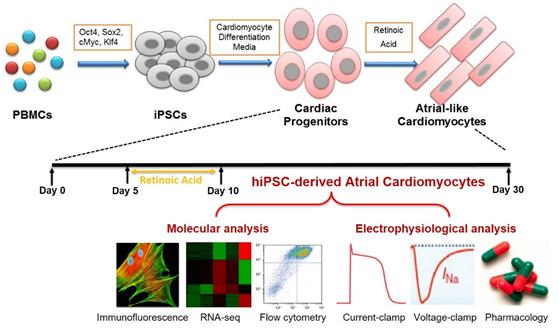
Atrial fibrillation (AF) is the most common arrhythmia worldwide; it is associated with increased risk for stroke, heart failure, inconsistent blood supply, and additional heart rhythm problems. Despite recent advances in antiarrhythmic drugs (AADs) therapies, variability in response to AADs in individual patients is caused either by heterogeneity of the underlying electrical substrate in patients or by our inability to select mechanism-based therapies. Currently, it has been increasing interest in developing cellular models of disease that are genetically-matched to specific patients using human induced pluripotent stem cells (human iPSCs). The generation of hiPSC-derived cardiomyocytes (hiPSC-CMs) from patients’ peripheral mononuclear blood cells has provided novel insights into underlying mechanisms of inherited arrhythmia syndromes. This mini-review will discuss this innovative genotype-guided approach for Atrial fibrillation (AF) therapy, which would prove to be a formative step for the field of personalized medicine.
Figures
References
-
Lau DH, Nattel S, Kalman JM, Sanders P (2017) Modifiable Risk Factors and Atrial Fibrillation. Circulation 136(6): 583-596.
-
Chugh SS, Havmoeller R, Narayanan K, Singh D, Rienstra M, et al. (2014) Worldwide epidemiology of atrial fibrillation: a Global Burden of Disease 2010 Study. Circulation 129(8): 837-847.
-
Darghosian L, Free M, Li J, Gebretsadik T, Bian A, et al. (2015) Effect of omega-three polyunsaturated fatty acids on inflammation, oxidative stress, and recurrence of atrial fibrillation. Am J Cardiol 115(2): 196-201.
-
Darbar D, Roden DM (2013) Genetic mechanisms of atrial fibrillation: impact on response to treatment. Nat Rev Cardiol 10(6): 317-329.
-
Watanabe H, Yang T, Stroud DM, Lowe JS, Harris L, et al. (2011) Striking In vivo phenotype of a disease- associated human SCN5A mutation producing minimal changes in vitro. Circulation 124(9): 1001- 1011.
-
Parvez B, Vaglio J, Rowan S, Muhammad R, Kucera G, et al. (2012) Symptomatic response to antiarrhythmic drug therapy is modulated by a common single nucleotide polymorphism in atrial fibrillation. J Am Coll Cardiol 60(6): 539-545.
-
Kaab S, Darbar D, van Noord C, Dupuis J, Pfeufer A, et al. (2009) Large scale replication and meta-analysis of variants on chromosome 4q25 associated with atrial fibrillation. Eur Heart J 30(7): 813-819.
-
Gudbjartsson DF, Holm H, Gretarsdottir S, Thorleifsson G, Walters GB, et al. (2009) A sequence variant in ZFHX3 on 16q22 associates with atrial fibrillation and ischemic stroke. Nat Genet 41(8): 876- 878.
-
Moretti A, Bellin M, Welling A, Jung CB, Lam JT, et al. (2010) Patient-specific induced pluripotent stem-cell models for long-QT syndrome. N Engl J Med 363(15): 1397-409.
-
Itzhaki I, Maizels L, Huber I, Zwi-Dantsis L, Caspi O, et al. (2011) Modelling the long QT syndrome with induced pluripotent stem cells. Nature 471(7337): 225-229.
-
Deschenes I, Neyroud N, DiSilvestre D, Marban E, Yue DT, et al. (2002) Isoform-specific modulation of voltage-gated Na(+) channels by calmodulin. Circ Res 90(4): E49-57.
-
Lee JH, Protze SI, Laksman Z, Backx PH, Keller GM (2017) Human Pluripotent Stem Cell-Derived Atrial and Ventricular Cardiomyocytes Develop from Distinct Mesoderm Populations. Cell Stem Cell 21(2): 179-194.
-
Devalla HD, Schwach V, Ford JW, Milnes JT, El-Haou S, et al. (2015) Atrial-like cardiomyocytes from human pluripotent stem cells are a robust preclinical model for assessing atrial-selective pharmacology. EMBO Mol Med 7(4): 394-410.
-
Liang P, Sallam K, Wu H, Li Y, Itzhaki, et al. (2016) Patient-Specific and Genome-Edited Induced Pluripotent Stem Cell-Derived Cardiomyocytes Elucidate Single-Cell Phenotype of Brugada Syndrome. J Am Coll Cardiol 68(19): 2086-2096.
-
Shi Y, Inoue H, Wu JC, Yamanaka S (2017) Induced pluripotent stem cell technology: a decade of progress. Nat Rev Drug Discov 16(2): 115-130.
- Anomalous Origin of the Left Coronary System from the Right Coronary Cusp: A Rare Coronary Anomaly in a Patient Undergoing Aortic Stenosis Workup
- Optimizing the Therapeutic Potential of Sacubitril/Valsartan: The Promise of Co-Crystal Engineering
- Association between Mortality and Topography of Peripheral Arterial Disease due to Atherosclerosis Obliterans
- Mitral Valve Replacement vs Mitral Valve Repair
- Characteristics and Evolution of Patients with Heart Failure Hospitalized in the Cardiology Department of Dalal Jamm Hospital
- Distribution of Association between Basic Knowledge of Chest Pain and Myocardial Infarction (Heart Attack) and Demographic Variables: A Survey-Based Study