
Cor Triatriatum Sinister in Adult
A 19 years old male presented with complaint of atypical chest pain for 2-3 days. He did not have any history of fever, palpitations, pre-syncope or syncope. On examination, his pulse rate was 80 per minute, regular and the blood pressure was 120/60 mm Hg. Rest of the general physical examination and systemic examination was unremarkable.
Image Article
A 19 years old male presented with complaint of atypical chest pain for 2-3 days. He did not have any history of fever, palpitations, pre-syncope or syncope.
On examination, his pulse rate was 80 per minute, regular and the blood pressure was 120/60 mm Hg. Rest of the general physical examination and systemic examination was unremarkable.
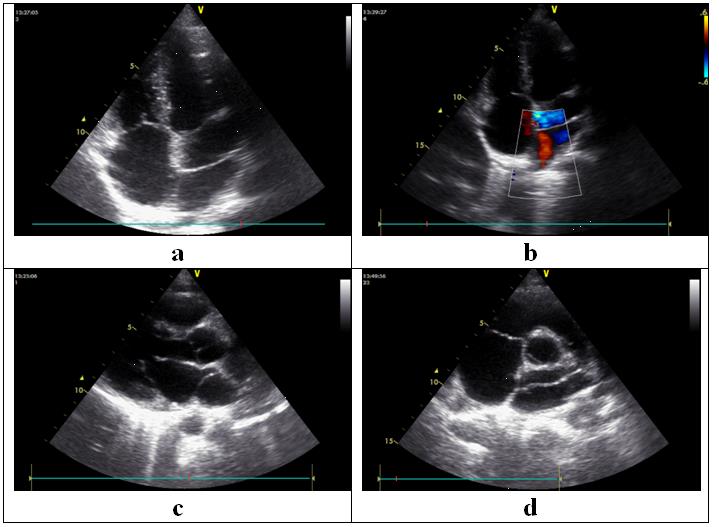
His transthoracic echocardiogram revealed a membrane in the left atrium which was dividing it into two distinct chambers. The pulmonary venous blood was draining into the superior chamber while the inferior chamber was in contact with the atrio-ventricular valve and contained the atrial appendage and the fossa ovalis.
Triatrial heart is a rare congenital abnormality, reported by Jeiger, in 0.4% of patients with congenital heart disease at autopsy [1]. The typical findings of subdivided left atrium were first described in 1868 by Church [2] and term Cor triatriatum was initially applied to this anomaly by Borst in 1905 [3]. It usually involves the left atrium (cor triatriatum sinister) and rarely the right atrium (cor triatriatum dexter).
The atrium is divided into two distinct compartments, usually by a thick fibro-muscular membrane, with transverse or horizontal orientation. It may be band-like Image Article or funnel shaped. The proximal or superior chamber drains the pulmonary venous blood while the distal or inferior chamber (true atrium) is in contact with the atrio-ventricular valve and contains the atrial appendage and the true atrial septum [4].
Several classification schemes have been proposed to describe Cor triatriatum sinister; the simplest was given by Loeffler in 1949 [5]. It is based on the number and size of fenestrations in the fibro-muscular membrane and it identifies three groups: group 1 is defined by the absence of connection between the two chambers, the accessory chamber might connect with the right atrium or some of the pulmonary veins might drain in anomalous fashion; in group 2, there are one or more small openings in the intra-atrial membrane; and in group 3, the accessory chamber communicates widely with the true atrium by a single large opening.
The first two groups are usually diagnosed in highly symptomatic infants and children and are associated with increased mortality at a younger age. While the 3rd group is mostly found in the adult population having this abnormality. Adults having the disease are usually asymptomatic, due to the presence of a large (non- restrictive) opening with no intra-atrial pressure gradient as in our case.
Compliance with Ethical Standards
- Conflict of Interest: Ashok Garg, Deepak Agrawal, Himanshu Arora & Ashutosh Angrish declare that they have no conflict of interest.
- Human Rights Statements: All procedures followed were in accordance with the ethical standards of the responsible committee on human experimentation (institutional and national) and with the Helsinki Declaration of 1964 and later revisions.
- Informed Consent: Informed consent was obtained from patient being included in the study.
References
-
Jegier W, Gibbons JE, Wiglesworth FW (1963) Cortriatriatum: Clinical, hemodynamic and pathological studies surgical correction in early life. Pediatrics 31: 255-267.
-
Church WS (1868) Congenital malformation of the heart: Abnormal septum in the left auricle. Trans Pathol Soc Lond 19: 188.
-
Borst H (1905) Ein Cor triatriatum. Zentralbl Allg Pathol 16: 812.
-
Niwayama G (1960) Cor triatriatum. Am Heart J 59: 291-317.
-
Loeffler E (1949) Unusual malformation of the left atrium: Pulmonary sinus. Arch Pathology (Chic) 48(5): 371-376.
- Anomalous Origin of the Left Coronary System from the Right Coronary Cusp: A Rare Coronary Anomaly in a Patient Undergoing Aortic Stenosis Workup
- Optimizing the Therapeutic Potential of Sacubitril/Valsartan: The Promise of Co-Crystal Engineering
- Association between Mortality and Topography of Peripheral Arterial Disease due to Atherosclerosis Obliterans
- Mitral Valve Replacement vs Mitral Valve Repair
- Characteristics and Evolution of Patients with Heart Failure Hospitalized in the Cardiology Department of Dalal Jamm Hospital
- Distribution of Association between Basic Knowledge of Chest Pain and Myocardial Infarction (Heart Attack) and Demographic Variables: A Survey-Based Study