
Investigating the Behavior of UVC Rays on the Inactivation of Staphylococcus Aureus from Simulated Contaminated Air Using a Probit Model
Today, one of the most significant health challenges is controlling airborne microbial agents. Utilizing ultraviolet (UV) rays is a method to eliminate these microbial agents and can be an effective approach for disinfecting hospitals. The main mechanism in which UV radiation works is not by directly eliminating bioaerosols, rather by preventing their proliferation through damaging the outer structure of their cells. As a result, bioaerosols cease to proliferate and eventually die due to cell death. In this study, our objective is to determine the optimal duration of UV irradiation and temperature and pH required to achieve efficient removal of S. aureus bacteria. A suspension of bacteria was prepared using the 0.5 McFarland standard. The desired contaminated air was produced and blown into the reactor using an air pump. Sampling was done using a membrane biosterile filter with a pore diameter of 0.22 micrometers in various UV irradiation time, temperature, and pH. The number of colonies grown from the samples was counted. The removal efficiency of S. aureus bacteria was >70% after 10 minutes of irradiation, >80% after 20 minutes, and >95% after 30 minutes at a constant rate. Also, the actual bacterial removal efficiency differs slightly from the removal efficiency predicted by the probit model.
Introduction
Today, one of the most important health challenges is preventing the spread of hospital infections. This is achieved by controlling airborne microbial agents that can be transmitted through droplets spread by exhalation. These droplets remain suspended in the air for some time [1, 2, 3]. These droplets may even enter the bloodstream through the lower respiratory system [4, 5, 6]. In addition, bacteria can produce toxins that initiate harmful processes in the host Thesis organism. These toxins inhibit protein synthesis, stimulate immune responses, and damage cell membranes. Bacterial cell wall compounds such as endotoxins and peptidoglycans have pro-inflammatory properties that can lead to respiratory symptoms like asthma, bronchitis and byssinosis. While most bacteria are usually harmless or even beneficial to us and the environment, problems arise when the concentration of potentially pathogenic bacteria exceeds the infectious dose. This infectious dose can vary significantly among different pathogenic species [7]. Staphylococcus bacteria are one of the main causes of nosocomial infections, accounting for 55-75% of these cases [8]. Due to concerns surrounding these infections, more focus has been placed on the use of ultraviolet radiation as a quick method to kill microbial agents. UV germicidal irradiation is a disinfection technique that uses UV radiation with short wavelengths of 100 to 280 nm [1, 9, 10]. The main mechanism by which UV radiation kills microorganisms is through the disruption of molecular bonds in DNA and RNA. This happens when photons are absorbed, leading to the formation of pyrimidine dimers from thymine and cytosine bases. It is important to note that UV radiation does not directly destroy bioaerosols, but prevents their proliferation by damaging the outer cell structure. As a result, bioaerosols can no longer reproduce and are not able to cause disease. Eventually they die due to cell death. Studies have shown that ultraviolet radiation emitted at a wavelength of 254 nanometers (nm) is particularly effective for this inactivation [11, 12]. In addition, doses of 1.5-1.8 x 10^8 bacteria create the highest efficiency in exposure to UV with a wavelength of 254 nm for inactivating bacteria [13]. Increasing air humidity by trapping bacteria in water droplets increases the time bacteria stay suspended in the air. This will increase the efficiency of removing bacteria through UV irradiation [14]. Therefore, the contact time of airborne bacteria with ultraviolet rays is also an important factor [15]. when exposed to ultraviolet rays, based on similar studies [13]. UV radiation also provides rapid and significant inactivation by directly affecting the genetic material of microorganisms without leaving any by-products. This targeted mechanism makes UV radiation an effective and efficient method for microbial inactivation at a lower cost and without producing harmful byproducts [1]. Thus, this study aimed to determine the optimal humidity, temperature and exposure time required to achieve effective elimination of S. aureus bacteria using the UVC irradiation reactor.
Materials and Methods
UVC Device Specification
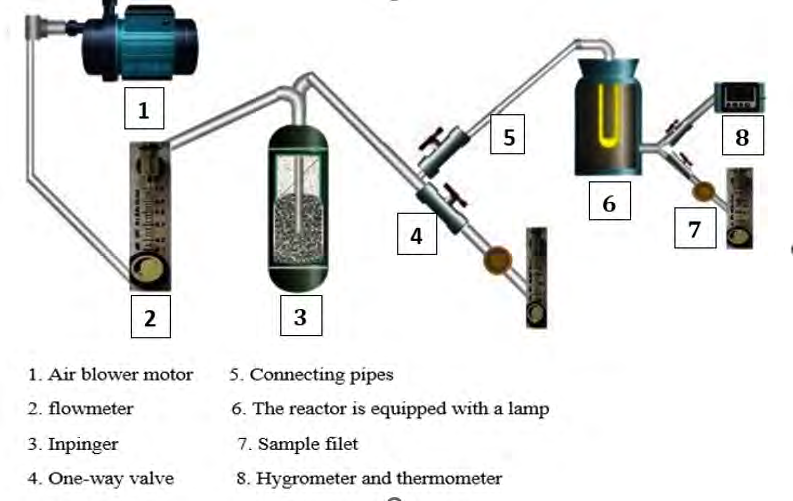
In the current study, an airtight reactor made of PVC with a polyamide coating was constructed. The reactor was equipped with a 9-watt UVC lamp with a wavelength of 254 nm. The reactor had dimensions of 14 cm in height, 13 cm in diameter, and a volume of 0.0018 cubic meters (Figure 1).
Quantification of UVC Dose
To begin, a bacterial suspension of S. aureus was prepared from a S. aureus bank using a 0.5 McFarland standard [16]. The concentration of the suspension was then adjusted to 0.6 density at 620 nm wavelength using a spectrophotometer.
Preparation and Counting of Microorganisms
Air sampling was performed at the beginning and end of the reactor using a 47 mm CA Membrane bio sterile filter made of cellulose acetate with a 0.22-micron pore diameter. The filters were then placed on mannitol salt agar plates and incubated for 24-48 hours. After incubation, the grown colonies on the plates were counted using a colony counter device.
Bioaerosol Production and Air Sampling
The air was contaminated with the bacterial suspension using an air pump and impinger before entering the reactor at the desired flow rates. Air samples were then taken at a constant flow rate of 500 ml/s from the beginning and end of the reactor.
Number of Samples
Based on the capacity of the reactor and available laboratory facilities, a total of 78 samples were collected from the inlet and outlet air of the reactor over 11 experimental runs at different time intervals.
Statistical Analyses
In the present study, the distribution of bacteria in the air exposed to ultraviolet rays was analyzed by probit regression test.
Scenario Based Modelling
The probit regression model yielded an R2 value of 0.5818. Additionally, Eq1 was derived to model the efficiency of bacterial removal:
$$ y = 0. 3 9 1 7 x + 5 3. 6 9 1 \tag {1} $$
Results and Discussion
The Effect of Sampling Time on the Performance of UVC Reactor
In order to determine the appropriate sampling time, air contaminated with S. aureus bacteria was sampled from the UVC reactor at time intervals of 0, 5, 10, 15, and 20 minutes, with a flow rate of 30 liters per minute. During all stages of the experiment, samples were taken using a cellulose acetate filter to collect bacteria from the air before and after exposure to ultraviolet rays. These samples were then analyzed by placing the filters containing the trapped bacteria on mannitol salt agar culture medium. The bacterial density was counted using a colony counter. The obtained results are shown in Figure 2.
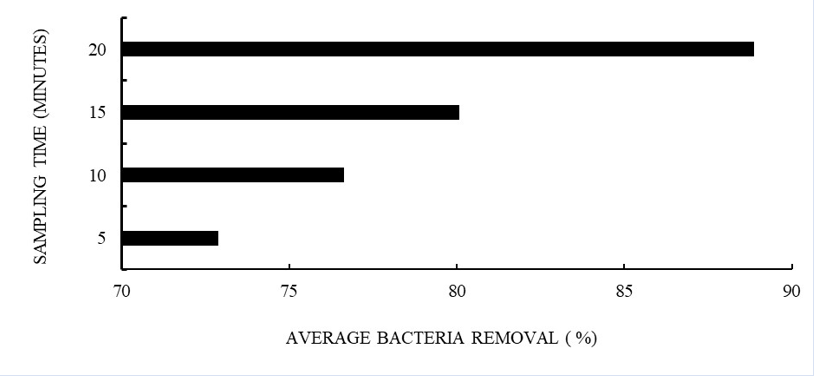
As shown in Figure 2, the removal efficiency of S. aureus bacteria in the UVC reactor was 72.88±0.11% at 0-5 minutes; 76.64±4.17% at 0-10 minutes; 80.07±3.84% at 0-15 minutes and 87.87±2.40% at 0-20 minutes. This demonstrates that bacteria removal efficiency increased with longer sampling times.
The Effect of Elapsed Time on Bacteria Removal Since UVC Reactor Start
In order to determine the effect of UVC radiation, at air flow rates in the reactor of 25, 30, 35, and 40 liters per minute, the retention time inside the reactor was calculated to be 4.32, 3.6, 3.08, and 2.7 seconds, respectively, based on the reactor dimensions. Sampling was done at different time periods of 5-10, 10-15, 20-25, 30-35, and 40-45 minutes for each of the mentioned flow rates (Figure 3).
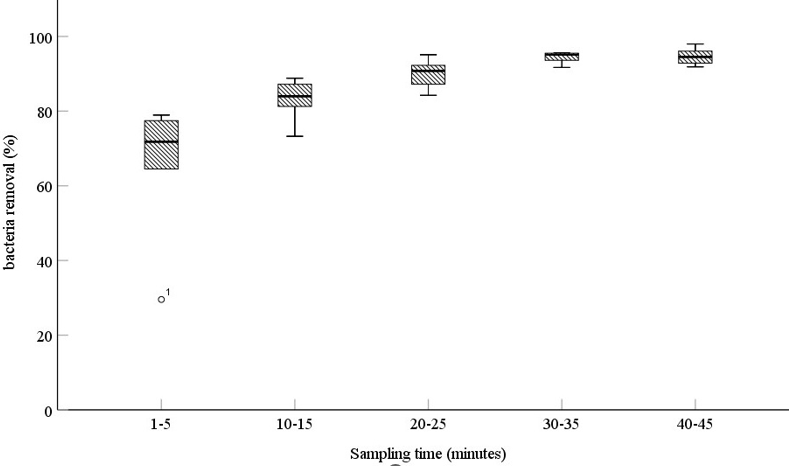
According to the results shown in the Figure 3, at 5-10 minutes the bacteria inactivation was 73.17 % on average; at 10-15 minutes it was 82.90%; at 20-25 minutes it was 91.36%. At 30-35 minutes it was recorded as 94.30%; and at 40-45 minutes it was 94.66. This demonstrates that the percentage of bacteria inactivation increased with longer UV radiation time at first. However, after 30 minutes of irradiation, the deactivation percentage took a constant trend. Consistent with the results of our study, Ewan Eadie et al.’s research showed that after 10 times applied at 5-minute intervals, for a total of 50 minutes, the efficiency of bacterial inactivation was 98.4% [17].
Determining Reactor Performance with 30-35 Minutes of UVC Radiation
In order to determine the effect of retention time on the removal of S. aureus bacteria from the air flow during 30- 35 minutes after reactor start, contaminated air was fed into the reactor at inlet flow rates of 30, 40, 50, 60, and 70 liters per minute. Based on reactor dimensions, this resulted in retention times of 3.6, 2.7, 2.16, 1.8 and 1.5 seconds, respectively. The average bacterial removal vs exposure time are shown in Figure 4.
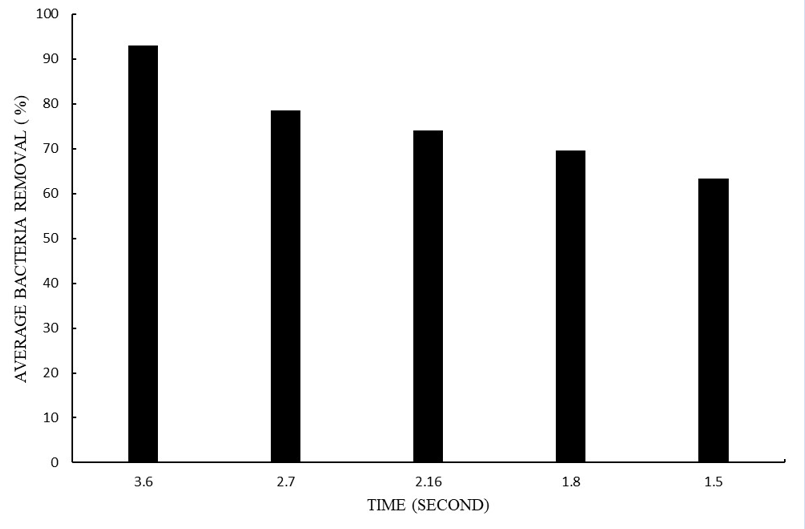
According to Figure 4, the removal efficiency of S. aureus bacteria were: at 3.6 seconds retention time, 93.26%, at 2.7 seconds 78.65%; at 2.16 seconds 74.29%; at 1.8 seconds 69.71%; and at 1.5 seconds 63.59%. This demonstrates that bacteria removal increased with longer residence times in the
Temperature and Humidity Changes
reactor. In addition, the results obtained are consistent with Min Shang, et al. study’s, which showed that the maximum inactivation of airborne viruses and bacteria was achieved with an optimal UVC radiation time of 30 minutes, aligning with the findings of our study [15].
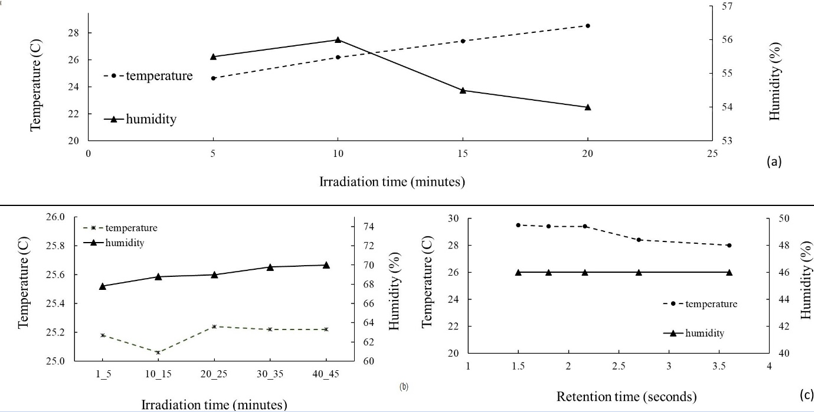
In Figure 5 (a), the average humidity was 55% ± 0.9%. In Figure 5 (b), the average increased to 69.07% ± 0.87% over time. However, in Figure 5 (c) the average humidity remained constant at 46%. The temperature data showed different trends between the sections. In Figure 5 (c), the average temperatures were 26.7°C ± 1.66 and 28.94°C ± 0.66; respectively, indicating an initial increase followed by a decrease. In contrast, Figure 5 (b) had an average of 25.3°C ± 0.07 that first decreased then increased before stabilizing. According to Aclaub, et al. in the removal of S. bacteria, both the high humidity and low temperature favors the removal efficiency [18].
Probit Regression Analysis
According to Probit Regression Analysis, the following results obtained, showing the actual bacteria amounts compared to the predicted model. As shown in Table 1, the actual efficiency of bacteria removal compared to the predicted efficiency from the Probit
| Number | Retention time | Irradiation time | Number of Subjects | Observed Responses | Expected Responses | Residual | Percentage removal efficiency observed | Percentage removal efficiency percentage | |
|---|---|---|---|---|---|---|---|---|---|
| 1 | 5.4 | 1-5 | 176 | 124 | 43.402 | 80.598 | 29.55 | 75.34 | |
| 2 | 4.32 | 1-5 | 155 | 55 | 38.223 | 16.777 | 64.52 | 75.34 | |
| 3 | 3.6 | 1-5 | 375 | 79 | 92.476 | -13.476 | 78.93 | 75.34 | |
| 4 | 3.08 | 1-5 | 71 | 16 | 17.509 | -1.509 | 77.46 | 75.34 | |
| 5 | 2.7 | 1-5 | 234 | 66 | 57.705 | 8.295 | 71.79 | 75.34 | |
| 6 | 5.4 | 10-15 | 181 | 29 | 31.054 | -2.054 | 83.98 | 82.84 | |
| 7 | 4.32 | 10-15 | 202 | 54 | 34.657 | 19.343 | 73.27 | 82.84 | |
| 8 | 3.6 | 10-15 | 1126 | 126 | 193.188 | -67.188 | 88.81 | 82.84 | |
| 9 | 3.08 | 10-15 | 80 | 15 | 13.726 | 1.274 | 81.25 | 84.09 | |
| 10 | 2.7 | 10-15 | 336 | 43 | 57.648 | -14.648 | 87.2 | 82.84 | |
| 11 | 5.4 | 20-25 | 211 | 27 | 23.843 | 3.157 | 87.2 | 88.7 | |
| 12 | 4.32 | 20-25 | 323 | 25 | 36.498 | -11.498 | 92.26 | 88.7 | |
| 13 | 3.6 | 20-25 | 1189 | 109 | 134.355 | -25.355 | 90.83 | 88.7 | |
| 14 | 3.08 | 20-25 | 87 | 5 | 9.831 | -4.831 | 94.25 | 88.7 | |
| 15 | 2.7 | 20-25 | 339 | 26 | 38.306 | -12.306 | 92.33 | 88.7 | |
| 16 | 5.4 | 30-35 | 266 | 13 | 18.702 | -5.702 | 95.11 | 92.97 | |
| 17 | 4.32 | 30-35 | 181 | 15 | 12.726 | 2.274 | 91.71 | 92.97 | |
| 18 | 3.6 | 30-35 | 1232 | 55 | 86.62 | -31.62 | 95.54 | 92.97 | |
| 19 | 3.08 | 30-35 | 89 | 4 | 6.257 | -2.257 | 95.51 | 92.97 | |
| 20 | 2.7 | 30-35 | 345 | 22 | 24.256 | -2.256 | 93.62 | 92.97 | |
| 21 | 5.4 | 40-45 | 256 | 14 | 10.562 | 3.438 | 94.53 | 95.87 | |
| 22 | 4.32 | 40-45 | 294 | 21 | 12.13 | 8.87 | 92.86 | 95.87 | |
| 23 | 3.6 | 40-45 | 1302 | 106 | 53.72 | 52.28 | 91.86 | 95.87 | |
| 24 | 3.08 | 40-45 | 98 | 2 | 4.043 | -2.043 | 97.96 | 95.87 | |
| 25 | 2.7 | 40-45 | 357 | 14 | 14.73 | -0.73 | 96.08 | 95.87 |
Table 1: Predicted and actual bacterial removal efficiency percentage.
Test differed by 5%< for irradiation times under 15 minutes. For irradiation times over 15 minutes, the difference between actual and predicted efficiency was also <5% (Figure 6). The figure below shows the process of removing bacteria.
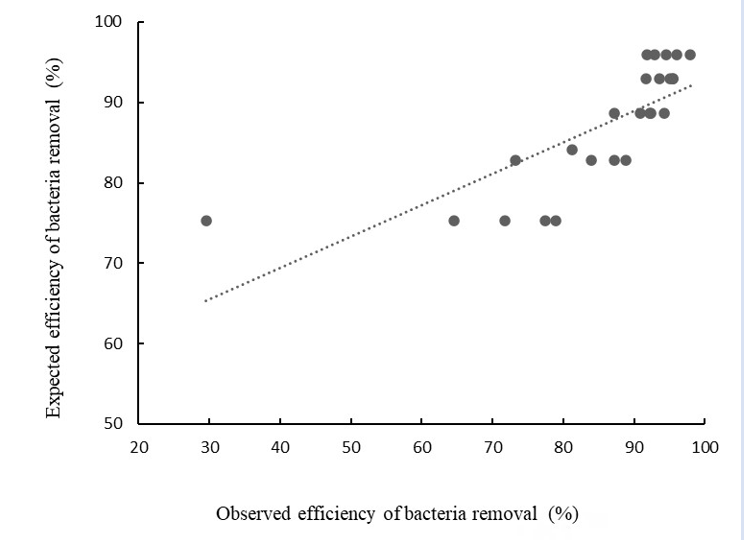
Figure 6 shows the probit model comparing the actual amount of bacteria removed to the expected amount. This indicates that there is not much difference between the actual removal efficiency of 30% to 80% compared to the expected efficiency of 75% for removing Staphylococcus aureus bacteria from air, while the observed bacterial removal efficiency above 80% shows a 15% difference from the expected values. In general, a greater difference from the expected values was observed for the efficiency measurements above 80% compared to the measurements below 80%.
Conclusion
The results showed that the efficiency of removing bacteria depends on the exposure time to ultraviolet rays and the levels of humidity and temperature. Specifically, the bacteria removal efficiency first increases over time and then stabilizes. Additionally, higher humidity and lower temperature also improve bacteria removal by trapping bacteria in the air for longer periods, leading to increased removal efficiency.
Acknowledgments
This manuscript is a part of a funded MSc. thesis (Grant No. 140104142673). The authors would like to thank the Hamadan University of Medical Sciences, and the Semnan University of Medical Sciences.
Data Availability
The datasets used and/or analysed during the current study are available from the corresponding author on reasonable request.
Funding
This manuscript is a part of a funded MSc. thesis (Grant No. 140104142673, by Hamadan University of Medical Sciences.
Contributions
All the authors contribute to the work. All authors read and approved the final manuscript.
Ethics Declarations
Ethics approval and consent to participate Not applicable.
Consent for Publication
Not applicable. Competing Interests
The authors declare that they have no competing interests.
Authorship Statement
All authors meet the ICMJE authorship criteria. Sedighe Afrasiabi, ML and RR contributed to the study conception and design; SA acquired data; MK was a contributor in acquiring data; SA, ML, RR, and MK, conducted formal analysis, drafted, edited and reviewed the manuscript; All the authors have read and approved the final manuscript.
References
-
Corrêa TQ, Blanco KC, Vollet-Filho JD, Morais VS, Trevelin WR, et al. (2021) Efficiency of an air circulation decontamination device for micro-organisms using ultraviolet radiation. Journal of Hospital Infection 115: 32-43.
-
Lanzerstorfer A, Hackl M, Schlömer M, Rest B, Deutsch- Grasl E, et al. (2019) The influence of air-dispersed essential oils from lemon (Citrus limon) and silver fir (Abies alba) on airborne bacteria and fungi in hospital rooms. Journal of Environmental Science and Health 54(3): 256-260.
-
Argyropoulos CD, Skoulou V, Efthimiou G, Michopoulos AK (2022) Airborne transmission of biological agents within the indoor built environment: a multidisciplinary review. Air Quality, Atmosphere & Health 16(3): 477- 533.
-
Changkaew K (2020) Assessment of indoor air quality and particle size distribution of total bacteria and staphylococcus spp in an urban hospital in Thailand. Southeast Asian Journal of Tropical Medicine and Public Health 51(6): 896-907.
-
Morawska L (2006) Droplet fate in indoor environments, or can we prevent the spread of infection?. Indoor Air 16(5): 335-347.
-
Lin JH, Yang L, Hu X, Peng H, Ren GH, et al. (2023) Photodynamic antibacterial micro/nanofiber composite membrane with high efficiency and low resistance filtration performance for medical protective materials. Journal of Industrial and Engineering Chemistry 128: 184-195.
-
Monteiro A, Cardoso J, Guerra N, Ribeiro E, Viegas C, et al. (2022) Exposure and health effects of bacteria in healthcare units: An overview. Applied Sciences 12(4): 1958.
-
Bayat H, Habibipour R, Ghobadi N, Golipoue F (2021) Evaluating Anti-Bacterial Effect of Doped Silver Nanoparticles on Iron Oxide Nanocrystal in Staphylococcus Epidermidis Isolated from Nosocomial Infection. Journal of Sabzevar University of Medical Sciences 28(5): 713-727.
-
Vashishtha K, Xi F, dharmalingam P, Douplik A (2023) Comparative Study of Blue Light with Ultraviolet (UVC) Radiation on Betacoronavirus 1. Applied Sciences 13(3): 1426.
-
Khillare S (2020) The Review on Uv B and Uv-C Disinfection System.
-
Song L, Li W, He J, Li L, Li T, et al. (2020) Development of a pulsed xenon ultraviolet disinfection device for real- time air disinfection in ambulances. Journal of healthcare engineering.
-
Demeersseman N, Seageman V, Cossey V, Devriese H, Schuermans A (2022) Shedding a light on UV-C technologies in the hospital environment. Journal of Hospital Infection 132: 85-92.
-
De Souza SO, Cardoso AA, Sarmento ASC, d’Errico F (2022) Effectiveness of a UVC air disinfection system for the HVAC of an ICU. The European Physical Journal Plus 137(1): 37.
-
Wang C, Lu S, Zhang Z (2019) Inactivation of airborne bacteria using different UV sources: performance modeling, energy utilization, and endotoxin degradation. Science of the Total Environment 655: 787-795.
-
Shang M, Kong Y, Yang Z, Cheng R, Zheng X, et al. (2023) Removal of virus aerosols by the combination of filtration and UV-C irradiation. Frontiers of environmental science & engineering 17(3): 27.
-
(2009) McFarland standards. DalynnBiologicals. JSTOR.
-
Eadie E, Hiwar W, Fletcher L, Tidswell E, O’Mahoney P, et al. (2022) Far-UVC (222 nm) efficiently inactivates an airborne pathogen in a room-sized chamber. Scientific reports 12(1): 4373.
-
Clauß M, Linke S, Tautz C, Bromman S (2022) Development of a Novel Bioaerosol Chamber to Determine Survival Rates of Airborne Staphylococci. Atmosphere 13(6): 869.
- Pattern of Gonadal Hormones in Oral Testosterone-Supplimented Male Wistar Rats with Diabetes-Induced Hypogonadism
- Re-Evaluation of the Genotoxicity of Currently Used Food Dyes in Mouse Multiple Organs Via Continuous Administration by Drinking Using the Comet Assay
- Pharmacogenetics of Type 2 Diabetes Mellitus: Linking Genetic Variability to Drug Efficacy and its Cardiovascular Outcomes
- Exploratory Proteomic Profiling of SARS-CoV-2 Infected THP-1 Macrophages Reveals Alterations in Inflammatory Response and Cellular Metabolism
- Study of Genotoxicity of Hepatocarcinogens in Multiple Organs in Mice by Feeding and Drinking Using the Comet Assay
- Spirulina Polypeptides Inhibit the Growth of Human Lung Tumor (H460) Cells