
An Anti-Inflammatory and Analgesic Drug Etoricoxib Investigated by Design of Experimentation (DOE) and in Vitro Characterization
The objective studies enhance drug release of etoricoxib by Binders, disintegrant& β- Cyclodextrin. The 2 level factorial designs employing (DOE) Design expert software; 3 independent with 3 central points. The prepared granules and tablets were subjected to flow, physical characteristics and dissolution. The optimized formulation exhibited 4 independent variables Y1 (DR 30), Y2 (DR 60), Y3 (DR 90) Y4 (T50 30), Y5 (DE10). DoE used to find response surface plots, optimization and Desirability and analysis of variance (ANOVA), p <0.005 indicates that the ANOVA of responses (dependent variables) Y1, Y2, Y3, Y4& Y5 is significant. The formulation Fa, formulated employing PVP as binder (factor A) and potato starch as disintegrant (factor B) had the highest drug release rate of 95 % in 1 h. The desirability function was 0.90170 and the predicted and experimental values had strong correlations.
Introduction
Etoricoxib, a widely prescribed anti-inflammatory and analgesic drug belongs to class-II under BCS, Poor watery dissolvability of the medication likewise brings about troubles in the detailing of strong dose structures and prompts poor and variable disintegration rate and oral bioavailability. The biopharmaceutical consideration dosage forms are reported Ramarao CT, et al. [1] tablets structure contains various excipients to fill different needs. Fastener is a basic fixing in tablet that impacts tablet characters. The binder, disintegrant and β-cyclodextrin are widely employed for enhance drug release employed are reported Reshma K, et al. [2], Chowdary KPR, et al. [3], Ramarao CHT, et al. [4, 5, 6, 7, 8].
Experimental
Etoricoxib and croscarmellose were gift samples from M/s Natco Pharma. Ltd., Hyderabad, Di Calcium Phosphate IP (SD fine-chem. limited, Mumbai), β Cyclodextrin (Balaji drugs private limited), Gelatin (MERCK Specialties private limited), Potato starch (SD Fine chem), CCS (Dr.Reddy’s laboratories, Hyderabad), Poly vinyl Pyrrollidone (LOBA chemie PVT.LTD, Mumbai), Talc (LOBA chemie PVT.LTD, Mumbai), Magnesium Stearate (Oxford laboratory, Mumbai) I.P were procure from commercial source . All the materials use were of pharmacopeia grades.
Experimental Design
DoE used to develop response surface plots, best fitting model, parameters with coefficient of variation (CV), coefficient of determination(R2), adjusted R2, Predicted R2, Adeq Precision, optimization , Desirability, analysis of variance (ANOVA), ‘F’ test and ‘P’ values. The Binders (acacia/ PVP(X1), Disintegrants Potato starch/ Cros carmellose (X2) and β Cyclodextrin (X3) concentrations with Statistical
models. To find interaction terms were used to evaluate the effect of the three factors on the The optimized formulation exhibited 4 independent variables Y1 (DR 30), Y2 (DR 60), Y3 (DR 90) Y4 (T50 30), Y5 (DE10) on the prepared tablets as per factorial design model. The polynomial terms was used to evaluate the responses basing on Y= β0 + β1X1 + β2X2) + β12 (X1 X2) + β3 (X3) + β13 (X1 X3) + β2,3 (X2 X3) – β123 (X1 X2 X3). Where Y is the dependent variables here β0 is mean response of the 8 runs; and β1, β2 and β3are the estimated coefficients for the factors X1, X2 and X3 respectively. The interaction terms (X1X2, X1X3 and X2X3) shows the responses.
Preparation of Tablets
The wet granulation process was used to prepare the formula are reported Ramarao CHT, et al. [9].
Content Active Ingredients
Five tablets were accurately weighed and pulverised. The equivalent of 60 mg tablet powder was placed in boiling test tubes and extracted with 4 into 10ml methanol, collected into a 50ml volumetric flask, and the volume was increased to 50ml in methanol the solution, diluted with phosphate buffer pH 7.4 at 284nm using the UV-spectrophotometric method.
Hardness
By using MONSANTO hardness tester.
Friability
By using ROCHY friabilator.
Disintegration Time (DT)
Using LABINDIA tablet disintegration test apparatus using distilled water as fluid.
Dissolution Rate Studies
By using DS 8000 (LABINDIA) 8 station, 900 ml of phosphate buffer of pH 7.4 with the paddle stirrer at 50 rpm, a temperature of 37 ±0.5⁰C , The sample of the dissolution media 5ml was withdrawn through a filter (0.45 microns) at different intervals of time and analyzed by UV at 284nm [10, 11, 12, 13, 14, 15, 16, 17].
Statistical Analysis
The dissolution characteristics were analyzed as per zero and first order kinetic model, statistically by ANOVA using design expert software [18, 19, 20, 21, 22, 23, 24].
Results and Discussion
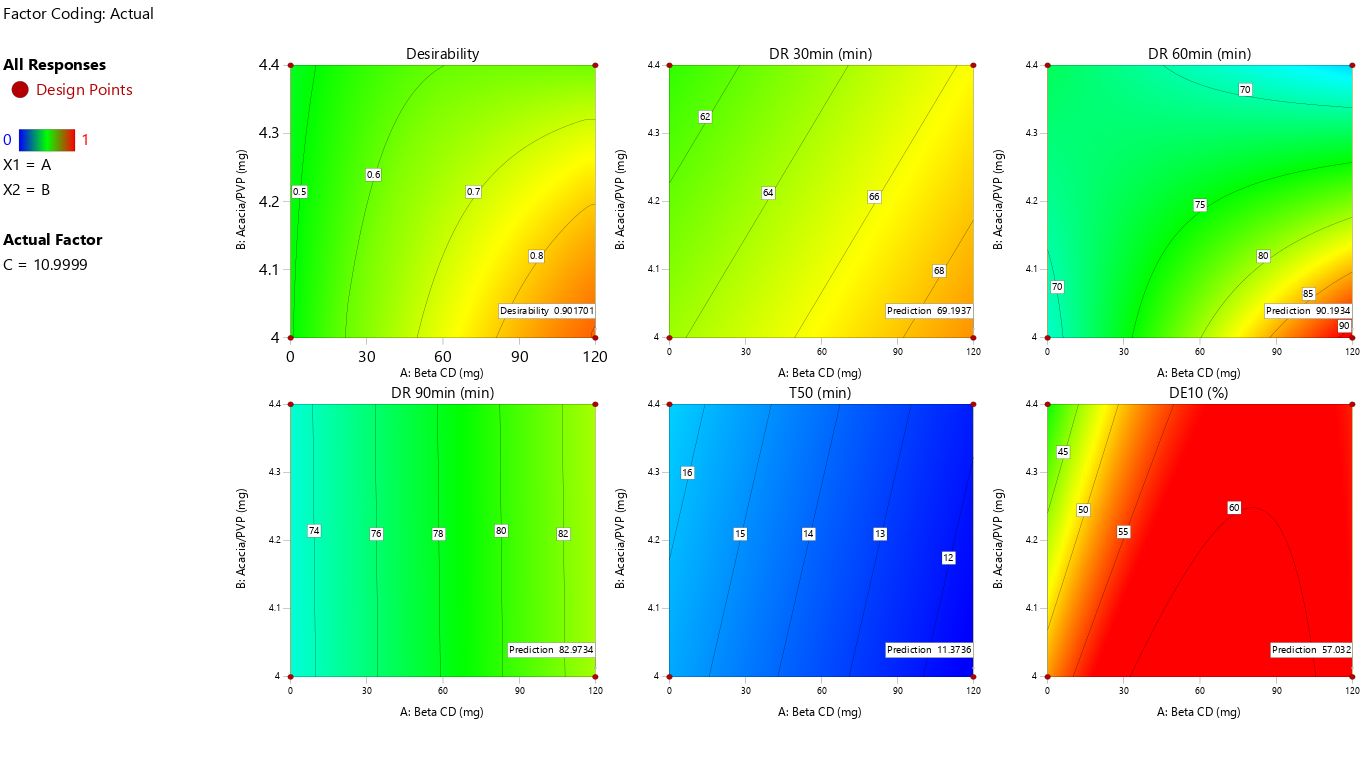
All the tablets prepared evaluated for assay, hardness, friability, disintegration time, physical parameters shown hardness 4.5-5.7kg/cm2, friability was less than 0.90%, drug content of tablets 100±2.5%, DT was found 2.30 to 7.40 min. In all situations, the correlation coefficient value (r) in the first order model was higher than that in the zero order models, first order dissolution profile. This study used a 23 Factorial Design to investigate the individual main and combined effects of three factors: X1, X2and X3. The dissolution parameters Y1, Y2, Y3, and Y4& Y5 were subjected to ANOVA to find out the significance of individual main and combined effects of the factors involved shown in Table 1. The results of ANOVA are given significant (p < 0.05) & counter plots, 3D surface plots shown in Figure 1.
| Source | Sum of Squares | df | Mean Square | F-value | p-value | Remark |
|---|---|---|---|---|---|---|
| Model | 622.75 | 7 | 88.96 | 13.24 | 0.0288 | significant |
| A-Beta CD | 117.2 | 1 | 117.2 | 17.44 | 0.025 | |
| B-Acacia/PVP | 14.74 | 1 | 14.74 | 2.19 | 0.2352 | |
| C-Starch/CCS | 156.82 | 1 | 156.82 | 23.33 | 0.0169 | |
| AB | 70.81 | 1 | 70.81 | 10.53 | 0.0476 | |
| AC | 0.1922 | 1 | 0.1922 | 0.0286 | 0.8765 | |
| BC | 127.36 | 1 | 127.36 | 18.95 | 0.0224 | |
| ABC | 135.63 | 1 | 135.63 | 20.18 | 0.0206 | |
| Residual | 20.16 | 3 | 6.72 | |||
| Lack of Fit | 20.16 | 1 | 20.16 | |||
| Pure Error | 0 | 2 | 0 | |||
| Cor Total | 642.91 | 10 |
Table 1: The results of ANOVA are given significant (p < 0.05) & counter plots, 3D surface plots shown in Figure 1.
Conclusion
The etoricoxib tablets developed succefully by doe and achieved quality by design (QBD) [25] desirability and other surface and counterplots. It is an excellent contribution for enhancing oral bioavailability.
References
-
Ramarao CT, Vineeth P, Bhanuchandar P, Madhuri M, Jayaram P, et al. (2016) Drug delivery systems and biopharmaceutical consideration of drug products designs: a review. Eur J Pharm Med Res 3: 146-154.
-
Reshma K, Rao CHT (2017) Formulation and Development of Telmisartan Tablets Employing Factorial Designs and Stability. Indo Am J P Sci 4(7): 2029-2035.
-
Chowdary KPR, Rao CHT (2016) Formulation Development of Valsartan Tablets: Optimization by 23 Factorial Design, in vitro and Pharmacokinetic Evaluation. World journal of Pharmaceutical Research 5(2): 1423-1434.
-
Ramarao CHT, Chowdary KPT (2014) Development and Evaluation of Irbesartan Tablets: Optimization by 22 Factorial Design. World journal of Pharmaceutical Research 5(2): 1435-1443.
-
Ramarao CHT, Chowdary KPT, Rajeswara PR (2015) Pharmacokinetic Evaluation of Optimized Valsartan Tablets Formulated Employing βCD, Crospovidone and SLS in Comparison to a Market product. World journal of pharmacy and pharmaceutical sciences 4(9): 979-986.
-
Ramarao CHT, Chowdary KPT (2016) Formulation development of valsartan tablets: optimization by 23 factorial design, in vitro and pharmacokinetic evaluation. World journal of Pharmaceutical Research 5(2): 1423- 1434.
-
Ramarao CHT, Chowdary KPT (2015) Formulation development of valsartan tablets Employing β CD, Crospovidone and SLS: optimization by 23 Factorial designs. World journal of Pharmaceutical Research 4(4): 992-1000.
-
Ramarao CHT, Chowdary KPT (2015) Optimization of Irbesartan Tablet Formulation by 23 Factorial design employing β CD, Crospovidone and SLS. World journal of Pharmaceutical Research 4(2): 1593-1601.
-
Ramarao CHT, Chowdary KPT (2011) A Factorial Study on the Evaluation of Formulation Variables on the Dissolution Rate of Etoricoxib Tablets. Asian Journal of Chemistry 23(3): 958-960.
-
Ramarao CT, Pavani P (2023) Atorvastatin calcium formulation development followed by pharmacokinetic with in vitro and in vivo correlation (IVIVC) with employing soluplus and hydroxy propyl methyl cellulose with optimization. Egyptian Pharmaceutical Journal 22(2): 209-222.
-
Ramarao CT, Jami R (2022) Formulation development of Ezetimibe by using Soluplus and Co- Processed Acacia: tragacanth with Design Expert. Health Biotechnology and Biopharma (HBB) 6(3): 33-56.
-
Challa TR, Reshma K (2022) Experimental Design Statistically by Design Expert Software: A Model Poorly Soluble Drug with Dissolution Enhancement and Optimization. International Journal of Drug Delivery Technology 12(3): 1367-1375.
-
Ramarao T, Preethi G (2022) Statistically Optimization and Formulation Development of Bromofenac Sodium Ophthalmic Drug Delivery System. Suranaree Journal of Science & Technology 29(6): 1-10.
-
Ramarao ChT, Madhuri S (2022) Statistically 2 Level Factorial by Design Expert: In-vitro Design and Formulation of Levitiracetam Extended Release Tablets. Indian J of Pharmaceutical Education and Research 56(4): 994-1002.
-
Ramarao CHT, Somireddy M (2022) In-vitro Design and Formulation of Levitiracetam Extended Release Tablets. Research J Pharm and Tech 15(8): 3681-3684.
-
Ramarao CHT, Chowdary KPT, Rao PR (2020) In Vitro and In Vivo Pharmacokinetic Evaluation of Valsartan Tablets: Optimization by Factorial Design 2³. Indian Drugs 57(11): 15-21.
-
Ramarao CHT, Rao SB (2018) Design and Characterization of Alfuzosin Hcl Gastroretentive Floating Matrix tablets Employing HPMC K100 M, Indian Drugs 55(11): 71-73.
-
Ramarao CHT, Srinivasarao B, Vijayaratna J (2017) Sustained Release Matrix Tablets of Diclofenac Sodium Employing Kollidon SR, PEG 6000, Lactose Mono Hydrate and Eudragit S100 in Colon Target. Indian drugs 54(10): 38-43.
-
Bhavyasri K, Ramarao CHT (2018) Formulation and Evaluation of Zidovudine Floating Tablets. World journal of Pharmacy and Pharmaceutical Sciences 7(8): 1210- 1220.
-
Lavyna G, Rao CHT (2015) Atenolol and Glipizide bilayer Floating Tablets: Formulation and Evaluation. European Journal of Pharmaceutical and Medical Research 2(7): 211-219.
-
Rao BS, Vijayanratna J, Ramarao CT (2016) Optimization of Matrix Tablets Containing Alfuzosin Hcl Employing Hpmc K4 M. European Journal of pharmaceutical and medical research 3(9): 529-533.
-
Ramarao CHT, Sravani P (2018) Mucoadhesive microspheres of metoprolol succinate formulation and in vitro evaluation studies. Innooriginal International Journal of Science 5(6): 33-39.
-
Bammidi I, Banala M, Balaga K, Cheekati P, Busa Y, et al. (2023) Assessment and Validation of Emulgel Based Salicylic acid Formulation Development to Drug release and Optimization by Statistical Design. International Journal of Computational Biology and Drug Design. In press 15(6).
-
Ramarao CT, Laxmi SB (2023) Floating Drug Delivery of Sustained Release Antidepressant Mirtazapine Tablets by Box-Behnken Design: Formulation and Optimization. Indian J of Pharmaceutical Education and Research 57(4): 1-10.
- Effects of 5-HTP and Melatonin on the Sleep Cycle of Medical Students
- Adsorption of Bisphenol A on NH4OH- Modified Rice Husk and Sugar Cane Bagasse Biochar
- Comparative Assessment of the Reinforcement Efficiency of Palm Fruit Fibre and Coconut Fibre in High Density Polyethylene (HDPE) Matrix Composite
- Importance of Bio Compounds Naturally Present in Food with Functionality in Animal Metabolism
- Sub-Acute Study on the Cardiotoxic Effects of Monosodium Glutamate Ingestion in Albino Rat
- Weight Management and Its Natural Solutions: A Review