
The Hidden Impact of COVID-19 Lockdowns: A Study in Non COVID Venous Thromboembolism Cases-our Experience
Background: In March 2020, the World Health Organization declared COVID-19 a pandemic, disrupting healthcare systems globally. While COVID-19-related venous thromboembolism (VTE) has been widely studied, the impact of the pandemic on non-COVID-19 VTE cases remains unclear. VTE includes pulmonary embolism (PE) and deep venous thrombosis (DVT), both of which are linked to lifestyle factors, such as physical inactivity. Aim: This study aimed to investigate the effect of pandemic-related restrictions on the prevalence of non-COVID-19 VTE hospitalizations. Methods: We performed a single-center retrospective analysis of consecutive non-COVID-19 patients admitted for VTE at University Hospital Centre Zagreb. Patients hospitalized between March 1 and October 31, 2019, were compared to those hospitalized during the same period in 2020. Data on demographic characteristics, diagnostics, and outcomes were collected. Results: In 2019, 70 non-COVID-19 patients (48% female; mean age 60.8 ± 17.2 years) were admitted, compared to 86 patients (50% female; mean age 68.5 ± 16.8 years) in 2020. A significant increase in combined DVT and PE cases was observed in 2020 (p = 0.03). While the overall prevalence of VTE hospitalizations was not statistically different (4.1% in 2019 vs 5.4% in 2020, p = 0.106), patients in 2020 were significantly older (p = 0.002). Conclusion: The COVID-19 pandemic has indirectly led to an increase in non-COVID-19 VTE cases, especially combined DVT and PE. This is likely due to the sedentary lifestyle imposed by pandemic restrictions, delayed medical treatment, and avoidance of healthcare facilities.
Abbreviations
VTE: Venous Thromboembolism; DVT: Deep Venous Thrombosis; PE: Pulmonary Embolism.
Introduction
The COVID-19 pandemic caused an unprecedented global health crisis, shifting attention and resources toward managing the direct impacts of the virus. While the association between COVID-19 and venous thromboembolism (VTE) is well-documented, less is known about how the pandemic affected non-COVID-19 VTE cases [1]. VTE, encompassing deep venous thrombosis (DVT) and pulmonary embolism (PE), is a serious condition that is influenced by both hereditary and acquired factors, including immobility [2].
Sedentary behavior, particularly during pandemic- induced lockdowns, may have contributed to a rise in non-COVID-19 VTE cases. This study aims to explore the pandemic’s indirect effect on non-COVID-19 VTE hospitalizations.
Methods
This was a retrospective study conducted at University Hospital Centre Zagreb. We analyzed non-COVID-19 patients who were hospitalized due to VTE from March 1 to October 31 in both 2019 and 2020. The inclusion criteria were a confirmed diagnosis of DVT, PE, or combined DVT+PE, and a negative SARS-CoV-2 swab test upon admission. The 2019 patient group served as a pre-pandemic control, while the 2020 group represented the pandemic period.
Data Collection
Data on age, gender, VTE type, diagnostic findings, and length of hospital stay were collected. Diagnostic tests included laboratory work, venous ultrasonography, and CT pulmonary angiography. Anticoagulation treatment protocols followed standard guidelines for VTE management.
Statistical Analysis
We used SPSS software for data analysis. The chi- square test with Yates correction was employed to compare categorical variables, while t-tests were used for continuous variables. A p-value of less than 0.05 was considered statistically significant.
Results
In 2019, 70 patients were admitted with VTE (mean age: 60.8 ± 17.2 years, 48% female). In contrast, 86 patients were admitted during the same period in 2020 (mean age: 68.5 ± 16.8 years, 50% female).
Prevalence of VTE
Although there was no statistically significant difference in the overall prevalence of VTE hospitalizations (4.1% in 2019 vs 5.4% in 2020, p = 0.106), a significant increase in the number of patients with combined DVT and PE was observed in 2020 (p = 0.03).
Age and Gender
Patients in 2020 were significantly older than those in 2019 (p = 0.002), while the gender distribution remained similar.
Type of VTE
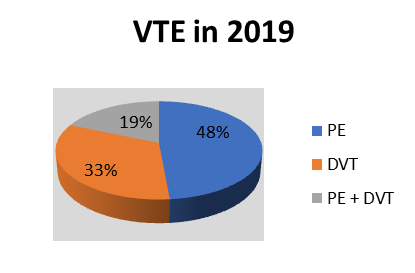
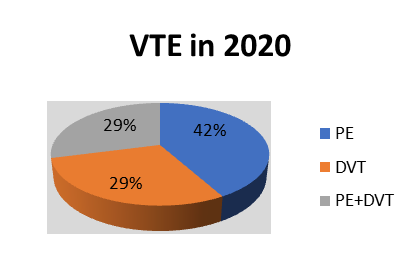
The proportion of patients with isolated PE was highest in both years (48% in 2019 vs 42% in 2020), while DVT cases slightly increased (23 vs 25 cases). However, combined DVT and PE cases significantly rose from 13 in 2019 to 25 in 2020.
Discussion
The COVID-19 pandemic indirectly impacted the prevalence of non-COVID-19 VTE, with a particular rise in combined DVT and PE cases in 2020. The results suggest that pandemic-related changes, especially lifestyle restrictions, may have played a critical role in this increase.
Sedentary Lifestyle as a Key Factor
The observed rise in combined DVT and PE cases could be linked to increased sedentary behavior during lockdowns. The widespread shift to remote work, closure of gyms, and restrictions on outdoor activities likely led to reduced physical movement. Prolonged sitting is a known risk factor for VTE, and this has been observed in other settings, such as long-haul flights, where limited mobility contributes to clot formation [3]. Beasley, et al. previously introduced the term “eThrombosis” to describe thrombosis associated with prolonged use of electronic devices, which is analogous to the immobility observed during pandemic restrictions.
Delayed Medical Care
Another contributing factor may be the delay in seeking medical attention. Fear of SARS-CoV-2 exposure and reluctance to visit healthcare facilities might have led patients to postpone treatment for initial DVT. Delayed medical intervention can result in the progression of DVT to PE, as evidenced by the increase in combined DVT and PE cases observed in our study.
Older Age of Patients
The significant difference in the age of patients between 2019 and 2020 (p = 0.002) could also explain the increased VTE incidence during the pandemic. Older individuals are generally more susceptible to VTE, and pandemic restrictions may have disproportionately affected this group, limiting their physical activity and access to preventive healthcare Figures 1 & 2.
Implications for Future Care
These findings highlight the need for proactive measures to mitigate VTE risk in non-COVID-19 patients during public health crises. Promoting physical activity during lockdowns, even within the confines of a home setting, could help reduce the risk of VTE. Additionally, healthcare systems must find ways to maintain routine medical care and ensure patients with chronic conditions do not delay seeking treatment due to fear of virus exposure.
Conclusion
This study underscores the hidden impact of the COVID-19 pandemic on non-COVID-19 venous thromboembolism, with a marked increase in combined DVT and PE cases. The sedentary lifestyle imposed by lockdowns and delayed medical care likely contributed to this surge. Moving forward, it is essential to address these indirect effects of pandemic restrictions by encouraging physical activity and ensuring timely medical intervention for patients at risk of VTE.
References
-
Cucinotta D, Vanelli M (2020) WHO Declares COVID-19 a Pandemic. Acta Biomed 91(1): 157-160.
-
Banfic LJ (2016) Guidelines on diagnosis, treatment and prevention of venous thrombosis. Cardiol Croat 11(9): 351-374.
-
Kunutsor SK, Makikallio TH, Seidu S, de Araujo CGS, Dey RS, et al. (2020) Physical activity and risk of venous thromboembolism: systematic review and meta-analysis of prospective cohort studies. Eur J Epidemiol 35(5): 431-442.
- Anomalous Origin of the Left Coronary System from the Right Coronary Cusp: A Rare Coronary Anomaly in a Patient Undergoing Aortic Stenosis Workup
- Optimizing the Therapeutic Potential of Sacubitril/Valsartan: The Promise of Co-Crystal Engineering
- Association between Mortality and Topography of Peripheral Arterial Disease due to Atherosclerosis Obliterans
- Mitral Valve Replacement vs Mitral Valve Repair
- Characteristics and Evolution of Patients with Heart Failure Hospitalized in the Cardiology Department of Dalal Jamm Hospital
- Distribution of Association between Basic Knowledge of Chest Pain and Myocardial Infarction (Heart Attack) and Demographic Variables: A Survey-Based Study