
Waste Management of Seafood Processing Effluents, Hadhramout Governorate, Yemen
Wastewater samples were collected from the Hadhramout Governorate/Yemen. Ten wastewater samples were collected from the biggest three fish canning factories in Hadhramout Governorate/Yemen (Tuna for Canning Packing Fishing Factory, AL Mukalla fish canning factory and Sabaa fishing factory). During this study, special precautions were taken to avoid samples contamination during collection, transportation, and preservation and laboratory analyses. The three bacteria isolates (Pseudomonas sp. Y1, Pseudomonas sp. Y2, Hafnia sp. Y) from wastewater fish canning showed a good results in pollutants removal as compared to the 45 isolated species bacteria. Results of the present study proved the biotechnological importance and advantages of using the tested bacteria for wastewater treatment where promising removal of the investigated contaminants were achieved in a short time. For organic matter removal, the highest achieved OOM, BOD5 and COD RE recorded 79, 74 and 73% achieved by ponds, respectively. For oil and grease the highest achieved FOG RE recorded 87% and was achieved by ponds. Removal of wastewater pollutants, where the results showed laboratory based on the concentration of pollutants before and after the treatment occurs, the removal of organic matter (OOM, BOD, and COD), oil and grease at rates of 70%, 60%, 50% and 85% respectively by treatment ponds. Pond, which was shown to have high potential for use in wastewater treatment, was tested for its ability to treat the wastewater sample. It was found that waste decomposition by natural microorganisms already present in the wastewater. Finally, our study indicates that strains of Pseudomonas and Hafnia alvei isolated from wastewater samples of fish canning industry of Hadramout, Yemen and ponds method were able to be the pollutants that these strains could be efficient pollutants removal.
Introduction
The world seafood industry plays a significant role in the economic and social wellbeing of nations, as well as in the feeding of a significant part of the world’s population. The fisheries sector is an important source of employment and income generation for coastal communities in many Arab countries, whether directly engaged in the industry or in associated activities at the input or the output stages of production. The coastal water of Yemen is characterized by its high primary and secondary productivity making it a basic feeding and nursery ground for marine species. The fisheries sector represent the most important non– oil production in Yemen through its five distinct fishing regions, its coastline of 2,230 km and fishing area of more than 40,000 km2, total fish landings exceeded 260,000 tons in 2005. Almost 30% of this quantity was mainly to Arab, Asian and European countries, while the remaining 70% were consumed locally [1].
Many people in the region depend on maritime activities and seafood products. The majority of the communities are engaged in fishery sector activities such as fish processing, canning, and trading. The region is relatively enriched with commercial living marine resources. Specifically, Hadhramout is considered as an industrial and commercial center for fishes. Accordingly, the food security at the region depends highly on maritime products. Consequently, any severe contamination, either caused by industrial activities, would have direct or indirect negative impact on the sea life, marine environment and territorial seawater of the region [2].
In general, seafood-processing industries use high volume of water for processing activities, for reasons of hygiene; however, most of factories are located near river or the sea. Some factories do not have any wastewater treatment facilities and discharge wastewater directly into the environment [3]. There are large quantities of waste generated during the process, which may lead to environment problem [4].
Untreated wastewater generally contains high levels of organic material, numerous pathogenic microorganisms, as well as nutrients and toxic compounds. It thus entails environmental and health hazards and, consequently, must immediately be conveyed away from its generation sources and treated appropriately before final disposal. The ultimate goal of wastewater management is the protection of the environment in a manner commensurate with public health and socio-economic concerns [5]. The effluent streams are discharged without treatment into water bodies; the pollutants they contain can cause eutrophication and oxygen depletion. In addition, fish processing industries have been known to pollute nearby beaches and shores by releasing wastewater containing oils. Since oil floats on water, it can end up on the surrounding coastline.
Materials and Methods
Study Area
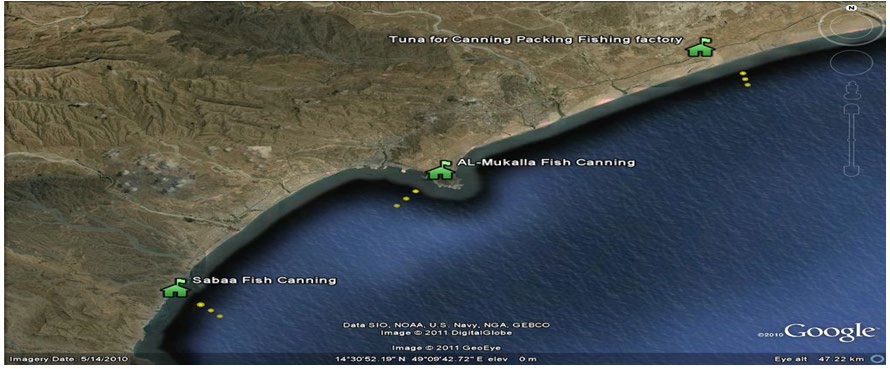
The study area is located in Hadhramout Governorate and includes three fish canning factories namely. Al Mukalla fish canning factory, Sabaa fishing factory and tuna for canning packing fishing factory Figure 1. Al Mukalla fish canning factory is located on the southern shores of Yemen on the Arabian Sea Coast between latitude 14.5°N and 15°N and longitude 49°E and 50°E. Sabaa Fishing factory is located in the west (15° 23́ 355″ N and 48° 59́ 537″E). Tuna for canning packing fishing factory is located in (14º35’ N and
49º15’ E).
The canning factories are located adjacent to the shoreline, with the exception of one factory that is a few hundred meters off the coast and consequently has difficulty in discharging the liquid waste to the sea due to the pipe length. The factories use some plant oils in the canning processes. Some of these oils dropped from canning lines to the ground that is washed with water and detergents. This in turn, accounts, along with the municipal wastewater of the factories, a large amount of liquid effluent reaching 10 cubic meters per day. All this effluent is discharged to the sea immediately, after passing through filtration clasps (or what is called traps for sticking or solid substances), through pipelines, without any treatment.
The factories produce monthly about 7 tons of organic solid waste as a result of the canning processes. These wastes are dumped into the sea, either directly or through wadis run-off. About 90% of the wastes are the remaining parts of the fishes processed and 10 % are materials not suitable for cooking or crushing. The waste and the garbage of the factories are often collected to be thrown away, along with the garbage of the city, in the nearby wadi beds without any treatment process. They ultimately reach the coast during rainy seasons. Otherwise, they were directly disposed of into the sea (this is what takes place usually).
Sample Collection and Analysis
Ten Wastewater samples were collected from the biggest three fish - canning factories in Hadhramout Governorate/ Yemen (Al Mukalla fish canning factory, Sabaa fishing factory and Tuna for Canning Packing Fishing Factory) The samples were transported in cool boxes to the laboratory for analysis.
Isolation of microorganisms
The microorganisms used in this study were isolated from wastewater sample collected from fish canning industry, Hadhramout Governorate/Yemen using the enrichment technique in LB medium (g/l): peptone, 10; yeast extract, 5; NaCl, 5) [6]. Typically, one ml of the wastewater was cultured in 250 ml, incubated at 37°C in shaking incubator. Streaking purification technique was used to obtain clear separate colonies. The selected colonies were subsequently preserved in LB and kept in refrigerator at 4°C till further investigations. Pure separate colonies were tested for wastewater treatment.
Bacterial isolates identification
Identification of the isolated bacteria was carried out by two main procedures: staining and microscopic examination, and by biochemical reaction.
- Methodology for identification of bacterial by biochemical reaction
- PCR 16SrRNA and Electrophoresis DNA extraction and PCR amplification of 156srDNA region. DNA was isolated from the selected isolates coded ………………………..according to Sambrook, et al. [7]. The 16srDNA was amplified by polymerase chain reaction (PCR) using primers designed to amplify 1500 bp fragment of the 16srDNA region. The forward primer was 5’AGAGTTTGATCMTGGCTCAG3’ and the reverse primer was 5’TACGGYTACCTTGTTACGACTT3’. The PCR mixture consists of 30picomoles of each primer, 10ng of chromosomal DNA, 200 µM dNTPs and 2.5 Units of Taq polymerase in 50 µl of polymerase buffer. The PCR was carried out for 30 cycles in 94°C for 1 min, 55°C for 1 min and 72°C for 2 minutes. After completion, a fraction of the PCR mixture was examined using agarose gel electrophoresis [8] and the remnant was purified using QIAquick PCR purification reagents (Qiagen). DNA sequences were obtained using an 3130 X DNA Sequencer (Genetic Analyzer, Applied Biosystems, Hitachi, Japan), BigDye Terminator Cycle Sequencing (see details below). The PCR product was sequenced using the same PCR primers. Blast program was used to assess the DNA similarities and multiple sequence alignment and molecular phylogeny were performed using BioEdit software [9]. The phylogenetic tree was displayed using the TREEVIEW program [10].
• DNA Sequencing Automated DNA sequencing based on enzymatic chain terminator technique, developed by Sanger, et al. [11] was done using 3130 X DNA Sequencer (Genetic Analyzer, Applied Biosystems, Hitachi, Japan). The sequencing reaction was performed with four different fluorescent labels identifying the ddNTPs, instead of the radioactive labels. These flurophores were excited with two argon lasers at 488 and 514 nm, respectively when the respective bands passed the lasers during the electrophoresis. The specific emissions were detected and the data were collected for analysis [12, 13]. The thermal cycling mixture was as follows: 8 µl of BigDye terminator mix, 6 µl of the sequencing primer (10 pmol) and 6 µl of the sample (PCR product or plasmid), then the reaction was run in the thermal cycler. The cyclic reaction composed of 1 min at 95°C, then 49 cycles of 30 sec at 95°C, 10 sec at 52°C and 4min at 60°C. The products were purified using special column according to the instruction of the manufacturer. The elute were taken and add high dye formamide with (1:1)/volume ratio, run at 95ºC for 5 min for denaturation, shock on ice, then the sample become ready for sequencing in 3130 X DNA sequencer and analysis.
• Lab scale wastewater treatment The aims of wastewater treatment are to convert the waste matter present into stable oxidized end-products which can be safely discharged to coastal waters without any adverse ecological and public health effects.
• Wastewater treatment by bacteria in shacked culture Isolated bacterial strains were transferred into conical flasks with containing wastewater (200 ml), incubated at 37°C in shaking incubator for 7 days. The optical density (OD600nm) and pH of the culture fluids were monitored at determined time intervals as biodegradation indices, samples were centrifuge at 4000 for 15 min to separate the bacterial cells from the liquid medium and supernatant was used for the parameter determination.
• Wastewater treatment by bacteria in static oxidation ponds Oxidation pond model was designed a glass vessel from volume of 2 L. (40 cm in length and 20 cm in width). The pond were placed and operated on the roof of the laboratory. Two ponds were used in this study. The first pond was field with raw wastewater. The second pond was field with wastewater and inculcated with the selected bacteria strain, both bond were examined for all wastewater parameters after 7 days. Parameters of wastewater before and after treatment compare were examined for all wastewater parameters after 7 days. Parameters of wastewater before and after treatment compare.
Results and Discussion
Organic Matter Removal
Biological treatment of wastewater significantly removed for organic matter from wastewater [14]. During the present study, the bacteria performed high efficiencies as suspended growth application toward the removal of both organic (OOM, BOD, COD) from fish canning industry wastewater in a relatively short duration.
• Oxidizable organic matter: Removal of OOM from the fish canning effluents using bacteria revealed the following points
1. High RE% were obtained for OOM removal from Al-Rayan effluents by ponds (1), considered as the most effective, achieving the highest RE (70%) followed by ponds (2) (68%), Hafnia alvei (48%), Pseudomonas putida (38 %), Pseudomona sp (33 %) and finally Pseudomona sp + Pseudomonas putida (12%), The maximum OOM RE% obtained for AL-Mukalla effluent by Pseudomona sp (73%) and a minimum by Pseudomona sp + Pseudomonas putida (28%). And Ponds (1) considered the most effective for removing OOM from Sabaa effluent achieving the maximum RE of 79% followed by Pseudomona sp (78%), Pseudomonas putida (68%), Pseudomona sp + Pseudomonas putida (50%), ponds (2) (43%) and finally Hafnia alvei (35%).
2. High removal efficiently for OOM in Sabaa fish canning wastewater. The OOM is significantly reduced removal in 7 days were 79 % by ponds (1). The degradation of organic matter and their concentration during the bacterial treatment of wastewater in ponds , which showed fast / drastic reduction in pollutants concentration during the bacterial treatment process in terms of reduction in peak area for ponds .
7 days were 74 % by ponds (1). These results suggest that other minor members of the microbial community caused their dominance, probably by converting the complex contaminants into lower molecular compounds, which can be assimilated by these microorganisms [15]. The reduction in BOD might be attributed to the bacterial degradation of complex organic and inorganic pollutants to meet the nutritional requirements.
3. Lower removal efficiencies for BOD were 47% by ponds (2) in AL-Rayan effluents. The lower BOD removal indicates that the biomass on the surface of the packing in the column also plays a significant role in the overall bio-oxidation of the organic material in the wastewater during the treatment process. The organic material was transferred from water to the biomass on the surface of the packing where the biological oxidation occurred.
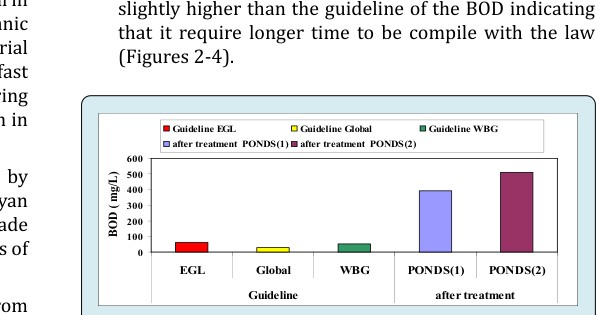
4. Despite the RE variations of BOD achieved by bacteria, RC of the BOD in the fish canning wastewater reached acceptable limits by bacteria after 7 days which is much slightly higher than the guideline of the BOD indicating that it require longer time to be compile with the law (Figures 2-4).
• Biochemical oxygen demand: Removal of BOD from the fish canning effluents using bacteria revealed the following points:
1. High removal for BOD (60%) by ponds (1) followed by ponds (2) (47 %).from AL-Rayan effluents, While BOD high removal (62, %) by ponds (1) followed by ponds (59 %) for AL-Mukalla effluents. BOD RE% recorded 74 by ponds (1) followed by ponds (2) (67%) in Sabaa effluents.
2. High removal efficiently for BOD in Sabaa fish canning wastewater. The BOD is significantly reduced removal in Figure 2: BOD (mg/L) in wastewater samples after treatment from AL-Rayan wastewater compared with guideline.
Guideline EGL Guideline Global Guideline WBG after treatment PONDS(1) after treatment PONDS(2)
| EGL Global WBG Guideline | PONDS(1) PONDS(2) after treatment |
| EGL WBG Guideline | PONDS(1) PONDS(2) after treatment |
| EGL Global WBG Guideline | PONDS(1) PONDS(2) after treatment |
• Chemical oxygen demand: Removal of COD from the fish canning effluents using bacteria revealed the following points: 1. High RE% were obtained for COD removal form Al-Rayan effluents by ponds (1) considered as the most effective, achieving the highest RE (50%) followed by ponds (2). 2. (43%) While COD high removal (72%) by ponds (1) followed by ponds (67%) in AL-Mukalla effluents. COD RE% recorded 73% by ponds (1) followed by ponds (2) (72%) in Sabaa effluents. 3. High removal efficiently for COD in Sabaa fish canning wastewater. The COD is significantly reduced removal in 7 days were 73 % by ponds (1). A high COD removal efficiency is observed in the ponds1 for Sabaa than that in AL-Rayan and AL-Mukalla. This can be attributed to the presence of high Phosphate and nitrate and hence favorable environment for bacterial growth in the effluent from AL-Rayan and AL-Mukalla. 4. Lower removal efficiencies for COD were 43% by ponds (2) in AL-Rayan effluents, Reduction in organic matter removal efficiency was an indication of insufficient elimination capacity because of limitation in oxygen mass transfer and surface area for microorganisms [16]. 5. The lowest residue concentration of by bacteria which is the maximum acceptable limit stated by the law (EGL and WBG) (Figures 5-7).
Guideline EGL Guideline WBG after treatment PONDS(1) after treatment PONDS(2)
0 100 200 300 400 500 600 700 800
| EGL WBG Guideline | PONDS(1) PONDS(2) after treatment |
| EGL Global WBG Guideline | PONDS(1) PONDS(2) Pseudomona sp Pseudomonas putida Pseudomona sp+Pseudomonas alvei putida Hafnia after treatment |
Guideline EGL Guideline WBG after treatment PONDS(1) after treatment PONDS(2)
0 50 100 150 200 250 300 350
Oil and Grease Removal
Fat, oil and grease (FOG) are also important parameters of fish processing wastewater. Around 60% of the oil and grease originates from the butchering process [17]. The rest of the oil and grease is generated during fish canning and fish processing operations [18]. The FOG should be removed from wastewater because it usually floats on the water’s surface and affects the oxygen transfer to water. In consistence with the present study, biological treatment of oil waste significantly removed oil and grease [14]. Moreover, in the present work, using bacteria was more effective in reducing oil and grease, which was previously indicated by other workers [19].
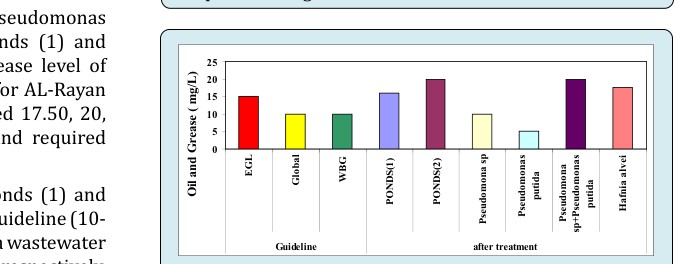
Removal of oil and grease from fish canning effluents using bacteria revealed the following points: 1. High removal efficiently for Oil and Grease in all fish canning wastewater. The Oil and Grease is significantly reduced removal in 7 days were77- 87 % by ponds (1). A pond, which was shown to have high potential for use in wastewater treatment, was tested for its ability to treat the wastewater sample. It was found that waste decomposition by natural microorganisms already present in the wastewater. Microbial oxidation is most rapid when the hydrocarbon molecule is in intimate contact with water at temperatures ranging from 15 to 35°C, which means adequate mixing or dispersion of the water and oil is necessary for effective degradation [20]. Where temperatures of ponds range from 28 to 30°C for present study.
2. The lower degradation of oil in AL-Mukalla effluents were 20.5% compared AL-Rayan and Sabaa could be explained by the reduced unsaturated fatty acid content relative to the other oils used in fish canning industry. However, work by Tano-Debrah, et al. [20] indicated that there was no relationship between the biodegradability of the fat/ oil and the degree of saturation, suggesting that other factors may be important. Another explanation for the reduced degradation may therefore be that solid fats are less likely to be as well dispersed in the media as liquid oils [21].
3. The levels of oil degradation reported here are higher than some other studies [21]. The used in previous work of dichloromethane as an extraction solvent may explain these differences, at least in part, since it is more effective at extracting slightly polar material such as fatty acids than hexane which has been widely used in present work, while the level of oil and grease degradation reported here are similar some other studies [21].
25
2. EPA (Environment Protection Authority) (2003) Yemen’s national program of action for the protection of the marine environment from land based activities (NPA).
3. Sirianuntapiboon S, Nimnu N (1999) Management
of water consumption and waste water of seafood processing industries of Thailand. Suranaree Journal of Science and Technology 6(3): 158- 167.
4. Prasertsan P, Jaturapornpipa M, Siripatana C (1997) Utilization and treatment of tuna condensate by photosynthetic bacteria. Pure & App/Chem 69(11): 2439-2445.
5. United Nations (2003) Waste-Water treatment technologies: A general review.
6. Matsumiya Y, Wakita D, Kimura A, Sanpa S, Kubo M (2007) Isolation and characterization of a lipid- degrading bacterium and its application to lipid- containing wastewater treatment. Journal of bioscience and bioengineering 103(4): 325-330.
7. Sambrook J, Fritsch EF, Maniatis T (1989) Molecular cloning A. Laboratory Manual. Cold Spring Harbor Laboratory, NY.
8. Ausubel FM, Brent R, Kingston RE, More DD, Seidam JG, et al. (1999) Short protocols in Molecular Biology. John Willey and Sons, Inc. NY.
9. Hall TA (1999) BioEdit: a user- friendly biological sequence alignment editor and analysis program for Windows 95/98/NT. Nucl Acid Symp Ser 41: 95-98.
10. Page RD (1996) Treeview: An application to display phylogenetic trees on personal computers. Computer Applications in the Biosciences 12(4): 357-358.
11. Sanger F, Nicklen S, Coulson AR (1977) DNA sequencing with chain terminating inhibitors. Proc Natl Acad Sci 74(12): 5463-5467.
12. Prober JM, Trainor GL, Dam RJ, Hobbs FW, Robertson CW, et al. (1987) A system for rapid DNA sequencing with fluorescent chain-terminating dideoxynucleotides. Science 238(4825): 336-341.
13. Freeman M, Baehler C, Spotts S (1990) Automated Lazer
fluorescence sequencing. Biotechnol 8: 147-148.
14. Martirani L, Giardina P, Marzullo L, Sannia G (1996) Reduction of Phenol content and toxicity in olive oil mill wastewaters with the Ligninolytic fungus Pleurotus Ostreatus. War Res 30(8): 1914-1918.
15. Loperena L, Ferrari M, Dxaz A, Ingold G, Perez L (2009) Isolation and selection of native microorganisms for the aerobic treatment of simulated dairy wastewaters. Bioresource Technology 100(5): 1762-1766.
16. Najafpour GD, Zinatizadeh AAL, Lee LK (2006) Performance of a three-stage aerobic RBC reactor in food canning wastewater treatment. Biochem Eng J 30(3): 297-302.
17. NovaTec Consultants Inc. and EVS Environmental Consultants (1994) Wastewater Characterization of Fish Processing Plant Effluents-A Report to Water Quality/ Waste Management Committee. Fraser River Estuary Management Program.
18. Chowdhury P, Viraraghavan T, Srinisvasan A (2010) Biological treatment processes for fish processing wastewater-A review. Bioresource Technology 101(2): 439-449.
19. El-Bestawy E, EL-Masry M, EL-Adi N (2005) The potentiality of free gram- negative bacteria for removing oil and grease from contaminated industrial effluents. World journal of microbiology and biotechnology 21: 815-822.
20. Tano-Debrah K, Fukuyama S, Taniguchi FO, Ogura M (1999) An inoculum for the aerobic treatment of wastewaters with high concentrations of fats and oils. Bioresource Technology 69(2): 133-139.
21. Brooksbank AM, Latchford JY, Mudge SM (2007) Degradation and modification of fats, oils and grease by commercial microbial supplements. World J Microbiol Biotechnol 23: 977-985.
- Pattern of Gonadal Hormones in Oral Testosterone-Supplimented Male Wistar Rats with Diabetes-Induced Hypogonadism
- Re-Evaluation of the Genotoxicity of Currently Used Food Dyes in Mouse Multiple Organs Via Continuous Administration by Drinking Using the Comet Assay
- Pharmacogenetics of Type 2 Diabetes Mellitus: Linking Genetic Variability to Drug Efficacy and its Cardiovascular Outcomes
- Exploratory Proteomic Profiling of SARS-CoV-2 Infected THP-1 Macrophages Reveals Alterations in Inflammatory Response and Cellular Metabolism
- Study of Genotoxicity of Hepatocarcinogens in Multiple Organs in Mice by Feeding and Drinking Using the Comet Assay
- Spirulina Polypeptides Inhibit the Growth of Human Lung Tumor (H460) Cells